
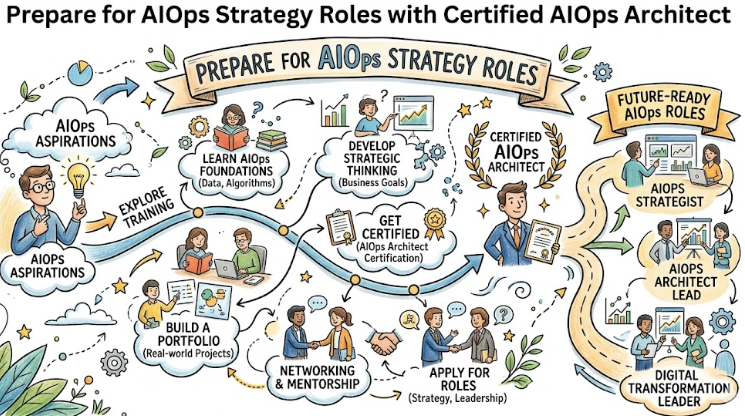
Introduction
The Certified AIOps Architect designation has emerged as a critical milestone for engineers looking to bridge the gap between traditional operations and artificial intelligence. This guide is designed for DevOps professionals, SREs, and platform engineers who need to understand how algorithmic IT operations can scale modern infrastructure. As systems grow in complexity, the ability to implement automated incident response and predictive analytics becomes a career-defining skill. By reading this comprehensive overview, you will gain the clarity needed to navigate the Certified AIOps Architect pathway and determine how it fits into your specific professional journey. This roadmap is curated by aiopsschool to help you make informed decisions about your technical evolution in a cloud-native world.
What is the Certified AIOps Architect?
The Certified AIOps Architect is a professional credential that validates an individual’s ability to design, implement, and manage AI-driven operations frameworks. Unlike theoretical courses, this program focuses on the practical application of machine learning and big data to solve real-world infrastructure challenges. It represents a shift from reactive monitoring to proactive, self-healing systems that can handle the massive telemetry data generated by modern microservices. It aligns perfectly with enterprise needs for reduced Mean Time to Repair (MTTR) and enhanced system reliability through intelligent automation.
Who Should Pursue Certified AIOps Architect?
This certification is ideal for senior DevOps engineers, Site Reliability Engineers (SREs), and Cloud Architects who are responsible for high-availability environments. It is equally beneficial for Data Engineers looking to apply their skills to infrastructure and for Engineering Managers who need to oversee the digital transformation of their operations teams. Whether you are an experienced professional in India’s growing tech hubs or working in a global distributed team, this path provides the technical depth required to lead AI-driven initiatives. Beginners with a strong foundation in Linux and Python will also find it a clear roadmap for specialized career growth.
Why Certified AIOps Architect is Valuable and Beyond
In an era where infrastructure scales faster than human capacity, AIOps provides the only sustainable way to manage enterprise environments. This certification ensures longevity in your career by moving you beyond basic scripting into the realm of intelligent architectural design. Organizations are rapidly adopting AIOps to combat “alert fatigue” and to optimize cloud costs, making architects in this field highly sought after. Investing time in this certification offers a significant return by positioning you as a specialist who can handle the complexity of modern, high-velocity software delivery pipelines.
Certified AIOps Architect Certification Overview
The program is delivered via the Certified AIOps Architect and hosted on the AIOpsSchool site. It utilizes a multi-tiered assessment approach that combines rigorous theoretical testing with hands-on laboratory exercises to ensure practical competency. The certification is structured to cover the entire lifecycle of an AIOps project, from data ingestion and noise reduction to automated remediation. It is owned and governed by industry experts who ensure the curriculum stays updated with the latest advancements in neural networks and anomaly detection for IT operations.
Certified AIOps Architect Certification Tracks & Levels
The certification is organized into three distinct levels: Foundation, Professional, and Advanced. The Foundation level introduces core concepts of data science for operations, while the Professional level dives deep into tool integration and pattern recognition. The Advanced level is reserved for those designing cross-functional AIOps strategies that span DevOps, SRE, and FinOps domains. These levels allow professionals to progress at their own pace, aligning their learning with their current job responsibilities and long-term leadership goals.
Complete Certified AIOps Architect Certification Table
| Track | Level | Who it’s for | Prerequisites | Skills Covered | Recommended Order |
| Operations | Foundation | Junior Engineers | Basic Linux/Cloud | Data Ingestion, Monitoring | 1 |
| Architecture | Professional | Senior SREs | Foundation Level | Anomaly Detection, Automation | 2 |
| Strategy | Advanced | Lead Architects | Professional Level | Enterprise Strategy, ROI | 3 |
Detailed Guide for Each Certified AIOps Architect Certification
Certified AIOps Architect – Foundation
What it is
This certification validates the fundamental understanding of AIOps terminology, the importance of big data in IT, and the basic mechanics of algorithmic noise reduction.
Who should take it
It is suitable for entry-level DevOps engineers or traditional SysAdmins who want to understand how AI is changing the landscape of IT operations.
Skills you’ll gain
- Understanding telemetry data types (Metrics, Logs, Traces).
- Basic knowledge of machine learning models used in operations.
- Competency in data visualization for system health.
Real-world projects you should be able to do
- Configure a centralized logging system with basic filtering.
- Set up basic threshold-based alerting in a cloud environment.
Preparation plan
- 7-14 Days: Focus on core definitions and the history of AIOps through official documentation.
- 30 Days: Complete all introductory lab exercises and understand data formats like JSON and Parquet.
- 60 Days: Review case studies of early AIOps adoption and take practice assessments.
Common mistakes
- Ignoring the mathematical basics of data distribution.
- Skipping the fundamentals of traditional monitoring before moving to AI.
Best next certification after this
- Same-track option: Certified AIOps Architect – Professional
- Cross-track option: Cloud Practitioner
- Leadership option: ITIL Foundation
Certified AIOps Architect – Professional
What it is
This level confirms the ability to deploy and tune AIOps tools that perform automated root cause analysis and predictive maintenance in production.
Who should take it
Experienced SREs and DevOps engineers who are actively managing large-scale infrastructure and need to implement intelligent automation.
Skills you’ll gain
- Implementing supervised and unsupervised learning for IT metrics.
- Building automated incident response workflows.
- Advanced pattern recognition in distributed systems.
Real-world projects you should be able to do
- Deploy an anomaly detection engine on a Kubernetes cluster.
- Create a self-healing script triggered by an AI-generated alert.
Preparation plan
- 7-14 Days: Deep dive into specific AIOps algorithms like Random Forest or K-Means for clustering.
- 30 Days: Spend significant time in hands-on labs building integration pipelines.
- 60 Days: Focus on performance tuning and reducing false positives in AI models.
Common mistakes
- Relying too heavily on “black box” tools without understanding the underlying logic.
- Failing to account for data bias in operational telemetry.
Best next certification after this
- Same-track option: Certified AIOps Architect – Advanced
- Cross-track option: MLOps Engineer
- Leadership option: Technical Program Manager
Choose Your Learning Path
DevOps Path
The DevOps path focuses on integrating AIOps into the CI/CD pipeline to predict deployment failures before they reach production. Engineers learn to use AI to analyze code commit patterns and deployment logs to ensure higher release velocity with lower risk. This path emphasizes the “Shift Left” philosophy by applying intelligence early in the software development lifecycle.
DevSecOps Path
In this path, the focus shifts to security-related telemetry and threat detection. Professionals learn to use AIOps to identify “zero-day” patterns and anomalous user behavior that traditional signature-based security tools might miss. It bridges the gap between infrastructure operations and proactive security hunting.
SRE Path
The SRE path is heavily focused on reliability, service level objectives (SLOs), and error budgets. AIOps is used here to automate the manual “toil” of incident management and to provide deeper insights into system dependencies. This path is essential for those managing high-scale, mission-critical services.
AIOps Path
This is the core architectural path, focusing specifically on the engine that powers intelligent operations. It covers data science, large-scale data processing, and the implementation of the AIOps platform itself. It is designed for those who want to be the primary architects of an organization’s intelligence layer.
MLOps Path
The MLOps path focuses on the operationalization of machine learning models. While AIOps uses AI to help IT, MLOps uses IT principles to help AI teams deploy and monitor their models effectively. This is a crucial distinction for engineers working in data-heavy organizations.
DataOps Path
DataOps focuses on the quality and velocity of data pipelines that feed into AIOps engines. Without clean, reliable data, AI models fail; therefore, this path teaches engineers how to build resilient data architectures. It ensures the telemetry “fuel” for AIOps is always accurate and timely.
FinOps Path
The FinOps path applies AI to cloud cost management and optimization. By using predictive analytics, engineers can forecast cloud spend and identify waste in real-time, allowing for automated rightsizing of resources. This path is increasingly vital for maintaining profitability in cloud-native enterprises.
Role → Recommended Certified AIOps Architect Certifications
| Role | Recommended Certifications |
| DevOps Engineer | AIOps Foundation + Professional |
| SRE | AIOps Professional + Advanced |
| Platform Engineer | AIOps Professional |
| Cloud Engineer | AIOps Foundation |
| Security Engineer | AIOps DevSecOps Specialization |
| Data Engineer | AIOps DataOps Specialization |
| FinOps Practitioner | AIOps FinOps Specialization |
| Engineering Manager | AIOps Foundation + Advanced |
Next Certifications to Take After Certified AIOps Architect
Same Track Progression
Once you have achieved the Architect level, the natural progression is to move toward specialized AI research or becoming a Principal AIOps Consultant. This involves staying at the bleeding edge of Generative AI and how Large Language Models (LLMs) can be used to interpret system logs and generate remediation scripts.
Cross-Track Expansion
Broadening your skills into MLOps or Data Engineering provides a holistic view of the “AI for IT” ecosystem. Understanding how data is transformed before it reaches your AIOps platform allows you to troubleshoot the entire stack, making you an invaluable asset for complex technical organizations.
Leadership & Management Track
For those looking to move away from hands-on keyboard work, transitioning into a Director of Operations or VP of Infrastructure role is the next step. This requires using your technical AIOps knowledge to drive business value, reduce operational costs, and lead large-scale digital transformation initiatives.
Training & Certification Support Providers for Certified AIOps Architect
DevOpsSchool
This provider is a pioneer in the training space, offering extensive deep dives into the DevOps ecosystem with a strong emphasis on practical tools and industry-standard workflows for modern engineers.
Cotocus
Known for its specialized consulting and training approach, this organization helps professionals master complex infrastructure concepts through personalized mentorship and high-quality lab environments tailored for real-world scenarios.
Scmgalaxy
A comprehensive community-driven platform that provides a wealth of resources, tutorials, and certification support for those looking to master software configuration management and integrated delivery pipelines.
BestDevOps
This provider focuses on delivering top-tier educational content specifically designed to help engineers transition into senior roles by focusing on the most relevant tools and methodologies in today’s market.
devsecopsschool
Dedicated to the intersection of security and operations, this institution provides the specialized knowledge required to build secure, resilient pipelines and implement automated security controls at scale.
sreschool
Focused entirely on the principles of Site Reliability Engineering, this school offers targeted training for maintaining high-availability systems and managing service levels through modern operational techniques.
aiopsschool
The primary authority for AIOps education, this provider offers the specific curriculum and certification paths required to become a master in AI-driven operations and intelligent automation.
dataopsschool
This school addresses the growing need for data pipeline reliability, providing engineers with the skills to manage the full lifecycle of data while ensuring high quality and accessibility for AI systems.
finopsschool
Focused on the financial management of the cloud, this provider teaches the essential skills needed to balance technical performance with cost-efficiency through automated cloud financial operations.
Frequently Asked Questions (General)
- How difficult is the Certified AIOps Architect exam?
The exam is considered moderate to high difficulty because it requires both theoretical knowledge of AI and practical experience with infrastructure tools. - What is the typical time commitment for preparation?
Most professionals spend between 2 to 4 months preparing, depending on their existing experience with cloud platforms and data analytics. - Are there any mandatory prerequisites for the Foundation level?
While there are no strict mandatory certifications, a basic understanding of Linux, networking, and at least one cloud provider is highly recommended. - What is the Return on Investment (ROI) for this certification?
Certified professionals often see significant salary increases and are eligible for senior architectural roles that demand intelligent automation skills. - Should I take the SRE or AIOps certification first?
If you are focused on reliability, start with SRE; if your goal is to build the future of automated operations, AIOps is the better starting point. - Does this certification cover specific tools like Splunk or ELK?
The certification focuses on architectural principles and the logic of AIOps, though it uses common industry tools for its practical lab exercises. - How often does the certification need to be renewed?
The certification typically remains valid for two to three years, after which a refresher or moving to the next level is required. - Is this program recognized globally?
Yes, the framework is designed based on global enterprise standards and is recognized by major tech companies and consulting firms worldwide. - Can a manager benefit from this technical certification?
Absolutely, it provides managers with the technical vocabulary and strategic understanding to lead AI-driven transformation projects effectively. - Are the labs conducted in a real cloud environment?
Yes, the certification emphasizes hands-on experience, often utilizing sandbox environments in AWS, Azure, or Google Cloud. - How does this differ from a standard AI or Machine Learning course?
Standard courses focus on general AI; this program is specifically laser-focused on using AI for the purpose of IT operational excellence. - Is there a community or forum for certified members?
Yes, becoming certified usually grants access to an exclusive network of professionals and ongoing educational resources.
FAQs on Certified AIOps Architect
- What specific AIOps platforms are covered in the curriculum?
The course is platform-agnostic, focusing on the logic that powers all major tools, ensuring your skills are portable across any enterprise environment you encounter. - Do I need to be a mathematician to pass this?
No, while you need to understand how algorithms behave, the focus is on the implementation and architectural design rather than complex formula derivation. - How does this certification help with alert fatigue?
It teaches specific techniques for event correlation and noise reduction, which directly reduces the number of unnecessary notifications sent to engineering teams. - Is Python a requirement for the professional level?
Basic Python proficiency is very helpful, as many AIOps integrations and data processing scripts are written in Python to ensure maximum flexibility. - Can I skip the Foundation level and go straight to Professional?
It is not recommended, as the Professional level builds directly on the data structures and terminology established in the Foundation curriculum. - Does the certification cover Generative AI for operations?
Yes, the latest versions of the curriculum include modules on how LLMs can assist in log analysis and automated documentation for incidents. - What is the focus of the Advanced level?
The Advanced level focuses on enterprise-wide strategy, including selecting vendors, calculating ROI, and building a center of excellence for AIOps. - Are there practice exams available?
Yes, the provider offers simulated environments and practice questions to help candidates familiarize themselves with the format and technical depth of the actual exam.
Final Thoughts: Is Certified AIOps Architect Worth It?
From a career mentorship perspective, the answer is a clear yes. We are moving toward a future where “human-only” operations are no longer viable for modern business speeds. This certification does not just add a badge to your profile; it shifts your mindset toward building systems that think and learn. If you want to move beyond the daily grind of manual troubleshooting and into a role where you design the brains of the infrastructure, this is the right path. It is a practical, rigorous, and highly relevant investment for any serious engineer in the cloud era.

