
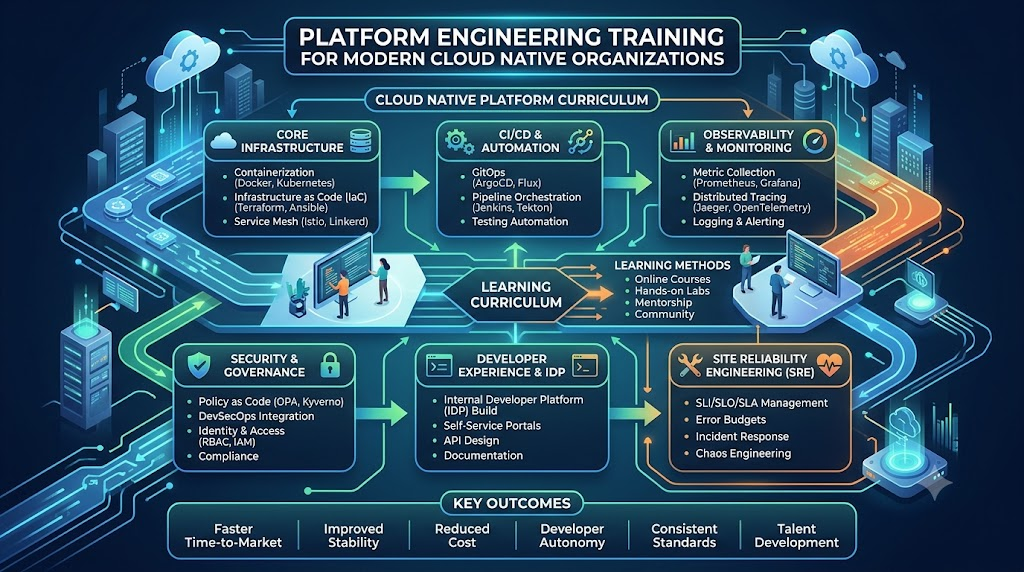
Introduction
Modern organizations are under constant pressure to deliver software faster without compromising quality, reliability, or security. As businesses adopt cloud-native architectures, microservices, containers, Kubernetes, and DevOps automation, engineering teams must manage increasingly complex infrastructure and deployment workflows.
This growing complexity has given rise to Platform Engineering, a discipline focused on building standardized internal platforms that empower developers while reducing operational overhead. Instead of asking every development team to become infrastructure experts, organizations build reusable platforms that simplify deployments, automate infrastructure, and improve developer experiences.
Successful platform initiatives require more than technology—they require experienced guidance. A skilled Platform Engineering Consultant, DevOps Trainer, Cloud DevOps Consultant, and Kubernetes Trainer can help organizations develop practical skills, establish best practices, and build platforms that support long-term business growth.
This article explores why Platform Engineering Training has become essential for modern cloud-native organizations and how structured training helps engineering teams build scalable, reliable, and secure software delivery platforms.
Who Is Rajesh Kumar?
Rajesh Kumar is recognized for helping technology professionals and organizations strengthen their capabilities across modern cloud engineering and DevOps practices. His work focuses on practical implementation, enterprise learning, and consulting rather than purely theoretical instruction.
His expertise spans multiple areas, including:
- DevOps transformation
- Kubernetes and container orchestration
- Cloud-native application delivery
- Site Reliability Engineering (SRE)
- DevSecOps practices
- Infrastructure as Code
- CI/CD automation
- Platform Engineering
- Enterprise DevOps consulting
- Cloud migration strategies
As an experienced DevOps Trainer, DevOps Consultant, Kubernetes Trainer, SRE Trainer, DevSecOps Trainer, Platform Engineering Consultant, and AWS DevOps Consultant, he emphasizes real-world implementation that prepares teams to solve production challenges confidently.
Understanding Platform Engineering
Platform Engineering is the practice of designing and maintaining internal developer platforms that provide standardized tools, automation, and infrastructure services for engineering teams.
Rather than requiring every team to build deployment pipelines, infrastructure templates, monitoring solutions, and security controls independently, platform teams create reusable services that developers can consume easily.
Typical platform capabilities include:
- Self-service infrastructure
- Automated CI/CD pipelines
- Kubernetes environments
- Infrastructure as Code
- Security automation
- Monitoring and observability
- Developer portals
- GitOps workflows
- Policy enforcement
- Standard deployment templates
This approach improves consistency while allowing developers to focus on building business applications.
Why Organizations Need Platform Engineering Training
Many organizations invest heavily in cloud technologies but struggle to achieve consistent engineering practices.
Without proper training, teams often encounter:
- Manual deployment processes
- Inconsistent infrastructure
- Security gaps
- Configuration drift
- Slow onboarding
- Poor developer experience
- Operational complexity
- Difficult troubleshooting
- Unclear ownership
Comprehensive Platform Engineering Training equips engineers with the knowledge required to build standardized platforms that reduce complexity and improve productivity.
Training helps participants understand:
- Platform architecture
- Automation principles
- Kubernetes operations
- Infrastructure automation
- Cloud-native design
- Developer self-service
- Governance
- Scalability
- Security integration
The Connection Between DevOps and Platform Engineering
Platform Engineering builds upon mature DevOps practices rather than replacing them.
An experienced DevOps Trainer helps organizations establish the cultural and technical foundations required before implementing advanced platform strategies.
Key DevOps capabilities include:
- Continuous Integration
- Continuous Delivery
- Infrastructure as Code
- Automation
- Monitoring
- Collaboration
- Feedback loops
- Quality engineering
Organizations also benefit from DevOps Corporate Training, enabling developers, operations teams, QA engineers, and engineering managers to adopt shared practices and common workflows.
For companies seeking expert guidance, a DevOps Trainer in India with enterprise experience can help accelerate organizational transformation while addressing real operational challenges.
Platform Engineering Consultant for Enterprise Transformation
A Platform Engineering Consultant helps organizations design platforms that improve developer productivity while maintaining governance and operational reliability.
Key consulting activities include:
Platform Assessment
Understanding current infrastructure, deployment processes, tooling, and organizational maturity.
Platform Architecture
Designing reusable infrastructure components that support multiple engineering teams.
Standardization
Creating consistent deployment pipelines, infrastructure templates, security policies, and monitoring practices.
Automation
Reducing repetitive manual tasks through infrastructure automation and self-service capabilities.
Governance
Ensuring compliance, policy enforcement, and operational consistency across environments.
Developer Experience
Improving onboarding, reducing cognitive load, and enabling faster software delivery.
Kubernetes Trainer and Kubernetes Corporate Training
Kubernetes has become the standard platform for container orchestration in cloud-native environments.
However, production Kubernetes environments require much more than basic deployment knowledge.
An experienced Kubernetes Trainer helps teams understand:
- Kubernetes architecture
- Cluster administration
- Pod lifecycle
- Networking
- Storage
- Security
- Scaling
- Resource management
- Production troubleshooting
- High availability
Comprehensive Kubernetes Corporate Training enables engineering teams to deploy and manage applications confidently in enterprise environments.
Docker Kubernetes Training also teaches how containers and Kubernetes work together to deliver portable, scalable applications across multiple cloud environments.
SRE Trainer and SRE Consultant for Reliable Platforms
Platform Engineering and Site Reliability Engineering complement each other.
While platform teams build reusable infrastructure, SRE teams ensure reliability, availability, and operational excellence.
A qualified SRE Trainer teaches engineers how to design systems that remain dependable under production workloads.
Important topics include:
Service Level Indicators (SLIs)
Metrics used to measure service performance.
Service Level Objectives (SLOs)
Reliability targets that guide operational decisions.
Incident Response
Efficient approaches to identifying, mitigating, and learning from production incidents.
Observability
Building comprehensive visibility using logs, metrics, and distributed tracing.
Automation
Reducing manual operational work through intelligent automation.
An experienced SRE Consultant helps organizations establish reliability practices that reduce downtime and improve customer experience through effective Site Reliability Engineering Training.
DevSecOps Trainer for Secure Platform Engineering
Security should be integrated throughout the software delivery lifecycle rather than added at the end.
A knowledgeable DevSecOps Trainer helps engineering teams incorporate security into every stage of development.
Training typically includes:
- Secure CI/CD pipelines
- Infrastructure security
- Container security
- Kubernetes security
- Vulnerability scanning
- Compliance automation
- Secret management
- Identity and access management
- Policy enforcement
- Runtime protection
Organizations investing in DevSecOps Corporate Training create development environments where security becomes a shared responsibility.
Cloud DevOps Consultant and AWS DevOps Consultant
Modern Platform Engineering depends heavily on cloud infrastructure.
A Cloud DevOps Consultant assists organizations with:
- Cloud migration planning
- Infrastructure automation
- Multi-cloud strategies
- Cost optimization
- High availability
- Disaster recovery
- Cloud governance
- Performance optimization
An experienced AWS DevOps Consultant further supports AWS environments using automation, managed services, Infrastructure as Code, monitoring, and deployment best practices.
Tools and Technologies Covered
| Area | Tools / Topics | Business Value |
|---|---|---|
| Terraform Training | Terraform, Modules, State Management | Standardized Infrastructure as Code |
| Jenkins Training | Jenkins Pipelines, Automation | Faster software delivery |
| CI/CD Pipeline Training | GitHub Actions, GitLab CI, Jenkins | Reliable automated deployments |
| GitOps Training | Argo CD, Flux, Git workflows | Consistent production deployments |
| Docker Kubernetes Training | Docker, Kubernetes, Helm | Scalable container orchestration |
| AWS DevOps | EC2, EKS, IAM, CloudFormation, CodePipeline | Cloud automation and scalability |
| Monitoring and Observability | Prometheus, Grafana, OpenTelemetry, ELK | Better operational visibility |
| DevSecOps | SonarQube, Trivy, SAST, DAST | Improved software security |
| SRE | SLIs, SLOs, Incident Response, Reliability | Higher service availability |
| Platform Engineering | Internal Developer Platforms, Self-Service, Automation | Increased developer productivity |
Why Choose Rajesh Kumar for Training and Consulting?
Organizations value practical guidance that reflects real-world engineering challenges. Rajesh Kumar’s approach emphasizes implementation-focused learning that helps teams apply concepts in production environments.
Key strengths include:
- Practical enterprise-oriented training
- Strong understanding of cloud-native technologies
- Hands-on learning approach
- Experience across DevOps, Kubernetes, SRE, DevSecOps, and Platform Engineering
- Focus on automation and operational excellence
- Guidance for both engineers and leadership teams
- Training aligned with modern software delivery practices
- Emphasis on real implementation challenges rather than theory alone
Best Fit Audience
Platform Engineering Training is valuable for:
- DevOps engineers
- Platform engineers
- Cloud engineers
- Software developers
- Infrastructure engineers
- Build and release engineers
- Engineering managers
- IT managers
- Corporate engineering teams
- Startup technology organizations
- Enterprise cloud migration teams
- SRE teams
- DevSecOps professionals
- Organizations adopting Kubernetes
- Teams implementing cloud-native architectures
Business Benefits of Platform Engineering Training
Organizations that invest in structured Platform Engineering education often experience measurable operational improvements.
Faster Software Delivery
Automation reduces deployment delays and improves release frequency.
Better Developer Productivity
Self-service platforms allow developers to focus on building applications rather than managing infrastructure.
Improved Standardization
Reusable infrastructure and deployment templates reduce inconsistencies.
Enhanced Reliability
Reliable platforms improve uptime and operational stability.
Stronger Security
Integrated security practices reduce vulnerabilities throughout the software delivery lifecycle.
Reduced Operational Complexity
Automation minimizes repetitive tasks and manual intervention.
Better Cloud Utilization
Efficient cloud resource management supports scalable growth and cost awareness.
Improved Collaboration
Shared tooling and standardized workflows strengthen collaboration between development, operations, security, and platform teams.
Frequently Asked Questions
1. Why should companies invest in Platform Engineering Training?
Platform Engineering Training helps organizations build standardized, automated platforms that improve developer productivity, reduce operational complexity, and support scalable cloud-native application delivery.
2. How does a DevOps Trainer support Platform Engineering initiatives?
A DevOps Trainer teaches automation, CI/CD, Infrastructure as Code, collaboration, and operational best practices that form the foundation of successful platform engineering.
3. Who should attend Kubernetes Corporate Training?
Developers, DevOps engineers, cloud engineers, platform teams, infrastructure engineers, and operations professionals responsible for deploying and managing containerized applications benefit from Kubernetes Corporate Training.
4. How does Site Reliability Engineering Training improve production systems?
Site Reliability Engineering Training teaches observability, automation, incident management, reliability metrics, and operational best practices that improve service availability and customer experience.
5. Why is Platform Engineering important for cloud-native organizations?
Platform Engineering provides reusable infrastructure, self-service capabilities, standardized workflows, automation, and governance, enabling organizations to deliver software more efficiently while maintaining reliability and security.
Conclusion
As cloud-native adoption continues to accelerate, organizations need more than modern tools—they need well-trained engineering teams capable of building scalable, secure, and reliable delivery platforms. Platform Engineering Training provides the knowledge required to simplify infrastructure management, improve developer productivity, standardize operations, and support long-term business growth.
Combined with expertise in DevOps, Kubernetes, Site Reliability Engineering, DevSecOps, Infrastructure as Code, GitOps, and cloud automation, structured learning helps engineering teams confidently manage modern production environments.
Professionals and organizations looking to strengthen their capabilities through practical mentoring, enterprise-focused consulting, or hands-on technical training can learn more about Rajesh Kumar’s expertise and services by visiting https://www.rajeshkumar.xyz/.

