
Introduction
In aviation training, becoming a competent pilot is not just about learning to operate an aircraft. It is about developing discipline, decision-making ability, situational awareness, and safety-first thinking. At the core of this transformation stands the flying instructor role, which plays a decisive part in shaping how a student pilot progresses through every stage of training.
A flying instructor is more than a trainer sitting in the cockpit. They act as a mentor, evaluator, safety supervisor, and learning guide. From the first ground lesson to the final solo flight, instructors ensure that students build the right habits and eliminate unsafe practices early.
Without structured instruction, student pilots may develop incorrect techniques that are difficult to correct later. This makes the instructor’s role essential in building strong aviation fundamentals.
Who Is a Flying Instructor?
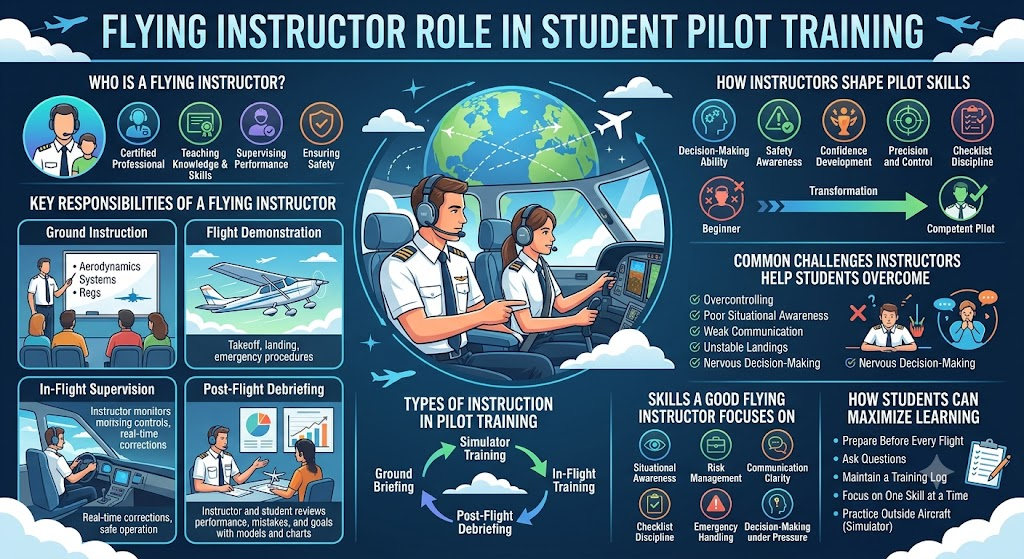
A flying instructor is a certified aviation professional responsible for training student pilots in both theoretical knowledge and practical flying skills. They are qualified to teach aircraft operations, navigation, air regulations, communication procedures, and emergency handling.
Their primary responsibilities include:
- Teaching aircraft handling and flight fundamentals
- Supervising student performance during training flights
- Ensuring strict compliance with aviation safety standards
- Preparing students for solo flights and licensing exams
In simple terms, a flying instructor transforms a beginner into a safe, confident, and competent pilot.
Key Responsibilities of a Flying Instructor in Student Pilot Training
The flying instructor role involves structured responsibilities that directly influence pilot development.
Ground Instruction
Before entering the cockpit, students receive theoretical training on:
- Aerodynamics and flight principles
- Aircraft systems and controls
- Aviation regulations and airspace rules
- Weather interpretation and planning
Flight Demonstration
Instructors demonstrate key maneuvers such as:
- Takeoff procedures
- Landing techniques
- Controlled turns and climbs
- Emergency handling procedures
In-Flight Supervision
During training flights, instructors:
- Monitor student actions continuously
- Provide real-time corrections
- Ensure safe aircraft operation
- Gradually transfer control to students
Post-Flight Debriefing
After each flight session:
- Performance is reviewed in detail
- Mistakes are identified and explained
- Clear improvement goals are set
How Flying Instructors Shape Pilot Skills
A strong instructor does not just correct errors; they build professional flying behavior.
Decision-Making Ability
Students learn:
- When to continue or abort maneuvers
- How to prioritize safety over procedure
- How to evaluate changing flight conditions
Safety Awareness
Instructors reinforce:
- Checklist discipline
- Airspace awareness
- Risk identification techniques
Confidence Development
Through step-by-step training:
- Students progress from dual control to solo flying
- Fear is reduced through repetition and guidance
- Confidence is built through structured exposure
Precision and Control
Students gradually develop:
- Stable altitude control
- Smooth approach paths
- Accurate aircraft handling
Types of Instruction in Pilot Training
The flying instructor role spans multiple learning environments.
Ground Briefing
- Explains theory before flight
- Sets clear training objectives
- Prepares students for upcoming exercises
Simulator Training
- Allows safe practice of complex scenarios
- Builds emergency response skills
- Reinforces standard procedures
In-Flight Training
- Real-time learning inside the aircraft
- Immediate corrections from instructor
- Hands-on skill development
Post-Flight Debriefing
- Detailed performance analysis
- Identification of strengths and weaknesses
- Planning for improvement
Instructor–Student Relationship in Aviation Training
A strong instructor-student relationship is built on trust, communication, and discipline.
Key elements include:
- Open and honest communication
- Respect for safety instructions
- Acceptance of constructive feedback
- Continuous learning mindset
When students actively engage with their instructors, learning becomes faster and more effective.
Common Challenges Instructors Help Students Overcome
Student pilots often face predictable challenges, and instructors help correct them early.
1. Overcontrolling the Aircraft
Students tend to make excessive corrections instead of smooth inputs.
2. Poor Situational Awareness
Focusing too much inside the cockpit instead of external environment.
3. Weak Communication Skills
Delayed or unclear radio communication with air traffic control.
4. Unstable Landings
Incorrect timing during flare and touchdown phases.
5. Nervous Decision-Making
Hesitation during critical flight phases like approach or takeoff.
Real Cockpit Training Scenarios
Scenario 1: Unstable Approach
Instructor notices fluctuating airspeed and altitude during final approach.
Learning outcome:
- Maintain steady glide path
- Reduce unnecessary control inputs
- Focus on visual references
Scenario 2: Checklist Missed Steps
Instructor identifies skipped checklist items before takeoff.
Learning outcome:
- Build strict procedural discipline
- Use structured checklist flow
- Avoid memory-based flying
Scenario 3: Poor Turn Coordination
Student applies incorrect bank angle during turns.
Learning outcome:
- Improve smooth control inputs
- Understand coordinated flight principles
- Enhance spatial awareness
Skills a Good Flying Instructor Focuses On
A professional instructor develops both technical and mental aviation skills:
- Situational awareness
- Risk management
- Communication clarity
- Checklist discipline
- Emergency handling
- Decision-making under pressure
These skills ensure students are prepared for real-world aviation operations, not just exams.
How Students Can Maximize Learning from Instructors
Students can significantly improve their progress by adopting the right approach.
1. Prepare Before Every Flight
Review previous feedback and set learning goals.
2. Ask Questions
Clarify doubts instead of guessing corrections.
3. Maintain a Training Log
Record mistakes and instructor feedback after every flight.
4. Focus on One Skill at a Time
Avoid trying to fix multiple issues in a single flight.
5. Practice Outside Aircraft
Use simulators and mental rehearsal for reinforcement.
FAQs
1. What is the role of a flying instructor in pilot training?
A flying instructor trains student pilots in both theoretical knowledge and practical flying skills while ensuring safety and correct technique development.
2. Why is the flying instructor role important?
They ensure students develop safe flying habits, correct mistakes early, and build strong aviation decision-making skills.
3. Do flying instructors only teach flying techniques?
No, they also teach communication, situational awareness, safety procedures, and emergency handling.
4. How do instructors correct mistakes during flight?
They provide real-time instructions, take control if necessary, and explain corrections during post-flight debriefing.
5. What happens during debriefing sessions?
Flight performance is reviewed, mistakes are analyzed, and improvement plans are created for future flights.
6. How do instructors help build confidence?
They gradually increase flight complexity and support students through structured learning stages.
7. What challenges do instructors commonly fix?
They address issues like unstable landings, poor coordination, weak communication, and lack of situational awareness.
8. Can students improve faster with instructors?
Yes, consistent feedback and proper application of corrections significantly accelerate learning.
9. Is simulator training part of instructor guidance?
Yes, simulators are widely used for practicing procedures and emergency scenarios safely.
10. What makes a good flying instructor?
A good instructor has technical expertise, patience, strong communication skills, and a focus on aviation safety.
Conclusion
The flying instructor role in student pilot training is fundamental to developing safe, skilled, and confident pilots. Instructors are not just teachers but mentors who guide students through every phase of their aviation journey.
From classroom learning to cockpit training and simulator practice, instructors ensure that every student builds strong fundamentals and correct flying habits. Their feedback shapes decision-making, improves safety awareness, and builds professional discipline.
A student pilot’s growth depends heavily on how effectively they understand and apply instructor guidance. Those who listen actively, practice consistently, and follow structured learning approaches become more competent and confident pilots over time.

