
Introduction
Many beginners enter the stock market with excitement but quickly get confused about where to start, how to choose stocks, and which strategy actually works. The truth is, the stock market is not about luck—it is about using the right stock market strategies with simple practical examples.
Without understanding strategies, beginners often invest randomly, follow tips, or trade emotionally. This leads to unnecessary losses and frustration.
This blog will help you understand simple, practical, and beginner-friendly strategies that can build a strong foundation in stock market education and improve your decision-making skills step by step.
We will also include the learning platform 👉 https://www.stocksmantra.com/ to help you continue your stock market learning journey.
What Are Stock Market Strategies?
Stock market strategies are planned methods used by investors and traders to make decisions in the market. These strategies help you decide:
- When to buy a stock
- When to sell a stock
- Which stocks to choose
- How much risk to take
In simple words, strategies remove guesswork and replace it with logic and analysis.
Why Strategies Are Important in Stock Market for Beginners
Beginners often rely on emotions, but strategies help in:
- Reducing emotional decisions
- Avoiding random investing
- Managing risk properly
- Improving consistency
- Building long-term discipline
A good strategy does not guarantee profit, but it improves decision quality.
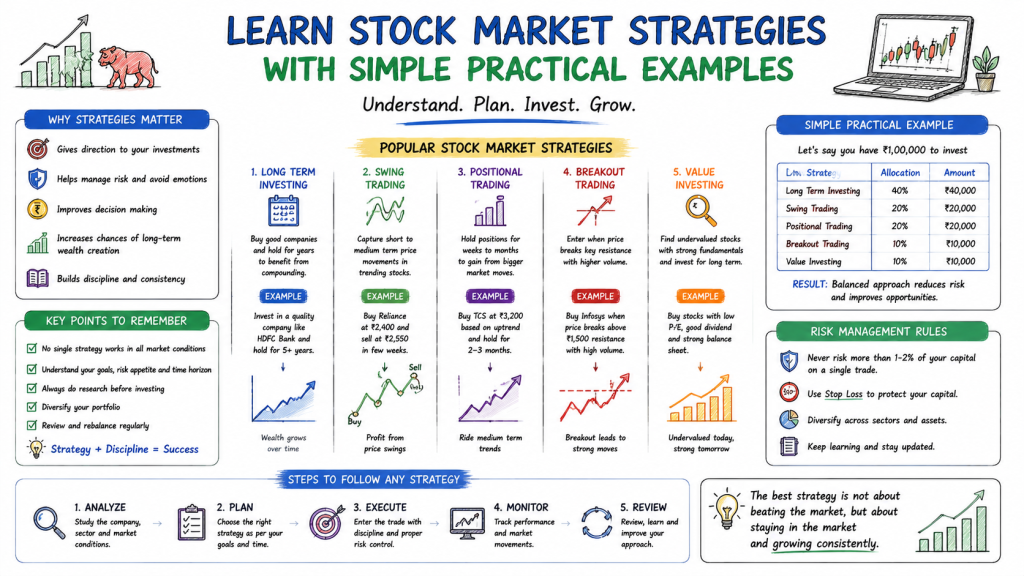
Stock Market Strategies with Simple Practical Examples
Let’s understand some beginner-friendly strategies with real-life examples.
1. Long-Term Investing Strategy
This is the simplest and safest strategy for beginners.
Concept:
Buy good companies and hold them for years.
Practical Example:
Imagine you buy shares of a strong company like a well-established bank or IT company. Instead of selling it in weeks, you hold it for 5–10 years.
Over time:
- The company grows
- Profits increase
- Stock value rises
Key Idea:
Time in the market is more important than timing the market.
2. Value Investing Strategy
Concept:
Buy stocks that are undervalued compared to their real worth.
Practical Example:
A company’s actual value is strong, but due to temporary market negativity, its price is low.
A value investor:
- Studies financial reports
- Checks profit and debt
- Buys when price is lower than value
Key Idea:
Buy quality at a discount.
3. Momentum Investing Strategy
Concept:
Invest in stocks that are already moving upward strongly.
Practical Example:
If a company is showing strong earnings growth and its stock price is consistently rising, a momentum investor may enter during the trend.
Key Idea:
Ride the trend, but exit when momentum slows.
4. SIP (Systematic Investment Strategy)
Concept:
Invest a fixed amount regularly instead of investing all at once.
Practical Example:
You invest ₹2,000 every month in selected stocks or funds.
Benefits:
- Reduces market timing risk
- Builds discipline
- Averages purchase cost
Key Idea:
Consistency beats timing.
5. Breakout Trading Strategy
Concept:
Buy stocks when they break important price levels.
Practical Example:
A stock is moving between ₹100 and ₹120 for weeks. Suddenly, it crosses ₹120 with high volume.
A trader may:
- Enter at breakout
- Expect upward movement
Key Idea:
Price breakout can signal strong momentum.
6. Support and Resistance Strategy
Concept:
Stocks move between support (low price zone) and resistance (high price zone).
Practical Example:
- Stock falls to ₹200 multiple times but bounces back → support
- Stock struggles above ₹250 → resistance
Traders:
- Buy near support
- Sell near resistance
Stock Market Analysis for Beginners
To apply strategies, you need analysis skills:
- Fundamental Analysis → Study company health
- Technical Analysis → Study charts and patterns
- Sector Analysis → Understand industry growth
- IPO Analysis → Evaluate new listings
- Market Sentiment Analysis → Understand news and emotions
Simple Beginner Strategy Roadmap
Here is a step-by-step path for beginners:
- Learn basic stock market terms
- Understand risk and return
- Start with long-term investing
- Study simple company fundamentals
- Practice SIP investing
- Learn basic chart reading
- Observe market trends
- Avoid emotional trading
- Track IPOs carefully
- Keep learning consistently
Common Mistakes Beginners Make
- Following random tips
- Overtrading frequently
- Ignoring research
- Investing without understanding business
- Expecting quick profits
- Panicking during market falls
- Using borrowed money
How Stocks Mantra Helps Beginners
Platforms like 👉 https://www.stocksmantra.com/ help beginners understand:
- Stock market basics
- Simple investing concepts
- Practical trading strategies
- IPO learning
- Market analysis techniques
- Financial education in easy language
This makes learning structured and beginner-friendly instead of confusing.
Best Practices for Using Stock Market Strategies
- Always start with learning, not earning
- Focus on long-term thinking
- Never rely on one strategy only
- Diversify investments
- Stay consistent with learning
- Control emotions during volatility
Expert Tips for Beginners
- Strategy without discipline fails
- Risk management is more important than returns
- Simplicity works better than complexity
- Market patience creates better results
- Learning never stops in investing
FAQs
1. What are stock market strategies?
They are planned methods used to buy and sell stocks based on analysis instead of emotions.
2. Which is the best strategy for beginners?
Long-term investing and SIP-based strategies are best for beginners.
3. What is value investing?
It is buying undervalued stocks with strong fundamentals for long-term growth.
4. What is momentum strategy?
It focuses on stocks that are already moving in a strong upward trend.
5. Is trading risky for beginners?
Yes, trading is riskier than investing and requires proper knowledge.
6. What is support and resistance?
They are price levels where stocks tend to bounce or reverse.
7. Can I use multiple strategies?
Yes, combining strategies with proper understanding can improve results.
8. Do strategies guarantee profit?
No, strategies reduce risk but cannot guarantee profits.
9. Why is stock market education important?
It helps beginners make informed decisions and avoid costly mistakes.
10. Where can I learn stock market strategies?
You can learn through educational platforms like Stocks Mantra.
Conclusion
Learning stock market strategies with simple practical examples is the first step toward becoming a confident investor or trader. Instead of relying on luck or tips, strategies help you make structured and informed decisions.
Whether you choose long-term investing, SIP, or basic technical strategies, the key is consistency, discipline, and continuous learning.
To strengthen your understanding of stock market education for beginners, you can explore more learning resources at 👉 https://www.stocksmantra.com/
Final Disclaimer:
This content is for educational purposes only and should not be considered financial advice.

