
Introduction
As organizations embrace cloud-native architectures, microservices, DevOps, and Kubernetes, platform engineering has become a cornerstone of modern software development. Internal developer platforms, self-service infrastructure, automated CI/CD pipelines, and standardized development environments enable engineering teams to build and deploy software faster than ever before.
However, speed alone does not guarantee success. Without governance, platform engineering initiatives can lead to inconsistent practices, security gaps, fragmented tooling, operational inefficiencies, and increasing technical debt.
This is where Platform Engineering Governance becomes essential.
Platform engineering governance provides organizations with a structured approach to assess, measure, standardize, and continuously improve their software delivery ecosystem. Instead of focusing only on tools, governance focuses on engineering maturity, operational excellence, security, compliance, reliability, and continuous improvement.
SCMGalaxy OS is a Software Delivery Governance Platform that helps organizations assess, score, and improve their entire software delivery lifecycle—from source code to production. It enables engineering leaders to conduct DevOps Maturity Assessment, Software Delivery Maturity Assessment, SCM Maturity Assessment, CI/CD Maturity Assessment, Release Management Maturity Assessment, DevSecOps Maturity Assessment, Observability and SRE Maturity Assessment, and AI Code Governance Platform evaluations through a unified governance framework.
Learn more at https://os.scmgalaxy.com/.
The Growing Importance of Platform Engineering
Platform engineering has evolved beyond infrastructure automation. Today’s platform teams build reusable platforms that simplify software development while improving security, reliability, and operational consistency.
A modern engineering platform often includes:
- Source code repositories
- CI/CD pipelines
- Kubernetes clusters
- Infrastructure as Code
- Security automation
- Artifact repositories
- Container registries
- Monitoring and observability
- Developer self-service portals
- Internal developer platforms
While these technologies improve productivity, they also introduce governance challenges.
Questions such as these become increasingly important:
- Are development standards consistent across teams?
- Are CI/CD pipelines following best practices?
- Is security integrated into every stage of delivery?
- Are platform services properly governed?
- Can engineering maturity be measured objectively?
- Are AI-assisted development practices properly controlled?
- Are reliability practices improving over time?
Platform Engineering Governance answers these questions with measurable assessments rather than assumptions.
What Is Platform Engineering Governance?
Platform Engineering Governance is the process of defining standards, measuring engineering maturity, identifying operational risks, and continuously improving the software delivery platform used by development teams.
Rather than simply managing infrastructure or developer tools, governance evaluates how effectively the entire engineering ecosystem operates.
It includes governance across:
- Source code management
- Platform architecture
- Infrastructure automation
- CI/CD pipelines
- Release processes
- Security controls
- Compliance
- Developer experience
- Production reliability
- AI-assisted development
A mature governance model helps organizations ensure that engineering practices remain scalable, secure, standardized, and continuously improving.
Why Governance Matters More Than Tool Adoption
Many enterprises have invested heavily in tools such as GitHub, Jenkins, Jira, Kubernetes, Terraform, Argo CD, Prometheus, Grafana, SonarQube, and numerous cloud services.
Despite these investments, engineering leaders often struggle to answer critical questions:
- How mature is our engineering organization?
- Which teams follow platform standards?
- Where are the highest operational risks?
- Which delivery processes need improvement?
- Which security controls are missing?
- Are developer experience initiatives working?
- Are we improving over time?
Simply adopting tools does not guarantee engineering maturity.
Organizations need governance that converts engineering activities into measurable maturity scores, actionable recommendations, and structured improvement plans.
SCMGalaxy OS: A Governance Layer Above Engineering Tools
SCMGalaxy OS serves as the operating system for enterprise software delivery governance.
Instead of replacing engineering tools, it sits above them to evaluate how effectively they are being used.
SCMGalaxy OS helps organizations:
- Assess engineering maturity
- Measure governance effectiveness
- Identify delivery risks
- Benchmark engineering practices
- Generate maturity scores
- Build executive dashboards
- Produce consultant-ready reports
- Recommend improvements
- Create 30/90/180-day transformation roadmaps
This makes SCMGalaxy OS an enterprise-wide governance platform rather than another DevOps tool.
Explore the platform at https://os.scmgalaxy.com/.
Core Components of Platform Engineering Governance
Source Code Governance
Every software platform begins with source code.
Governance ensures repositories follow consistent standards, branch protection rules, code ownership, review policies, documentation requirements, and access controls.
Through comprehensive SCM Maturity Assessment, organizations gain visibility into how effectively source code is managed across development teams.
Platform Standardization
Large organizations often support dozens of development teams.
Without governance, every team builds software differently.
Platform governance promotes standardized:
- Development environments
- Deployment templates
- Infrastructure modules
- Security baselines
- CI/CD workflows
- Operational policies
Standardization improves scalability while reducing operational complexity.
CI/CD Governance
Automated delivery pipelines are essential for modern engineering organizations.
Governance evaluates:
- Pipeline consistency
- Build reliability
- Deployment automation
- Test coverage
- Quality gates
- Rollback readiness
- Approval workflows
- Environment consistency
Using CI/CD Maturity Assessment, SCMGalaxy OS helps organizations improve delivery performance while maintaining governance.
Release Governance
Fast deployments require disciplined release management.
Governance focuses on:
- Release planning
- Deployment approvals
- Change management
- Rollback strategies
- Release documentation
- Production readiness
- Risk management
Organizations can perform structured Release Management Maturity Assessment to identify weaknesses before they impact production.
5. DevSecOps Governance
Security should be integrated throughout the software delivery lifecycle.
Governance evaluates:
- Secure coding practices
- Dependency management
- Vulnerability scanning
- Secret management
- Container security
- Infrastructure security
- Compliance validation
- Security automation
A structured DevSecOps Maturity Assessment helps engineering teams continuously strengthen software security.
6. Observability and SRE Governance
Modern software requires visibility after deployment.
Governance evaluates:
- Monitoring coverage
- Alert quality
- Incident response
- Service Level Objectives
- Reliability engineering
- Performance analysis
- Capacity planning
- Operational excellence
SCMGalaxy OS supports comprehensive Observability and SRE Maturity Assessment to improve production reliability.
AI Code Governance
AI-assisted software development is transforming engineering productivity.
However, organizations must govern:
- AI-generated code quality
- Security validation
- Compliance
- Code ownership
- Human review processes
- Development policies
SCMGalaxy OS supports organizations through its AI Code Governance Platform, helping engineering leaders evaluate AI adoption while maintaining governance standards.
Measuring Platform Engineering Maturity
Engineering maturity cannot be improved without measurement.
SCMGalaxy OS converts engineering practices into structured maturity assessments across multiple domains.
Organizations receive:
- Maturity scores
- Risk analysis
- Engineering benchmarks
- Governance recommendations
- Improvement priorities
- Executive reporting
- Transformation roadmaps
Instead of relying on assumptions, engineering leaders gain objective insights into platform effectiveness.
Supporting Enterprise Engineering Leadership
Platform Engineering Governance benefits multiple stakeholders across the organization.
CTOs
Gain visibility into engineering maturity, software delivery performance, governance effectiveness, and organizational readiness.
DevOps Leaders
Identify CI/CD bottlenecks, automation gaps, deployment risks, and continuous improvement opportunities.
Platform Engineering Teams
Evaluate internal developer platforms, self-service capabilities, automation maturity, and platform consistency.
Security Teams
Assess DevSecOps maturity, governance compliance, and engineering security posture.
SRE Teams
Measure operational reliability, observability maturity, and production readiness.
Enterprise Architects
Evaluate enterprise-wide engineering governance and technology standardization.
Consultants
Create client workspaces, perform professional assessments, generate executive reports, and deliver structured transformation roadmaps.
Moving Beyond Engineering Tools
Organizations frequently believe that implementing GitHub, Jenkins, Kubernetes, Terraform, Jira, and monitoring platforms automatically creates engineering excellence.
The reality is different.
Engineering excellence requires:
- Governance
- Measurement
- Standardization
- Continuous assessment
- Risk visibility
- Executive reporting
- Improvement planning
SCMGalaxy OS bridges the gap between tool adoption and engineering governance by helping organizations understand how mature their software delivery ecosystem truly is.
30/90/180-Day Transformation Roadmaps
Assessment alone does not improve engineering maturity.
SCMGalaxy OS provides structured transformation plans that help organizations improve continuously.
First 30 Days
Focus on immediate governance improvements:
- Repository governance
- Platform ownership
- Access control
- Branch protection
- Security policies
- Initial maturity improvements
Next 90 Days
Strengthen engineering practices:
- CI/CD optimization
- Platform standardization
- Release governance
- Security automation
- Developer experience improvements
Following 180 Days
Drive long-term transformation:
- Enterprise-wide governance
- Observability improvements
- SRE maturity
- AI governance
- Continuous measurement
- Organizational benchmarking
These roadmaps help engineering organizations move from reactive operations to continuous governance.
Business Benefits of Platform Engineering Governance
Organizations implementing structured governance gain significant advantages.
Key benefits include:
- Faster software delivery
- Improved engineering consistency
- Stronger security posture
- Better compliance
- Reduced operational risk
- Higher deployment confidence
- Improved developer productivity
- Better platform reliability
- Enhanced executive visibility
- Continuous engineering improvement
Governance transforms platform engineering into a measurable business capability.
Why SCMGalaxy OS Is the Right Governance Platform
SCMGalaxy OS provides enterprises with a comprehensive framework for evaluating software delivery maturity across every stage of the engineering lifecycle.
As a Software Delivery Governance Platform, it enables organizations to perform:
- DevOps Maturity Assessment
- Software Delivery Maturity Assessment
- SCM Maturity Assessment
- Software Configuration Management Platform evaluation
- CI/CD Maturity Assessment
- Release Management Maturity Assessment
- DevSecOps Maturity Assessment
- Observability and SRE Maturity Assessment
- AI Code Governance Platform assessment
Instead of simply collecting engineering metrics, SCMGalaxy OS transforms them into actionable governance insights that help organizations continuously improve.
Learn more by visiting:https://os.scmgalaxy.com/
Frequently Asked Questions (FAQs)
1. What is Platform Engineering governance?
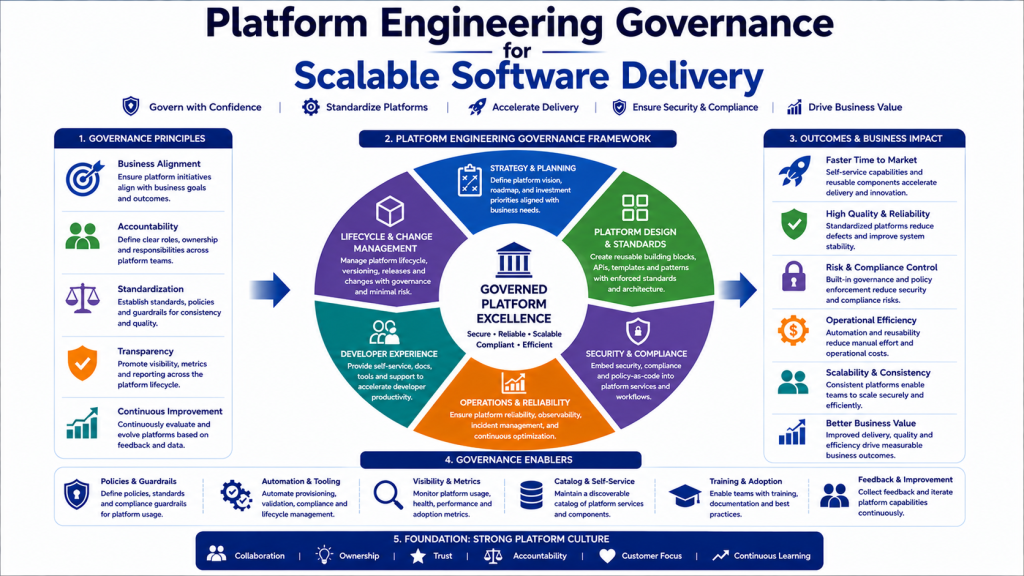
Platform Engineering governance is a structured framework that defines policies, standards, roles, and operational controls for building and managing internal developer platforms. It ensures that platform services remain secure, scalable, compliant, and aligned with business and engineering objectives.
2. Why is governance important in Platform Engineering?
Governance helps organizations maintain consistency across infrastructure, development tools, and platform services. It reduces operational risks, improves developer productivity, enforces security policies, and ensures that engineering teams follow standardized practices while delivering software at scale.
3. What are the key components of a Platform Engineering governance framework?
A comprehensive framework typically includes platform architecture standards, service catalogs, infrastructure governance, access management, security controls, compliance policies, automation standards, observability, performance monitoring, lifecycle management, and continuous improvement processes.
4. How does Platform Engineering governance improve software delivery?
Governed platforms provide reusable services, standardized environments, automated provisioning, and self-service capabilities. This reduces development bottlenecks, accelerates deployments, minimizes configuration errors, and enables faster, more reliable software delivery across multiple teams.
5. What role does automation play in Platform Engineering governance?
Automation enforces governance policies consistently by provisioning infrastructure, validating configurations, applying security controls, managing deployments, monitoring compliance, and generating audit reports. This reduces manual effort while improving speed, consistency, and operational efficiency.
6. How does Platform Engineering governance support security and compliance?
Governance embeds security throughout the platform by implementing identity management, policy enforcement, infrastructure security, vulnerability scanning, secrets management, audit logging, and compliance monitoring. These controls help organizations meet regulatory requirements while protecting critical systems.
7. Which organizations benefit most from Platform Engineering governance?
Large enterprises, cloud-native organizations, financial institutions, healthcare providers, technology companies, government agencies, and organizations operating multiple development teams benefit significantly from standardized platform governance that supports scalable software delivery.
8. What challenges are commonly encountered when implementing Platform Engineering governance?
Organizations often face challenges such as integrating legacy systems, standardizing development workflows, managing platform adoption, balancing governance with developer autonomy, maintaining consistent policies across cloud environments, and ensuring ongoing platform scalability.
9. How can organizations measure the effectiveness of Platform Engineering governance?
Key performance indicators include deployment frequency, developer onboarding time, infrastructure provisioning speed, platform adoption rate, service availability, change failure rate, policy compliance, security incident reduction, operational costs, and overall developer satisfaction.
10. What are the best practices for establishing successful Platform Engineering governance?
Successful governance begins with clearly defined ownership, standardized platform architectures, automated policy enforcement, self-service capabilities, Infrastructure as Code, continuous monitoring, developer training, security-by-design principles, regular governance reviews, and ongoing optimization based on measurable business and engineering outcomes.
Conclusion
Platform engineering has become the foundation of modern software development, but scalable software delivery requires more than automation and cloud-native tools. Organizations need governance that measures engineering maturity, identifies operational risks, standardizes delivery practices, and drives continuous improvement.
SCMGalaxy OS delivers exactly that. By providing structured maturity assessments, governance scoring, risk analysis, executive reporting, and 30/90/180-day transformation roadmaps, it enables engineering organizations to move from isolated tool adoption to enterprise-wide software delivery excellence.
Whether your organization is modernizing DevOps, strengthening platform engineering, improving release governance, enhancing security, expanding observability, or governing AI-assisted development, SCMGalaxy OS provides the insights and governance framework needed to build a secure, scalable, and continuously improving software delivery ecosystem.

