
Introduction
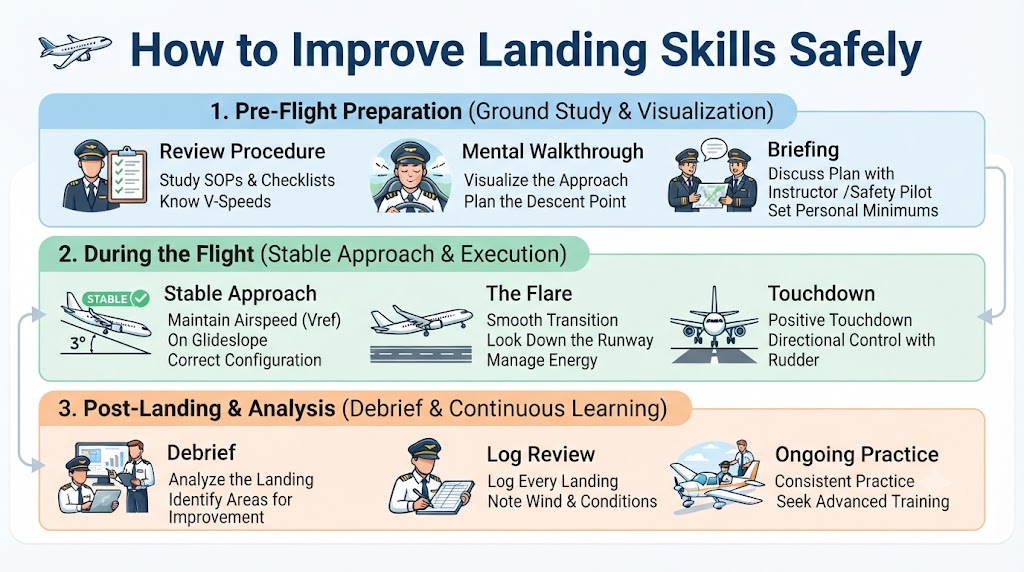
Landing is one of the most important skills in flight training. It is also one of the skills that takes time, patience, and repeated practice. Many beginner pilots want smooth landings quickly, but safe landings are more important than soft landings.
This blog on How to Improve Landing Skills Safely is written for student pilots who want to build better landing confidence during training. The goal is not to replace instructor guidance. The goal is to help learners understand what areas to focus on during landing practice.
Always practice landings under the supervision of a certified flight instructor and follow your aircraft manual, airport procedures, and aviation authority rules.
Why Safe Landing Improvement Matters
Landing improvement is not just about touching down smoothly. A safe landing includes good approach planning, correct alignment, stable speed, proper judgment, and the ability to go around when needed.
Better landing skills help student pilots improve:
- Aircraft control
- Runway awareness
- Confidence
- Decision-making
- Wind correction
- Traffic pattern discipline
- Safety habits
A pilot who makes safe decisions is more valuable than a pilot who only tries to make every landing soft.
Start With a Stable Approach
A good landing starts before the aircraft reaches the runway. If the approach is unstable, the landing becomes harder.
A stable approach means the aircraft is properly aligned, controlled, and prepared for landing. Student pilots should learn to manage approach setup with their instructor before focusing only on touchdown.
Important parts of a stable approach include:
- Correct runway alignment
- Good airspeed awareness
- Controlled descent
- Proper spacing
- Checklist completion
- Calm decision-making
If the approach does not look safe or stable, a go-around may be the best choice.
Learn Proper Runway Alignment
Runway alignment is one of the first landing skills student pilots should improve. The aircraft should stay aligned with the runway centerline during final approach and touchdown.
Poor alignment can happen because of wind, late correction, or over-controlling. Beginner pilots may not notice drift early enough.
To improve runway alignment safely, students should:
- Look outside properly
- Notice drift early
- Listen to instructor correction
- Avoid large sudden control movements
- Practice centerline awareness regularly
Good runway alignment builds confidence and improves landing safety.
Improve Airspeed Awareness
Airspeed awareness is very important during landing practice. If the aircraft is too fast, it may float longer. If it is too slow, control may become difficult and unsafe.
Student pilots should learn to balance outside visual references with instrument checks. Staring only at the airspeed indicator is not helpful. Ignoring it is also unsafe.
With instructor guidance, students learn how airspeed affects:
- Approach stability
- Descent control
- Flare timing
- Touchdown distance
- Overall landing safety
Better airspeed awareness usually leads to better landings.
Understand the Landing Flare Gradually
The landing flare is one of the most challenging parts of landing for beginner pilots. It requires timing, feel, and visual judgment.
Many students flare too early, too late, too aggressively, or too slowly. These mistakes are normal during training.
The best way to improve flare awareness is through repeated practice with instructor feedback. Students should focus on learning the correct sight picture instead of trying to force a perfect landing.
Flare skill improves slowly. Patience is important.
Practice Go-Around Decisions
A go-around is a normal safety action. It is not a failure.
Student pilots should learn early that not every approach should end in a landing. If the approach is unstable, alignment is poor, speed is not correct, or the runway situation changes, going around may be the safest decision.
Practicing go-around decisions helps students build:
- Confidence
- Safety judgment
- Workload management
- Situational awareness
- Better landing discipline
A safe pilot is willing to go around instead of forcing a bad landing.
Learn From Every Landing Attempt
Every landing teaches something. A smooth landing is not always perfect, and a firm landing is not always useless.
After each landing, students should review what happened with their instructor.
Useful questions include:
- Was the approach stable?
- Was the runway alignment good?
- Was airspeed controlled properly?
- Was the flare early or late?
- Was wind correction needed?
- Was a go-around considered?
- What should improve next time?
This reflection helps students improve faster and avoid repeating the same mistakes.
Avoid Common Unsafe Habits
Some landing habits can slow progress and reduce safety. Student pilots should correct these habits early.
Common unsafe habits include:
- Forcing the aircraft onto the runway
- Ignoring an unstable approach
- Delaying a go-around
- Over-controlling near the runway
- Looking too close in front of the aircraft
- Skipping checklist items
- Focusing only on making the landing smooth
- Not listening to instructor feedback
Safe landings come from discipline, not pressure.
How Flight Instructors Help Improve Landing Skills
A certified flight instructor plays a major role in landing improvement. The instructor observes things the student may miss.
Instructors help students improve:
- Approach setup
- Runway alignment
- Airspeed control
- Descent judgment
- Flare timing
- Wind correction
- Go-around decisions
- Confidence after mistakes
Instructor feedback is one of the most valuable parts of landing training. Students should ask questions and review each landing honestly.
Ground Preparation Before Landing Practice
Students can improve landing skills before entering the aircraft. Good preparation reduces cockpit workload.
Helpful ground preparation includes:
- Reviewing traffic pattern procedures
- Studying the landing checklist
- Understanding runway markings
- Reviewing previous lesson notes
- Practicing mental rehearsal
- Asking the instructor about the lesson goal
- Learning basic weather and wind effects
Prepared students usually learn faster because they are not trying to understand everything for the first time in the air.
Safe Practice Tips for Student Pilots
Landing improvement takes time. The goal is steady progress.
Helpful tips include:
- Stay calm during final approach
- Use the checklist every time
- Maintain good visual awareness
- Focus on stable approaches first
- Listen carefully to instructor feedback
- Do not chase perfect landings
- Correct small errors early
- Practice consistently
- Review each landing after the lesson
- Choose safety over pride
A beginner pilot should measure progress by safer decisions, not only by smoother touchdowns.
Why Confidence Comes With Repetition
Landing confidence does not come from one perfect landing. It comes from repeated practice and understanding.
With time, students begin to recognize the runway sight picture, aircraft response, wind effect, and flare timing. They also become more comfortable making go-around decisions.
Confidence grows when students know what they are doing, why they are doing it, and when to stop trying and go around.
FAQs About Improving Landing Skills Safely
Why are landings difficult for student pilots?
Landings are difficult because they require speed control, runway alignment, descent judgment, flare timing, and wind correction at the same time.
How can I improve my landings faster?
You can improve by practicing regularly, listening to instructor feedback, reviewing each landing, and focusing on stable approaches before touchdown.
Is a smooth landing always a good landing?
Not always. A safe landing is more important than a smooth landing. Alignment, control, and decision-making matter more.
What is the most important part of landing practice?
A stable approach is one of the most important parts. Good landings usually begin with a good approach.
Why is go-around practice important?
Go-around practice teaches students not to force unsafe landings. It builds confidence and safety judgment.
Can I improve landing skills by reading only?
Reading helps understanding, but landing skills require real practice with a certified flight instructor.
What should I do after a bad landing?
Review it calmly with your instructor. Understand what happened, learn from it, and focus on one improvement at a time.
Final Thoughts
Learning How to Improve Landing Skills Safely is a major part of becoming a confident pilot. Landing skills improve through patience, repetition, honest feedback, and strong safety habits.
Student pilots should not rush the process. A safe landing is not about impressing anyone. It is about controlling the aircraft, making good decisions, and knowing when to go around.

