
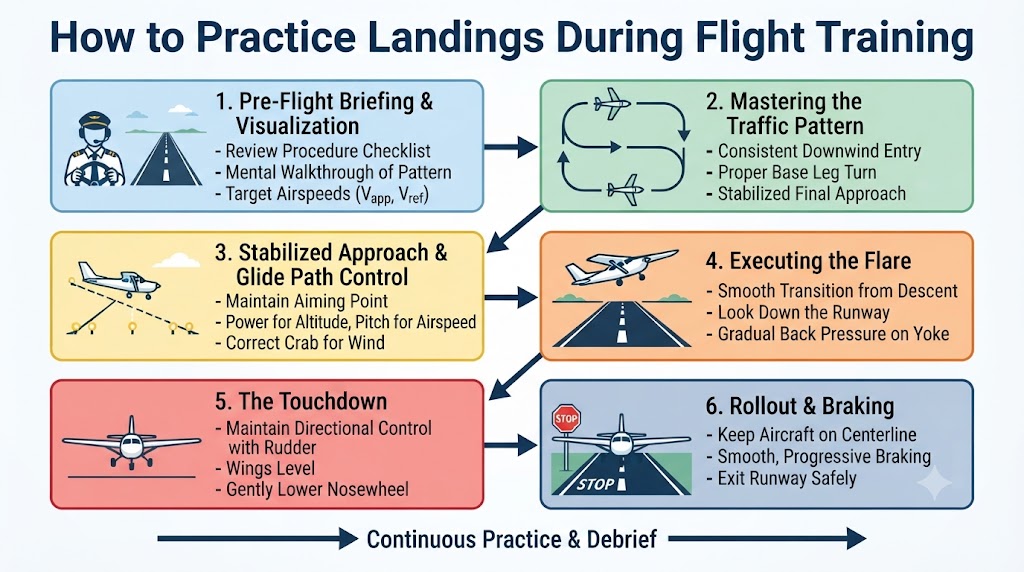
Introduction
Landing is one of the most important skills in flight training. For many student pilots, it is also one of the most challenging parts of learning to fly. A good landing is not only about touching the runway smoothly. It is about planning, control, judgment, timing, and safety.
This guide on How to Practice Landings During Flight Training is written for beginner pilots who want to understand how landing practice works and what skills they should build during training.
Landing practice should always be done under the guidance of a certified flight instructor. Every aircraft, runway, weather condition, and airport procedure can be different.
Why Landing Practice Matters for Student Pilots
Landing practice helps student pilots develop control and confidence. It teaches them how to manage the aircraft close to the ground, where small mistakes can matter more.
During landing training, students learn:
- Approach control
- Airspeed awareness
- Runway alignment
- Descent planning
- Wind correction
- Flare awareness
- Touchdown control
- Go-around decision-making
A safe landing starts before the aircraft reaches the runway. It begins with good planning, correct setup, and calm flying.
What Students Should Learn Before Practicing Landings
Before practicing landings, student pilots should understand the basic flow of the traffic pattern and approach. They should know how to use checklists, communicate clearly, and follow instructor guidance.
Important areas include:
- Aircraft control basics
- Traffic pattern awareness
- Final approach setup
- Runway direction
- Wind direction
- Radio communication
- Landing checklist
- Go-around awareness
Students do not need to master everything immediately. Landing is a skill that improves slowly through repeated practice.
Understanding the Landing Checklist
The landing checklist helps pilots prepare the aircraft before landing. It reduces missed steps and keeps the pilot organized during a busy phase of flight.
A landing checklist may include items related to fuel, mixture, carburetor heat, flaps, landing gear, lights, and other aircraft-specific checks.
Student pilots should not treat the checklist as a formality. It is a safety habit. Using it correctly builds discipline and helps prevent avoidable mistakes.
Basic Skills Involved in Landing Practice
Landing practice includes several connected skills. Each skill supports the next one.
Stable Approach
A stable approach means the aircraft is properly aligned, at a suitable speed, and descending in a controlled way. If the approach is not stable, the safest decision may be to go around.
Airspeed Awareness
Airspeed control is one of the most important landing skills. Too fast or too slow can make landing difficult and unsafe. Student pilots learn to monitor speed while also looking outside.
Runway Alignment
The aircraft should stay aligned with the runway centerline. This helps prevent drifting and improves touchdown control.
Descent Control
Students learn how to judge whether the aircraft is too high, too low, or on the correct approach path. This takes time and instructor feedback.
Flare Awareness
The flare is the transition just before touchdown. Timing is important. Students often need many practice landings before they understand the correct sight picture and feel.
Touchdown Control
Touchdown should be controlled and safe. The goal is not only a smooth landing but also proper alignment, speed control, and aircraft control after landing.
Go-Around Decision-Making
A go-around is a normal safety decision. It is not a failure. Student pilots should learn early that a safe go-around is better than forcing a bad landing.
Common Landing Types Student Pilots May Learn
During training, students may practice different types of landings under instructor supervision.
Normal Landing
A normal landing is used in standard conditions. It helps students build basic approach and touchdown skills.
Crosswind Landing
A crosswind landing teaches students how to manage wind blowing across the runway. It requires good alignment, drift correction, and instructor guidance.
Short-Field Landing
A short-field landing is practiced for runways where distance is limited or obstacle clearance is important. It requires careful planning and performance awareness.
Soft-Field Landing
A soft-field landing is used for grass, dirt, or softer runway surfaces. It teaches students how surface conditions can affect landing technique.
Common Mistakes During Landing Practice
Landing mistakes are common in flight training. The goal is to recognize them early and correct them safely.
Common mistakes include:
- Unstable approach
- Poor runway alignment
- Incorrect airspeed control
- Looking too close in front of the aircraft
- Flaring too early
- Flaring too late
- Hard landing
- Ballooning
- Drifting sideways
- Not correcting for wind
- Delaying a go-around
These mistakes improve with instruction, repetition, and honest feedback after each lesson.
How Flight Instructors Help During Landing Training
A flight instructor plays a major role in landing practice. The instructor helps the student understand what to look for, when to act, and how to stay safe.
Instructors help students with:
- Approach planning
- Airspeed control
- Runway alignment
- Flare timing
- Wind correction
- Touchdown control
- Go-around decisions
- Post-landing feedback
At first, the instructor may guide most of the landing. Over time, the student takes more responsibility as skill and confidence improve.
Safety Tips for Practicing Landings
Landing safety depends on preparation and awareness. Student pilots should build safe habits from the beginning.
Important safety tips include:
- Follow the checklist every time
- Listen carefully to instructor guidance
- Maintain a stable approach
- Watch runway alignment
- Correct for wind
- Keep proper spacing from other traffic
- Communicate clearly
- Do not force a bad landing
- Go around when needed
Good pilots are not judged only by smooth landings. They are judged by safe decisions.
How Students Can Prepare Before Each Landing Lesson
Students can improve faster by preparing before each flight lesson.
Helpful preparation steps include:
- Review traffic pattern procedures
- Study the landing checklist
- Review previous instructor feedback
- Practice mental rehearsal
- Understand the lesson goal
- Ask questions before the flight
- Learn from each landing attempt
Preparation helps reduce pressure in the cockpit and allows the student to focus better during training.
Building Confidence Through Repeated Landing Practice
Landing confidence comes from repetition. At first, landing may feel fast and difficult. With time, students begin to understand the aircraft’s movement, runway sight picture, descent, and flare timing.
Each landing teaches something. Even a poor landing can be useful if the student understands what happened and how to improve next time.
The key is not perfection. The key is steady progress under instructor supervision.
Why Landing Practice Builds Better Pilots
Landing practice improves many pilot skills at once. It teaches patience, control, judgment, and decision-making.
A student who practices landings properly becomes better at:
- Managing workload
- Staying calm
- Looking outside
- Using checklists
- Controlling speed
- Correcting mistakes
- Making safe decisions
These skills are useful throughout a pilot’s flying journey.
FAQs About Practicing Landings During Flight Training
Why are landings difficult for student pilots?
Landings are difficult because many things happen at once, including speed control, descent, runway alignment, flare timing, and wind correction.
How many landings does it take to become confident?
It varies for every student. Some learners improve quickly, while others need more repetition. Consistent practice and instructor feedback are most important.
What is a stable approach?
A stable approach means the aircraft is properly aligned, controlled, and prepared for landing. If the approach is not stable, a go-around may be the safest choice.
Is a go-around a mistake?
No. A go-around is a normal safety procedure. It shows good judgment when the landing approach is not safe or stable.
What is the most common landing mistake?
One common mistake is poor airspeed control. Another common issue is flaring too early or too late.
Can student pilots practice landings alone?
Student pilots may practice solo landings only after proper training, instructor approval, and meeting aviation authority requirements.
How can I improve my landings?
Listen to your instructor, review each landing, practice regularly, use checklists, understand wind correction, and do not rush the learning process.
Final Thoughts
Learning How to Practice Landings During Flight Training is a major step in becoming a safe and confident pilot. Landing practice teaches control, timing, awareness, and decision-making.
Student pilots should remember that safe landings are built through patience, repetition, and proper instruction. Always practice landings with a certified flight instructor and follow your aircraft manual, local airport procedures, and aviation authority guidance.

