
Introduction
Engineering teams rarely fail because they lack technical tools. More often, problems appear because developers, operations teams, security specialists, testers, and engineering managers work with different priorities and incomplete information.
Developers may focus on releasing features, while operations teams focus on service stability. Security teams may review risks late in the process, and testers may receive changes only after most technical decisions have already been made.
These working patterns create silos.
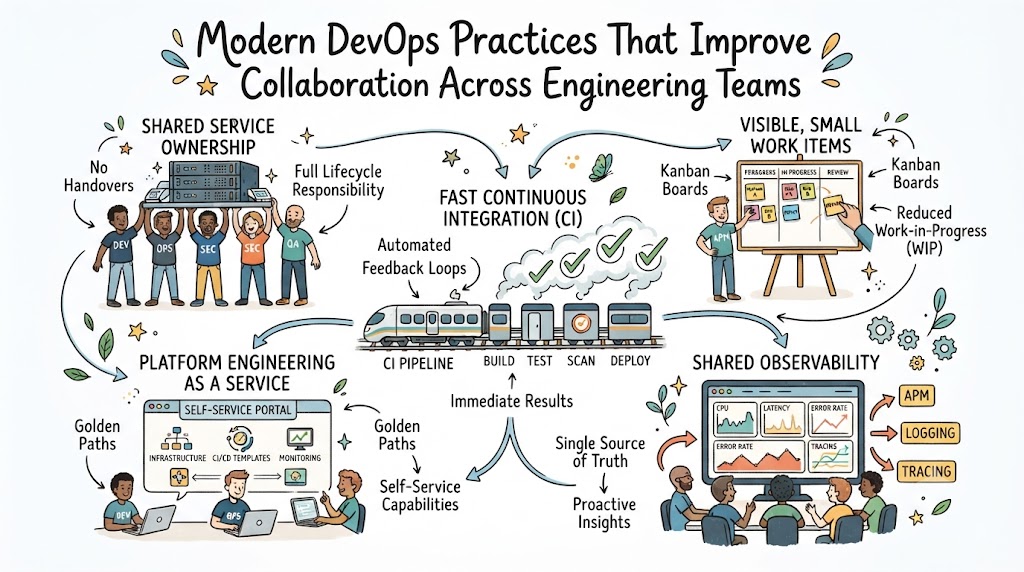
Modern DevOps Practices improve collaboration by giving teams shared workflows, common information, faster feedback, and clearer ownership. Instead of passing work from one department to another, cross-functional teams participate throughout the software lifecycle.
Effective collaboration does not mean that everyone performs the same job. Developers, SREs, security engineers, platform teams, and testers still bring different skills. DevOps helps them combine those skills around a shared goal: delivering valuable software safely and reliably.
This article explains the practices that make such collaboration possible. It covers shared responsibility, pull-request workflows, continuous integration, platform engineering, documentation, observability, incident reviews, security, DORA metrics, practical projects, and the roles of BestDevOps and DevOpsIQ.
Why Engineering Collaboration Matters
Software delivery is a connected process.
A feature may begin as a product requirement, become a code change, enter an automated pipeline, create an infrastructure update, pass security checks, reach production, and later generate operational alerts.
When teams cannot see this complete flow, several problems appear:
- Requirements are misunderstood.
- Reviews take too long.
- Security issues are discovered late.
- Deployments depend on manual handovers.
- Operations teams lack change context.
- Developers lack production visibility.
- Incidents become blame-focused.
- Improvement work receives low priority.
DORA describes visibility of work as the ability to understand how work moves from business ideas to customers. Shared visual information can support better communication, expose bottlenecks, and help teams make improvement decisions together.
Collaboration improves when teams can answer:
- What are we building?
- Why is it important?
- Who owns the service?
- What stage has the change reached?
- What checks have passed?
- What happened after deployment?
- How are users affected?
- What should we improve next?
Collaboration Is More Than Communication
Meetings and messaging tools can support teamwork, but they cannot replace a well-designed engineering process.
Strong collaboration requires four connected elements.
Shared Goals
Teams need common objectives that balance customer value, delivery speed, reliability, security, and maintainability.
Shared Workflows
Developers, testers, security specialists, and operations teams should work through visible and repeatable processes.
Shared Information
Code, deployment status, documentation, incidents, service health, and engineering metrics should be easy for authorized team members to find.
Shared Responsibility
The team building a service should participate in its quality, deployment, security, and operational health.
These elements reduce the need for repeated handovers and make technical decisions easier to understand.
1. Create Cross-Functional Service Ownership
Traditional organizations often divide responsibility by technical function.
One team writes the code, another creates infrastructure, another deploys the application, and another responds to incidents. Each transfer creates waiting time and loss of context.
Modern DevOps teams organize responsibility around applications, services, products, or customer outcomes.
A cross-functional service team may include:
- Software developers
- Test engineers
- DevOps engineers
- SRE professionals
- Security specialists
- Product representatives
- Platform engineers
The team does not need every specialist permanently assigned. However, the necessary knowledge and support should be available throughout the delivery process.
Practical Implementation
Create a simple service-ownership record containing:
- Service name
- Business purpose
- Technical owner
- Product owner
- Repository
- Deployment pipeline
- Production dashboard
- Runbook
- On-call contact
- Dependencies
- Reliability objectives
Clear ownership prevents incidents and delivery problems from moving between teams without action.
2. Use Small and Visible Work Items
Large projects make collaboration difficult because progress remains unclear for long periods.
Smaller work items create more frequent opportunities for:
- Review
- Testing
- Feedback
- Deployment
- Measurement
- Course correction
Teams should make work visible through a shared board or value-stream view.
The board can include stages such as:
Planned → Development → Review → Testing → Ready for Deployment → Released → Verified
DORA notes that visual management tools such as Kanban boards and delivery dashboards can create shared understanding and help teams identify obstacles.
Practical Implementation
Set limits on the number of items that may remain in development or review.
When the review stage becomes full, engineers should help complete existing work instead of beginning more tasks.
This creates a collaborative focus on finishing valuable work rather than maximizing individual activity.
3. Standardize Git and Pull-Request Collaboration
Source control is not only a place to store code. It is also a collaboration system.
A clear Git workflow helps teams discuss, review, approve, trace, and reverse technical changes.
GitHub pull requests allow contributors to propose changes, discuss them, and complete reviews before integration.
A practical pull-request process should include:
- A clear description of the change
- The business or technical reason
- Testing evidence
- Security impact
- Deployment considerations
- Rollback information
- Related issue or requirement
- Reviewer responsibilities
Keep Reviews Small
Large pull requests are difficult to understand.
Small reviews help engineers:
- Respond faster
- Find defects more easily
- Discuss design clearly
- Reduce merge conflicts
- Share knowledge regularly
Review the System, Not the Person
Comments should focus on code behaviour, maintainability, security, performance, and operational impact.
Respectful reviews turn source control into a learning system.
4. Build Fast Continuous Integration Feedback
Collaboration becomes slower when engineers discover integration problems days after submitting a change.
Continuous integration provides early feedback by automatically building and testing code whenever changes are proposed.
GitHub Actions, for example, can automate build, test, and deployment workflows directly from repository events.
A collaborative CI pipeline may include:
- Compilation or build validation
- Unit testing
- Integration testing
- Code-quality analysis
- Dependency checks
- Secret detection
- Container-image creation
- Configuration validation
Make Results Easy to Understand
A pipeline should not return only “failed.”
It should show:
- Which stage failed
- Which test failed
- What file or service was affected
- Where logs are available
- What action may be required
Fast and understandable feedback reduces the need for another team to investigate basic failures.
5. Practise Continuous Delivery
Continuous delivery keeps software in a deployable condition throughout its lifecycle.
DORA defines continuous delivery as the ability to release changes quickly, safely, and sustainably on demand. It emphasizes fast feedback and maintaining software in a deployable state.
A collaborative continuous-delivery process should make the same workflow visible to development, operations, quality, and security teams.
The process may include:
- Code review
- Automated build
- Automated testing
- Security validation
- Artifact creation
- Non-production deployment
- Acceptance verification
- Approval where required
- Production deployment
- Post-deployment verification
Replace Informal Handovers
Avoid release processes that depend on private messages such as:
“The code is ready. Please deploy it.”
The pipeline should show what was built, which tests passed, which version is being released, and who approved it.
Protect Important Environments
Deployment platforms can support environment-specific secrets, approvals, branch restrictions, and concurrency controls. GitHub Actions environments provide examples of these controls.
6. Build Platform Engineering as an Internal Service
Individual teams should not need to solve the same infrastructure and delivery problems repeatedly.
Platform engineering creates shared capabilities that product teams can use through clear and supported workflows.
DORA describes platform engineering as a sociotechnical discipline combining team interactions with automation, self-service, and repeatability. Internal platforms often provide common tools, services, and approved “golden paths.”
A platform may provide:
- CI/CD templates
- Application starter repositories
- Cloud infrastructure modules
- Kubernetes deployment templates
- Secret-management integration
- Monitoring defaults
- Security policies
- Service catalogues
- Development environments
- Self-service deployment
Treat Developers as Platform Customers
Platform teams should not build features based only on technical assumptions.
They should:
- Interview application teams
- Identify repeated friction
- Measure adoption
- Collect feedback
- Improve documentation
- Remove unnecessary complexity
A platform improves collaboration when it makes good practices easier without removing appropriate team autonomy.
7. Use Documentation as Part of Delivery
Documentation should not be created once and forgotten.
It should change with the system.
Useful engineering documentation includes:
- Architecture diagrams
- Repository guidance
- Deployment instructions
- Service dependencies
- Environment information
- Security requirements
- Troubleshooting steps
- Incident runbooks
- Recovery procedures
- Ownership records
DORA research treats accessible, current documentation as an important capability supporting code quality, learning, and software delivery.
Use Documentation as Code
Store technical documentation near the system it describes when practical.
This allows teams to:
- Review documentation changes
- Track history
- Update instructions with code
- Use automated link or format checks
- Invite contributions through pull requests
Write for the Next Engineer
Documentation should answer practical questions:
- How do I run this service?
- How do I deploy it?
- How do I verify it?
- What commonly fails?
- How do I recover it?
- Who can help?
8. Create Shared Observability
Developers and operations teams often see different parts of a production problem.
Developers understand application logic, while operations teams understand infrastructure and runtime behaviour. Shared observability allows both groups to investigate the same evidence.
OpenTelemetry describes observability through telemetry signals such as traces, metrics, and logs. Traces show request paths, metrics capture runtime measurements, and logs record events.
Shared dashboards should include both technical and user-facing information:
- Request volume
- Error rate
- Response time
- Availability
- Successful transactions
- Resource use
- Queue delays
- Database health
- Recent deployments
- Active incidents
Connect Telemetry
A trace identifier can connect a user request with logs from multiple services. This reduces the time engineers spend searching separate systems without common context.
Give Developers Production Visibility
Appropriate read-only access to production dashboards and logs helps developers understand how their applications behave after release.
Access should still follow security and privacy requirements.
9. Use Shared Service-Level Objectives
Teams sometimes argue because they use different definitions of reliability.
An application team may consider the service healthy because the process is running. A customer-support team may consider it unhealthy because users cannot complete an important transaction.
A service-level objective creates a shared reliability target.
Examples include:
- Successful checkout rate
- API availability
- Search response time
- Payment-processing success
- Data-processing delay
Connect Reliability with Product Decisions
When a service consumes its error budget too quickly, teams may temporarily prioritize reliability work.
This creates a structured discussion between product, development, operations, and SRE teams instead of treating reliability as an operations-only concern.
10. Include Security in Everyday Engineering
Security collaboration becomes difficult when security reviews happen only before release.
DevSecOps introduces security feedback throughout development and delivery.
Shared security practices may include:
- Secure coding guidance
- Dependency scanning
- Secret detection
- Infrastructure scanning
- Container-image scanning
- Policy checks
- Threat modelling
- Access reviews
- Security test cases
Give Developers Useful Feedback
A security tool should explain:
- What was detected
- Why it matters
- Where it appears
- How serious it is
- How it may be corrected
Security teams should help define safe defaults and reusable controls rather than becoming a final approval queue for every change.
11. Use Blameless Incident Reviews
Incidents can either strengthen collaboration or damage it.
A blame-focused review makes engineers hide mistakes and avoid difficult conversations. A learning-focused review examines how technical and organizational conditions allowed the failure to occur.
DORA’s guidance on generative organizational culture recommends blameless postmortems because removing blame and fear helps teams surface problems and solve them more effectively.
A useful incident review should include:
- Customer impact
- Detection method
- Timeline
- Technical conditions
- Contributing process issues
- Recovery actions
- What worked well
- What was confusing
- Follow-up improvements
- Owners and completion dates
Avoid “Human Error” as the Final Cause
Ask why the system allowed one action to create a major failure.
Possible improvements may include:
- Better testing
- Safer permissions
- Smaller releases
- Clearer documentation
- Stronger validation
- Improved alerts
- Easier rollback
12. Create Collaborative Kubernetes Boundaries
Shared Kubernetes environments require clear technical boundaries.
Namespaces can help multiple teams or projects share a cluster by separating groups of resources. Kubernetes documentation specifically describes namespaces as useful in environments containing many users across teams or projects.
Teams may use namespaces to separate:
- Applications
- Business units
- Development environments
- Testing environments
- Platform services
Role-based access control should provide only the permissions required for each team and workload. Kubernetes distinguishes namespace-level RoleBindings from cluster-wide ClusterRoleBindings, allowing access to be limited appropriately.
Resource quotas can also reduce conflict by preventing one team from consuming an unfair share of cluster resources.
13. Streamline Change Approval
Heavy approval processes can create delays without improving safety.
DORA recommends moving detailed technical review closer to knowledgeable practitioners and automated controls rather than relying entirely on centralized approval boards that may lack change context.
A modern approval process may use:
- Peer review
- Automated testing
- Security policies
- Environment protection
- Risk classification
- Approval only for high-risk changes
- Automatic deployment for low-risk changes
Match Control to Risk
A documentation correction should not require the same process as a database migration affecting customer records.
Risk-based approvals make governance more practical and reduce unnecessary waiting.
14. Establish Common Engineering Standards
Collaboration becomes easier when teams follow shared standards.
Standards may cover:
- Repository structure
- Branch protection
- Pipeline stages
- Artifact naming
- Environment names
- Logging formats
- Service labels
- Monitoring requirements
- Security controls
- Documentation templates
Kubernetes recommends common application labels partly because standardized descriptions allow tools to work together and make resources easier to query.
Standards should provide useful consistency without forcing every application into an identical design.
DevOps Collaboration Tools Comparison
| Collaboration Area | Common Tools | Main Purpose | Primary Users |
|---|---|---|---|
| Work planning | Jira, GitHub Issues, Azure Boards | Organize and visualize work | Product and engineering teams |
| Source collaboration | GitHub, GitLab, Bitbucket | Review and manage technical changes | Developers and reviewers |
| CI/CD | Jenkins, GitHub Actions, GitLab CI/CD | Automate feedback and delivery | Development and DevOps teams |
| Documentation | Markdown, internal portals, wikis | Share operational and technical knowledge | All engineering teams |
| Platform engineering | Backstage, Kubernetes, Terraform | Provide shared self-service capabilities | Platform and application teams |
| Observability | Prometheus, Grafana, OpenTelemetry | Share service-health evidence | Developers, SREs, and operations |
| Incident response | PagerDuty, Opsgenie, incident.io | Coordinate response and escalation | On-call and service teams |
| Security | Trivy, SonarQube, Vault | Integrate security into delivery | Developers and security teams |
| Engineering intelligence | DevOpsIQ | Connect delivery and reliability information | Teams and engineering leaders |
Benefits of Collaborative DevOps Practices
Faster Feedback
Automated tests, pull-request reviews, and shared dashboards make problems visible earlier.
Fewer Handovers
Teams can complete more work through connected workflows rather than passing tickets between departments.
Better Operational Understanding
Developers gain visibility into how applications behave after release.
Stronger Security
Security specialists contribute standards and automated controls throughout delivery.
Faster Incident Recovery
Shared telemetry, ownership, deployment information, and runbooks improve coordination.
Better Engineering Decisions
Teams can discuss priorities using delivery, reliability, and customer-impact information.
Continuous Learning
Code reviews, incident reviews, documentation, and retrospectives help knowledge move across team boundaries.
Common Collaboration Challenges
| Challenge | Why It Happens | Practical Response |
|---|---|---|
| Development and operations conflict | Teams have different goals | Create shared delivery and reliability objectives |
| Slow reviews | Changes are too large or ownership is unclear | Reduce change size and define reviewers |
| Too many meetings | Workflows do not provide enough visibility | Use dashboards, issue tracking, and automation |
| Platform resistance | Platform features do not solve developer problems | Treat application teams as customers |
| Documentation becomes outdated | Updates are separate from delivery | Review documentation with code changes |
| Security becomes a bottleneck | Controls happen late | Automate common checks and safe defaults |
| Alert fatigue | Every technical event generates a notification | Alert on meaningful, actionable conditions |
| Blame after incidents | Reviews focus on individuals | Use learning-focused incident analysis |
| Conflicting tools | Teams independently select overlapping platforms | Define shared toolchain principles |
| Metrics create pressure | Measures are used for ranking | Measure services and systems for improvement |
Step-by-Step Collaboration Improvement Plan
Step 1: Map the Delivery Value Stream
Bring product, development, testing, security, operations, and platform representatives together.
Map the process from idea to customer.
Identify:
- Waiting time
- Manual handovers
- Repeated approvals
- Missing information
- Common failures
- Ownership gaps
Step 2: Select One Collaboration Problem
Do not transform every process simultaneously.
Begin with a clear issue, such as slow code reviews or unclear production ownership.
Step 3: Define a Shared Outcome
Examples include:
- Pull requests reviewed within an agreed period
- Every service has an owner and runbook
- Deployment status is visible to the full team
- Security feedback appears during development
- Production incidents connect to recent releases
Step 4: Improve the Workflow
Update automation, templates, documentation, permissions, or responsibilities.
Step 5: Measure the Result
Use practical indicators such as:
- Review time
- Pipeline waiting time
- Deployment lead time
- Incident response time
- Documentation use
- Platform adoption
- Repeated support requests
Step 6: Review with the Team
Discuss what improved, what became harder, and what should change next.
Practical Collaboration Example
Consider a company operating an online travel-booking service.
Previously, developers completed features and opened deployment tickets for the operations team. Security reviewed releases near the end, and production dashboards were available only to operations engineers.
A failed release created booking errors. Developers did not know which version was running, while operations engineers did not understand the application change.
The company changed its workflow.
Developers, testers, security engineers, and operations representatives created a shared pipeline. Every pull request ran tests, dependency scanning, and configuration checks.
The platform team supplied a standard deployment template containing health checks, monitoring, and rollback support.
Application developers received read-only access to production telemetry. Deployment markers appeared in the shared dashboard.
When a later release increased booking latency, the team immediately connected the change with the affected service. A distributed trace identified a slow call to an inventory dependency.
The team rolled back the release and added a performance test to the pipeline.
Collaboration improved because the workflow provided shared context, not because the company scheduled more meetings.
Real-World Use Cases
Startup Teams
Small teams can use lightweight ownership, shared repositories, automated pipelines, and common dashboards without creating complex organizational structures.
Growing Technology Companies
Standard templates and platform services reduce duplication as the number of teams increases.
Large Enterprises
Service catalogues, role-based access, shared standards, and value-stream visibility help coordinate many applications and departments.
Regulated Organizations
Automated evidence, controlled approvals, audit records, and policy-based delivery can improve both collaboration and governance.
SRE Teams
SRE specialists can collaborate with product teams through SLOs, error budgets, observability standards, and incident learning.
Platform Engineering Teams
Platform teams can reduce repeated infrastructure work by offering supported self-service capabilities.
DevOps Roadmap for Collaborative Teams
Stage 1: Shared Foundations
Learn Linux, networking, Git, basic security, and software-delivery concepts.
Stage 2: Source Collaboration
Introduce common repositories, branch protection, pull requests, and review standards.
Stage 3: Continuous Integration
Automate builds, tests, and fast technical feedback.
Stage 4: Continuous Delivery
Create visible and repeatable release workflows.
Stage 5: Infrastructure Automation
Store infrastructure and configuration in version control.
Stage 6: Shared Observability
Give teams access to relevant service-health information.
Stage 7: Reliability Practices
Introduce SLOs, error budgets, runbooks, and incident reviews.
Stage 8: Platform Engineering
Provide reusable delivery and infrastructure capabilities.
Stage 9: Engineering Intelligence
Connect delivery, incident, reliability, and service data for shared improvement.
Essential DevOps Engineer Skills
Technical Skills
- Linux
- Networking
- Git
- CI/CD
- Containers
- Cloud platforms
- Infrastructure as Code
- Kubernetes
- Observability
- Security
- Incident response
- Automation
Collaboration Skills
- Clear technical writing
- Respectful code review
- Active listening
- Cross-team communication
- Conflict resolution
- Knowledge sharing
- Incident coordination
- Giving and receiving feedback
Engineering Skills
- System thinking
- Risk assessment
- Workflow design
- Troubleshooting
- Root-cause analysis
- Measurement
- Continuous improvement
Practical DevOps Collaboration Projects
Project 1: Shared Pull-Request Workflow
Create contribution guidance, review templates, branch protection, and automated checks.
Skills developed: Git collaboration, review quality, workflow design.
Project 2: Reusable CI/CD Template
Build a standard pipeline that several application repositories can reuse.
Skills developed: automation, standardization, platform thinking.
Project 3: Service Catalogue
Document application ownership, repositories, dashboards, dependencies, and runbooks.
Skills developed: documentation, operational readiness, service management.
Project 4: Shared Observability Dashboard
Connect application, infrastructure, deployment, and user-experience indicators.
Skills developed: telemetry, service understanding, incident collaboration.
Project 5: Blameless Incident Simulation
Introduce a controlled deployment failure, recover the system, and run a learning review.
Skills developed: communication, diagnosis, recovery, process improvement.
Project 6: Internal Developer Platform
Provide application templates, infrastructure modules, deployment automation, and monitoring defaults.
Skills developed: platform engineering, self-service design, developer experience.
Project 7: Value-Stream Analysis
Map a change from requirement to production and measure waiting time at every stage.
Skills developed: workflow analysis, bottleneck identification, team facilitation.
Best DevOps Course and Certification Approach
A collaboration-focused DevOps course should include:
- Team-based projects
- Pull-request reviews
- Shared pipeline development
- Infrastructure automation
- Security collaboration
- Observability exercises
- Incident simulations
- Documentation practice
- Platform engineering concepts
- DORA metrics
- Retrospectives
Certifications can support structured knowledge in cloud computing, Kubernetes, Terraform, security, and Site Reliability Engineering.
However, collaboration ability cannot be demonstrated through certificates alone.
Learners should also practise explaining decisions, reviewing work, responding to incidents, and improving shared systems.
DevOps Career Opportunities
DevOps Engineer
Connects development and operations workflows through automation, infrastructure, deployment, and monitoring.
Site Reliability Engineer
Works with product teams to improve reliability, service objectives, incident response, and operational engineering.
Platform Engineer
Builds shared tools and self-service capabilities for application teams.
DevSecOps Engineer
Helps development and security teams include protection throughout delivery.
Engineering Productivity Engineer
Improves development workflows, build systems, testing, and feedback.
Observability Engineer
Creates shared telemetry and investigation capabilities.
Release Engineer
Coordinates reliable and repeatable software releases across teams.
DevOps Engineer Salary Factors
A DevOps Engineer Salary may be influenced by:
- Country and city
- Experience level
- Automation knowledge
- Cloud expertise
- Kubernetes skills
- Security responsibilities
- Incident-response experience
- Platform engineering knowledge
- Leadership responsibilities
- Communication ability
- Cross-team influence
Professionals who can connect technical systems with team needs may qualify for broader responsibilities than those who understand tools only at a command level.
DORA Metrics for Collaborative Improvement
DORA currently uses five software-delivery performance measures divided into throughput and instability. These are change lead time, deployment frequency, failed deployment recovery time, change fail rate, and deployment rework rate.
| Metric | Collaboration Question |
|---|---|
| Change lead time | Where do teams wait for information, review, or approval? |
| Deployment frequency | Can teams release through a shared and repeatable process? |
| Failed deployment recovery time | Can teams coordinate recovery quickly? |
| Change fail rate | Are testing and operational responsibilities connected? |
| Deployment rework rate | How much delivery work is created by production failures? |
Metrics should begin conversations rather than end them.
For example, a long lead time may result from slow reviews, unstable tests, approval queues, unclear requirements, or unavailable environments. The metric identifies a symptom; the team must investigate the system.
How BestDevOps Supports Collaborative Learning
BestDevOps can help engineering professionals explore:
- DevOps fundamentals
- CI/CD practices
- Tool comparisons
- Learning roadmaps
- Platform engineering
- Observability
- DevSecOps
- SRE practices
- Practical projects
- Interview preparation
- Certifications
- Career resources
These resources can help learners understand how technical practices support communication, shared responsibility, and continuous improvement.
How DevOpsIQ Supports Team Collaboration
Within the BestDevOps and DevOpsIQ model, DevOpsIQ connects engineering information from systems such as repositories, pipelines, issue trackers, monitoring platforms, and incident tools.
This unified view can help teams:
- Connect changes with deployments
- Relate releases to incidents
- Review recovery events
- Track DORA metrics
- Monitor SLO performance
- View error-budget consumption
- Compare service trends
- Identify delivery bottlenecks
- Prioritize shared improvement work
The Pulse Score can offer a summarized service-health view.
It should be used to begin investigation rather than replace discussion. Teams should review the underlying changes, incidents, reliability measures, dependencies, and service context.
DevOps Interview Questions and Answers
1. How does DevOps improve collaboration?
DevOps creates shared ownership, automated workflows, common visibility, and faster feedback across development, operations, security, and quality teams.
2. What is shared service ownership?
It means the team responsible for building a service also participates in its delivery, quality, reliability, and operational health.
3. Why are small changes better for collaboration?
They are easier to review, test, discuss, deploy, and recover.
4. What information should a pull request contain?
It should explain the change, purpose, testing, risks, deployment needs, and rollback considerations.
5. How does continuous integration improve teamwork?
It provides fast and consistent feedback that is visible to everyone working on the change.
6. What is continuous delivery?
It is the ability to keep software deployable and release changes safely on demand.
7. What is platform engineering?
Platform engineering provides shared and reusable technical capabilities that help application teams work more independently.
8. What is a golden path?
It is a supported workflow or template that helps teams follow recommended engineering practices.
9. Why should developers have production visibility?
Production visibility helps developers understand application behaviour and participate in troubleshooting.
10. What is a service catalogue?
It is a structured record of services, owners, repositories, dependencies, dashboards, and operational information.
11. What is value-stream mapping?
It is a method for visualizing how work moves from an idea to customer delivery and identifying delays or bottlenecks.
12. Why are blameless incident reviews important?
They encourage engineers to share information openly and focus on system improvement rather than personal blame.
13. How does documentation support collaboration?
It preserves operational and technical knowledge so teams do not depend entirely on individual memory.
14. What is an SLO?
An SLO is a measurable reliability target shared by technical and product stakeholders.
15. How can security teams avoid becoming delivery bottlenecks?
They can provide automated checks, safe defaults, reusable policies, and early guidance.
16. How do Kubernetes namespaces support teams?
They can separate groups of resources and help organize access, policies, and quotas for different teams or projects.
17. Should DORA metrics measure individual engineers?
No. They should be applied to services and delivery systems to guide team improvement.
18. What makes a DevOps platform successful?
It solves real developer problems, offers reliable self-service capabilities, and improves through user feedback.
Future DevOps Collaboration Trends
Product-Oriented Platform Teams
Platform teams will increasingly manage internal capabilities as products with users, feedback, and service expectations.
AI-Assisted Collaboration
AI tools may help summarize pull requests, incidents, logs, and documentation. Teams must still validate technical recommendations.
Unified Engineering Data
Organizations will continue connecting repository, delivery, incident, reliability, and product information.
Policy as Code
More security and governance requirements will become automated, versioned, and reviewable.
Observability Standards
Common telemetry formats will make it easier for teams to share investigation data across tools.
Developer Experience Measurement
Platform and engineering teams will pay greater attention to workflow friction, feedback speed, cognitive load, and self-service success.
Frequently Asked Questions
1. Can DevOps collaboration work without changing team structure?
Yes, but responsibilities, workflows, and communication must still change. Organizational structure can make collaboration easier or harder.
2. Does DevOps remove the need for operations specialists?
No. It changes how operations expertise participates in software design, delivery, reliability, and automation.
3. How can teams reduce unnecessary meetings?
Make work, ownership, pipeline status, documentation, and service health visible through shared systems.
4. Who should own production incidents?
The service-owning team should participate, supported by SRE, platform, security, and incident specialists where needed.
5. How can remote teams improve DevOps collaboration?
They can use clear written decisions, visible workflows, shared dashboards, recorded demonstrations, and maintained documentation.
6. Should all engineering teams use the same tools?
Not always. Teams need sufficient standardization for integration and support, while retaining flexibility for legitimate technical needs.
7. How can code reviews become faster?
Keep changes small, define reviewer ownership, automate basic checks, and avoid using reviews for unrelated design debates.
8. What should be included in a service runbook?
Include service purpose, dependencies, dashboards, common failures, recovery steps, escalation paths, and verification procedures.
9. How can platform teams encourage adoption?
Solve real developer problems, provide clear documentation, reduce setup effort, and improve the platform through feedback.
10. What is the difference between collaboration and handover?
Collaboration involves working together throughout delivery. A handover transfers work and context from one group to another.
11. How often should teams review collaboration practices?
They should review them during retrospectives, after major incidents, and whenever delivery bottlenecks or repeated conflicts appear.
12. What is the strongest sign of successful DevOps collaboration?
Teams can deliver, operate, investigate, and improve services together without depending on hidden knowledge or repeated manual handovers.
Key Takeaways
- DevOps collaboration requires shared goals, workflows, information, and responsibility.
- Small and visible work improves review and feedback.
- CI/CD reduces manual handovers and creates common delivery information.
- Platform engineering can provide reusable self-service capabilities.
- Documentation should evolve with technical changes.
- Shared observability connects development and operational knowledge.
- SLOs help teams agree on reliability.
- Security should be included throughout delivery.
- Blameless reviews turn incidents into learning opportunities.
- DORA metrics should support team improvement rather than individual ranking.
- BestDevOps supports collaborative learning, while DevOpsIQ connects engineering performance information.
Conclusion
Modern DevOps Practices improve collaboration by changing how engineering work is designed, delivered, operated, and measured.
The goal is not to remove specialist roles or make every engineer responsible for every technical task. The goal is to connect different forms of expertise through shared workflows and shared outcomes.
Cross-functional ownership helps teams understand a service throughout its lifecycle. Small work items and pull requests create frequent opportunities for feedback. Continuous integration detects problems early, while continuous delivery replaces informal handovers with visible and repeatable release processes.
Platform engineering reduces repeated work by providing supported self-service capabilities. Documentation preserves knowledge, and shared observability gives development and operations teams common evidence during production problems.
Reliability and security must also become team concerns. SLOs create shared service expectations, DevSecOps introduces earlier security feedback, and blameless incident reviews help teams learn without creating fear.
Engineering measurement can strengthen this process when used responsibly. DORA metrics, service health, incident trends, and value-stream information can reveal where collaboration is breaking down. These measures should lead to investigation and improvement rather than competition.
BestDevOps can help individuals understand DevOps culture, tools, platforms, reliability, and automation. DevOpsIQ can help teams connect deployments, incidents, recovery, SLOs, and engineering trends.

