
Introduction
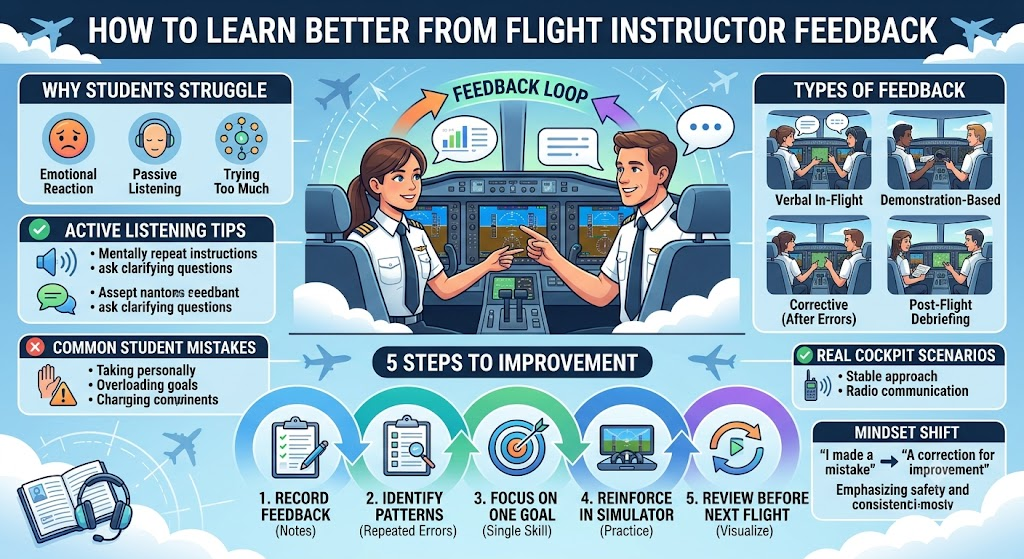
In flight training, one of the most important learning tools is flight instructor feedback. Every correction, instruction, and debrief given by an instructor is designed to help a student pilot improve safety, precision, and decision-making in the cockpit.
However, many student pilots do not fully benefit from this feedback. Some take it emotionally, some forget key points, and others fail to apply corrections in the next flight. This slows down progress and creates repeated mistakes.
Learning how to properly receive and apply instructor feedback can significantly improve flying skills. It helps build consistency, reduce errors, and develop the disciplined mindset required in aviation.
Why Student Pilots Struggle to Use Feedback Effectively
Even when instructors give clear guidance, students often struggle to convert it into improvement.
Common reasons include:
- Emotional reaction to correction during training flights
- Focusing only on mistakes instead of understanding patterns
- Not asking clarifying questions after landing
- Trying to fix too many issues at once
- Lack of structured review after each flight
In aviation training, small misunderstandings can lead to repeated performance issues in critical phases like takeoff, climb, approach, and landing.
Types of Flight Instructor Feedback
Understanding different types of feedback helps students respond correctly.
1. Verbal In-Flight Feedback
Immediate instructions given during flight such as:
- Adjust pitch
- Maintain altitude
- Correct airspeed
This is meant for instant correction and safety.
2. Demonstration-Based Feedback
Instructor takes control and demonstrates correct technique:
- Proper landing flare
- Coordinated turns
- Stabilized approach
3. Corrective Feedback After Errors
Focuses on mistakes observed during maneuvers:
- Poor glide path control
- Incorrect flap usage
- Unstable approach
4. Post-Flight Debriefing
Detailed discussion after landing:
- What was done correctly
- What needs improvement
- What should be practiced next
Common Mistakes Students Make When Receiving Feedback
Many students unintentionally block their own progress.
1. Taking feedback personally
Viewing correction as criticism instead of learning guidance.
2. Passive listening
Hearing instructions but not fully understanding them.
3. Not documenting feedback
Failing to write down key points after flight sessions.
4. Ignoring repeated mistakes
Repeating the same errors without tracking improvement.
5. Overloading improvement goals
Trying to fix multiple flying skills in a single session.
How to Actively Listen During Flight Training
Active listening is essential for effective learning.
Key practices include:
- Focus on instruction intent rather than tone
- Mentally repeat instructions before applying them
- Ask clarifying questions after landing
- Confirm understanding with the instructor
- Avoid defensive thinking during correction
Active listening ensures that flight instructor feedback becomes actionable improvement.
How to Convert Feedback into Skill Improvement
Receiving feedback is only the first step. Applying it correctly is where real progress happens.
Step 1: Record Feedback Immediately
After each flight, note:
- Instructor comments
- Errors observed
- Flight phase where issue occurred
Step 2: Identify Patterns
Look for repeated issues such as:
- Speed instability on approach
- Delayed control inputs
- Poor situational awareness
Step 3: Focus on One Improvement Area
Each flight should have one main goal:
- Improve descent control
- Maintain stable approach speed
- Improve radio communication timing
Step 4: Reinforce in Simulator
Practice weak areas in simulator sessions:
- Repeat maneuvers
- Focus on correction timing
- Build muscle memory
Step 5: Review Before Next Flight
Before flying again:
- Review notes
- Visualize corrections
- Mentally rehearse procedures
Real Cockpit Training Scenarios
Scenario 1: Unstable Approach
Instructor feedback: Approach is unstable and speed is fluctuating.
Improvement focus:
- Maintain steady glide path
- Avoid over-controlling pitch
- Use consistent visual references
Scenario 2: Poor Radio Communication
Instructor feedback: Radio calls are unclear or delayed.
Improvement focus:
- Practice standard phraseology
- Prepare calls in advance
- Speak early and confidently
Scenario 3: Hard Landings
Instructor feedback: Flare timing is incorrect.
Improvement focus:
- Visualize flare point
- Reduce descent rate early
- Practice landing timing in simulator
Practical Tips to Improve Learning from Feedback
- Treat every flight as a learning session
- Maintain a dedicated training logbook
- Ask for one key takeaway after each flight
- Focus on patterns, not isolated mistakes
- Use simulator training to reinforce corrections
- Avoid rushing improvements across multiple skills
Mindset Shift: From Criticism to Learning System
One of the most important changes in aviation training is mindset.
Instead of thinking:
- I made a mistake
Think:
- This is a correction for improvement
Every piece of flight instructor feedback is part of a structured system designed to:
- Improve safety
- Build consistency
- Strengthen decision-making
Successful pilots are not those who avoid mistakes, but those who learn quickly from them and improve continuously.
FAQs
1. Why is flight instructor feedback important in pilot training?
It helps students identify mistakes early and build safe flying habits before they become permanent.
2. How should I react during instructor correction in flight?
Stay calm, listen carefully, and apply the instruction without emotional reaction.
3. What is the best way to remember feedback?
Write it immediately after the flight in a structured logbook.
4. How can I improve faster as a student pilot?
Focus on one key improvement area per flight instead of multiple corrections.
5. Should I ask questions during debriefing?
Yes, clarifying doubts ensures better understanding and application.
6. Why do I repeat the same mistakes?
Usually due to lack of structured tracking and focused practice.
7. Can simulator training help with feedback?
Yes, it helps reinforce corrections in a controlled environment.
8. How do I handle criticism without stress?
Treat feedback as a tool for improvement, not personal judgment.
9. What should I focus on in debriefing?
Focus on patterns of errors and improvement priorities.
10. How many skills should I improve per flight?
One or two key areas are ideal for effective learning.
Conclusion
Learning to effectively use flight instructor feedback is a critical part of becoming a competent pilot. It directly impacts how quickly a student improves and how safely they operate an aircraft. Feedback should never be seen as criticism, but as a structured guide for skill development.
By actively listening, documenting key points, focusing on one improvement area at a time, and reinforcing learning through simulator practice, student pilots can significantly enhance their performance. Over time, this disciplined approach builds confidence, consistency, and strong situational awareness.
A successful pilot is not defined by the absence of mistakes, but by the ability to learn from every correction and continuously improve in the cockpit.

