
Introduction
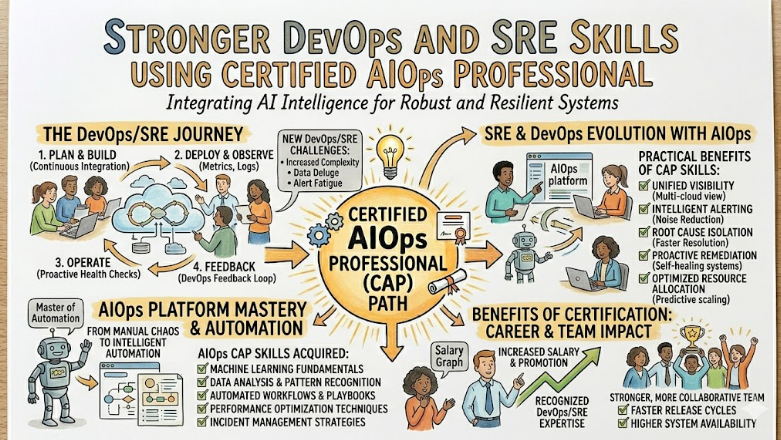
The Certified AIOps Professional is a comprehensive program designed to bridge the gap between traditional operations and the future of artificial intelligence in infrastructure management. This guide is written for engineers who recognize that manual intervention is no longer sustainable in high-scale cloud environments. We will explore how this certification impacts careers in DevOps, platform engineering, and site reliability.
By following this resource, professionals can understand the specific technical requirements and the strategic advantages of adopting AI-driven operations. Navigating the modern tech landscape requires more than just knowing how to script; it requires understanding how to leverage machine learning to predict and resolve incidents before they impact users. This program, hosted on aiopsschool, provides a structured path to achieving that expertise.
What is the Certified AIOps Professional?
The Certified AIOps Professional represents a new standard in operational excellence where machine learning and big data meet IT operations. It exists to address the growing complexity of modern microservices architectures that generate more data than human teams can realistically process in real-time. This certification validates an engineer’s ability to implement automated observation and response systems that learn from historical patterns.
Unlike purely theoretical academic courses, this program emphasizes production-focused learning and real-world deployment scenarios. It aligns with modern engineering workflows where uptime is critical and the volume of logs and metrics necessitates an algorithmic approach to filtering and correlation. It ensures that engineers can transition from being reactive troubleshooters to proactive architects of self-healing systems.
Who Should Pursue Certified AIOps Professional?
This certification is highly beneficial for DevOps engineers, SREs, and cloud architects who are responsible for maintaining large-scale distributed systems. Security professionals and data engineers also find significant value here, as the techniques used for operational anomaly detection are often applicable to threat hunting and data pipeline monitoring. It is designed to serve both individual contributors looking for deep technical skills and managers aiming to lead digital transformation efforts.
In the global market, including the rapidly expanding tech hubs across India, there is a massive demand for professionals who can reduce the mean time to resolution using smart automation. Those with a strong foundation in Linux and networking can use this as a roadmap to high-demand roles, while experienced leads use it to validate their expertise in cutting-edge operational strategies. It is essentially for anyone who wants to move beyond manual dashboards and into autonomous operations.
Why Certified AIOps Professional is Valuable in the Future and Beyond
The demand for AIOps is driven by the sheer scale of cloud-native adoption and the push toward enterprise-wide digital transformation. As companies move toward serverless and edge computing, the traditional ways of monitoring become obsolete, ensuring that AIOps remains a relevant and necessary skill set for years to come. This certification helps professionals stay relevant by teaching them the underlying logic of data-driven operations rather than just specific, fleeting tools.
Investing time in this program offers a high return because it positions an engineer at the intersection of AI and Infrastructure, two of the most lucrative areas in technology today. Enterprise adoption of these practices is increasing because it directly impacts the bottom line by reducing downtime and operational overhead. Professionals holding this credential demonstrate that they are prepared to handle the infrastructure challenges of the next decade with sophistication and efficiency.
Certified AIOps Professional Certification Overview
The program is delivered via the official portal at Certified AIOps Professional and is hosted on the aiopsschool platform. The certification is structured into distinct tiers that cater to different stages of a professional’s career, ensuring a logical progression of knowledge. It uses a rigorous assessment approach that combines conceptual exams with practical, hands-on evaluations to ensure that candidates can actually perform the tasks they are certified in.
The ownership of the curriculum lies with industry veterans who have managed massive global infrastructures, ensuring the content is practical and current. The structure is modular, allowing learners to focus on specific domains such as noise reduction, anomaly detection, and automated remediation. By completing this program, engineers gain a comprehensive framework for applying machine learning to the entire IT operations lifecycle.
Certified AIOps Professional Certification Tracks & Levels
The certification is categorized into three primary levels: Foundation, Professional, and Advanced. The Foundation level introduces the core concepts of data science for operations, while the Professional level dives deep into implementation and tool integration. The Advanced level is aimed at architects and leads who are responsible for designing entire AIOps strategies for large organizations.
Specialization tracks are also available to align the AIOps knowledge with existing domains such as DevOps, SRE, or FinOps. For instance, an SRE might focus on tracks that emphasize incident prediction, while a FinOps practitioner might focus on AI-driven cost optimization and forecasting. This tiered structure ensures that no matter where you are in your career, there is a clear step forward to enhance your professional standing.
Complete Certified AIOps Professional Certification Table
| Track | Level | Who it’s for | Prerequisites | Skills Covered | Recommended Order |
| Core AIOps | Foundation | Aspiring Engineers | Basic Linux & Ops | Data collection, monitoring basics | 1 |
| Engineering | Professional | SREs & DevOps | 2+ years experience | Anomaly detection, automation | 2 |
| Strategy | Advanced | Leads & Architects | 5+ years experience | Strategy design, ML governance | 3 |
| Optimization | Specialization | FinOps & Managers | Cloud knowledge | AI cost modeling, forecasting | 4 |
Detailed Guide for Each Certified AIOps Professional Certification
Certified AIOps Professional – Foundation
What it is
This entry-level certification validates a basic understanding of how artificial intelligence and machine learning can be applied to IT operations. It ensures the candidate understands the terminology, the data types involved, and the general architecture of an AIOps platform.
Who should take it
It is suitable for junior engineers, IT students, and project managers who need to understand the fundamental shift from traditional monitoring to intelligent observability. It is a perfect starting point for those new to the domain.
Skills you’ll gain
- Understanding the difference between AIOps and traditional ITOps.
- Knowledge of telemetry data types including logs, metrics, and traces.
- Familiarity with the AIOps stages: Observe, Engage, and Act.
- Basic understanding of how algorithms assist in noise reduction.
Real-world projects you should be able to do
- Setup a basic centralized logging system with structured data.
- Create simple alerts based on static and dynamic thresholds.
- Visualize operational data using modern dashboarding tools.
Preparation plan
- 7-14 Days: Focus on core terminology and the history of IT operations and monitoring tools.
- 30 Days: Explore the different data sources and practice installing basic collectors like Fluentd or Prometheus.
- 60 Days: Take mock exams and review case studies of how large companies have transitioned to AIOps.
Common mistakes
- Focusing too much on pure data science without understanding operational requirements.
- Ignoring the importance of data cleaning and normalization.
Best next certification after this
- Same-track option: Certified AIOps Professional – Professional
- Cross-track option: SRE Foundation
- Leadership option: ITIL Specialist
Certified AIOps Professional – Professional
What it is
This level validates the ability to implement and manage AIOps solutions within a production environment. It focuses on the technical integration of machine learning models with existing DevOps toolchains and incident management systems.
Who should take it
Intermediate to senior DevOps engineers and SREs who are responsible for building and maintaining automated systems. It is for those who want to be the hands-on implementers of AI strategies.
Skills you’ll gain
- Implementing real-time anomaly detection using statistical models.
- Automating root cause analysis through event correlation.
- Integrating AI insights into Slack, Jira, or PagerDuty workflows.
- Configuring self-healing scripts triggered by AI-driven alerts.
Real-world projects you should be able to do
- Build a system that automatically suppresses duplicate alerts from different sources.
- Implement a predictive scaling model for Kubernetes clusters based on historical traffic.
- Create an automated incident response workflow that executes a script when a specific anomaly is detected.
Preparation plan
- 7-14 Days: Deep dive into time-series analysis and common ML algorithms used in operations.
- 30 Days: Practice integrating monitoring tools with ML libraries or AIOps platforms.
- 60 Days: Focus on complex troubleshooting scenarios where AIOps can reduce MTTR.
Common mistakes
- Over-complicating the solution with complex models when simple heuristics would suffice.
- Failing to account for model drift in changing infrastructure.
Best next certification after this
- Same-track option: Certified AIOps Professional – Advanced
- Cross-track option: MLOps Professional
- Leadership option: Technical Program Management
Choose Your Learning Path
DevOps Path
The DevOps path focuses on integrating AIOps into the continuous integration and delivery pipeline. Professionals here learn to use AI to predict build failures and optimize deployment frequencies. The goal is to move from manual quality gates to automated, data-driven releases that ensure stability. This path is essential for teams looking to achieve high-velocity software delivery without compromising reliability.
DevSecOps Path
In this path, the emphasis is on applying AI to security operations and vulnerability management. It covers the use of machine learning to identify unusual access patterns or potential data breaches in real-time. By automating the detection of security anomalies, engineers can respond to threats much faster than traditional methods allow. This is a critical domain for maintaining compliance and protecting sensitive data in cloud environments.
SRE Path
The SRE path is deeply focused on availability and performance through the lens of Service Level Objectives (SLOs). It teaches engineers how to use AI for error budget tracking and predictive incident management. SREs learn to build systems that not only alert on failures but also predict when a service is trending toward an SLO violation. This path is the backbone of maintaining global-scale reliability.
AIOps Path
This is the core technical track for those who want to become specialists in the AIOps platform itself. It covers the end-to-end architecture of data ingestion, processing, and algorithmic decision-making. Specialists in this path are the ones who design the overarching AI strategy for the entire IT organization. They ensure that all operational tools are feeding into a unified intelligence layer.
MLOps Path
The MLOps path focuses on the lifecycle of the machine learning models used within operations. It involves versioning models, managing training data, and ensuring that the AI itself is performing as expected. This path bridges the gap between data scientists and operations engineers to ensure models are production-ready. It is vital for maintaining the accuracy and reliability of the AIOps system over time.
DataOps Path
DataOps focuses on the pipelines that feed the AIOps engine, ensuring that data is high-quality, timely, and accessible. It applies DevOps principles to data management, emphasizing automation and monitoring of data flows. This path is crucial because the effectiveness of any AIOps implementation is entirely dependent on the quality of the input data. Without clean data, the AI models cannot provide accurate insights.
FinOps Path
The FinOps path leverages AI to manage and optimize cloud spending across multiple providers. It involves using machine learning to forecast future costs and identify areas where resources are being underutilized. Professionals in this path help organizations balance technical performance with financial efficiency. It is an increasingly important role as cloud bills become a significant portion of corporate expenditures.
Role → Recommended Certified AIOps Professional Certifications
| Role | Recommended Certifications |
| DevOps Engineer | Professional Level + DevOps Track |
| SRE | Professional Level + SRE Track |
| Platform Engineer | Advanced Level + Core AIOps |
| Cloud Engineer | Foundation Level + Professional Level |
| Security Engineer | Professional Level + DevSecOps Track |
| Data Engineer | Professional Level + DataOps Track |
| FinOps Practitioner | Professional Level + FinOps Track |
| Engineering Manager | Foundation Level + Strategy Track |
Next Certifications to Take After Certified AIOps Professional
Same Track Progression
Deep specialization within AIOps involves moving from implementation to strategic architecture. This means pursuing the Advanced or Expert tiers where you focus on organizational-wide AI governance and complex multi-cloud strategies. It also involves staying current with the latest research in generative AI and how it can be applied to automated documentation and code fixes within the operations domain.
Cross-Track Expansion
Broadening your skills often means moving into adjacent fields like MLOps or DevSecOps to create a more rounded profile. By understanding how security and machine learning lifecycles interact with operations, you become a high-value T-shaped professional. This expansion allows you to lead cross-functional teams that tackle complex, multi-dimensional problems in modern engineering organizations.
Leadership & Management Track
For those looking to move away from individual contribution, the leadership track focuses on technical management and director-level roles. This involves understanding how to build AIOps teams, manage budgets, and align technical strategies with business goals. AIOps knowledge is a powerful asset for leaders who need to justify infrastructure investments and demonstrate operational ROI to executive stakeholders.
Training & Certification Support Providers for Certified AIOps Professional
DevOpsSchool
DevOpsSchool stands out as a primary resource for technical training, offering a massive catalog of hands-on labs tailored for AIOps. They focus on bridging the gap between legacy systems and modern cloud-native environments through intensive practical workshops. Their curriculum is updated frequently to reflect the shifting landscape of automated operations, ensuring that students are always working with current tools. The platform is highly regarded for its community support and the ability to simulate large-scale enterprise environments for training purposes.
Cotocus
Cotocus specializes in delivering high-end technical expertise and corporate training solutions for modern engineering practices. They provide a unique blend of consulting and education that helps organizations implement AIOps methodologies while training their internal staff. Their focus is on ensuring that the move to AI-driven operations is technically sound and aligned with business objectives. By offering deep-dive sessions on algorithmic monitoring and predictive maintenance, they ensure that professionals gain more than just a certificate.
Scmgalaxy
Scmgalaxy is a widely recognized community hub that provides an extensive range of tutorials, documentation, and technical forums for AIOps candidates. It serves as a vital knowledge repository for self-paced learners who need to troubleshoot specific technical implementation hurdles. The platform encourages peer-to-peer learning and provides a wealth of free resources that complement formal certification tracks. Many engineers use this site to keep their skills sharp and stay updated on the latest open-source tools in the ecosystem.
BestDevOps
BestDevOps focuses on providing streamlined, efficient training paths for professionals who need to gain high-level skills in a short timeframe. Their approach is centered on high-impact learning modules that strip away the fluff and focus on the technical core of AIOps implementation. They are particularly known for their career guidance and for helping engineers map their existing experience to new, AI-focused roles. Their training is ideal for those looking for a clear, no-nonsense path to mastering production-grade automation.
devsecopsschool
devsecopsschool provides specialized training at the critical intersection of security and operations. Their AIOps training includes deep dives into how machine learning can be used for automated threat hunting and vulnerability management. They emphasize the importance of secure data handling when building intelligent observability pipelines. This provider is the preferred choice for security professionals who want to lead the adoption of intelligent security operations centers in cloud environments.
sreschool
sreschool is dedicated exclusively to the principles of Site Reliability Engineering and its evolution through AI. They offer courses that focus on the technical aspects of error budgets, SLO management, and predictive incident response. Their goal is to turn traditional sysadmins into modern SREs who can handle the scale of global distributed systems. The curriculum is deeply rooted in practical reliability engineering, ensuring that AIOps techniques are used to improve system uptime and performance.
aiopsschool
aiopsschool is the official host and curriculum owner for the Certified AIOps Professional credential. They provide the most direct and accurate path to certification by offering official study guides and practice assessments. Their training modules are designed by the same experts who developed the certification standards, ensuring total alignment with the exam objectives. This platform is the central authority for anyone seeking to validate their expertise in algorithmic IT operations and modern observability.
dataopsschool
dataopsschool focuses on the vital data engineering skills required to power any AIOps implementation. They teach professionals how to build resilient data pipelines and manage the quality of telemetry data. Without high-quality data, AIOps models cannot function effectively, making the training here essential for the entire ecosystem. Their curriculum covers everything from real-time data ingestion to the management of large-scale time-series databases used in modern operational workflows.
finopsschool
finopsschool specializes in the application of AI and machine learning to cloud financial management. They provide training that helps engineers and finance teams collaborate on AI-driven cost optimization and forecasting. This provider addresses the growing need for fiscal responsibility in cloud-native environments where costs can spiral out of control. Their courses teach candidates how to use AIOps data to drive better financial decisions and maximize the return on cloud investments.
Frequently Asked Questions (General)
- How long does it take to get certified?
Preparation usually takes between one to two months, depending on your prior experience with operations and machine learning. Candidates who are already working in DevOps or SRE roles may find they can move through the material faster. - Is there a prerequisite for the Professional level?
While not strictly mandatory, it is highly recommended to have passed the Foundation level and have at least two years of experience in a systems administration or engineering role. This ensures you have the necessary context for the technical implementation tasks. - What is the format of the exam?
The exam typically consists of a mix of multiple-choice questions and practical, lab-based scenarios. This dual approach ensures that you have both the theoretical knowledge and the hands-on skills required for the role. - Can I take the exam in my local language?
Currently, the primary language for the exam and training materials is English. This is to ensure a global standard of proficiency, as English is the predominant language used in the international tech community. - How does this certification help my salary?
Professionals with AIOps expertise often see a significant increase in their earning potential, as these skills are in very high demand. Many organizations offer a premium for engineers who can demonstrate a mastery of intelligent automation. - What happens if I fail the exam?
Most programs allow for a retake after a certain waiting period. It is recommended to use the feedback from your first attempt to focus your studies on the areas where you need the most improvement. - Do I need to know how to code?
Yes, for the Professional and Advanced levels, a working knowledge of Python or similar scripting languages is essential. You will need to be able to write scripts that interact with APIs and automate operational tasks. - Is the certification valid for life?
The certification is typically valid for three years, after which you will need to recertify. This ensures that your skills remain current in a field that is constantly evolving with new technologies. - Are there any hands-on labs provided?
Yes, most authorized training providers include access to a virtual lab environment where you can practice the technical tasks covered in the curriculum. This is a critical part of the learning process. - Can I transition from a non-IT role to AIOps?
While it is possible, it is much easier if you first gain a foundation in basic IT operations and networking. AIOps is an advanced field that builds upon traditional systems management principles. - How is the exam proctored?
The exams are usually proctored online through a secure platform that requires a webcam and microphone. This allows you to take the exam from anywhere while maintaining the integrity of the certification. - Are there any community study groups?
Yes, many of the training providers host forums and chat groups where you can connect with other candidates. These communities are a great resource for sharing study tips and clarifying difficult concepts.
FAQs on Certified AIOps Professional
- What is the main focus of the Professional exam?
The Professional exam focuses heavily on the technical integration of machine learning models into operational workflows. You will be tested on your ability to configure anomaly detection and automated remediation systems. - How does this certification address noise reduction?
The curriculum includes specific modules on event correlation and alert suppression techniques. You will learn how to use algorithms to group related alerts into a single actionable incident, significantly reducing “alert fatigue.” - Does the program cover open-source AIOps tools?
Yes, the training often uses popular open-source tools like the Elastic Stack, Prometheus, and various Python ML libraries. This ensures that you have practical experience with the tools commonly used in the industry. - Is the certification applicable to on-premises environments?
While the focus is often on cloud-native systems, the principles of AIOps are equally applicable to large-scale on-premises data centers. Any environment that generates significant telemetry can benefit from intelligent operations. - How does AIOps relate to the “Observability” trend?
AIOps is the engine that makes observability actionable at scale. While observability provides the data, AIOps provides the intelligence to interpret that data and take automated action based on the insights gained. - Can managers benefit from this technical certification?
Yes, specifically through the Strategy and Foundation tracks. Understanding the technical possibilities and limitations of AIOps is crucial for making informed decisions about infrastructure investment and team structure. - How often is the curriculum updated?
The curriculum is reviewed annually to ensure it reflects the latest advancements in AI and infrastructure management. This ensures that the certification remains relevant in a fast-paced technical landscape. - What is the difference between AIOps and traditional automation?
Traditional automation follows fixed “if-this-then-that” rules, whereas AIOps uses machine learning to adapt to changing conditions and identify patterns that were not explicitly programmed. It is a more flexible and intelligent approach to management.
Final Thoughts: Is Certified AIOps Professional Worth It?
From the perspective of an industry veteran, the move toward intelligent operations is not just a trend; it is a necessity. The scale of modern cloud environments has surpassed the point where human operators can effectively manage everything manually. This certification is a solid investment for anyone who wants to stay at the cutting edge of infrastructure management and lead the next wave of technical innovation.
The Certified AIOps Professional program provides a clear, practical, and highly relevant path to mastering the most important skills in technology today. It isn’t about hype or sales; it’s about giving you the tools to build more resilient, efficient, and smarter systems. If you are serious about your career in DevOps or SRE, this is the logical next step in your professional journey.

