
Introduction
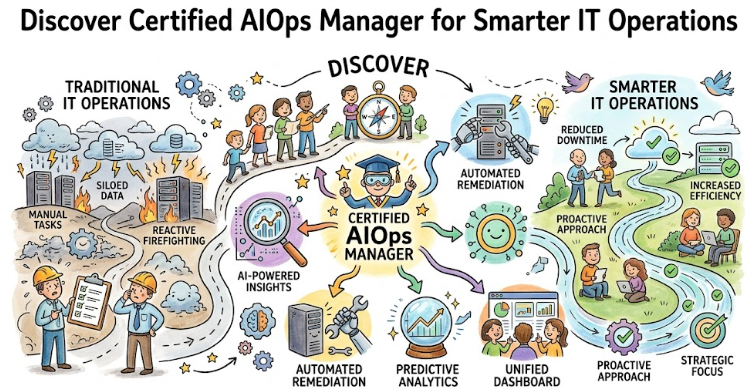
The Certified AIOps Manager is a specialized professional credential designed to bridge the gap between traditional IT operations and the burgeoning world of artificial intelligence and machine learning. This guide is crafted for engineering leaders, SREs, and platform engineers who recognize that manual intervention no longer scales in modern, complex cloud environments. As organizations transition from reactive monitoring to proactive, AI-driven observability, the role of an AIOps manager becomes pivotal in ensuring system reliability and operational efficiency. By exploring this comprehensive roadmap, professionals can make informed decisions about their career trajectory within the DevOps and platform engineering ecosystems. You can learn more about this specialization at Certified AIOps Manager, which is hosted by AIOpsSchool.
What is the Certified AIOps Manager?
The Certified AIOps Manager represents a shift from “human-in-the-loop” to “AI-augmented” operations. It is a curriculum and certification standard that focuses on the practical application of machine learning algorithms to ingest, analyze, and act upon massive volumes of telemetry data. Unlike theoretical AI courses, this program is rooted in production-focused learning, emphasizing how to reduce mean time to repair (MTTR) and eliminate alert fatigue. It aligns perfectly with modern enterprise practices where speed and stability must coexist, providing a framework for managing automated incident response and predictive maintenance.
Who Should Pursue Certified AIOps Manager?
This certification is highly beneficial for experienced DevOps engineers and Site Reliability Engineers (SREs) who want to move into strategic leadership roles. It is equally relevant for Cloud Architects and Platform Engineers in India and globally who are tasked with managing hyper-scale infrastructures that are too vast for manual oversight. Security and Data professionals will find value in the anomaly detection aspects, while Engineering Managers can use this knowledge to build more resilient teams. Even beginners with a strong foundation in Linux and scripting can use this as a north star to understand where the industry is heading.
Why Certified AIOps Manager is Valuable and Beyond
The demand for AIOps expertise is driven by the sheer complexity of microservices and distributed systems which have surpassed human cognitive limits. By earning this certification, professionals ensure their longevity in the job market, moving beyond basic automation into the realm of intelligent orchestration. It offers a significant return on time because it teaches principles of data-driven decision-making that remain relevant even as specific tools evolve. Enterprises are actively seeking leaders who can implement AI to reduce operational costs, making this a high-impact career investment.
Certified AIOps Manager Certification Overview
The program is delivered via the Certified AIOps Manager and is hosted on the AIOpsSchool website. It follows a structured approach to learning, moving from data collection basics to advanced algorithmic implementation and team management. The assessment is designed to be practical, testing a candidate’s ability to interpret operational data and design AIOps workflows rather than just memorizing definitions. This ownership-driven structure ensures that certified individuals can step into an organization and immediately contribute to the maturity of their operational stack.
Certified AIOps Manager Certification Tracks & Levels
The certification is structured into three primary levels: Foundation, Professional, and Advanced. The Foundation level introduces the concepts of big data in operations and basic machine learning models. The Professional level dives deep into integration with DevOps and SRE workflows, focusing on real-time event correlation. The Advanced level is geared toward aspiring managers and directors, focusing on ROI, strategy, and cross-departmental AI implementation. These levels allow for a natural career progression from a technical practitioner to a strategic leader.
Complete Certified AIOps Manager Certification Table
| Track | Level | Who it’s for | Prerequisites | Skills Covered | Recommended Order |
| Operations | Foundation | Aspiring AIOps Engineers | Basic Linux & Scripting | Data Ingestion, Pattern Recognition | 1 |
| Engineering | Professional | SREs and DevOps Pros | 2+ Years Ops Experience | Anomaly Detection, Auto-remediation | 2 |
| Leadership | Advanced | Engineering Managers | Professional Level Cert | Strategic Planning, AI Governance | 3 |
Detailed Guide for Each Certified AIOps Manager Certification
Certified AIOps Manager – Foundation
What it is
This certification validates a candidate’s understanding of the core pillars of AIOps, including data sources, observability, and the fundamental role of AI in IT operations.
Who should take it
It is ideal for junior sysadmins, support engineers, or recent graduates who want to enter the specialized field of intelligent operations.
Skills you’ll gain
- Understanding of noise reduction in monitoring.
- Basics of log aggregation and telemetry analysis.
- Identification of common AI use cases in IT.
Real-world projects you should be able to do
- Configure a basic data pipeline for system logs.
- Create dashboards that distinguish between signals and noise.
Preparation plan
- 7–14 days: Focus on core definitions, the history of AIOps, and understanding the differences between monitoring and observability.
- 30 days: Deep dive into data formats like JSON and Protobuf, and study common machine learning terminology.
- 60 days: Practice with open-source logging tools and complete all mock exams provided in the coursework.
Common mistakes
- Ignoring the importance of data quality before applying AI models.
- Focusing too much on coding and not enough on operational logic.
Best next certification after this
- Same-track option: Certified AIOps Manager Professional
- Cross-track option: SRE Foundation
- Leadership option: Team Lead – Operations
Certified AIOps Manager – Professional
What it is
This level confirms the ability to implement and manage AIOps tools within a CI/CD pipeline and production environment.
Who should take it
Senior DevOps Engineers and SREs who are responsible for maintaining high-availability systems and reducing incident response times.
Skills you’ll gain
- Implementation of predictive analytics for capacity planning.
- Automated incident grouping and correlation.
- Developing self-healing infrastructure scripts.
Real-world projects you should be able to do
- Build an automated alert correlation engine for a microservices cluster.
- Implement a predictive scaling policy based on historical traffic patterns.
Preparation plan
- 7–14 days: Review advanced statistics and probability as they relate to anomaly detection.
- 30 days: Hands-on lab work integrating AI tools with existing Prometheus or ELK stacks.
- 60 days: Case study analysis of enterprise-level AIOps failures and successes.
Common mistakes
- Over-automating without setting proper guardrails.
- Failing to align AIOps goals with business KPIs.
Best next certification after this
- Same-track option: Certified AIOps Manager Advanced
- Cross-track option: MLOps Engineer
- Leadership option: Technical Program Manager
Choose Your Learning Path
DevOps Path
The DevOps path focuses on integrating AI into the delivery pipeline. It starts with automating testing and moves toward using AI to predict deployment risks. Professionals here learn how to make the “Dev” and “Ops” feedback loop faster and more intelligent. It is about using data to prove that a release is safe.
DevSecOps Path
In this path, the focus is on “AI for Security Operations” or AISecOps. Professionals learn to use AIOps to detect zero-day threats and unusual user behavior patterns. It involves integrating security telemetry into the broader AIOps platform. This ensures that security is not a bottleneck but an automated enabler.
SRE Path
The SRE path is heavily focused on reliability and error budgets. Here, AIOps is used to predict when a service level objective (SLO) might be breached. It emphasizes automated root cause analysis to help SREs focus on engineering rather than firefighting. It is the most technical of the AIOps specializations.
AIOps Path
This is the core path for those wanting to become pure AIOps specialists. It focuses on the end-to-end lifecycle of operational data, from ingestion to automated action. You will study various algorithms specifically tuned for time-series data. It is ideal for those who want to build the “brain” of the infrastructure.
MLOps Path
MLOps focuses on the operationalization of machine learning models themselves. While AIOps uses AI to help IT, MLOps uses IT principles to help AI. This path covers model versioning, monitoring, and deployment. It is crucial for organizations that have AI products as their core offering.
DataOps Path
DataOps is about the orchestration of people, processes, and technology to deliver trusted data quickly. In an AIOps context, this path ensures the data feeding the AI models is clean and timely. It focuses on data pipelines and quality frameworks. Without DataOps, AIOps cannot function effectively.
FinOps Path
This path merges cloud financial management with intelligent automation. AIOps is used here to predict cloud spend and automatically identify wasted resources. It helps organizations move from static budgeting to dynamic, AI-driven cost optimization. It is becoming essential for large-scale cloud consumers.
Role → Recommended Certified AIOps Manager Certifications
| Role | Recommended Certifications |
| DevOps Engineer | Certified AIOps Manager Professional |
| SRE | Certified AIOps Manager Professional / Advanced |
| Platform Engineer | Certified AIOps Manager Foundation |
| Cloud Engineer | Certified AIOps Manager Foundation |
| Security Engineer | Certified AIOps Manager Professional (Security focus) |
| Data Engineer | Certified AIOps Manager Foundation (DataOps focus) |
| FinOps Practitioner | Certified AIOps Manager Professional (FinOps focus) |
| Engineering Manager | Certified AIOps Manager Advanced |
Next Certifications to Take After Certified AIOps Manager
Same Track Progression
Once you have mastered the manager level, you should look toward specialized architectural certifications. Deepening your knowledge in specific AI frameworks or large-scale data processing (like Spark or Flink) will complement your AIOps expertise. This ensures you can not only manage the system but also design its core components.
Cross-Track Expansion
Broadening your skills into MLOps or FinOps is a logical next step. Since AIOps gives you the foundation in operational AI, moving into MLOps allows you to support data science teams. Conversely, moving into FinOps allows you to apply your analytical skills to the company’s bottom line, making you a multi-dimensional asset.
Leadership & Management Track
For those aiming for the C-suite, transitioning into an ITIL Master or a CTO-focused leadership program is recommended. The Certified AIOps Manager credential provides the technical credibility needed to lead digital transformation projects. It serves as a bridge to roles like Director of Infrastructure or Head of Platform Engineering.
Training & Certification Support Providers for Certified AIOps Manager
DevOpsSchool
This provider offers extensive community support and a massive library of video content. They focus on the holistic view of DevOps, ensuring that AIOps is seen as an extension of existing agile methodologies. Their trainers are often industry veterans who provide real-world context to theoretical concepts.
Cotocus
Known for its high-intensity bootcamps and lab-based learning approach. They specialize in cloud-native technologies and provide a very hands-on environment for practicing AIOps tool integrations. Their focus is on getting engineers “production-ready” in the shortest possible time.
Scmgalaxy
A long-standing resource in the configuration management and DevOps space. They provide a wealth of blogs, tutorials, and community forums that help students troubleshoot real-world issues. It is a great place for continuous learning even after the certification is completed.
BestDevOps
Focuses on curated learning paths that remove the clutter from technical education. Their approach to AIOps training is streamlined, focusing only on the tools and techniques that are currently in high demand by top-tier tech companies.
devsecopsschool
The go-to provider for those looking to integrate security into their operational AI workflows. They provide specialized modules on how AI can be used for automated threat hunting and compliance monitoring. Their curriculum is highly specialized for the security-conscious engineer.
sreschool
Dedicated entirely to the discipline of Site Reliability Engineering. Their AIOps training is filtered through the lens of reliability, focus on SLOs, and incident management. This is the best choice for professionals who live and breathe system uptime.
aiopsschool
The primary authority for the Certified AIOps Manager program. They offer the most direct and comprehensive curriculum tailored specifically to this certification. Their resources include official study guides, practice exams, and access to a network of certified professionals.
dataopsschool
Provides the necessary foundation in data engineering that makes AIOps possible. Their courses focus on the pipeline aspect of operations, ensuring that the “Data” in “Data-driven ops” is handled with the same rigor as the code.
finopsschool
Specializes in the intersection of finance and technology. Their training helps AIOps professionals understand the financial impact of their technical decisions. This is crucial for anyone looking to use AI for cloud cost optimization.
Frequently Asked Questions
- How difficult is the Certified AIOps Manager exam?The exam is moderately difficult and requires a solid understanding of both IT operations and data science basics. It is not just about theory; you must understand how to apply concepts to real-world scenarios.
- How long does it take to get certified?Depending on your background, it typically takes between 30 to 60 days of consistent study. Those already working in SRE or DevOps roles may find they can complete it faster.
- What are the prerequisites for this certification?There are no strict formal prerequisites for the foundation level, but a basic understanding of Linux, cloud computing, and at least one scripting language like Python is highly recommended.
- What is the ROI of becoming a Certified AIOps Manager?Professionals often see a significant salary increase and access to more strategic roles. Organizations benefit from reduced operational costs and improved system reliability.
- Should I learn AI/ML before taking this course?You don’t need to be a data scientist, but understanding basic concepts like regression, clustering, and neural networks will help you grasp the “AI” part of AIOps much faster.
- In what order should I take the certifications?It is always best to follow the Foundation, Professional, then Advanced sequence. This ensures you build a strong conceptual base before tackling complex management and architectural tasks.
- Is this certification recognized globally?Yes, the concepts taught are based on industry-standard practices used by major cloud providers and global enterprises, making it valuable in any geographic market.
- Does this certification focus on specific tools?While it covers popular tools, the focus is on the underlying principles and workflows. This ensures your skills remain relevant even if your company changes its tool stack.
- How often do I need to renew the certification?Most professional certifications require renewal or continuing education every two to three years to ensure you are up to date with the latest technological shifts.
- Can a manager with no coding background take this?A manager can take the Foundation and Advanced tracks, but the Professional level requires some technical comfort to understand the implementation details effectively.
- Are there any lab requirements for the exam?The Professional level often includes practical assessments or lab-based questions where you must demonstrate your ability to configure or interpret AIOps workflows.
- How does this differ from a standard DevOps certification?Standard DevOps focuses on the “how” of delivery and integration. AIOps focuses on the “intelligence” of monitoring and managing that delivery at a massive scale using data science.
FAQs on Certified AIOps Manager
- What specific AI models are covered in the Certified AIOps Manager curriculum?The course typically covers time-series forecasting, K-means clustering for log grouping, and Random Forest or Decision Trees for root cause analysis.
- Does the certification cover both On-premise and Cloud environments?Yes, the principles of AIOps are environment-agnostic, though most practical examples focus on cloud-native architectures like Kubernetes.
- How does Certified AIOps Manager help with alert fatigue?It teaches specific techniques for event correlation and suppression, ensuring that only actionable incidents reach the human engineers.
- Is Python mandatory for the Certified AIOps Manager?While not strictly mandatory for every level, Python is the industry standard for AI and MLOps, and knowing it will greatly enhance your practical abilities.
- Will this certification help me move into a Director of Engineering role?Absolutely, as it demonstrates your ability to manage modern, complex systems and lead teams toward high-efficiency, automated operations.
- Does the program include training on AIOps vendors like Splunk or Dynatrace?The program focuses on the logic used by these vendors, allowing you to use any enterprise AIOps tool more effectively.
- How does AIOps integrate with the ITIL framework?The certification explains how AI can automate ITIL processes like Incident, Problem, and Change Management, making them faster and more accurate.
- Is there a community for Certified AIOps Managers?Yes, aiopsschool provides access to an exclusive community where professionals share insights, job opportunities, and technical solutions.
Final Thoughts: Is Certified AIOps Manager Worth It?
From a mentor’s perspective, the industry is moving toward a future where “NoOps” or highly automated operations is the goal. The Certified AIOps Manager is not just another badge; it is a signal that you understand the next evolution of infrastructure management. If you are tired of reactive firefighting and want to build systems that learn and adapt, this path is worth every hour of study. It positions you at the intersection of two of the most powerful forces in technology today: AI and Cloud Operations. For those willing to put in the work, the career rewards and the technical satisfaction are substantial.

