
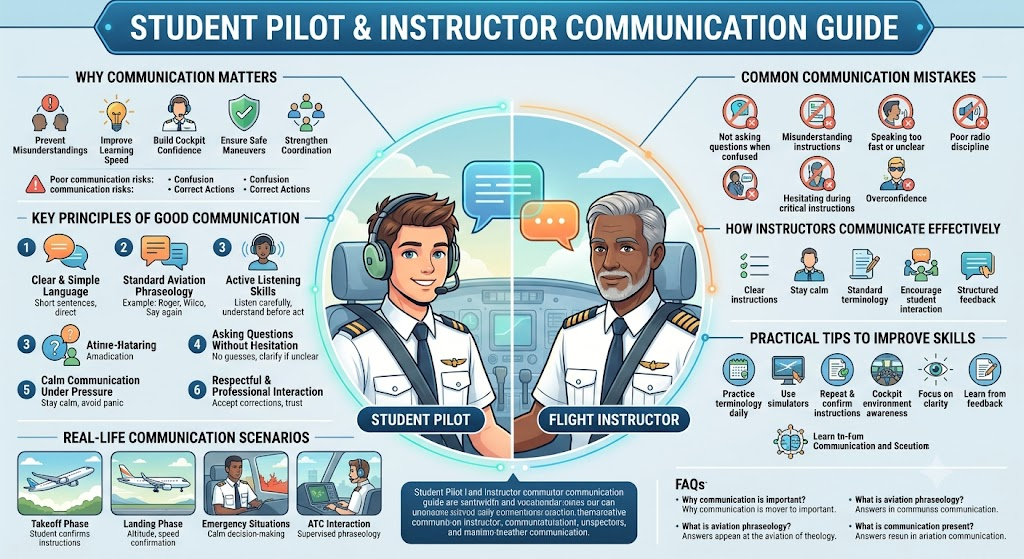
Introduction
Effective communication between a student pilot and a flight instructor is one of the most important foundations of safe and successful flight training. Aviation is a highly structured environment where every instruction, response, and confirmation plays a direct role in safety and learning outcomes.
Good communication helps student pilots develop confidence, discipline, and the ability to make correct decisions in real-time flight situations.
Why Communication Matters in Flight Training
Communication is not just about talking in the cockpit—it is about ensuring complete understanding between instructor and student.
Strong communication helps to:
- Prevent misunderstandings during flight operations
- Improve learning speed and skill development
- Build cockpit confidence and discipline
- Ensure safe execution of flight maneuvers
- Strengthen coordination with instructors and air traffic control
Poor communication can lead to confusion, incorrect actions, and unnecessary safety risks.
Key Principles of Good Pilot–Instructor Communication
Successful flight training depends on structured and disciplined communication habits.
1. Clear and Simple Language
Aviation communication must always be direct and easy to understand.
Students should:
- Use short and clear sentences
- Avoid unnecessary words
- Speak with confidence and clarity
Clear communication reduces errors during critical flight phases.
2. Standard Aviation Phraseology
Standard terminology ensures global consistency in aviation communication.
Common examples include:
- “Roger” for acknowledgment
- “Wilco” for will comply
- “Say again” for repetition
Using standard phraseology reduces confusion and improves safety.
3. Active Listening Skills
Listening carefully is as important as speaking clearly.
A student pilot should:
- Fully understand instructions before acting
- Avoid distractions inside the cockpit
- Ask for clarification when needed
Active listening prevents incorrect actions during flight.
4. Asking Questions Without Hesitation
Aviation learning requires curiosity and clarity.
Students must:
- Ask questions whenever instructions are unclear
- Confirm important commands before execution
- Avoid guessing or assuming instructions
No doubt should be left unresolved in the cockpit.
5. Calm Communication Under Pressure
Flight training often involves challenging situations.
Students should:
- Stay calm during complex maneuvers
- Speak slowly and clearly under pressure
- Avoid panic or rushed responses
Calm communication leads to better decision-making.
6. Respectful and Professional Interaction
Professional behavior strengthens instructor-student trust.
This includes:
- Respecting instructor feedback
- Accepting corrections positively
- Maintaining discipline in communication
A respectful environment improves learning efficiency.
Common Communication Mistakes Student Pilots Make
Beginners often face communication challenges during training.
Avoid these mistakes:
- Not asking questions when confused
- Misunderstanding instructor instructions
- Speaking too fast or unclearly
- Poor radio discipline during communication
- Hesitating during critical instructions
- Overconfidence in decision-making
These mistakes can impact both safety and learning progress.
How Instructors Should Communicate Effectively
Communication is a two-way process, and instructors play a key role.
Good instructors:
- Provide clear step-by-step instructions
- Stay calm during corrections
- Use standard aviation terminology
- Encourage student interaction
- Give structured feedback after flights
This helps students build confidence and skill.
Practical Tips to Improve Communication Skills
Student pilots can improve communication through consistent practice.
Helpful tips include:
- Practice aviation terminology daily
- Use simulators for communication training
- Repeat and confirm all instructions
- Stay aware of cockpit environment
- Focus on clarity instead of speed
- Learn from instructor feedback
Regular practice builds strong communication habits.
Real-Life Communication Scenarios in Training
Understanding real flight situations improves practical communication skills.
Takeoff Phase
Instructor gives instructions, and the student must confirm clearly before action. This ensures safe aircraft movement.
Landing Phase
Instructor guides altitude, speed, and approach path while the student confirms each step for accuracy.
Emergency Situations
Clear and calm communication becomes critical for safe decision-making and response.
Air Traffic Control Interaction
Students learn proper phraseology and structured responses under instructor supervision.
Conclusion
Effective communication between a student pilot and instructor is a core requirement in flight training. It directly influences safety, learning quality, and cockpit discipline. Clear language, active listening, standard aviation phraseology, and calm behavior are essential skills every pilot must develop.
Students who master communication become more confident, accurate, and safety-oriented pilots. Consistent practice, openness to learning, and strong coordination with instructors ensure long-term success in aviation training.
FAQs
1. Why is communication important in pilot training?
Communication ensures safety, prevents misunderstandings, and improves coordination between student and instructor during flight operations.
2. What is aviation phraseology?
It is a standardized set of words and expressions used in aviation to ensure clear and consistent communication worldwide.
3. How can student pilots improve communication skills?
By practicing terminology, listening carefully, using simulators, and confirming all instructions before acting.
4. What is the most common communication mistake students make?
Not asking questions when instructions are unclear or misunderstood.
5. Why is listening important in the cockpit?
Listening ensures instructions are fully understood before execution, reducing the risk of errors.
6. How should students respond to instructor instructions?
They should respond clearly, repeat critical instructions, and confirm understanding before action.
7. Why is calm communication important in aviation?
It helps prevent panic, supports better decision-making, and ensures safe flight operations.
8. Do instructors also need communication skills?
Yes, instructors must communicate clearly, calmly, and in a structured way to ensure effective learning.
9. Can poor communication affect flight safety?
Yes, poor communication can lead to misunderstandings, incorrect actions, and safety risks.
10. What is the best way to practice cockpit communication?
Simulator training, real-time instructor feedback, and consistent practice of aviation terminology.

