
Introduction
Stall recovery is one of the most important skills a new pilot learns during flight training. It teaches students how to recognize an approaching stall, prevent loss of control, and return the aircraft to normal flight safely.
An aircraft stall does not mean that the engine has stopped. A stall occurs when the wing exceeds its critical angle of attack and can no longer produce normal lift efficiently.
Low airspeed is often connected with stalls, but an aircraft can stall at different speeds, attitudes, and power settings. The actual cause is always excessive angle of attack.
Stall recovery training must be completed with a qualified flight instructor. The exact recovery technique should always follow the approved aircraft flight manual, operating handbook, training syllabus, and applicable aviation regulations.
What Is an Aircraft Stall?
An aircraft stall is an aerodynamic condition caused by airflow separation over the wing.
During normal flight, air flows smoothly around the wing and produces lift. As the pilot increases the angle of attack, lift generally increases until the wing reaches its critical angle.
When the critical angle of attack is exceeded:
- Smooth airflow begins to separate
- Lift decreases
- Drag increases
- Control effectiveness may reduce
- The aircraft may begin descending
- One wing may drop
- The nose may pitch downward
A stall can happen during climbing, turning, descending, landing, or other manoeuvres.
Why New Pilots Need Stall Recovery Training
Stall recovery training helps new learners understand how an aircraft behaves near its aerodynamic limit.
The training develops:
- Better aircraft control
- Stronger stall recognition
- Faster decision-making
- Improved pitch and power coordination
- Better rudder use
- Increased confidence
- Safer landing and go-around skills
- Greater awareness during low-speed flight
The main purpose is not to encourage pilots to fly close to a stall. The purpose is to help them recognize danger early and prevent an accidental stall.
Understanding Angle of Attack
Angle of attack is the angle between the wing’s chord line and the direction of the relative airflow.
When the pilot raises the aircraft’s nose, the angle of attack usually increases. However, nose attitude and angle of attack are not always the same.
An aircraft can stall:
- With the nose above the horizon
- With the nose near the horizon
- During a descending turn
- At a high airspeed
- Under increased load factor
This is why student pilots must understand that stall recovery begins by reducing the angle of attack rather than simply adding power.
Common Signs of an Approaching Stall
Aircraft often provide warning signs before a full stall occurs.
New learners should watch for:
- Stall warning horn or light
- Airframe vibration or buffet
- Reduced control effectiveness
- Soft or unresponsive controls
- Increasing back pressure
- Decreasing airspeed
- High nose attitude
- Difficulty maintaining altitude
- Increased sink rate
- Unstable yaw
- Poor roll response
Not every aircraft displays the same warning signs. Pilots must learn the behaviour of the specific aircraft they are flying.
The Basic Stall Recovery Principle
The most important action during stall recovery is to reduce the angle of attack.
A wing cannot return to normal lift production until its angle of attack is reduced below the critical value.
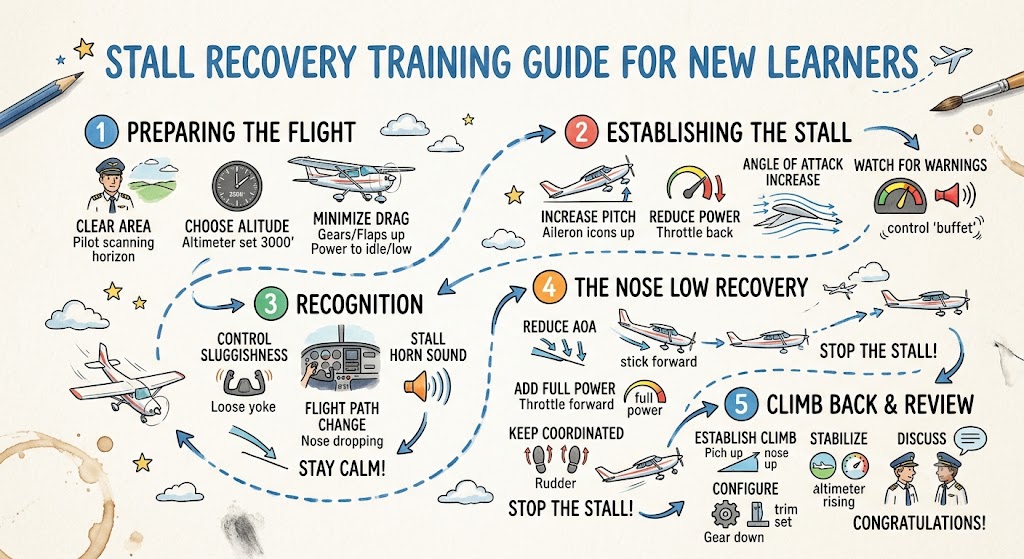
A general recovery sequence includes:
- Reduce the angle of attack.
- Apply appropriate power.
- Maintain coordinated flight.
- Level the wings safely.
- Allow the aircraft to regain airspeed.
- Adjust the configuration as recommended.
- Return smoothly to the desired flight path.
This is a general training sequence only. Aircraft-specific procedures may differ.
Step-by-Step Stall Recovery Training
Recognize the Stall
The first step is recognizing that the aircraft is approaching or entering a stall.
Possible indications include:
- Stall warning activation
- Buffet
- Nose-high attitude
- Poor control response
- Wing drop
- Unusual sink rate
- Difficulty maintaining altitude
Early recognition allows the pilot to respond before the stall becomes fully developed.
Reduce the Angle of Attack
Release excessive back pressure and lower the nose as required.
This may initially increase the descent, but reducing the angle of attack is necessary to restore smooth airflow over the wing.
A common beginner mistake is trying to prevent altitude loss by pulling back further. This increases the angle of attack and may keep the aircraft stalled.
The nose movement should be sufficient to recover the wing without being unnecessarily aggressive.
Apply Appropriate Power
Apply power according to the approved aircraft procedure.
Power helps:
- Reduce altitude loss
- Increase airflow
- Improve acceleration
- Support the return to normal flight
- Improve climb performance after recovery
Adding power alone does not recover a stalled wing if the critical angle of attack remains exceeded.
Pitch and power must work together.
Maintain Coordinated Flight
Use appropriate rudder pressure to control yaw.
Coordination is especially important because an uncoordinated stall may cause one wing to stall more deeply than the other.
This may result in:
- A sudden wing drop
- Rapid yaw
- Spin entry
- Greater altitude loss
New learners should avoid using large or abrupt control inputs.
Level the Wings Safely
If a wing drops, follow the approved recovery technique for the aircraft.
The pilot should maintain coordination and avoid aggressive aileron use while the wing remains stalled. Large aileron inputs can increase the angle of attack on one wing and worsen the roll.
Once the angle of attack has been reduced and control effectiveness returns, level the wings smoothly.
Allow Airspeed to Recover
Do not raise the nose immediately after the initial stall break.
Allow the aircraft to accelerate to a safe airspeed before returning to the desired attitude.
Trying to recover altitude too quickly can cause a secondary stall.
Manage the Aircraft Configuration
Flaps and landing gear should be handled according to the approved procedure.
Flaps should normally be retracted in stages when recommended. Sudden flap retraction at low airspeed may cause:
- Loss of lift
- Increased sink rate
- Altitude loss
- Another stall
Configuration changes should not distract the pilot from maintaining attitude, airspeed, and coordination.
Return to Normal Flight
After the aircraft has regained sufficient airspeed:
- Establish the correct pitch attitude
- Maintain a safe climb or level flight
- Confirm the aircraft is coordinated
- Check engine instruments
- Adjust the power
- Retract remaining flaps as recommended
- Re-trim the aircraft
- Confirm altitude and heading
Recovery is not complete until the aircraft is stable and under full control.
Power-Off Stall Recovery
A power-off stall is often used to simulate conditions that may occur during approach and landing.
During training, the aircraft may be configured with reduced power and landing flaps.
The student learns to recognize:
- Reducing airspeed
- Increasing angle of attack
- Stall warning
- Reduced control effectiveness
- Possible wing drop
- Increasing sink rate
A general recovery involves reducing the angle of attack, applying power, maintaining coordination, controlling the wings, and managing the flap configuration.
Power-On Stall Recovery
A power-on stall represents situations that may develop during takeoff, climb, or go-around.
These stalls may involve:
- High engine power
- Nose-high attitude
- Strong yawing tendencies
- Increased rudder requirement
- Greater workload
During recovery, the pilot must reduce the angle of attack while controlling yaw and maintaining coordination.
Power-on stalls can be challenging for beginners because the aircraft may react strongly when power is high.
Accelerated Stall Recovery
An accelerated stall occurs when the aircraft stalls under increased load factor.
This may happen during:
- Steep turns
- Abrupt pull-ups
- Sudden manoeuvres
- High-speed turns
- Excessive back pressure
An accelerated stall can occur at a higher airspeed than a normal straight-and-level stall.
Recovery still depends on reducing the angle of attack and controlling the aircraft smoothly.
Turning Stall Recovery
During a turn, the aircraft may stall if the pilot uses excessive back pressure, allows the speed to decrease, or increases the bank angle too much.
A turning stall may produce a stronger wing drop.
The pilot should:
- Reduce the angle of attack
- Maintain coordination
- Control yaw
- Apply power as recommended
- Level the wings safely
- Regain airspeed
Trying to level the wings aggressively before reducing the angle of attack can worsen the situation.
Secondary Stalls
A secondary stall occurs when the aircraft stalls again during recovery.
It usually happens when the pilot raises the nose too quickly before enough airspeed has been regained.
To avoid a secondary stall:
- Reduce the angle of attack properly
- Allow the aircraft to accelerate
- Avoid abrupt back pressure
- Recover altitude gradually
- Monitor airspeed and control feel
- Maintain coordination
A smooth recovery is safer than a rushed recovery.
Common Stall Recovery Mistakes
Adding Power Without Lowering the Nose
Power may reduce altitude loss, but it cannot correct an excessive angle of attack by itself.
The pilot must first reduce the angle of attack.
Pulling Back to Prevent Altitude Loss
Beginners may become uncomfortable when the aircraft begins descending.
Pulling back too early can keep the aircraft stalled or cause a secondary stall.
Using Too Much Aileron
Aggressive aileron input during a stall may increase the stall on one wing.
Rudder coordination and correct pitch control are essential.
Ignoring Rudder
Improper rudder use may cause yaw, wing drop, or spin entry.
Pilots must learn to keep the aircraft coordinated during both stall entry and recovery.
Recovering Too Abruptly
A sudden pull-up can create excessive load factor and cause another stall.
The return to normal flight should be smooth.
Retracting Flaps Too Quickly
Sudden flap retraction can reduce lift and increase altitude loss.
Follow the recommended flap-retraction sequence.
Looking Only at the Instruments
New learners sometimes focus entirely on the airspeed indicator.
Pilots should also observe:
- Aircraft attitude
- Horizon
- Control feel
- Warning signs
- Coordination
- Flight path
Delaying Recovery
Waiting too long can increase altitude loss and make recovery more difficult.
Pilots should respond as soon as stall warning signs are recognized.
Safety Checks Before Stall Training
Stall training requires careful preparation.
Before beginning, confirm:
- A qualified instructor is present
- The aircraft is suitable for the exercise
- Weather conditions are acceptable
- The training area is clear
- A safe altitude has been established
- Weight and balance are within limits
- Loose objects are secured
- Seat belts and harnesses are fastened
- Engine instruments are normal
- The recovery procedure has been reviewed
- A thorough lookout has been completed
The required training altitude depends on the aircraft, training organization, instructor guidance, and local regulations.
The Importance of a Proper Lookout
Stall training requires significant attention inside the cockpit. This can increase the risk of losing awareness of nearby traffic.
Before each exercise:
- Check above and below
- Scan both sides
- Look ahead
- Monitor radio traffic
- Confirm the training area is clear
- Consider nearby airspace activity
A lookout should continue throughout the exercise.
Stall Recovery Near the Ground
Accidental stalls near the ground are particularly dangerous because there may be limited height available for recovery.
High-risk situations include:
- Takeoff and initial climb
- Low-speed turns
- Base-to-final turn
- Unstable approach
- Landing flare
- Go-around
- Missed approach
The best defence is prevention.
Pilots should maintain safe airspeed, use coordinated controls, avoid excessive bank angles, and go around when an approach becomes unstable.
Base-to-Final Stall Risk
The base-to-final turn is a critical phase of flight.
A pilot who overshoots the runway centreline may use excessive inside rudder while applying opposite aileron. This creates a cross-controlled condition.
If the aircraft stalls, it may rapidly enter a spin.
Safe practices include:
- Plan the turn early
- Maintain the correct airspeed
- Use coordinated controls
- Avoid excessive bank
- Never force runway alignment
- Go around when necessary
A go-around is always safer than continuing an unstable approach.
Stall Recovery During a Go-Around
A go-around involves rapid changes in power, pitch, trim, and configuration.
A stall can occur if the pilot:
- Raises the nose too quickly
- Fails to control yaw
- Retracts flaps suddenly
- Allows airspeed to decrease
- Becomes distracted
During a go-around, the pilot should follow the approved procedure, establish the correct attitude, maintain coordination, and allow the aircraft to accelerate.
Weather Conditions That Affect Stall Training
Turbulence
Turbulence can cause rapid changes in angle of attack.
Stall training should not be conducted in conditions that make aircraft control unsafe or unpredictable.
Wind Shear
Wind shear can create sudden airspeed and flight-path changes, especially during takeoff and landing.
Icing and Contamination
Ice, frost, snow, or dirt on the wing can:
- Reduce lift
- Increase drag
- Increase stall speed
- Reduce stall warning
- Change stall behaviour
Aircraft surfaces must be clean before flight.
High Density Altitude
High temperature and high altitude can reduce aircraft performance.
The aircraft may:
- Accelerate slowly
- Climb poorly
- Require more time for recovery
- Lose more altitude
Pilots should consider performance conditions before training.
Practical Training Tips for New Learners
Learn the Warning Signs
Pay attention to the stall warning, buffet, control softness, aircraft attitude, and decreasing airspeed.
Use Smooth Controls
Avoid sudden pitch, power, rudder, or aileron movements.
Practise Verbal Callouts
During training, identify what is happening:
- Airspeed decreasing
- Stall warning active
- Controls becoming soft
- Wing beginning to drop
- Reducing angle of attack
- Applying power
- Airspeed recovering
Keep Looking Outside
Use the horizon to judge pitch and bank while checking instruments briefly.
Do Not Rush the Recovery
The goal is a controlled recovery, not the smallest possible altitude loss at any cost.
Review Every Exercise
After training, discuss:
- When the first warning appeared
- Whether the aircraft remained coordinated
- How the wing drop was managed
- How much altitude was lost
- Whether recovery was smooth
- Whether a secondary stall occurred
Stall Recovery Training Checklist
Before the Exercise
- Safe altitude established
- Training area clear
- Weather suitable
- Aircraft checks complete
- Lookout completed
- Recovery procedure reviewed
- Instructor instructions understood
During Stall Recognition
- Monitor aircraft attitude
- Watch airspeed
- Maintain coordination
- Identify warning signs
- Avoid abrupt controls
- Remain aware of altitude
During Recovery
- Reduce the angle of attack
- Apply appropriate power
- Control yaw with rudder
- Level the wings safely
- Regain airspeed
- Manage flaps correctly
- Avoid a secondary stall
- Return to stable flight
Frequently Asked Questions
What is the first step in stall recovery?
The first and most important step is reducing the angle of attack. The full recovery procedure must follow the aircraft’s approved instructions.
Does adding power automatically recover a stall?
No. Power helps recovery, but the wing will remain stalled if the critical angle of attack is not reduced.
Why does the nose need to be lowered?
Lowering the nose or releasing back pressure reduces the angle of attack and allows smooth airflow to return over the wing.
Can an aircraft stall at high airspeed?
Yes. Increased load factor or abrupt manoeuvring can cause a stall at a higher airspeed.
What causes a secondary stall?
A secondary stall usually happens when the pilot raises the nose too quickly before the aircraft has regained sufficient airspeed.
Why is rudder important during recovery?
Rudder controls yaw and helps keep the aircraft coordinated. Poor coordination can increase the risk of a wing drop or spin.
Should a pilot use ailerons when a wing drops?
The correct response depends on the aircraft and approved procedure. Aggressive aileron use while stalled may worsen the wing drop.
Why are flaps retracted gradually?
Retracting flaps too quickly can reduce lift and cause additional altitude loss.
How much altitude is lost during stall recovery?
Altitude loss depends on the aircraft, stall type, pilot technique, configuration, and flight conditions.
Can a new learner practise stall recovery alone?
Initial stall recovery training should be completed with a qualified flight instructor. Solo practice must follow instructor authorization, aircraft limitations, and local regulations.
Conclusion
Stall recovery training teaches new pilots how to recognize warning signs, reduce the angle of attack, apply power correctly, maintain coordination, and return the aircraft to stable flight. Smooth controls, early recognition, and proper instructor guidance are essential for safe and effective training.

