
Introduction
Landing is one of the most important skills in flight training. It is also one of the hardest skills for beginner pilots to master. A good landing needs timing, control, judgment, runway awareness, and calm decision-making.
Most student pilots make landing mistakes during training. This is normal. The goal is not to be perfect from the first lesson. The goal is to understand the mistakes, correct them safely, and build better habits with the help of a certified flight instructor.
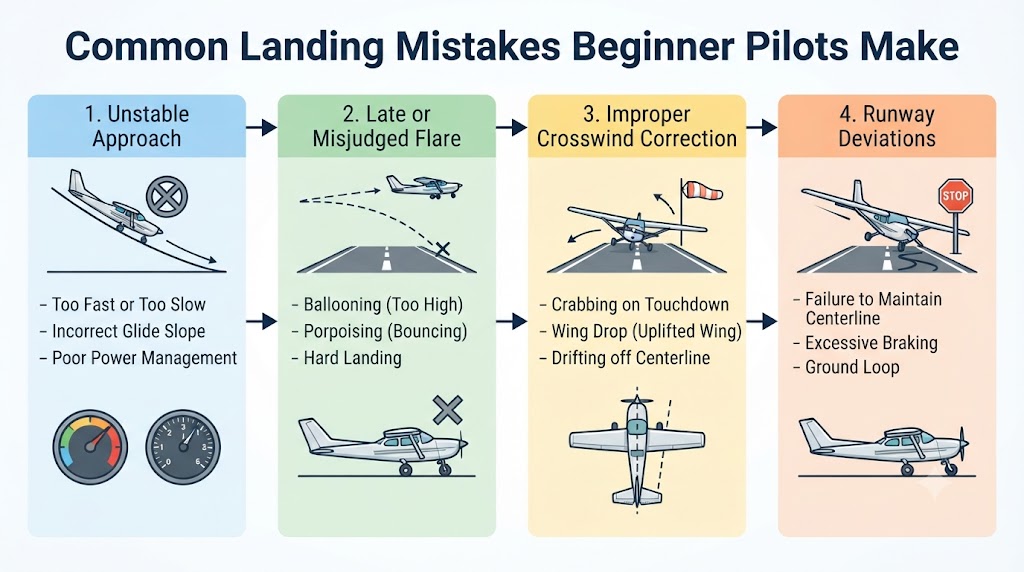
This blog explains the Common Landing Mistakes Beginner Pilots Make and why they happen during flight training.
Why Landing Mistakes Happen in Flight Training
Landing mistakes happen because the landing phase has a high workload. The pilot must manage speed, descent, alignment, wind correction, flare timing, and communication in a short time.
Beginner pilots are still learning how the aircraft feels near the runway. They may look at the wrong place, react too late, or make large control inputs.
Common reasons landing mistakes happen include:
- Poor airspeed control
- Wrong runway sight picture
- Wind correction problems
- Late decision-making
- Stress during final approach
- Over-controlling the aircraft
- Not understanding instructor feedback
With practice, these problems become easier to recognize and correct.
Mistake 1: Unstable Approach
An unstable approach is one of the most common reasons for poor landings. If the aircraft is too high, too low, too fast, too slow, or not aligned properly, the landing becomes difficult.
A stable approach gives the student pilot more time to think and control the aircraft. An unstable approach increases workload and can lead to rushed decisions.
Beginner pilots should learn that a poor approach should not be forced into a landing. A go-around is often the safer choice.
Mistake 2: Poor Airspeed Control
Airspeed control is a major part of landing practice. If the aircraft is too fast, it may float longer than expected. If it is too slow, control can become difficult and unsafe.
Many beginner pilots focus too much on the runway and forget to monitor airspeed properly. Others stare at the airspeed indicator and forget to look outside.
Good landing practice requires balance. The student must learn to check instruments while also using outside visual references.
Mistake 3: Poor Runway Alignment
Runway alignment means keeping the aircraft properly lined up with the runway centerline. Beginner pilots often drift left or right during final approach.
Poor alignment may happen because of wind, late correction, or weak rudder control. It can also happen when a student does not notice drift early enough.
Good alignment helps the aircraft touch down safely and continue straight after landing. This skill improves with instructor guidance and repeated practice.
Mistake 4: Looking Too Close to the Runway
Many beginner pilots look too close in front of the aircraft during landing. This makes it harder to judge height, flare timing, and runway position.
During landing practice, instructors often teach students where to look as the aircraft approaches the runway. The correct visual focus helps the student understand height and movement better.
Looking in the right area improves landing judgment and reduces overreaction.
Mistake 5: Flaring Too Early or Too Late
The flare is the transition before touchdown, where the aircraft slows and settles onto the runway. Beginner pilots often struggle with flare timing.
If the flare is too early, the aircraft may float or balloon. If the flare is too late, the landing may be firm or hard.
Flare timing takes practice because it depends on sight picture, speed, aircraft type, and instructor guidance. It is one of the skills that improves slowly with experience.
Mistake 6: Ballooning During Landing
Ballooning happens when the aircraft rises during the flare instead of settling smoothly. This can happen when the flare is too aggressive, the aircraft has too much speed, or control inputs are not smooth.
Ballooning can surprise beginner pilots. The important lesson is not to panic or force the aircraft down.
Students should follow instructor guidance and learn when a go-around is the safest decision.
Mistake 7: Hard Landing
A hard landing is another common beginner mistake. It may happen because of late flare, poor descent control, wrong airspeed, or trying to force the aircraft onto the runway.
Student pilots should understand that the goal is a controlled and safe landing, not just touching down quickly.
Hard landings should be reviewed with the instructor. The student should learn what caused the problem and how to avoid repeating it.
Mistake 8: Not Correcting for Crosswind
Crosswind landings can be difficult for beginner pilots. Wind from the side can push the aircraft away from the runway centerline.
If the student does not correct for wind, the aircraft may drift during final approach or touchdown. This can make the landing unsafe or uncomfortable.
Crosswind correction should always be learned with a certified flight instructor. It requires proper timing, control coordination, and good judgment.
Mistake 9: Delaying the Go-Around Decision
Some beginner pilots try to save a bad landing instead of going around. This is a serious habit to avoid.
A go-around is not a failure. It is a normal safety decision. If the approach is unstable, alignment is poor, or the landing does not feel right, going around may be the best choice.
Good pilots are not afraid to go around. They choose safety over pride.
Mistake 10: Not Learning From Instructor Feedback
Landing skills improve when students listen carefully after each attempt. Some students forget the feedback quickly or focus only on whether the landing was smooth.
A landing can feel smooth but still have mistakes. Another landing may feel firm but still teach a useful lesson.
Instructor feedback helps students understand:
- What went well
- What went wrong
- What caused the mistake
- What to focus on next time
Learning from feedback is one of the fastest ways to improve.
How Flight Instructors Help Correct Landing Mistakes
Flight instructors play a key role in landing training. They observe the aircraft, the runway position, the student’s control inputs, and the overall approach.
An instructor helps students improve:
- Airspeed awareness
- Runway alignment
- Descent control
- Flare timing
- Wind correction
- Go-around judgment
- Confidence under pressure
At first, the instructor may guide most of the landing. Over time, the student takes more responsibility as skill improves.
Tips to Reduce Landing Mistakes
Beginner pilots can reduce landing mistakes by building safe habits early.
Helpful tips include:
- Use the checklist every time
- Maintain a stable approach
- Do not rush the landing
- Keep good runway alignment
- Listen carefully to instructor feedback
- Stay calm during final approach
- Correct small mistakes early
- Do not force the aircraft onto the runway
- Go around when needed
- Practice consistently with an instructor
Landing improvement takes time. Small progress in each lesson is more important than one perfect landing.
Why Landing Mistakes Are Part of Learning
Every student pilot makes mistakes. Landing is a skill that depends on judgment, timing, and experience. These cannot be learned from reading alone.
The important thing is to practice safely. Each mistake should become a lesson. With instructor support, repeated practice, and honest review, beginner pilots become more confident and controlled.
FAQs About Common Landing Mistakes Beginner Pilots Make
Why do beginner pilots struggle with landings?
Beginner pilots struggle because landing requires speed control, alignment, descent judgment, flare timing, and wind correction at the same time.
What is the most common landing mistake?
One of the most common mistakes is an unstable approach. Poor airspeed control and incorrect flare timing are also very common.
Is a hard landing normal during training?
Yes, hard landings can happen during training. The important thing is to review the cause with an instructor and improve technique safely.
What causes ballooning during landing?
Ballooning may happen because of too much speed, early flare, or aggressive control input. It should be corrected only with instructor guidance.
Is going around a bad thing?
No. A go-around is a safe and professional decision when the approach or landing is not stable.
How can beginner pilots improve landings?
They can improve by practicing regularly, using checklists, maintaining stable approaches, listening to instructor feedback, and staying calm.
Can I correct landing mistakes by myself?
Landing mistakes should be corrected with a certified flight instructor. Self-correction without proper guidance can create unsafe habits.
Final Thoughts
The Common Landing Mistakes Beginner Pilots Make are part of normal flight training. Mistakes like unstable approach, poor airspeed control, runway misalignment, early flare, hard landing, and delayed go-around decisions are common among student pilots.
What matters most is how the student responds. Safe pilots learn from every landing, accept instructor feedback, and never force a bad approach.
Landing skill improves with patience, practice, and proper supervision. Always practice landings under the guidance of a certified flight instructor and follow your aircraft manual, airport procedures, and aviation authority rules.

