
Introduction
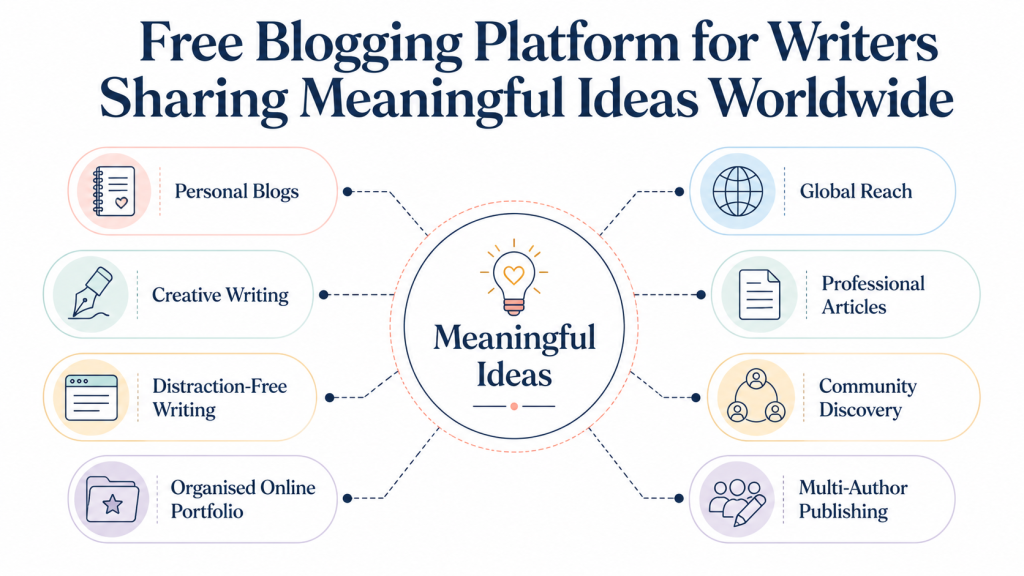
Every writer has ideas worth sharing, but finding the right place to publish them can be difficult. Social media posts disappear quickly, personal websites may require technical knowledge, and some publishing platforms can feel crowded or distracting. A free blogging platform for writers offers a simpler way to publish thoughtful content, organise ideas, and build a lasting online presence.
Writers across different countries, professions, and creative fields can use blogging to share personal experiences, educational knowledge, research, opinions, poetry, tutorials, and stories. A well-organised blog gives each idea enough space to be explained clearly instead of reducing it to a short update.
For beginners, the most useful platform is often one that removes technical barriers. It should allow writers to focus on their words, publish from different devices, and present their work in a clean format. This article explains the value of free blogging, the importance of meaningful publishing, and the practical steps writers can take to reach readers worldwide.
Meaningful Ideas Deserve a Permanent Online Space
A meaningful idea can educate someone, encourage discussion, preserve an experience, or help readers understand a difficult subject. However, the value of an idea can be lost when it is shared only through a temporary social media post.
A personal blog gives writers a permanent and organised space for their work. Articles remain grouped under the writer’s identity, making it easier for readers to explore older posts and understand the writer’s interests.
This organised approach is useful for many types of writers:
- Students sharing academic learning
- Professionals publishing industry knowledge
- Teachers creating educational articles
- Researchers explaining complex topics
- Storytellers publishing fiction and personal experiences
- Poets sharing creative work
- Freelancers building writing portfolios
- Independent thinkers expressing thoughtful opinions
Instead of allowing valuable ideas to disappear in fast-moving feeds, blogging creates a searchable and structured collection of published work.
Independent Publishing Gives Writers Greater Control
Independent publishing allows writers to decide what subjects they want to explore, how deeply they want to explain them, and how frequently they want to publish.
Traditional publications may have strict editorial requirements, limited space, or specific content preferences. These standards can be valuable, but they may not suit every writer or every type of article. A personal publishing platform gives writers more freedom to experiment with their voice and develop ideas at their own pace.
Greater control also helps writers maintain consistency. They can select their own categories, create a recognisable writing style, and publish content that reflects their personal or professional identity.
This does not mean writers should publish without responsibility. Independent publishing still requires accuracy, proofreading, respectful language, and clear explanations. Freedom becomes more valuable when it is supported by thoughtful editorial habits.
Global Blogging Connects Writers and Readers
The internet allows a writer in one location to reach readers in many different parts of the world. A global blogging platform can support the exchange of ideas between people with different backgrounds, professions, cultures, and experiences.
Writers do not always need an international marketing strategy to create global value. They can begin by writing clearly about subjects they understand. A practical tutorial, personal story, professional lesson, or educational explanation may be useful to readers far beyond the writer’s local community.
Global publishing also encourages writers to consider a wider audience. This can improve the quality of their work because they begin explaining local terms, adding context, avoiding unnecessary assumptions, and making articles easier to understand.
Simple language is especially helpful when writing for international readers. Clear sentences and organised paragraphs make content more accessible to people with different levels of English proficiency.
A Free Blogging Platform Removes Common Starting Barriers
Many aspiring writers delay publishing because they believe they need money, technical skills, web-development knowledge, or professional equipment. A free blogging platform can remove several of these barriers.
Writers can begin with the tools and knowledge they already have. They do not need to become website developers before sharing their first article. They can focus on selecting a topic, writing useful content, proofreading carefully, and publishing consistently.
Free access is particularly helpful for:
- Students exploring online writing
- Beginners testing different subjects
- Independent writers without a publishing budget
- Professionals starting a personal knowledge blog
- Creative writers building an online collection
- Community groups developing shared publications
A free platform also gives writers time to understand their publishing goals. They can learn which topics interest readers, which article formats suit their style, and whether they prefer personal blogging or collaborative publishing.
Clear Writing Creates Stronger Reader Connections
Publishing worldwide does not require complicated language. Readers usually respond better to writing that is clear, honest, organised, and relevant.
A meaningful article should have a clear purpose. Before writing, the author should understand the main point they want the reader to remember. This central idea helps guide the title, introduction, examples, and conclusion.
Strong articles often include:
- A focused topic
- A useful opening
- Short and readable paragraphs
- Descriptive headings
- Practical examples
- Accurate information
- A clear conclusion
Writers should avoid adding unnecessary words merely to make an article appear longer. Depth comes from useful explanation, not repetition.
A personal voice can also make content more engaging. Writers do not need to sound formal in every article. They can write naturally while still maintaining accuracy and professionalism.
Long-Form Content Supports Deeper Understanding
Short posts are useful for announcements and quick updates, but some ideas require more space. Long-form writing allows authors to explain context, provide examples, compare viewpoints, and guide readers through a subject carefully.
A long-form writing platform can support articles such as:
- Detailed tutorials
- Personal essays
- Research summaries
- Professional guides
- Educational lessons
- Travel experiences
- Book discussions
- Creative stories
- Opinion pieces
- Reflective writing
Long-form publishing does not mean every article must contain thousands of words. The appropriate length depends on the subject. A simple personal reflection may be short, while a detailed educational guide may require several sections.
The main goal is completeness. Writers should give the topic enough space without overwhelming readers with unnecessary information.
Personal Blogs Help Build a Digital Identity
A digital identity is the way a writer’s knowledge, interests, values, and communication style appear online. A personal blog can become an important part of that identity.
When readers see several organised articles from the same writer, they can understand the subjects the writer cares about and the quality of their thinking. Over time, this collection can become a writing portfolio.
A personal blog may support different goals:
- Demonstrating subject knowledge
- Developing professional credibility
- Recording personal growth
- Building a creative portfolio
- Sharing educational resources
- Connecting with people who have similar interests
Writers should not expect immediate recognition. A strong digital identity develops gradually through consistent, honest, and useful publishing.
The quality of the archive matters more than the number of articles. A smaller collection of thoughtful posts can create a stronger impression than a large collection of rushed or repetitive content.
Calm Publishing Environments Improve Focus
Writing requires attention. Platforms filled with excessive visual elements, notifications, or complicated controls can make the publishing process feel stressful.
A distraction-free blogging platform keeps the main focus on writing and reading. Clean layouts help authors review their content, while comfortable page designs help readers stay engaged with the article.
BlogAion is designed for writers who prefer a calm and beginner-friendly publishing environment. Writers can create individual blogs, claim personal BlogAion subdomains, and begin publishing without coding knowledge.
The platform supports articles, stories, tutorials, poetry, research, opinions, and other forms of personal or professional writing. Its clean presentation, responsive pages, and light and dark reading modes are intended to create a comfortable experience across computers, tablets, and mobile devices.
These features can be helpful for writers who want a simple online home for their work without managing technical website tasks.
Community Discovery Helps Independent Voices Gain Visibility
Publishing an article is only one part of the writing journey. Writers also want their ideas to be discoverable by people who may find them useful.
A community blogging platform can create opportunities for readers to explore new subjects and independent voices. Instead of following only well-known publishers, readers can discover students, educators, professionals, storytellers, researchers, and creative writers.
BlogAion includes a shared discovery environment where published content can become part of a broader writing community. This can help readers explore fresh stories and ideas from different subjects and locations.
Discovery should not be treated as a guarantee of large audiences. Writers still need to create clear titles, publish valuable content, and develop realistic expectations. Community visibility works best when it supports genuine writing rather than encouraging people to chase attention.
Collaborative Blogs Support Shared Knowledge
Some publishing projects are stronger when several people contribute. A multi-author blogging platform can support teams that want to share knowledge under one organised publication.
Collaborative blogs may be useful for:
- Educational institutions
- Research groups
- Professional communities
- Non-profit organisations
- Interest-based magazines
- Creative writing collectives
- Industry knowledge platforms
- Community storytelling projects
BlogAion supports multiple contributors, allowing blog owners to develop collaborative publications without limiting the blog to a single author.
Before inviting contributors, the blog owner should create simple editorial guidelines. These guidelines may cover article topics, writing style, proofreading expectations, publishing frequency, and the process for reviewing submissions.
Clear responsibilities reduce confusion and help the publication maintain a consistent identity.
Practical Steps for Starting a Meaningful Blog
Beginning a blog becomes easier when the writer follows a simple plan.
Select a Focused Subject
Choose a subject that matches your knowledge, experience, or curiosity. A clear focus helps readers understand what they can expect from the blog.
The topic does not need to be extremely narrow, but it should have a recognisable direction. For example, a blog about professional learning may include career lessons, workplace communication, and industry knowledge.
Choose a Memorable Blog Identity
Select a blog name and subdomain that are simple, readable, and connected to the subject. Avoid confusing spellings or names that limit future growth unnecessarily.
A personal name can work well for a portfolio, while a subject-based name may suit an educational or collaborative publication.
Plan a Small Set of Categories
Too many categories can make a new blog feel disorganised. Start with three to five clear areas. Additional categories can be added later when the blog has enough content.
Each category should represent a meaningful group of related articles.
Prepare Initial Article Ideas
Create a list of ten realistic topics before publishing the first article. This reduces uncertainty and helps maintain momentum.
Useful topic formats include:
- Beginner guides
- Personal lessons
- Common mistakes
- Practical checklists
- Detailed explanations
- Case-based discussions
- Creative stories
- Opinion articles supported by reasoning
Create a Sustainable Publishing Routine
Writers do not need to publish every day. A realistic schedule is more valuable than an ambitious plan that becomes difficult to maintain.
One carefully written article each week or every two weeks can create steady progress. Consistency should support quality rather than reduce it.
Review Every Article Before Publishing
Proofreading protects the writer’s credibility. Check spelling, grammar, paragraph length, headings, facts, and overall clarity.
Reading the article aloud can help identify awkward sentences and repeated words.
Common Publishing Mistakes That Reduce Article Value
New writers often make mistakes because they are focused on publishing quickly. Recognising these problems early can improve the quality of the blog.
Writing Without a Clear Purpose
An article may feel confusing when it covers several unrelated ideas. Define one main message before writing and remove sections that do not support it.
Copying Popular Writers
Learning from strong writers is useful, but copying their language or structure prevents the development of an original voice. Writers should study techniques while expressing ideas in their own words.
Ignoring Readability
Large blocks of text can discourage readers. Short paragraphs, useful headings, and clear transitions make articles easier to follow.
Expecting Immediate Traffic
New blogs usually require patience. Writers should focus on building a useful archive rather than measuring success only through early attention.
Publishing Unsupported Claims
Professional and educational content should be accurate. Writers should avoid presenting assumptions as facts and should update articles when reliable information changes.
Depending Entirely on Social Media
Social media can help share an article, but it should not replace an organised publishing home. A blog keeps complete articles together and gives readers a clearer view of the writer’s work.
Building a Long-Term Writing Practice
A meaningful blog is created gradually. Writers improve through publishing, reviewing reader responses, studying their own work, and continuing to learn.
Keeping a simple content calendar can make the process easier. Writers can record topic ideas, draft status, publication dates, and articles that may need future updates.
It is also useful to review older work. An early article may contain outdated details, unclear explanations, or formatting problems. Updating it can improve the overall quality of the blog.
Writers should also protect their motivation. Comparing a new blog with established publications can create unnecessary pressure. Progress is better measured through clearer writing, stronger research, improved consistency, and a growing collection of useful articles.
A blog becomes meaningful when it reflects genuine thought and provides lasting value to readers.
Frequently Asked Questions
Is a free blogging platform suitable for professional writers?
Yes. A free blogging platform can help professionals publish industry insights, educational articles, personal experiences, and portfolio content. The value depends on the quality and organisation of the writing. Professionals should select a clean platform, maintain accurate information, proofread carefully, and publish content that reflects their knowledge responsibly.
Can beginners create a blog without coding knowledge?
Yes. Beginner-friendly platforms allow writers to create and publish blogs without developing websites or managing code. This enables beginners to focus on selecting topics, writing articles, organising categories, and improving their publishing habits. BlogAion supports blog creation and publishing without requiring coding knowledge.
Can writers reach international readers through blogging?
Blogging makes content accessible to readers in different countries, although international reach is never guaranteed. Clear language, useful topics, descriptive titles, and well-structured articles can make content easier for global readers to understand and discover. Writers should explain local references when addressing a wider audience.
Is long-form writing better than short content?
Neither format is always better. Short content works well for quick updates, while long-form writing is useful for detailed explanations, tutorials, research, storytelling, and thoughtful opinions. Writers should choose the length that allows them to cover the subject completely without adding unnecessary information.
Can several writers contribute to the same blog?
Yes, when the selected platform supports multiple contributors. Collaborative blogs are useful for educational groups, professional communities, publications, creative teams, and research organisations. BlogAion supports multi-contributor blogs, allowing blog owners to build shared publications with clear editorial responsibilities.
Does publishing regularly guarantee a large audience?
No. Consistent publishing can improve a writer’s skills and build a stronger content archive, but it does not guarantee traffic or audience growth. Writers should focus on usefulness, originality, accurate information, readable formatting, and realistic long-term progress instead of expecting immediate results.
Conclusion
A free blogging platform for writers can provide the space needed to share meaningful ideas without facing technical or financial barriers. It allows beginners, professionals, students, educators, storytellers, and independent thinkers to organise their work and build a lasting digital identity.
Successful blogging depends on more than publishing frequently. Writers need clear topics, useful explanations, thoughtful editing, realistic expectations, and a sustainable routine. A clean and organised blog can preserve valuable ideas while helping readers explore the writer’s knowledge and creative voice.
BlogAion offers a calm publishing option for writers who want to create personal or collaborative blogs, claim a subdomain, and publish without coding. Its community discovery environment also gives readers a place to explore independent voices.

