
Introduction
Emergency procedure training helps beginner pilots remain calm, organised, and focused when something unexpected happens during flight. Most flying lessons are completed safely, but pilots must still prepare for equipment failures, weather problems, medical situations, communication difficulties, and other abnormal events.
Aviation emergencies are managed through preparation rather than panic. A trained pilot identifies the problem, keeps control of the aircraft, selects the safest available action, and follows the approved checklist.
The exact procedure depends on the aircraft type, operating conditions, and nature of the emergency. Beginner pilots must follow the aircraft flight manual, pilot operating handbook, approved checklist, instructor guidance, and applicable aviation regulations.
This guide explains general emergency-management principles. It does not replace aircraft-specific training or an official emergency checklist.
Why Emergency Procedure Training Is Important
Emergency training develops the judgement and control skills needed to manage abnormal situations safely.
It helps beginner pilots:
- Maintain aircraft control under pressure
- Recognise developing problems early
- Remember important cockpit priorities
- Use emergency checklists correctly
- Make safer landing decisions
- Communicate clearly with air traffic services
- Manage passengers and cockpit workload
- Avoid rushed or emotional decisions
- Prepare for forced and precautionary landings
Emergency preparation also increases confidence. Pilots who regularly review and practise emergency scenarios are less likely to freeze when faced with an unexpected event.
The Basic Emergency Priorities
A commonly taught order of priorities is:
- Aviate
- Navigate
- Communicate
These priorities help pilots avoid becoming distracted by secondary tasks.
Aviate
The first priority is to fly the aircraft.
The pilot should maintain:
- A safe attitude
- Appropriate airspeed
- Aircraft control
- Coordination
- A manageable flight path
Even during a serious emergency, losing control of the aircraft usually makes the situation worse.
Navigate
After stabilising the aircraft, decide where it should go.
This may involve:
- Turning toward a suitable airport
- Selecting a safe landing area
- Avoiding terrain and obstacles
- Remaining clear of dangerous weather
- Positioning for a forced landing
- Following an emergency route
Communicate
Once the aircraft is controlled and a plan is developing, communicate the situation.
Communication may include:
- Declaring an emergency
- Providing aircraft position
- Explaining the problem
- Reporting fuel remaining
- Stating pilot intentions
- Requesting assistance
- Setting the appropriate transponder code when available
Communication is important, but it must not replace flying the aircraft.
Immediate Actions and Checklists
Some emergencies require actions that must be completed without delay. These are often called memory items or immediate actions.
After the aircraft is stabilised, the pilot should use the approved checklist to confirm the procedure.
The correct approach is generally:
- Complete essential immediate actions
- Maintain aircraft control
- Open the approved emergency checklist
- Confirm each step carefully
- Avoid inventing unapproved procedures
Beginner pilots should not rely only on memory for long emergency sequences.
Staying Calm During an Emergency
Stress can reduce a pilot’s ability to think clearly.
A calm pilot is better able to:
- Recognise the actual problem
- Avoid unnecessary control inputs
- Follow the checklist
- Consider available options
- Communicate clearly
- Manage time effectively
Useful habits include:
- Take one controlled breath
- Maintain aircraft attitude
- State the problem clearly
- Follow the correct priority order
- Complete one task at a time
- Avoid rushing through the checklist
Preflight Emergency Preparation
Emergency management begins before takeoff.
Before every flight, a pilot should consider:
- Suitable departure emergency areas
- Weather along the route
- Nearby airports
- Fuel reserves
- Aircraft serviceability
- Terrain and obstacles
- Passenger briefing
- Emergency equipment
- Communication frequencies
- Alternate landing options
The pilot should also confirm the location of:
- Emergency checklist
- Fire extinguisher
- First-aid kit
- Emergency locator equipment
- Fuel shutoff controls
- Electrical switches
- Door and window controls
- Seat belts and harnesses
Passenger Safety Briefing
Passengers should receive a clear safety briefing before flight.
The briefing may include:
- Seat-belt operation
- Door operation
- Emergency exits
- Smoking restrictions
- Safe movement inside the aircraft
- Location of emergency equipment
- Actions during an emergency landing
- When to remain silent
- When to leave the aircraft
A good briefing reduces confusion if an abnormal situation occurs.
Engine Failure After Takeoff
An engine failure shortly after takeoff is one of the most time-critical emergencies because the aircraft is low and slow.
The pilot’s immediate priorities generally include:
- Lowering the nose to maintain safe airspeed
- Maintaining aircraft control
- Selecting a suitable landing area ahead
- Avoiding an unsafe turn back
- Following the approved immediate actions
- Preparing for landing
The exact procedure depends on aircraft height, runway length, wind, terrain, and aircraft performance.
Avoiding the Impossible Turn
A pilot may feel tempted to turn back toward the runway after an engine failure.
This can be dangerous because:
- Airspeed may decrease rapidly
- Bank angle increases stall speed
- The aircraft may be uncoordinated
- Altitude may be insufficient
- The turn may require more distance than expected
- A stall or spin can develop close to the ground
Unless the pilot has sufficient altitude, training, performance information, and an approved plan, landing generally ahead or within a limited forward area may be safer.
Engine Failure During Cruise
An engine failure at altitude usually provides more time for decision-making.
General priorities include:
- Establishing the recommended glide speed
- Selecting a suitable landing area
- Attempting an approved restart when appropriate
- Declaring the emergency
- Planning the forced landing
- Securing the aircraft when necessary
- Briefing passengers
- Completing the checklist
The pilot should avoid spending so much time attempting a restart that the landing opportunity is lost.
Best Glide Speed
Best glide speed provides an efficient balance between distance and altitude loss.
The correct value depends on:
- Aircraft type
- Weight
- Configuration
- Wind
- Manufacturer guidance
Pilots must know where to find the approved glide speed and should practise establishing it promptly.
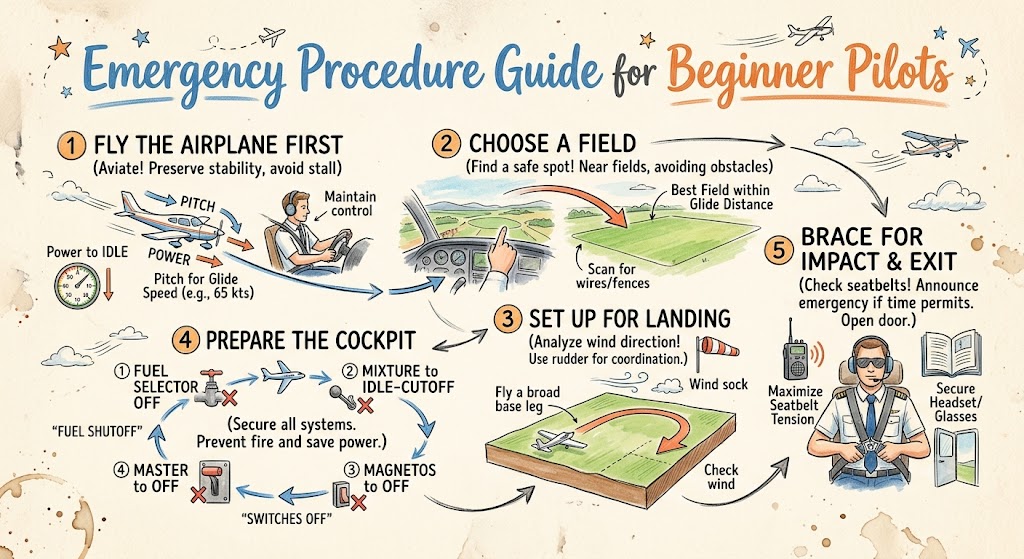
Forced Landing Procedure
A forced landing is an emergency landing made when continued flight is no longer possible.
The main goals are:
- Maintain aircraft control
- Select the best available landing area
- Plan the approach
- Complete emergency checks
- Communicate the situation
- Prepare occupants
- Touch down under control
Selecting a Forced-Landing Area
A suitable landing area should be assessed for:
- Length
- Surface condition
- Wind direction
- Slope
- Obstacles
- Power lines
- Buildings
- People
- Livestock
- Access for emergency services
Possible locations may include:
- Airports
- Open fields
- Dry lake beds
- Roads when safely usable
- Clear flat terrain
- Beaches under suitable conditions
The safest area is not always the closest area.
Planning the Approach
After choosing a landing area, the pilot should establish a clear approach plan.
Consider:
- Wind direction
- Available altitude
- Aircraft glide performance
- Terrain
- Final approach direction
- Overshoot possibilities
- Obstacle clearance
The pilot should avoid changing the selected area repeatedly unless the original option becomes clearly unsuitable.
Precautionary Landing
A precautionary landing is made when continued flight may become unsafe, even though the aircraft is still operating.
Reasons may include:
- Deteriorating weather
- Low fuel
- Failing daylight
- Navigation uncertainty
- Passenger illness
- Mechanical concerns
- Pilot fatigue
A precautionary landing is often safer than waiting for the situation to become a full emergency.
Engine Fire During Start
An engine fire during start requires immediate action.
General principles may include:
- Continue cranking when recommended
- Shut off fuel as specified
- Turn off electrical systems as required
- Evacuate when necessary
- Use a fire extinguisher if safe
- Move occupants away from the aircraft
- Contact emergency services
The correct procedure must come from the aircraft checklist.
Engine Fire in Flight
An engine fire in flight is a serious emergency.
General priorities include:
- Maintain aircraft control
- Shut off fuel as specified
- Switch off affected systems
- Increase airflow or adjust speed as approved
- Declare an emergency
- Land as soon as possible
- Prepare for evacuation
Pilots should not continue flying toward a distant preferred airport when a safer immediate landing option is available.
Cabin Fire or Smoke
Smoke in the cockpit can reduce visibility, affect breathing, and damage equipment.
General actions may include:
- Identify the likely source
- Use the appropriate extinguisher
- Switch off affected electrical equipment
- Ventilate the cabin when approved
- Use available protective equipment
- Declare an emergency
- Land as soon as practical or possible
Electrical smoke can indicate overheating or a developing fire.
Electrical System Failure
An electrical failure may affect:
- Radios
- Navigation equipment
- Lighting
- Flaps
- Fuel systems
- Instruments
- Transponder
- Communication
Possible indications include:
- Low-voltage warning
- Ammeter abnormality
- Battery discharge
- Equipment failure
- Burning smell
- Flickering lights
The pilot should follow the approved electrical-failure checklist and reduce unnecessary electrical load when instructed.
Alternator or Generator Failure
An alternator or generator failure may leave the aircraft operating on battery power.
Important considerations include:
- Remaining battery capacity
- Essential equipment
- Weather conditions
- Daylight
- Distance to landing
- Communication needs
The pilot should conserve electrical energy and land before battery power becomes exhausted.
Radio Communication Failure
A radio failure can occur because of:
- Incorrect frequency
- Volume setting
- Headset problem
- Microphone issue
- Circuit breaker problem
- Electrical failure
- Equipment malfunction
Before assuming total radio failure, check:
- Correct frequency
- Volume and squelch
- Headset connections
- Microphone selection
- Audio panel
- Circuit breakers according to procedure
- Alternative radio
The pilot should follow local communication-failure procedures and continue maintaining visual traffic awareness.
Transponder Use During Emergencies
Emergency transponder codes may be available for:
- General emergency
- Radio communication failure
- Unlawful interference
Pilots must learn the applicable codes and procedures during formal flight training.
The transponder should only be set when workload permits and when it does not interfere with aircraft control.
Fuel Exhaustion and Fuel Starvation
Fuel exhaustion means the aircraft has no usable fuel remaining.
Fuel starvation means fuel is available but is not reaching the engine.
Possible causes include:
- Incorrect fuel planning
- Wrong fuel-tank selection
- Fuel-pump failure
- Blocked fuel line
- Improper mixture setting
- Fuel-cap problems
- Fuel contamination
- Failure to monitor consumption
Fuel-related emergencies are often preventable through careful planning and regular fuel checks.
Preventing Fuel Emergencies
Pilots should:
- Calculate fuel requirements
- Include legal and practical reserves
- Visually confirm fuel quantity
- Check for contamination
- Monitor fuel use
- Change tanks according to procedure
- Compare actual consumption with planned consumption
- Divert early when fuel becomes uncertain
Never continue a flight based only on hope that the fuel will be sufficient.
Carburettor Icing
In aircraft with carburettor engines, carburettor ice may cause:
- Gradual power loss
- Rough engine operation
- Reduced revolutions per minute
- Manifold-pressure changes
Carburettor icing can occur even when outside temperatures are not extremely cold.
Pilots must understand the aircraft-specific use of carburettor heat and the expected engine response.
Partial Engine Power Loss
A partial power loss may be more confusing than a complete failure.
Possible causes include:
- Fuel-system problems
- Carburettor icing
- Ignition problems
- Incorrect mixture
- Mechanical failure
- Air-intake blockage
The pilot should maintain control, assess whether altitude can be maintained, follow the approved checklist, and prepare for landing if power cannot be restored reliably.
Propeller Problems
Abnormal propeller indications may include:
- Unusual vibration
- Overspeed
- Reduced thrust
- Unusual noise
- Rapid engine-speed changes
A propeller problem can create severe vibration and structural risk.
The pilot should follow the approved procedure and avoid unnecessary delay in landing.
Flight-Control Problems
A control problem may involve:
- Jammed control
- Restricted movement
- Trim malfunction
- Flap asymmetry
- Cable or linkage failure
- Autopilot malfunction
Pilots should:
- Avoid forcing controls
- Disconnect affected automation
- Use available controls carefully
- Maintain a safe airspeed
- Avoid unnecessary configuration changes
- Land as soon as conditions permit
The exact response depends heavily on aircraft design.
Flap Malfunction
A flap malfunction can change:
- Approach speed
- Landing distance
- Pitch forces
- Descent angle
- Go-around performance
If flaps fail to extend or become asymmetric, the pilot should follow the approved procedure and use the recommended landing configuration and speed.
Landing-Gear Malfunction
In retractable-gear aircraft, a gear malfunction may require:
- Checking indicators
- Recycling the gear when approved
- Using an emergency-extension system
- Confirming gear position visually
- Preparing for an abnormal landing
- Requesting assistance from the ground
The pilot should avoid repeated actions that could worsen the problem.
Door Opening During Flight
A cabin door opening in flight can be alarming but may not immediately make the aircraft uncontrollable.
The pilot should:
- Maintain aircraft control
- Reduce airspeed if recommended
- Avoid becoming distracted
- Follow the approved checklist
- Land when practical
Trying to close a door should never take priority over flying the aircraft.
Bird Strike
A bird strike may damage:
- Windscreen
- Propeller
- Engine
- Wing
- Lights
- Air intakes
After a bird strike:
- Maintain control
- Assess the damage
- Check engine instruments
- Avoid unnecessary manoeuvres
- Declare an emergency when needed
- Land as soon as practical
A damaged windscreen may reduce visibility and increase cockpit noise.
Pitot-Static System Failure
Pitot-static problems can affect:
- Airspeed indicator
- Altimeter
- Vertical-speed indicator
Possible causes include:
- Blockage
- Ice
- Water
- Equipment failure
Pilots must compare available instruments and follow the approved procedure. Maintaining a known pitch attitude and power setting may help stabilise flight.
Instrument Failure
A failed flight instrument can give misleading information.
Pilots should:
- Cross-check other instruments
- Use outside visual references when available
- Avoid trusting a single indication
- Maintain known pitch and power settings
- Exit poor weather when possible
- Seek assistance
Instrument cross-check training helps pilots recognise unreliable indications.
Vacuum-System Failure
Some aircraft use vacuum systems to power gyroscopic instruments.
A vacuum-system failure may affect:
- Attitude indicator
- Heading indicator
- Other gyro instruments
The pilot should identify the affected instruments, use reliable alternatives, and avoid entering conditions that require unavailable equipment.
Weather Emergency
Weather can become an emergency when a pilot encounters:
- Severe turbulence
- Thunderstorms
- Icing
- Low visibility
- Strong wind shear
- Unexpected cloud
- Rapidly changing conditions
The best protection is early avoidance.
Pilots should turn away, divert, or land before the weather removes safe options.
Accidental Entry Into Cloud
A visual-flight pilot who enters cloud may experience spatial disorientation.
General priorities include:
- Maintain aircraft control
- Use reliable instruments
- Avoid abrupt turns
- Establish a safe attitude
- Seek air traffic assistance
- Exit the cloud using the safest available method
- Avoid relying on body sensations
Formal instrument training greatly improves a pilot’s ability to manage this situation.
Spatial Disorientation
Spatial disorientation occurs when the body gives misleading information about aircraft movement or attitude.
It may happen:
- In cloud
- At night
- Over featureless terrain
- During prolonged turns
- During rapid acceleration
- When visual references are poor
Pilots should trust properly functioning instruments rather than physical sensations.
Severe Turbulence
In severe turbulence, the pilot should:
- Maintain a safe turbulence-penetration speed
- Avoid chasing altitude aggressively
- Keep control movements smooth
- Secure occupants
- Avoid thunderstorms
- Follow aircraft limitations
The aircraft should be allowed to move within reasonable limits rather than being overcontrolled.
Icing Encounter
Ice can reduce lift, increase drag, raise stall speed, and affect controls.
If unexpected icing is encountered:
- Exit the icing conditions
- Use anti-icing or de-icing systems as approved
- Maintain suitable airspeed
- Avoid abrupt manoeuvres
- Consider landing at the nearest suitable airport
- Follow the aircraft checklist
Aircraft without approval for icing conditions should not intentionally enter them.
Pilot Incapacitation
A pilot may become unable to continue because of:
- Illness
- Injury
- Hypoxia
- Food poisoning
- Severe pain
- Loss of consciousness
Good risk management includes avoiding flight when medically unfit.
In multi-pilot operations, the other pilot follows established incapacitation procedures. In training aircraft, instructors should brief students on how to maintain control and seek assistance if the instructor becomes unwell.
Passenger Medical Emergency
A passenger medical problem may require:
- Basic first aid
- Use of available oxygen
- Communication with air traffic services
- Diversion to a suitable airport
- Requesting medical assistance on arrival
The pilot must continue flying the aircraft while managing the passenger situation.
Emergency Descent
An emergency descent may be required because of:
- Fire
- Smoke
- Pressurisation problem
- Medical emergency
- Severe icing
The pilot must follow the aircraft-specific procedure and consider:
- Terrain
- Airspace
- Traffic
- Structural limitations
- Airspeed
- Passenger safety
Lost Procedures
Becoming uncertain of position can develop into a serious problem.
A useful general approach is to:
- Maintain control
- Climb when safe for better visibility and communication
- Conserve fuel
- Check navigation information
- Identify landmarks
- Contact air traffic services
- Use available navigation equipment
- Land before fuel or daylight becomes critical
Asking for help early is a sign of good judgement.
Emergency Communication
A clear emergency call should provide useful information without unnecessary detail.
Important information may include:
- Aircraft call sign
- Nature of emergency
- Position
- Altitude
- Heading
- Pilot intentions
- Fuel remaining
- Number of people onboard
The pilot should speak slowly and clearly.
Mayday and Pan-Pan
“Mayday” is commonly used for serious and immediate danger requiring urgent assistance.
“Pan-Pan” is commonly used for an urgent situation that does not yet involve immediate grave danger.
Student pilots should learn when and how to use these calls according to local aviation procedures.
Emergency Landing Preparation
Before an emergency landing, the pilot may need to:
- Secure loose objects
- Tighten seat belts and harnesses
- Brief passengers
- Unlock doors when specified
- Shut off fuel and electrical systems as directed
- Remove sharp objects
- Adopt the correct brace position
- Confirm the landing area
- Prepare for evacuation
Checklist timing should be managed carefully so that aircraft control and approach planning are not neglected.
After an Emergency Landing
After the aircraft stops:
- Shut down the aircraft
- Evacuate occupants
- Move away from fire or fuel
- Assist injured people
- Contact emergency services
- Use emergency equipment
- Avoid returning to the aircraft unless safe
- Preserve the scene for authorities when possible
Fuel leakage, fire, traffic, terrain, and propeller movement may create further hazards.
Common Beginner Mistakes During Emergencies
Focusing on the Problem Instead of Flying
Pilots may spend too much time troubleshooting and forget to maintain attitude and airspeed.
Rushing the Checklist
Reading too quickly can cause important steps to be skipped.
Attempting Too Many Restarts
Repeated restart attempts can waste altitude and delay landing preparation.
Changing Landing Areas Repeatedly
Constantly choosing new landing sites can result in an unstable approach.
Delaying the Emergency Declaration
Early communication provides more time and more assistance.
Continuing Toward the Original Destination
A pilot may continue because of schedule pressure, even when a nearby landing would be safer.
Forgetting Passenger Management
Unbriefed passengers may panic, interfere with controls, or delay evacuation.
Pulling Back After Engine Failure
An engine failure can cause airspeed to fall rapidly. The pilot must lower the nose as required to maintain safe glide speed.
Improvising Instead of Using the Checklist
Unapproved actions may worsen the failure or create a second problem.
Emergency Training Best Practices
Practise Regularly
Emergency procedures should be reviewed frequently rather than only before a flight test.
Chair-Fly the Procedure
Students can mentally rehearse:
- Recognition
- Immediate actions
- Checklist use
- Communication
- Landing decisions
Know the Aircraft
Pilots should know:
- Emergency speeds
- Fuel controls
- Electrical switches
- Fire procedures
- Best glide speed
- Emergency equipment
- Checklist location
Use Scenario-Based Training
Instructors may present realistic scenarios involving:
- Engine failure after takeoff
- Weather deterioration
- Low fuel
- Radio failure
- Electrical problems
- Passenger illness
Scenario training improves judgement, not just checklist memory.
Debrief Every Exercise
After training, discuss:
- What happened
- Which warning signs appeared
- Whether aircraft control was maintained
- Which checklist was used
- Whether the landing decision was appropriate
- What could be improved
Beginner Emergency Checklist
Before Flight
- Aircraft documents checked
- Fuel confirmed
- Weather reviewed
- Alternate airports identified
- Emergency equipment located
- Passengers briefed
- Departure emergency options considered
- Emergency checklist accessible
During an Emergency
- Maintain aircraft control
- Establish safe airspeed
- Identify the problem
- Complete immediate actions
- Select a safe route or landing area
- Use the approved checklist
- Communicate when able
- Brief passengers
- Prepare for landing
After Landing
- Stop the aircraft safely
- Shut down systems
- Evacuate when required
- Move occupants to safety
- Contact emergency services
- Provide first aid when qualified
- Remain clear of fire and fuel
Frequently Asked Questions
What is the first priority during an aviation emergency?
The first priority is maintaining control of the aircraft. This is commonly expressed as “aviate” before navigating and communicating.
Should a pilot use memory or a checklist?
Immediate actions may need to be completed from memory, but the approved checklist should be used as soon as workload allows.
What should a pilot do after an engine failure?
Maintain control, establish the recommended glide speed, select a landing area, complete the approved procedure, and prepare for landing.
Is turning back to the runway always safe after takeoff?
No. Turning back at low altitude can lead to a stall or spin. The decision depends on altitude, aircraft performance, wind, training, and available landing areas.
When should a pilot declare an emergency?
A pilot should declare an emergency whenever urgent assistance, priority handling, or immediate support is needed. It is better to communicate early than too late.
What is the difference between a forced landing and precautionary landing?
A forced landing is required because continued flight is not possible. A precautionary landing is made before the situation becomes a full emergency.
What should a pilot do if the radio fails?
Check the radio settings and connections, use available backup equipment, follow communication-failure procedures, and continue maintaining aircraft control and traffic awareness.
Can an electrical failure stop the engine?
It depends on the aircraft and ignition system. Some piston-aircraft engines may continue running, while radios, lights, instruments, and other systems may fail.
Why is best glide speed important?
Best glide speed helps the aircraft cover useful distance while losing altitude efficiently after power loss.
How often should emergency procedures be practised?
Pilots should review emergency procedures regularly and practise them during approved training sessions with a qualified instructor.
Conclusion
Emergency procedure training teaches beginner pilots to maintain aircraft control, recognise problems, use checklists, communicate clearly, and make safe landing decisions. Regular practice, aircraft knowledge, early action, and calm judgement are the foundations of effective emergency management.

