
Introduction
Age is one of the first questions aspiring pilots ask before joining a flight school. Some students wonder if they are too young to begin flying lessons, while many adults worry they may be too old to start. The truth is simple: there is no single age that is perfect for everyone. The right age depends on your goal, medical fitness, financial readiness, learning ability, and the pilot license you want to earn.
Learning to fly can begin before a person is old enough to hold a full pilot license. Many students start with aviation basics, simulator training, ground school, discovery flights, and instructor-led lessons before they become eligible for solo flying or licensing. Regulations vary by country, but most aviation authorities set minimum age limits for student pilot privileges, private pilot licenses, commercial pilot licenses, and airline pilot licenses.
This blog explains the age requirements for learning to fly, the minimum age for different pilot licenses, whether adults can start pilot training, and how to choose the right time to begin your aviation journey.
Why Age Matters in Flight Training
Age matters in aviation because flying is not only about interest or passion. It also involves legal responsibility, safety awareness, medical fitness, technical learning, decision-making, and emotional maturity.
A pilot must be able to understand instructions, communicate clearly, follow aviation rules, manage cockpit workload, and make safe decisions. That is why aviation authorities set minimum age requirements for different stages of pilot training.
Age requirements help ensure that students are ready for:
- Flight safety responsibilities
- Solo flying decisions
- Aviation medical certification
- Radio communication
- Aircraft handling
- Emergency procedures
- Written examinations
- Practical flight tests
- Licensing responsibilities
However, age alone does not decide whether someone can become a good pilot. Motivation, discipline, health, training quality, and consistency matter just as much.
What Is the Minimum Age to Start Learning to Fly?
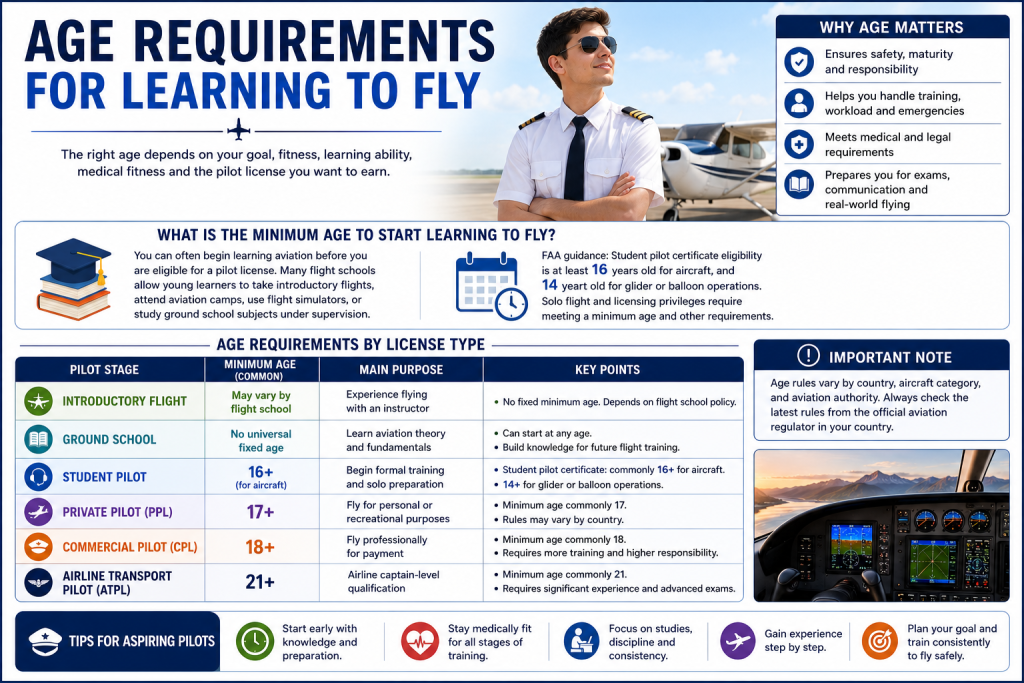
You can often begin learning aviation before you are eligible for a pilot license. Many flight schools allow young learners to take introductory flights, attend aviation camps, use flight simulators, or study ground school subjects under supervision.
For example, in the United States, the FAA says a student pilot certificate is needed before flying solo, but it is not required just to take flying lessons. The FAA lists student pilot certificate eligibility as at least 16 years old for aircraft, and 14 years old for glider or balloon operations.
This means a young student may begin aviation education early, but solo flight and licensing privileges usually require meeting a minimum age.
Minimum Age for Student Pilot Training
A student pilot is someone learning to fly under the supervision of a qualified flight instructor. Student pilots usually begin with dual instruction, which means the instructor is in the aircraft with the student.
Student pilot training may include:
- Basic aircraft controls
- Takeoff and landing practice
- Straight and level flight
- Turns and climbs
- Radio communication
- Navigation basics
- Emergency procedures
- Pre-flight inspection
- Ground school study
In many systems, students can start training before they are allowed to fly solo. Solo flying normally requires a minimum age, medical clearance, instructor approval, and proper training progress.
Minimum Age for Private Pilot License
A Private Pilot License allows a person to fly for personal or recreational purposes, depending on the rules of the country. It does not usually allow the pilot to fly commercially for payment.
In many aviation systems, the minimum age for a private pilot license is around 17 years. For example, the Irish Aviation Authority’s pilot licensing table lists the PPL minimum age as 17, CPL as 18, and ATPL as 21.
A private pilot license is a popular choice for people who want to fly as a hobby, travel privately, or build a foundation before professional training.
Minimum Age for Commercial Pilot License
A Commercial Pilot License is required for those who want to fly professionally. It allows a pilot to be paid for flying, subject to license privileges, ratings, and regulations.
In India, DGCA information for Commercial Pilot’s Licence states that the applicant shall be not less than 18 years of age on the date of application.
Commercial pilot training requires more commitment than private pilot training. It includes advanced flying skills, navigation, instrument flying, flight planning, aviation regulations, meteorology, aircraft systems, and professional decision-making.
Minimum Age for Airline Transport Pilot License
The Airline Transport Pilot License is generally the highest level of pilot license. It is required for pilots who want to act as airline captains in commercial air transport operations.
Many aviation systems set the minimum ATPL age around 21. The Irish Aviation Authority table lists ATPL minimum age as 21.
An ATPL usually requires significant flight experience, advanced examinations, medical fitness, and professional flying experience.
Age Requirements by License Type
| Pilot Stage | Common Minimum Age | Main Purpose |
|---|---|---|
| Introductory Flight | May vary by flight school | Experience flying with an instructor |
| Ground School | No universal fixed age | Learn aviation theory |
| Student Pilot | Commonly around 16 for aircraft | Begin formal training and solo preparation |
| Private Pilot | Commonly around 17 | Fly for personal or recreational purposes |
| Commercial Pilot | Commonly around 18 | Fly professionally |
| Airline Transport Pilot | Commonly around 21 | Airline captain-level qualification |
Age rules vary by country, aircraft category, and aviation authority. Always check the latest rules from the official aviation regulator in your region.
Age Requirements in Different Regions
| Country or Region | Student Pilot | Private Pilot | Commercial Pilot | Airline Pilot |
| India | Commonly 16 | Commonly 17 | 18 | Usually 21 for ATPL pathway |
| United States | 16 for aircraft, 14 for glider or balloon | 17 for airplane PPL | 18 | ATP commonly 23, with some restricted pathways |
| Europe | Commonly 16 for student pilot stage | 17 | 18 | 21 |
| Canada | Commonly 14 for student permit, depending on category | 17 | 18 | Usually 21 for ATPL |
| Australia | Training may start earlier under supervision | Usually 17 | Usually 18 | Usually 21 |
This table gives general guidance only. Aviation rules can change, and each country has its own medical, educational, and licensing requirements.
Can Teenagers Learn to Fly?
Yes, teenagers can begin learning to fly in many places. They may start with flight simulators, aviation camps, ground school, discovery flights, and instructor-led training.
Teenagers can benefit from starting early because they get more time to understand aviation basics, build confidence, and develop discipline. Early exposure can also help students decide whether aviation is truly the right career path.
Teen learners should focus on:
- School education
- English communication
- Basic mathematics
- Physics concepts
- Discipline and responsibility
- Medical fitness
- Aviation awareness
- Time management
Parents should also research flight schools carefully and understand the financial and medical requirements before committing to full training.
Can Adults Start Flight Training?
Yes, adults can absolutely start flight training. Many people begin learning to fly in their twenties, thirties, forties, fifties, or even later.
Adult learners often bring strong advantages, such as:
- Better financial planning
- Stronger discipline
- Clear career goals
- Professional maturity
- Better decision-making
- Serious commitment
- Life experience
Some adults learn flying as a hobby, while others pursue a career change into aviation. Age may affect airline career timelines, but it does not stop a person from learning to fly if they meet medical and training requirements.
Is There a Maximum Age to Learn Flying?
In most cases, there is no strict maximum age to begin learning to fly for personal or recreational flying. Medical fitness is usually more important than age alone.
However, professional airline careers may have retirement-age rules. For example, ICAO rules have historically limited pilots over 65 from operating international airline flights, and aviation groups have discussed possible changes to this limit.
For private flying, recreational flying, and personal aviation goals, many older adults continue to train and fly safely as long as they meet medical standards.
Medical Requirements Related to Age
Medical fitness is one of the most important parts of pilot eligibility. A person may meet the age requirement but still need medical approval before solo flying or licensing.
Aviation medical checks may include:
- Vision test
- Hearing test
- Blood pressure check
- General health review
- Medical history
- Heart health assessment
- Neurological fitness
- Mental health evaluation
- Medication review
Younger students should check medical eligibility early. Adult learners should also complete medical screening before investing heavily in training.
Educational Requirements Along With Age
Age is only one part of pilot eligibility. Education also matters, especially for professional pilot training.
Important learning areas include:
- English language
- Mathematics
- Physics
- Geography
- Weather basics
- Communication skills
- Problem-solving
- Technical understanding
- Computer-based learning
Aviation requires continuous study. Even after receiving a license, pilots keep learning through ratings, renewals, checks, simulator sessions, and operational training.
Best Age to Start Learning to Fly
There is no single best age for everyone. The best age depends on your goal.
If your goal is an airline career, starting earlier can help because you have more time to complete training, build flight hours, gain experience, and apply for professional roles.
If your goal is personal flying, you can start whenever you are medically fit, financially ready, and able to commit time to training.
A good time to start is when you have:
- Strong motivation
- Basic educational readiness
- Medical confidence
- Financial planning
- Family support
- Time for regular lessons
- Access to a reputable flight school
- Clear understanding of the training path
Benefits of Starting Flight Training Early
Starting early can be helpful for students who are serious about aviation careers.
Benefits include:
- More time to build flying experience
- Better career planning
- Early exposure to aviation culture
- More time to prepare for medical and written exams
- Stronger confidence in cockpit procedures
- Opportunity to progress step by step
- Better understanding before choosing a flight school
Early training should still be balanced with school education, maturity, and financial planning.
Benefits of Learning to Fly as an Adult
Adults can also become excellent student pilots. In fact, many flight instructors enjoy teaching adult learners because they are often focused, disciplined, and serious.
Benefits include:
- Clear purpose for training
- Better financial independence
- Strong communication skills
- Professional discipline
- Better understanding of responsibility
- More realistic expectations
- Ability to manage training schedules
Adults should not let age myths stop them from exploring aviation.
Common Myths About Pilot Age
| Myth | Fact |
| You must start flying as a child | Many pilots start as teenagers or adults |
| You are too old after 30 | Many adults begin flight training successfully after 30 |
| Teenagers cannot learn flying | Teenagers can often begin training under supervision |
| Airline pilots must start very young | Starting early helps, but career paths vary |
| Private flying is only for young people | Adults and older learners can fly if medically fit |
| Age is more important than health | Medical fitness is often more important than age alone |
How Parents Can Support Young Aspiring Pilots
Parents play an important role when a teenager wants to learn flying.
Helpful steps include:
- Research aviation careers properly
- Visit flight schools
- Speak with certified instructors
- Understand total training costs
- Check medical eligibility early
- Encourage school performance
- Support English communication skills
- Avoid rushing the process
- Choose safety-focused training
- Review aviation authority rules
Aviation is exciting, but it requires patience, planning, and responsible decision-making.
How Adults Can Plan Flight Training
Adult learners should begin with a practical plan.
Start by asking:
- Do I want to fly as a hobby or career?
- Can I pass the required medical exam?
- How much time can I give each week?
- What is my training budget?
- Which license do I need?
- Which flight school is suitable?
- Will I train full-time or part-time?
- What are my long-term aviation goals?
A clear plan saves time, money, and confusion.
Common Mistakes Aspiring Pilots Make
Many students make avoidable mistakes before starting flight training.
Common mistakes include:
- Believing age myths
- Ignoring medical requirements
- Joining a school without research
- Not checking license rules
- Poor financial planning
- Expecting training to be easy
- Delaying English communication practice
- Not preparing for theory exams
- Choosing speed over training quality
- Comparing themselves with others too much
Good planning creates a smoother training journey.
Tips for Choosing the Right Age to Begin Flying
Use these tips before starting:
- Take a discovery flight
- Speak with a flight instructor
- Complete a medical check early
- Understand license requirements
- Plan your finances
- Build aviation knowledge
- Improve English communication
- Study basic math and physics
- Compare flight schools carefully
- Start when you can train consistently
Consistency is very important. Flying once in a while with long gaps can slow progress and increase cost.
Frequently Asked Questions
1. What is the minimum age to learn flying?
You can often begin aviation learning before you are old enough for a pilot license. However, solo flying and licensing usually have minimum age rules set by the aviation authority.
2. Can a 16-year-old start pilot training?
Yes, in many countries a 16-year-old can begin student pilot training and may become eligible for solo flight if all regulatory, medical, and instructor requirements are met.
3. Can a 17-year-old get a private pilot license?
In many aviation systems, 17 is a common minimum age for a Private Pilot License. The exact rule depends on the country and aviation authority.
4. What is the minimum age for a commercial pilot license?
The common minimum age for a Commercial Pilot License is 18. In India, DGCA information also lists 18 as the minimum age for CPL application.
5. Is there a maximum age to learn flying?
For personal flying, there is usually no strict maximum age if the person is medically fit. Airline careers may have retirement-age rules.
6. Can adults become pilots?
Yes, adults can become pilots. Many people begin flight training later in life for private flying, career change, or personal achievement.
7. Can retired people learn to fly?
Yes, retired people may learn to fly if they meet medical and training requirements. Many older learners enjoy flying as a hobby.
8. Does age affect pilot medical certification?
Age can influence the frequency and depth of medical checks, but medical fitness matters more than age alone.
9. What is the best age to start pilot training?
The best age depends on your goal. Airline aspirants may benefit from starting early, while hobby pilots can begin whenever they are ready and medically fit.
10. Should students start preparing before flight school?
Yes. Students can prepare early by improving English, studying aviation basics, learning math and physics, and understanding medical requirements.
Conclusion
Age should not discourage anyone from learning to fly. Teenagers can begin aviation education early, young adults can pursue professional pilot training, and mature learners can still enjoy flying as a hobby or second career. The most important factors are medical fitness, discipline, training quality, and clear planning.
If you dream of becoming a pilot, start by understanding the age rules in your country, completing a medical check, and speaking with a reputable flight school. Whether you are a student, parent, working professional, or adult learner, aviation offers a path for those who are committed, responsible, and ready to learn.

