
Introduction
Starting flight training is an exciting step for anyone who dreams of becoming a pilot. But before a student sits inside an aircraft for the first lesson, there is an important process to complete: admission.
Many beginners feel confused about how to join a flight school, what documents are needed, whether medical fitness is compulsory, and how to choose the right training academy. Understanding the admission process early can save time, reduce stress, and help students make better decisions.
This guide explains the flight training admission process in a simple, step-by-step way. Whether you are a school student, college graduate, parent, or aviation enthusiast, this blog will help you understand how to begin your flying journey with confidence.
Why Flight Training Admissions Matter
Flight training is different from normal classroom education. It includes academic learning, practical flying, safety procedures, medical fitness, aircraft handling, and instructor-led training.
A proper admission process helps students:
- Choose the right flight school
- Understand eligibility requirements
- Prepare documents in advance
- Complete medical checks on time
- Plan training fees properly
- Avoid unnecessary delays
- Start training with confidence
When admission is handled carefully, the student begins training with better clarity and fewer surprises.
Who Can Apply for Flight Training?
Flight training is open to students who meet the basic eligibility standards set by the flight school and aviation authority of the country where training takes place.
General eligibility may include:
- Minimum age requirement
- Required educational qualification
- Basic English communication skills
- Medical fitness
- Valid identity documents
- Interest in aviation
- Ability to follow safety instructions
Exact requirements can vary depending on the country, training program, licence type, and flight school. Students should always confirm the latest admission rules directly with the selected academy.
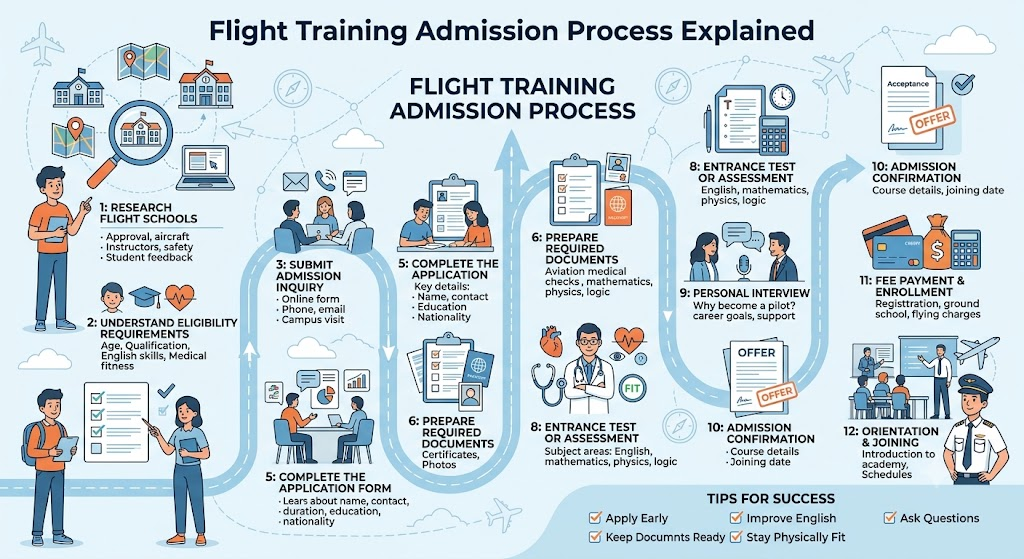
Step-by-Step Flight Training Admission Process
Step 1: Research Flight Schools
The first step is to research different flight schools carefully. Do not choose a school only because it is nearby or cheaper.
Look at important factors such as:
- Training approval or accreditation
- Aircraft availability
- Instructor experience
- Safety culture
- Maintenance standards
- Ground school quality
- Student reviews
- Training location
- Weather conditions
- Fee structure
- Hostel or accommodation support
- Career guidance support
A good flight school should offer structured training, clear communication, safe operations, and experienced instructors.
Step 2: Understand Eligibility Requirements
Before applying, students should check whether they meet the basic eligibility criteria.
Common requirements may include:
- Minimum age for training
- Educational qualification
- Medical fitness
- English language ability
- Identity proof
- Basic knowledge of mathematics and physics for some programs
For career-focused pilot training, eligibility may be stricter than for recreational flying. Students planning a professional aviation career should understand the full pathway before applying.
Step 3: Submit an Admission Inquiry
After shortlisting flight schools, the next step is to contact them.
This may happen through:
- Online inquiry form
- Phone call
- Campus visit
- Counseling session
- Education fair
- Referral from current students
During inquiry, students should ask clear questions about course structure, fees, aircraft, instructors, training duration, medical requirements, and admission steps.
Step 4: Attend Counseling or Information Session
Many flight schools provide counseling before admission. This helps students understand the training journey clearly.
Counseling may cover:
- Pilot licence options
- Training duration
- Ground school subjects
- Flying hours
- Medical requirements
- Fee payment schedule
- Career opportunities
- Student responsibilities
Parents can also attend counseling sessions because flight training requires financial planning and long-term commitment.
Step 5: Complete the Application Form
Once the student decides to apply, the flight school usually provides an application form.
The form may ask for:
- Full name
- Date of birth
- Contact details
- Educational background
- Nationality
- Identity details
- Program selected
- Previous aviation experience, if any
- Medical fitness details, if available
Students should fill the form carefully. Mistakes in name, date of birth, address, or document details can cause delays later.
Step 6: Prepare Required Documents
Document preparation is an important part of the flight training admission process. Missing documents can delay enrollment.
Commonly required documents may include:
| Document | Purpose | Requirement Type |
|---|---|---|
| Identity Proof | Confirms student identity | Usually mandatory |
| Address Proof | Confirms residence details | Usually mandatory |
| Educational Certificates | Verifies academic qualification | Usually mandatory |
| Passport-Size Photos | Used for forms and records | Usually mandatory |
| Medical Reports | Confirms fitness for training | Required where applicable |
| Passport | Needed for international training | Conditional |
| Birth Certificate | Confirms age | Conditional |
| Visa Documents | Needed for overseas training | Conditional |
| Parent/Guardian Consent | For minor students | Conditional |
| Payment Receipt | Confirms admission fee payment | Usually mandatory after payment |
Requirements vary by flight school, so students should request an official document checklist before submitting the application.
Step 7: Complete Medical Examination
Medical fitness is very important in aviation. Pilots must be physically and mentally fit to operate aircraft safely.
Aviation medical checks may assess:
- Vision
- Hearing
- General physical health
- Medical history
- Fitness for flying duties
- Mental alertness
- Overall suitability for aviation training
Students should complete medical checks early. If there is any medical concern, it is better to know before paying major training fees.
Step 8: Entrance Test or Assessment
Some flight schools may conduct an entrance test or basic assessment before admission. Not every school follows the same process.
Possible assessment areas include:
- English language
- Basic mathematics
- Physics fundamentals
- Logical reasoning
- General aptitude
- Aviation interest
- Communication skills
These tests are usually designed to understand whether the student is ready for aviation learning.
Step 9: Personal Interview
Some academies may conduct a personal interview or counseling-based discussion.
The interview may focus on:
- Why the student wants to become a pilot
- Career goals
- Communication ability
- Confidence level
- Understanding of aviation training
- Family support
- Financial planning
- Discipline and attitude
Students should answer honestly. Flight schools do not expect beginners to know everything, but they do expect seriousness and commitment.
Step 10: Admission Confirmation
After application review, document verification, medical checks, and assessment, the flight school may issue admission confirmation.
This may include:
- Admission offer
- Course details
- Fee schedule
- Joining date
- Student ID or enrollment details
- Rules and policies
- Training calendar
Students should read all admission terms carefully before making payment.
Step 11: Fee Payment and Enrollment
Flight training can be a significant investment. Before paying fees, students should clearly understand the fee structure.
Ask about:
- Registration fee
- Ground school fee
- Flying charges
- Simulator charges
- Examination fees
- Uniform cost
- Study material cost
- Hostel or accommodation charges
- Refund policy
- Extra flying hour cost
A transparent fee structure helps students and parents plan better.
Step 12: Orientation and Joining
After enrollment, students usually attend orientation.
Orientation may include:
- Introduction to the academy
- Meeting instructors
- Safety briefing
- Training schedule explanation
- Classroom rules
- Aircraft familiarization
- Attendance policy
- Student responsibilities
This stage helps students understand what to expect before ground school and flying lessons begin.
What Happens After Admission?
Admission is only the starting point. After joining, students begin their actual training journey.
The training process may include:
- Ground school classes
- Aviation theory lessons
- Simulator sessions
- Flight briefings
- Practical flying lessons
- Progress checks
- Instructor feedback
- Examinations
- Skill development
Students must stay disciplined, attend classes regularly, prepare before lessons, and follow safety procedures.
How to Choose the Right Flight School
Choosing the right flight school is one of the most important decisions in pilot training.
Consider these factors before admission:
Training Approval
Check whether the school is approved or recognized by the relevant aviation authority.
Safety Standards
Safety should be the top priority. Ask about maintenance practices, aircraft condition, and safety culture.
Instructor Quality
Experienced and patient instructors can make learning easier and safer.
Aircraft Availability
A school with limited aircraft may cause training delays. Ask how many aircraft are active and available for students.
Ground School Quality
Strong theory training is important for examinations and practical flying.
Transparent Fees
Avoid schools that are unclear about total costs. Ask for a detailed written fee structure.
Student Feedback
Speak to current or past students if possible. Their experience can help you understand the real training environment.
Training Timeline
Ask how long students usually take to complete training. Weather, aircraft availability, and student performance can affect timelines.
Common Admission Mistakes Students Should Avoid
Choosing Based Only on Low Fees
Low fees may look attractive, but training quality, safety, and aircraft availability matter more.
Ignoring Medical Fitness
Students should complete medical checks early to avoid problems after admission.
Submitting Incomplete Documents
Missing certificates, incorrect details, or unclear copies can delay enrollment.
Not Understanding Total Cost
Students should ask about all possible expenses, not just the basic course fee.
Not Researching the School
Joining without checking reviews, approval, aircraft, and instructors can lead to disappointment.
Poor Financial Planning
Pilot training requires proper budgeting. Families should plan fees, accommodation, travel, exams, and extra costs.
Waiting Until the Last Moment
Admission, documents, medical checks, and counseling take time. Early preparation is always better.
Tips to Improve Your Chances of Admission
Students can make the admission process smoother by following simple steps:
- Apply early.
- Keep documents ready.
- Improve English communication.
- Learn basic aviation terms.
- Stay physically fit.
- Complete medical checks early.
- Ask questions during counseling.
- Research the school carefully.
- Understand the fee structure.
- Be honest in your application.
- Stay disciplined and professional.
Flight schools look for students who are serious, responsible, and ready to learn.
Flight Training Admission Checklist
Before applying, use this checklist:
- Shortlist flight schools
- Check eligibility
- Attend counseling
- Understand fee structure
- Prepare documents
- Complete medical examination
- Submit application form
- Attend test or interview if required
- Receive admission confirmation
- Pay required fees
- Attend orientation
- Begin ground school and training
This checklist can help students stay organized throughout the admission process.
Frequently Asked Questions
1. What is the first step in joining a flight school?
The first step is to research flight schools and understand their eligibility requirements. Students should compare training approval, aircraft availability, instructor quality, fees, safety standards, and student feedback before applying.
2. What documents are usually required for flight training admission?
Common documents include identity proof, address proof, educational certificates, passport-size photographs, medical reports, and payment receipts. If training abroad, students may also need a passport, visa documents, and additional verification papers.
3. Is a medical examination compulsory for flight training?
Medical fitness is very important for aviation training. Most pilot training programs require students to meet medical standards before or during admission. The exact medical requirement depends on the licence type, country, and flight school.
4. Do all flight schools conduct entrance tests?
No, not all flight schools conduct entrance tests. Some schools may only review documents and conduct counseling, while others may test English, mathematics, physics, reasoning, or aviation aptitude.
5. Can international students apply for flight training?
Yes, many flight schools accept international students. However, international applicants may need additional documents such as passport, visa, financial proof, education equivalency documents, and medical certification based on the country’s rules.
6. How long does the admission process take?
The admission process may take a few days to several weeks depending on document readiness, medical examination, entrance assessment, fee payment, and flight school procedures. Early preparation can reduce delays.
7. What happens after enrollment?
After enrollment, students usually attend orientation and begin ground school. Later, they move into simulator training, flight briefings, practical flying, progress checks, and examinations based on the training program.
8. Can I apply before completing school?
Some students may inquire early, but actual eligibility depends on the training program and licensing requirements. Students should confirm with the flight school whether they can apply before completing their current education.
9. How should I prepare for flight training admission?
Students should prepare documents, improve English communication, study basic mathematics and physics, complete medical checks, understand the fee structure, and research flight schools carefully before applying.
10. How do I choose the best flight school?
The best flight school should have proper approval, good safety standards, experienced instructors, active aircraft, transparent fees, quality ground school, and positive student feedback. Do not choose only based on low cost.
Conclusion
The flight training admission process is the foundation of a successful aviation journey. When students understand the steps clearly, they can avoid delays, prepare better, and choose the right flight school with confidence.
From researching academies and checking eligibility to preparing documents, completing medical examinations, attending counseling, and joining orientation, every step matters.
A well-planned admission process helps students begin flight training with clarity, discipline, and confidence. If your dream is to learn flying, start by preparing early, asking the right questions, and choosing a training environment that supports safe and professional learning.

