
Introduction
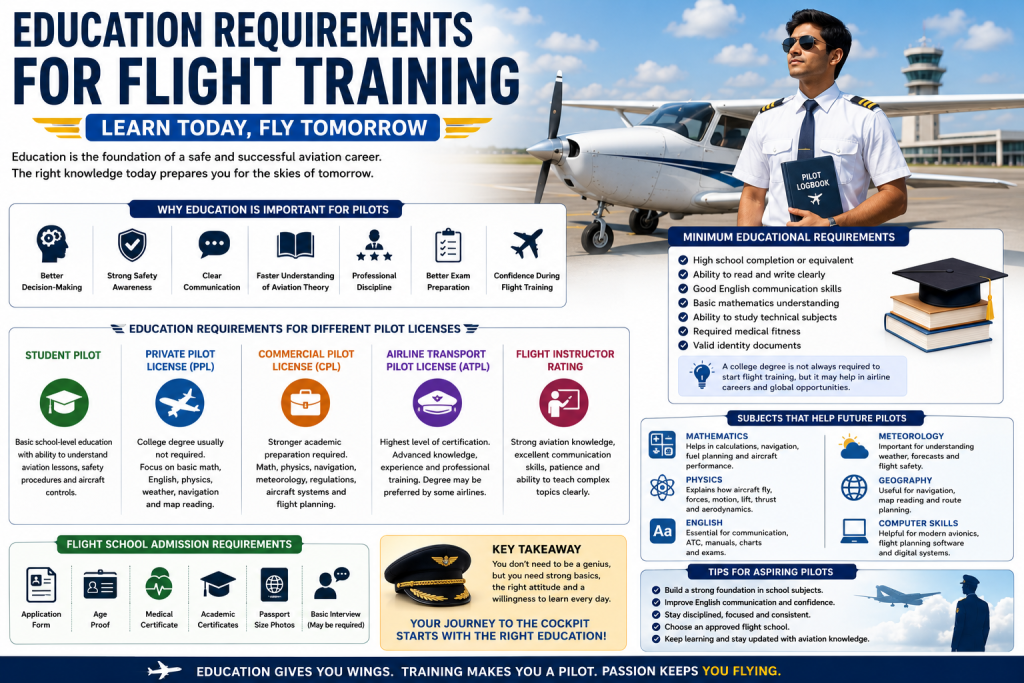
Flight training is an exciting first step toward becoming a pilot, but many beginners are unsure about the education needed to start. Some people believe that every pilot must have a college degree, while others think only science or engineering students can enter aviation. In reality, education requirements for flight training depend on the type of pilot license, the country’s aviation rules, and the student’s long-term career goal.
For basic flight training, many students can begin with a high school education or an equivalent qualification. However, becoming a professional pilot requires strong learning ability, discipline, English communication, technical understanding, and continuous study. Aviation is a career where learning never stops.
This guide explains the education requirements for flight training, useful school subjects, license-level expectations, flight school admission needs, and practical preparation tips for aspiring pilots.
Why Education Is Important for Flight Training
Education helps pilots understand both the theory and practical side of flying. A pilot must read charts, understand weather, calculate fuel, communicate with air traffic control, follow regulations, and make safe decisions in changing conditions.
Good education supports:
- Better decision-making
- Stronger safety awareness
- Clear communication
- Faster understanding of aviation theory
- Professional discipline
- Better exam preparation
- Confidence during flight training
Flying is not only about controlling an aircraft. It is about understanding why the aircraft behaves in a certain way and making correct decisions before, during, and after every flight.
Minimum Educational Requirements
The minimum education requirement for flight training usually starts with high school completion or an equivalent qualification. Exact requirements can vary depending on the aviation authority, flight school, and license type.
In general, aspiring pilots should have:
- Basic school education
- Ability to read and write clearly
- Good English communication skills
- Basic mathematics understanding
- Ability to study technical subjects
- Required medical fitness
- Valid identity documents
Some countries or flight schools may require specific subjects or academic certificates for commercial pilot training. Students should always check the requirements of the aviation authority and the flight school before applying.
Do You Need a College Degree to Become a Pilot?
A college degree is not always required to begin flight training. Many pilots start with school-level education and then complete their pilot licenses through an approved aviation academy or flight school.
However, a college degree may be helpful for certain airline jobs, international opportunities, or long-term career growth. Some airlines prefer candidates with higher education, while others focus more on pilot license, flying hours, medical fitness, communication skills, and interview performance.
Education Requirements for Different Pilot Licenses
Student Pilot
A student pilot is someone who has started basic flight training under the supervision of a flight instructor. The education requirement is usually basic school-level education, along with the ability to understand aviation lessons, safety procedures, and aircraft controls.
Students must also meet age, medical, and documentation requirements based on local aviation rules.
Private Pilot License
A Private Pilot License allows a person to fly for personal or recreational purposes, not for paid commercial flying. For this level, a college degree is usually not required.
Useful education for PPL training includes:
- Basic mathematics
- English language skills
- Basic physics understanding
- Reading comprehension
- Weather awareness
- Map and chart reading ability
PPL students must also pass ground school exams and practical flight tests.
Commercial Pilot License
A Commercial Pilot License is required for pilots who want to fly professionally. Educational requirements may be stricter than private pilot training, depending on the country and aviation authority.
CPL students should have strong preparation in:
- Mathematics
- Physics
- English
- Navigation
- Meteorology
- Aircraft systems
- Air regulations
- Flight planning
A degree may not always be mandatory, but strong academic ability is very important because commercial pilot training includes advanced theory and professional-level flying skills.
Airline Transport Pilot License
An Airline Transport Pilot License is the highest level of pilot certification for airline cockpit roles. This stage requires advanced knowledge, significant flying experience, and professional training.
Educational expectations are higher because airline pilots must understand complex aircraft systems, crew coordination, safety procedures, regulations, and operational decision-making.
A college degree may be preferred by some airlines, but licensing requirements mainly focus on experience, exams, medical standards, and professional competency.
Flight Instructor Rating
A flight instructor rating allows a pilot to teach student pilots. Formal education requirements vary, but the instructor must have strong aviation knowledge, communication skills, patience, and the ability to explain complex topics clearly.
Good instructors are not only skilled pilots; they are also effective teachers.
Subjects That Help Future Pilots
Mathematics
Mathematics helps pilots calculate fuel, distance, time, speed, weight, balance, climb rates, descent planning, and navigation problems. Pilots do not need to be math experts, but they should be comfortable with basic calculations.
Physics
Physics helps students understand lift, drag, thrust, weight, aircraft motion, pressure, engine performance, and weather behavior. A basic understanding of physics makes flight training easier.
English
English is widely used in aviation communication, flight manuals, air traffic control instructions, exams, and international operations. Strong English skills are very useful for both training and professional flying.
Geography
Geography helps pilots understand maps, routes, terrain, weather patterns, time zones, and navigation. It is especially useful for cross-country flying and flight planning.
Computer Skills
Modern aviation uses digital systems, online learning platforms, flight planning software, simulators, electronic charts, and aircraft avionics. Basic computer skills help students adapt quickly.
Meteorology Basics
Weather is one of the most important subjects in aviation. Students who understand clouds, wind, visibility, pressure, thunderstorms, and weather reports can make safer flight decisions.
Importance of English Language Skills
English language skills are extremely important in aviation. Pilots must communicate clearly with air traffic controllers, instructors, crew members, passengers, and ground staff.
English is used for:
- Radio communication
- Flight manuals
- Aviation charts
- Safety procedures
- Weather reports
- Aircraft checklists
- Emergency instructions
- International aviation operations
Poor communication can create safety risks. That is why aspiring pilots should build strong listening, speaking, reading, and writing skills.
Medical and Other Eligibility Requirements
Education is only one part of pilot eligibility. Students must also meet medical, age, and documentation requirements.
Common requirements include:
- Aviation medical certificate
- Minimum age requirement
- Valid identity proof
- Educational certificates
- Language proficiency
- Background documentation
- Passport for international training
- Financial planning documents if needed
Medical fitness is very important because pilots must meet physical and mental health standards for safe flying.
Flight School Admission Requirements
Flight schools may ask for different documents and assessments before admission.
Common admission requirements include:
- Completed application form
- Educational certificates
- Medical certificate
- Identity documents
- Passport-size photographs
- Language proficiency proof
- Entrance test if required
- Interview if required
- Fee payment documents
Students should contact the flight school directly and ask for a complete admission checklist before applying.
Skills Beyond Formal Education
Formal education is helpful, but successful pilots also need strong personal and professional skills.
Important skills include:
- Discipline
- Responsibility
- Focus
- Situational awareness
- Communication
- Teamwork
- Leadership
- Problem-solving
- Time management
- Decision-making
- Stress management
- Attention to detail
Aviation rewards students who are consistent, prepared, and safety-focused.
Common Myths About Pilot Education
Myth 1: You Must Have an Engineering Degree
An engineering degree is not mandatory for most flight training paths. It may help with technical understanding, but many successful pilots come from non-engineering backgrounds.
Myth 2: Only Science Students Can Become Pilots
Science subjects can be helpful, especially mathematics and physics, but requirements vary. Students from other backgrounds may still become pilots if they meet license, medical, and aviation authority requirements.
Myth 3: Mathematics Must Be Perfect
Pilots need practical mathematics, not advanced academic mathematics in every case. Students should be comfortable with basic calculations, formulas, conversions, and problem-solving.
Myth 4: A University Degree Guarantees an Airline Job
A degree alone does not guarantee an airline job. Airlines consider license, flying hours, simulator performance, medical fitness, communication skills, technical knowledge, attitude, and interview performance.
Myth 5: Older Students Cannot Begin Flight Training
Career changers can begin flight training if they meet medical, financial, and regulatory requirements. Age may affect career planning, but it does not automatically stop someone from learning to fly.
How Students Can Prepare for Flight Training
Students can prepare early by building strong academic and personal habits.
Useful preparation tips include:
- Improve English communication
- Strengthen basic mathematics
- Learn basic physics concepts
- Study aviation fundamentals
- Read about aircraft and weather
- Practice disciplined study habits
- Stay physically fit
- Research flight schools carefully
- Understand medical requirements
- Prepare a realistic financial plan
- Talk to pilots and instructors
- Build confidence and patience
Good preparation makes flight training smoother and more successful.
Career Opportunities After Flight Training
Flight training can lead to many aviation career paths, depending on license level, experience, and additional ratings.
Career options include:
- Airline pilot
- Charter pilot
- Corporate pilot
- Cargo pilot
- Flight instructor
- Agricultural pilot
- Survey pilot
- Emergency services pilot
- Ferry pilot
- Aviation operations role
Education and continuous learning help pilots grow throughout their careers. Even after earning a license, pilots must keep studying, training, and improving.
Tips for Choosing the Right Flight School
Choosing the right flight school is just as important as meeting education requirements.
Before enrolling, evaluate:
- Regulatory approval
- Instructor experience
- Aircraft fleet quality
- Safety culture
- Training facilities
- Ground school support
- Simulator access
- Fee transparency
- Student reviews
- Graduate success
- Maintenance standards
- Course structure
- Student support services
A good flight school should be transparent, professional, and focused on safety.
Key Takeaways
- Flight training usually begins with high school education or an equivalent qualification.
- A college degree is not always required, but it may help in some aviation careers.
- Mathematics, physics, English, geography, and computer skills are useful for pilots.
- Medical fitness and language ability are separate but important requirements.
- Different licenses have different knowledge and experience expectations.
- Strong discipline, communication, and decision-making are essential for pilots.
- Students should check local aviation authority and flight school requirements before applying.
FAQs
1. What education is required to start flight training?
Most students can start flight training after completing basic school education or an equivalent qualification. Exact requirements depend on the country, aviation authority, and type of pilot license.
2. Do I need a college degree to become a commercial pilot?
A college degree is not always required to become a commercial pilot. However, some airlines or employers may prefer higher education. License, flying hours, medical fitness, and skill are usually more important.
3. Can students from non-science backgrounds become pilots?
Yes, students from non-science backgrounds may become pilots if they meet aviation authority requirements. However, they should build basic knowledge of mathematics, physics, English, and aviation theory.
4. Is mathematics compulsory for flight training?
Mathematics is very useful in flight training. Pilots use math for navigation, fuel planning, speed, distance, time, and aircraft performance. Students should be comfortable with basic calculations.
5. Why is English important in aviation?
English is used in radio communication, flight manuals, checklists, air traffic control instructions, and international aviation. Clear English communication improves safety and professionalism.
6. What documents are needed for flight school admission?
Common documents include educational certificates, medical certificate, identity proof, photographs, application form, language proof if required, and payment documents. Requirements vary by school.
7. Can I become a pilot after changing careers?
Yes, many people begin flight training after working in another field. Career changers should check medical eligibility, financial planning, training time, and license requirements before starting.
8. Does education affect airline hiring?
Education may affect airline hiring depending on the airline’s requirements. Some airlines prefer degree holders, while others focus more on pilot licenses, flying hours, assessments, communication, and attitude.
9. What skills are most important besides academics?
Important skills include discipline, communication, decision-making, responsibility, teamwork, focus, problem-solving, and situational awareness. These skills are essential for safe and professional flying.
10. How can I prepare for flight school while still in school or college?
You can prepare by improving English, practicing basic math, learning aviation basics, staying physically fit, developing study habits, researching flight schools, and understanding pilot medical requirements.
Conclusion
Education requirements for flight training are important, but they are only one part of becoming a pilot. Most aspiring pilots can begin with school-level education, but success in aviation depends on continuous learning, discipline, medical fitness, communication, and professional attitude.
A college degree may help in some career paths, but it is not always mandatory for starting flight training. What matters most is choosing the right training path, meeting aviation authority requirements, preparing academically, and developing the mindset of a safe and responsible pilot.
For students dreaming of an aviation career, the best approach is to build a strong educational foundation, research flight schools carefully, and begin flight training with confidence and commitment.

