
Introduction
Slow flight is one of the most important exercises in basic flight training. It teaches student pilots how an aircraft behaves when flying at a low airspeed and a high angle of attack.
During slow flight, the aircraft becomes less responsive, additional power may be required, and control inputs must be smooth and carefully coordinated. The pilot must pay close attention to airspeed, altitude, attitude, balance, and warning signs of an approaching stall.
This exercise is not simply about flying slowly. It helps beginners develop better aircraft control, improve landing skills, recognize stall conditions, and understand the relationship between pitch, power, drag, and lift.
Slow flight should always be practised under the supervision of a qualified flight instructor and according to the aircraft flight manual, training syllabus, and local aviation regulations.
What Is Slow Flight?
Slow flight is a condition in which an aircraft operates at an airspeed significantly lower than its normal cruise speed.
The aircraft is usually flown close to the speed at which a stall warning may activate, while still maintaining controlled flight. At this speed, the aircraft requires a higher angle of attack to produce enough lift.
The exact procedure and target speed depend on the aircraft type and training standards. Student pilots should never rely on a single speed that applies to every aircraft.
During slow flight, the aircraft may display the following characteristics:
- Reduced control effectiveness
- Higher nose attitude
- Increased induced drag
- Greater power requirement
- Slower acceleration
- Reduced climb performance
- Increased sensitivity to uncoordinated control inputs
- Greater risk of an aerodynamic stall
Why Slow Flight Training Is Important
Slow flight training prepares pilots for situations where the aircraft must operate safely at low airspeeds.
These situations commonly occur during:
- Takeoff
- Initial climb
- Airport traffic patterns
- Approach
- Landing
- Go-around
- Short-field operations
- Precautionary manoeuvres
A pilot who understands slow flight is better prepared to recognize when the aircraft is approaching its performance limits.
Slow flight training also helps student pilots understand that airspeed alone does not cause a stall. An aircraft stalls when the wing exceeds its critical angle of attack.
Main Objectives of Slow Flight Training
The purpose of slow flight training is to help a beginner pilot develop several important skills.
Aircraft Control
The pilot learns to maintain:
- A selected altitude
- A safe heading
- Coordinated flight
- A controlled airspeed
- Proper aircraft configuration
Stall Awareness
Slow flight teaches the pilot to recognize warning signs that may appear before a stall, including:
- Stall warning activation
- Reduced control response
- Airframe vibration or buffeting
- High nose attitude
- Increased power requirement
- Difficulty maintaining altitude
- Unstable or uncoordinated flight
Power and Pitch Coordination
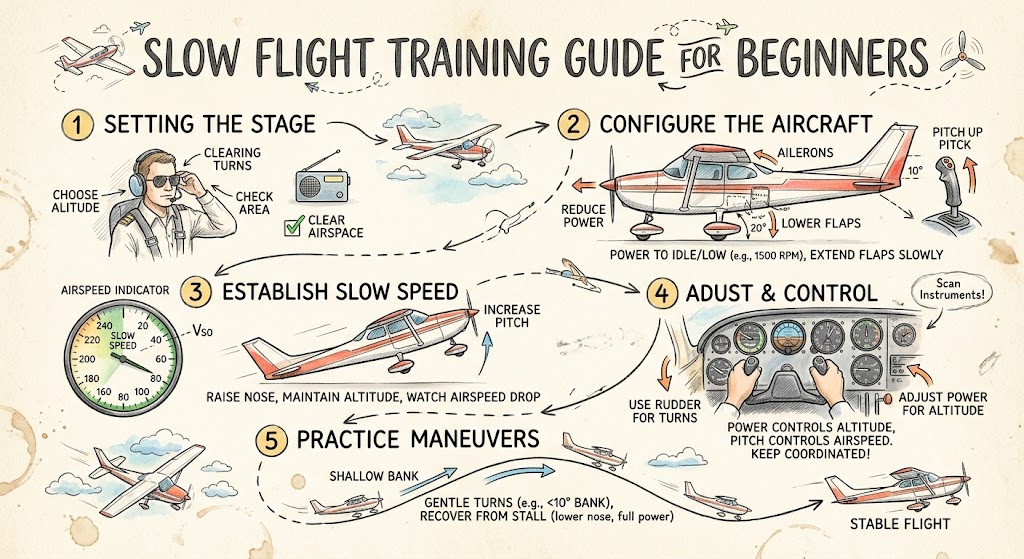
The exercise helps pilots understand how pitch and power work together.
A simplified training concept is:
- Pitch primarily influences airspeed
- Power primarily influences altitude or rate of climb and descent
However, pitch and power are closely connected. Changing one often requires an adjustment to the other.
Rudder Coordination
At high power and low airspeed, yawing tendencies can become more noticeable. The pilot must use appropriate rudder pressure to keep the aircraft coordinated.
Understanding the Aerodynamics of Slow Flight
Slow flight becomes easier to understand when a student pilot understands the basic aerodynamic changes taking place.
Higher Angle of Attack
As airspeed decreases, the wing must operate at a higher angle of attack to continue producing enough lift.
If the angle of attack becomes too high, the wing can exceed its critical angle and stall.
Increased Induced Drag
Induced drag increases when the aircraft flies at a high angle of attack. This means the aircraft may require more power even though it is travelling at a lower speed.
This is one reason slow flight may require surprisingly high engine power.
Reduced Control Effectiveness
At lower airspeeds, less airflow moves over the control surfaces.
As a result:
- Ailerons become less effective
- Elevator response becomes slower
- Rudder use becomes more important
- Larger but smoother control inputs may be required
Greater Risk of Adverse Yaw
When ailerons are used at slow speed, adverse yaw may become more noticeable. Coordinated rudder pressure is needed to keep the aircraft balanced during turns.
Preparation Before Practising Slow Flight
Before beginning the exercise, the pilot should complete several safety checks.
Select a Safe Training Area
Slow flight should be practised:
- Away from congested areas
- Clear of controlled or restricted airspace unless authorized
- At a safe altitude
- In suitable weather
- In an area with good visibility
- Away from other training aircraft when possible
Complete a Proper Lookout
The pilot should perform a thorough visual scan before changing speed or direction.
A good lookout includes:
- Checking above and below
- Checking both sides of the aircraft
- Looking ahead and behind where possible
- Monitoring radio traffic
- Reviewing nearby airspace activity
Review the Aircraft Checklist
The pilot should follow the approved checklist for the aircraft.
Typical checks may include:
- Fuel status
- Engine instruments
- Mixture setting
- Carburettor heat, when applicable
- Fuel selector position
- Aircraft configuration
- Seat belts and harnesses
- Training area clearance
The exact procedure must come from the aircraft flight manual and the instructor’s guidance.
Step-by-Step Slow Flight Procedure
The following is a general training sequence. It must not replace the approved procedure for a specific aircraft.
Establish Straight-and-Level Flight
Begin in stable, straight-and-level flight at a safe altitude.
Confirm:
- Altitude is steady
- Heading is stable
- Aircraft is properly trimmed
- Engine instruments are normal
- The training area is clear
Reduce Power Smoothly
Reduce power gradually while maintaining altitude with increasing back pressure.
As the aircraft slows:
- The nose attitude may need to increase
- Control response will become softer
- Drag will increase
- Additional power may eventually be needed
Avoid abrupt power changes.
Configure the Aircraft
Apply the required configuration according to the training exercise and aircraft procedure.
This may include:
- Flap extension
- Landing configuration
- Clean configuration
- Carburettor heat
- Propeller or mixture adjustments, when applicable
Configuration changes should be made within the aircraft’s approved operating limitations.
Maintain Altitude While Airspeed Decreases
As the aircraft slows, gradually increase pitch attitude to maintain altitude.
Monitor:
- Outside attitude
- Airspeed
- Altitude
- Heading
- Coordination
- Stall warning indications
Avoid focusing only on the airspeed indicator. The pilot must continue looking outside and maintaining situational awareness.
Add Power as Required
When the aircraft reaches the selected slow-flight condition, add enough power to maintain altitude.
Because induced drag is high, the aircraft may require considerable power.
Use smooth power changes and maintain coordinated flight with rudder.
Trim the Aircraft
Once the aircraft is stable, use trim to reduce control pressure.
Trim should support the selected attitude, but it should never replace active aircraft control.
The pilot must remain prepared to make immediate pitch, power, and rudder corrections.
Maintain Slow Flight
During stable slow flight, maintain:
- Target airspeed range
- Selected altitude
- Desired heading
- Proper coordination
- Safe angle of attack
- Correct aircraft configuration
Small deviations should be corrected early.
Control Technique During Slow Flight
Slow flight requires patience and smooth control inputs.
Pitch Control
Pitch changes should be small.
Excessive nose-up pitch may bring the aircraft closer to a stall. Excessive nose-down pitch may cause rapid acceleration or altitude loss.
Use the outside visual attitude as the primary reference, then confirm performance with the flight instruments.
Power Control
Power should be adjusted smoothly to maintain altitude or the desired flight path.
When power changes, the pilot may also need to adjust:
- Pitch
- Rudder
- Trim
Rudder Control
Rudder becomes especially important during slow flight.
The pilot should use rudder to:
- Maintain coordination
- Control yaw
- Support turns
- Counter power-related turning tendencies
Aileron Control
Aileron inputs should be smooth and limited.
Aggressive aileron use near a stall can increase the angle of attack on one wing and may contribute to an unwanted wing drop.
Turning During Slow Flight
Once straight-and-level slow flight is stable, the instructor may introduce gentle turns.
Turns should generally use shallow bank angles because turning increases the load on the wings and can reduce the stall margin.
During a slow-flight turn:
- Look in the direction of the turn
- Use coordinated aileron and rudder
- Maintain the selected airspeed
- Monitor altitude
- Avoid excessive bank
- Correct yaw early
- Keep control movements smooth
The pilot may need slightly more power to maintain altitude during the turn.
Climbing During Slow Flight
A climb at low airspeed can be challenging because aircraft performance is limited.
To begin a slow-flight climb:
- Apply power smoothly
- Maintain coordination
- Adjust pitch carefully
- Monitor airspeed
- Avoid excessive nose-up attitude
Climb performance may be weak, especially in high temperatures, at high altitude, or with a heavily loaded aircraft.
Descending During Slow Flight
A controlled descent can be started by reducing power while maintaining the desired airspeed.
The pilot should:
- Keep the aircraft coordinated
- Control the descent rate
- Avoid allowing the airspeed to decrease excessively
- Monitor the aircraft’s attitude
- Use trim carefully
A sudden power reduction combined with excessive nose-up attitude can quickly reduce the stall margin.
Recovering From Slow Flight
Recovery should be smooth and controlled.
A general recovery sequence may include:
- Apply appropriate power
- Reduce the angle of attack
- Maintain coordinated flight
- Retract flaps in stages as recommended
- Allow the aircraft to accelerate
- Return to the desired altitude and heading
- Re-trim the aircraft
- Complete the appropriate checks
Flaps should not be retracted abruptly unless the approved procedure specifically requires it. Sudden flap retraction at low airspeed may cause loss of lift and altitude.
Recognizing an Approaching Stall
A student pilot must learn to identify the early signs of an approaching stall.
Possible indications include:
- Stall warning horn or light
- Airframe buffet
- Reduced control effectiveness
- Difficulty maintaining altitude
- High nose attitude
- Increasing back pressure
- Unstable yaw
- Poor aileron response
- Rapidly decreasing airspeed
The correct response is to reduce the angle of attack and follow the approved recovery procedure.
The pilot should not wait for a fully developed stall before taking corrective action.
Common Slow Flight Mistakes
Fixating on the Airspeed Indicator
Some beginners focus continuously on airspeed and stop looking outside.
This can lead to poor heading control, altitude deviations, and reduced traffic awareness.
Use a balanced instrument scan while keeping the outside attitude as a major reference.
Using Excessive Back Pressure
Pulling too hard can increase the angle of attack rapidly and place the aircraft close to a stall.
Pitch corrections should be small and controlled.
Making Abrupt Power Changes
Rapid power changes can produce sudden yaw, pitch, and altitude changes.
Apply power smoothly and anticipate the need for rudder.
Ignoring Rudder
Failure to use rudder can result in uncoordinated flight.
This becomes especially dangerous near a stall because uncoordinated flight can increase the risk of a wing drop or spin entry.
Using Too Much Aileron
Large aileron movements at a high angle of attack can worsen wing imbalance.
Use coordinated, gentle control inputs.
Overusing Trim
Trim should reduce control pressure after the aircraft is established.
A student should not use trim as the primary method of controlling pitch.
Retracting Flaps Too Quickly
Abrupt flap retraction can cause a sudden reduction in lift.
Follow the aircraft’s approved flap-retraction sequence.
Failing to Maintain a Lookout
Traffic awareness remains essential during every manoeuvre.
The pilot should not become so focused on aircraft control that external scanning is forgotten.
Safety Considerations
Slow flight must be practised with a strong safety margin.
Important precautions include:
- Use a qualified flight instructor
- Practise at a safe altitude
- Follow the aircraft flight manual
- Respect weather limitations
- Avoid excessive bank angles
- Maintain coordinated flight
- Monitor engine temperatures and instruments
- Avoid practising over congested areas
- Maintain traffic awareness
- Recover immediately when safe limits are approached
The minimum training altitude and required recovery height depend on local regulations, the aircraft, the training organization, and instructor procedures.
How Weather Affects Slow Flight
Weather conditions can significantly influence aircraft handling.
Wind
Strong winds may not directly change the aircraft’s stall speed through the air, but they can affect:
- Ground track
- Drift
- Position awareness
- Workload
- Training area boundaries
Turbulence
Turbulence can cause rapid changes in angle of attack and airspeed.
Slow flight should not be practised in conditions that make aircraft control unsafe or unpredictable.
High Temperature
High temperatures reduce air density and can weaken aircraft performance.
The aircraft may:
- Accelerate more slowly
- Climb less effectively
- Require more runway
- Respond differently than expected
High Density Altitude
At high density altitude, engine, propeller, and wing performance may be reduced.
Pilots should understand that the aircraft may require more time and distance to recover or climb.
Practical Training Tips for Beginners
Look Outside More Often
Use the aircraft’s nose position relative to the horizon to judge pitch attitude.
Instrument checks should be brief and frequent rather than long and continuous.
Make Small Corrections
Slow flight rewards smooth flying.
Large corrections often create new problems, including airspeed fluctuations, altitude changes, and poor coordination.
Anticipate Rudder Requirements
When power increases, be ready to apply the appropriate rudder pressure.
Do not wait for the aircraft to yaw significantly before correcting it.
Listen to the Aircraft
Pay attention to:
- Engine sound
- Wind noise
- Stall warning
- Airframe vibration
- Control pressure
These cues help develop aircraft feel.
Practise Stable Entry and Recovery
The entry and recovery are as important as maintaining slow flight.
A well-controlled pilot plans each configuration, power, and pitch change before acting.
Debrief Every Exercise
After the flight, discuss:
- Altitude control
- Heading control
- Coordination
- Airspeed stability
- Stall recognition
- Recovery technique
- Areas needing improvement
Slow Flight and Landing Performance
Slow flight training directly supports better landing technique.
During the final approach and landing flare, the aircraft is operating at a relatively low airspeed and a higher angle of attack.
The skills developed during slow flight help the pilot:
- Maintain approach speed
- Control pitch accurately
- Use power correctly
- Recognize unstable conditions
- Coordinate the aircraft
- Avoid excessive sink rate
- Perform safer go-arounds
However, slow flight practice should not encourage flying an approach below the recommended speed. Pilots must use the approved approach speeds for the aircraft and operating conditions.
Slow Flight and Stall Training
Slow flight and stall training are closely connected, but they are not the same exercise.
Slow flight teaches controlled operation near the lower part of the aircraft’s speed range.
Stall training teaches the pilot to recognize, prevent, and recover from an aerodynamic stall.
In slow flight, the goal is to maintain controlled flight without exceeding the critical angle of attack.
Slow Flight Training Checklist
Before the exercise:
- Training area clear
- Safe altitude confirmed
- Weather suitable
- Aircraft checks complete
- Lookout performed
- Instructor briefing understood
During the exercise:
- Airspeed controlled
- Altitude monitored
- Heading maintained
- Aircraft coordinated
- Power adjusted smoothly
- Stall warnings recognized
- Control inputs kept gentle
During recovery:
- Angle of attack reduced
- Power applied as required
- Coordination maintained
- Flaps retracted correctly
- Aircraft allowed to accelerate
- Altitude and heading restored
- Trim reset
Frequently Asked Questions
Is slow flight the same as a stall?
No. In slow flight, the aircraft is still flying under control. A stall occurs when the wing exceeds its critical angle of attack.
Why does an aircraft need more power during slow flight?
At a high angle of attack, induced drag increases. Additional power may be needed to maintain altitude.
Why do the controls feel less effective?
At low airspeed, less airflow moves over the control surfaces. This reduces their effectiveness.
Can an aircraft stall at any airspeed?
Yes. An aircraft can stall at any airspeed if it exceeds the critical angle of attack.
Why is rudder important during slow flight?
Rudder helps maintain coordinated flight and controls yaw, especially when high power is used at low airspeed.
Should a student pilot use large aileron inputs?
No. Control inputs should be smooth and measured. Aggressive aileron use near a stall can increase the risk of a wing drop.
What happens when flaps are extended?
Flaps normally increase lift and drag. They allow slower flight but also change pitch, power, and handling characteristics.
Why is slow flight practised at altitude?
Practising at altitude provides a safety margin for recovery if the aircraft stalls or loses height.
How does slow flight improve landing skills?
It improves pitch control, power management, coordination, stall awareness, and handling at low airspeeds.
Can beginners practise slow flight alone?
Student pilots should practise slow flight only when authorized and properly trained. Early slow-flight training should be completed with a qualified flight instructor.
Conclusion
Slow flight training helps beginner pilots develop precise aircraft control, better coordination, improved stall awareness, and safer landing skills. By using smooth pitch, power, rudder, and trim inputs, student pilots can learn to manage the aircraft confidently near the lower end of its operating speed range. Every exercise should follow the aircraft flight manual, instructor guidance, and applicable aviation regulations.

