
Introduction
A go-around is one of the most important safety skills every student pilot must learn. Many beginners think a go-around means they failed the landing, but that is not true. A go-around is a smart decision when the landing approach is not safe, stable, or properly controlled.
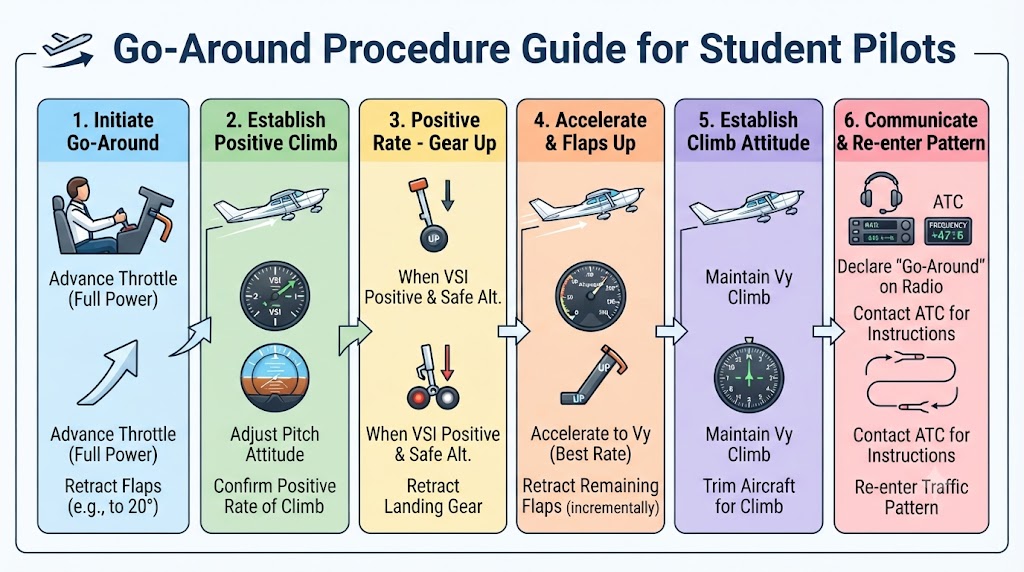
This Go-Around Procedure Guide for Student Pilots explains what a go-around means, why it matters, when it may be needed, and how student pilots can build safe decision-making habits during flight training.
What Is a Go-Around?
A go-around is the decision to stop the landing attempt and climb away safely. Instead of forcing the aircraft to land, the pilot continues flying and usually rejoins the traffic pattern or follows air traffic control instructions.
In simple words, a go-around means: “This landing is not right, so I will try again safely.”
Student pilots should understand that a go-around is normal. It is used by beginner pilots, experienced pilots, airline pilots, and flight instructors.
Why Go-Around Training Matters for Student Pilots
Go-around training teaches student pilots to choose safety over pressure. During landing practice, things may not always go as planned. The aircraft may be too high, too low, too fast, poorly aligned, or affected by wind.
Go-around training helps students improve:
- Landing safety
- Decision-making
- Aircraft control
- Workload management
- Traffic pattern awareness
- Confidence during approach
- Calm thinking under pressure
A pilot who knows when to go around is building professional judgment.
Common Reasons for a Go-Around
There are many reasons why a student pilot may need to go around. Some are caused by the aircraft’s approach, while others are caused by runway, weather, or traffic conditions.
Common reasons include:
- Unstable approach
- Poor runway alignment
- Too much speed on final approach
- Aircraft too high or too low
- Strong or changing wind
- Another aircraft or vehicle on the runway
- Bounced landing
- Traffic conflict
- Instructor decision
- Student feeling unsure or overloaded
The important point is simple: if the landing does not look safe, a go-around is better than forcing the aircraft onto the runway.
Basic Go-Around Learning Flow
A go-around should be learned directly from a flight instructor because exact actions depend on the aircraft and training procedure. However, student pilots can understand the general learning flow.
Recognizing an Unsafe Landing Situation
The first skill is awareness. Students must learn to notice when an approach is becoming unstable or unsafe.
Warning signs may include poor alignment, incorrect speed, wrong descent path, or late corrections.
Making the Decision Early
A delayed go-around can increase risk. Student pilots should learn that it is better to make a safe decision early than to continue hoping the landing will improve.
Following Instructor Guidance
During training, the instructor will guide the student through the proper aircraft-specific procedure. The student should listen carefully and avoid rushing.
Maintaining Aircraft Control
The main goal during any go-around is to keep the aircraft controlled and safe. Smooth control and calm thinking are more important than panic reactions.
Communicating as Required
At controlled airports, pilots may need to follow air traffic control instructions. At nontowered airports, clear communication helps other traffic understand the aircraft’s position and intention.
Rejoining the Traffic Pattern Safely
After the go-around, the aircraft may rejoin the traffic pattern or follow another safe path as instructed. The student should focus on traffic awareness and instructor guidance.
Go-Around Is Not a Failure
Many student pilots feel disappointed when their instructor calls for a go-around. This mindset should change early.
A go-around is not a failed landing. It is a successful safety decision.
Professional pilots go around when needed. Flight instructors teach it because it prevents unsafe landings. A student who chooses to go around at the right time shows good judgment.
In aviation, safety is always more important than pride.
Common Student Pilot Mistakes During Go-Arounds
Go-arounds can feel busy for beginner pilots. Because of this, students may make mistakes during early training.
Common mistakes include:
- Waiting too long to decide
- Trying to save a bad landing
- Rushing the response
- Over-controlling the aircraft
- Forgetting traffic awareness
- Missing radio communication
- Becoming nervous after the decision
- Not listening carefully to instructor guidance
These mistakes are normal during training, but they must be corrected with instructor feedback.
How Flight Instructors Teach Go-Around Procedures
Flight instructors help students understand both the technical and mental side of go-arounds.
An instructor teaches students how to:
- Recognize unstable approaches
- Stay calm during high workload
- Follow proper aircraft procedure
- Maintain aircraft control
- Communicate clearly
- Rejoin the traffic pattern
- Review mistakes after the lesson
At first, the instructor may lead the go-around. Over time, the student learns to recognize the need and respond with more confidence.
Go-Around Safety Tips for Beginners
Student pilots can build safer go-around habits by focusing on awareness and discipline.
Helpful safety tips include:
- Do not force a bad landing
- Make the decision early
- Stay calm and controlled
- Follow instructor guidance
- Maintain traffic awareness
- Use checklists as trained
- Communicate clearly when required
- Review every go-around after the lesson
- Treat go-arounds as normal practice
The safest pilots are not the ones who never go around. The safest pilots are the ones who go around when the situation requires it.
Go-Around Practice in Traffic Pattern Training
Go-around practice is often included during traffic pattern training because it connects directly with landing practice.
In the traffic pattern, students practice approach setup, runway alignment, descent control, communication, and landing decisions. A go-around fits naturally into this training because it teaches what to do when the approach should not continue.
This practice helps students understand that every landing attempt has two safe outcomes:
- A safe landing
- A safe go-around
Both outcomes are part of good pilot training.
How Students Can Prepare Before Go-Around Training
Good preparation helps student pilots feel less nervous during go-around practice.
Before the lesson, students can:
- Review traffic pattern basics
- Study the aircraft checklist with the instructor
- Understand common reasons for go-arounds
- Ask what signs to watch for during approach
- Practice mental rehearsal on the ground
- Review airport communication basics
- Listen carefully during the pre-flight briefing
Preparation does not replace real training, but it helps the student understand what the instructor is teaching.
Why Go-Around Confidence Builds Better Pilots
A student pilot who is comfortable with go-arounds becomes more confident during landing practice. They no longer feel trapped into completing every landing attempt.
This confidence improves safety because the student knows there is always another option. Instead of forcing a poor landing, they can make a better decision and try again.
Go-around confidence builds:
- Better judgment
- Lower stress
- Stronger safety habits
- Better landing discipline
- More professional thinking
FAQs About Go-Around Procedures for Student Pilots
What is a go-around in flight training?
A go-around is when the pilot stops the landing attempt and climbs away safely instead of continuing the landing.
Is a go-around a mistake?
No. A go-around is a normal safety decision. It shows that the pilot is choosing safety instead of forcing an unsafe landing.
When should a student pilot go around?
A student pilot may need to go around when the approach is unstable, runway alignment is poor, speed is not right, or the instructor decides it is safer.
Are go-arounds common during training?
Yes. Go-arounds are a normal part of landing and traffic pattern training for student pilots.
Can a go-around happen after touching the runway?
Yes, in some training situations, an instructor may teach recovery from a bounced or unsafe landing situation. This must be practiced only with instructor guidance.
Why do student pilots delay go-arounds?
Some students delay because they want to complete the landing or feel embarrassed. Training helps them understand that safety comes first.
How can I get better at go-arounds?
Practice with a certified flight instructor, learn to recognize unstable approaches early, stay calm, and review each attempt after the lesson.
Final Thoughts
This Go-Around Procedure Guide for Student Pilots shows that a go-around is not something to fear. It is one of the most valuable safety decisions a pilot can make.
Student pilots should learn early that every approach does not need to end in a landing. If the approach is unstable, the runway is not clear, wind changes, or the landing does not feel safe, a go-around may be the best decision.

