
Introduction
Learning to fly is not only about handling the aircraft in the sky. A big part of pilot training happens close to the airport, especially during takeoff and landing practice. This is where the traffic pattern becomes very important.
A traffic pattern is the planned path aircraft follow around an airport when taking off, landing, or practicing approaches. For student pilots, it helps build discipline, spacing, runway awareness, radio communication, and landing confidence.
This Traffic Pattern Guide for Student Pilots explains the basic parts of the traffic pattern, why it matters, common mistakes, and simple safety tips every beginner should understand.
What Is a Traffic Pattern?
A traffic pattern is a standard rectangular flying path used around an airport runway. It helps pilots organize aircraft movement near the airport so that takeoffs, landings, and practice circuits happen safely.
Think of it like road lanes near a busy junction. Everyone follows a known direction, uses communication, keeps spacing, and watches for other traffic.
Most training flights use the traffic pattern many times because it allows students to practice:
- Takeoffs
- Climbs
- Turns
- Level flight
- Descents
- Radio calls
- Approaches
- Landings
- Go-arounds
The FAA Airplane Flying Handbook explains the downwind leg as a course flown parallel to the landing runway but in the opposite direction of landing. This is one of the most important parts of the pattern for student pilots to understand.
Why Student Pilots Must Learn Traffic Patterns
Traffic pattern training teaches more than just landing practice. It builds a pilot’s habit of thinking ahead.
A student pilot must learn traffic patterns because they help with:
- Safe aircraft spacing
- Correct runway alignment
- Better speed and altitude control
- Better radio communication
- Wind correction practice
- Situational awareness
- Confidence during landing
When a student understands the pattern, they can predict what comes next. This reduces stress and makes training safer.
Main Parts of a Traffic Pattern
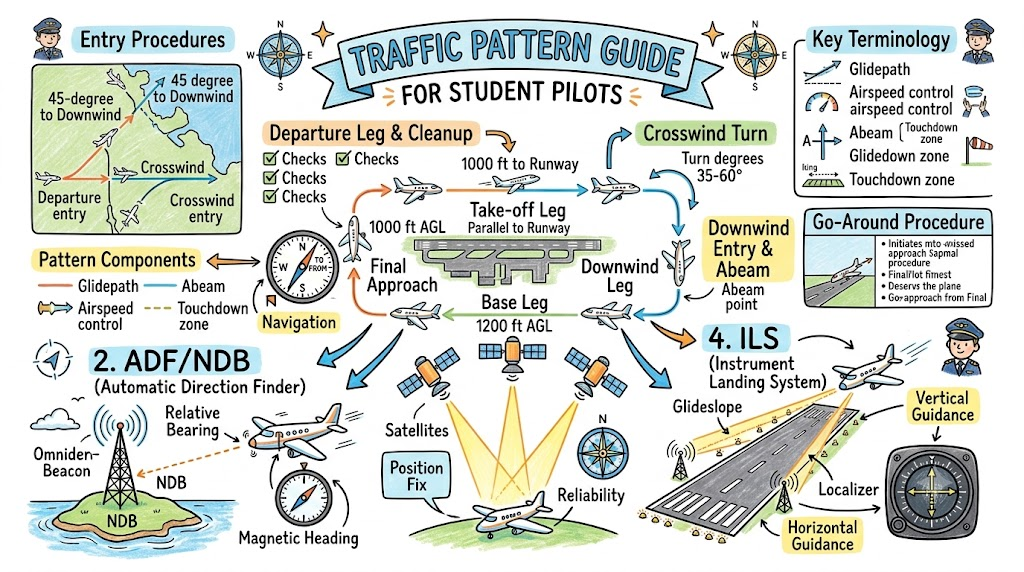
A normal traffic pattern has five main legs. Each leg has a purpose.
1. Upwind Leg
The upwind leg is flown in the direction of landing, usually after takeoff or during a go-around. The aircraft climbs while staying aligned with the runway direction.
For student pilots, this is the time to maintain runway heading, manage climb attitude, and listen for traffic.
2. Crosswind Leg
The crosswind leg is the turn made after departure, usually at a safe altitude and after passing the runway end. This leg is flown across the wind direction.
Students should avoid rushing this turn. A safe crosswind turn depends on altitude, traffic, instructor guidance, and local procedures.
3. Downwind Leg
The downwind leg is flown parallel to the runway but in the opposite direction of landing.
This is one of the busiest parts of the traffic pattern. The pilot checks spacing, completes pre-landing checks, monitors speed, observes the runway, and prepares for descent.
Student pilots often use the downwind leg to build a stable setup before turning base.
4. Base Leg
The base leg connects the downwind leg to the final approach. It is usually flown at a right angle to the runway.
This leg helps the pilot judge distance, descent, wind drift, and runway alignment before turning final.
Turning base too early or too late is a common student mistake. This is why instructors spend a lot of time helping students learn visual judgment.
5. Final Approach
Final approach is the last leg before landing. The aircraft is aligned with the runway centerline and descends toward the touchdown area.
This is where the student must focus on runway alignment, airspeed, descent rate, wind correction, and landing attitude.
If the approach becomes unstable, the correct decision may be to go around. A go-around is a normal safety maneuver, not a failure.
Standard Traffic Pattern Direction
Most airport traffic patterns are left-hand patterns. This means pilots make left turns around the runway.
However, some runways use right-hand traffic patterns because of terrain, noise-sensitive areas, obstacles, nearby airspace, or local airport rules. The FAA AIM states that pilots approaching to land should make all turns to the left unless a traffic pattern indicator shows that turns should be made to the right.
Student pilots should never assume the pattern direction. They should check airport information, listen to radio traffic, observe traffic flow, and follow instructor guidance.
Traffic Pattern Altitude
Traffic pattern altitude is the height aircraft normally fly while in the airport traffic pattern.
It is important because aircraft in the pattern need predictable spacing. If one aircraft is too high and another is too low, it can create confusion or safety risk.
Student pilots should learn the correct pattern altitude for each airport before flying. The FAA Pilot’s Handbook of Aeronautical Knowledge notes that nontowered airport traffic patterns are entered at pattern altitude.
In training, your instructor will teach you how to reach, maintain, and leave pattern altitude safely.
Radio Communication in the Pattern
Radio communication helps pilots know where other aircraft are and what they plan to do.
At controlled airports, pilots follow air traffic control instructions. At nontowered airports, pilots make position reports so other pilots can build a mental picture of traffic.
Common traffic pattern calls may include:
- Entering downwind
- Turning base
- Turning final
- Clear of runway
- Departing the area
Student pilots should keep radio calls short, clear, and accurate. A good radio call tells others who you are, where you are, and what you intend to do.
How to Enter a Traffic Pattern Safely
Entering the pattern safely is one of the most important skills for student pilots.
A common method is to enter on a 45-degree angle to the downwind leg at pattern altitude. This helps the arriving aircraft blend into the flow of traffic.
However, procedures may vary depending on airport type, runway in use, traffic, airspace, weather, and instructor guidance.
Before entering the pattern, student pilots should:
- Check airport information
- Listen to radio traffic
- Look outside carefully
- Confirm runway direction
- Confirm traffic pattern direction
- Maintain proper altitude
- Avoid cutting off other aircraft
The goal is simple: enter smoothly, remain predictable, and avoid surprising other pilots.
Common Mistakes Student Pilots Make
Student pilots often make mistakes in the traffic pattern because many tasks happen quickly. These mistakes are normal during training, but they must be corrected early.
Common traffic pattern mistakes include:
- Flying too close or too far from the runway
- Forgetting pre-landing checks
- Poor altitude control
- Poor airspeed control
- Turning base too early
- Turning final too late
- Overshooting the runway centerline
- Making unclear radio calls
- Not correcting for wind
- Focusing inside the cockpit too much
- Not looking for other aircraft
The best solution is practice with a qualified flight instructor. Traffic pattern flying improves when the student learns to plan earlier instead of reacting late.
Tips to Improve Traffic Pattern Flying
Here are practical tips for student pilots:
Keep Looking Outside
Traffic pattern flying is visual. Do not stare only at instruments. Look outside for runway position, other aircraft, wind drift, and spacing.
Maintain a Stable Speed
Good landings start with good speed control. If speed changes too much, the approach becomes harder to manage.
Use the Same Visual References
Your instructor may teach you how the runway should look from the downwind leg or when to turn base. Repeating the same visual references builds consistency.
Do Not Rush the Pattern
Many beginners fly the pattern too fast mentally. Stay calm and think one step ahead.
Correct for Wind
Wind can push the aircraft closer to or farther from the runway. Student pilots must learn to adjust their ground track.
Make Clear Radio Calls
Radio communication should be calm and simple. Speak clearly and avoid unnecessary words.
Go Around When Needed
A go-around is a smart safety decision when the approach is not stable. Student pilots should treat it as a normal part of training.
Role of the Flight Instructor
The flight instructor plays a major role in traffic pattern training.
An instructor helps the student understand:
- When to turn
- How to judge runway distance
- How to manage power and pitch
- How to correct for wind
- How to communicate clearly
- When to continue the approach
- When to go around
At first, traffic pattern work can feel busy. With practice, the student begins to understand the rhythm of each leg. The instructor’s job is to build safe habits before the student flies alone.
Traffic Pattern Safety Rules
Safety in the traffic pattern depends on discipline and awareness.
Student pilots should remember these basic rules:
- Follow local airport procedures
- Confirm runway and pattern direction
- Maintain proper spacing
- Keep a good lookout
- Listen before transmitting
- Avoid sudden or unexpected turns
- Maintain assigned or recommended altitude
- Respect other aircraft in the pattern
- Follow air traffic control instructions when applicable
- Ask the instructor when unsure
FAA guidance for nontowered airport operations also emphasizes awareness of other traffic and recommends that aircraft staying in the pattern should not begin the crosswind turn until beyond the departure end of the runway and within 300 feet below traffic pattern altitude.
Why Traffic Pattern Practice Builds Pilot Confidence
Traffic pattern practice is one of the best training exercises for student pilots because it repeats many core flying skills in a short time.
In one circuit, a student practices takeoff, climb, turn coordination, level flight, checklist use, descent, approach, landing, radio communication, and decision-making.
That is why flight schools spend so much time on pattern work. A confident pilot is not someone who never makes mistakes. A confident pilot is someone who recognizes problems early and corrects them safely.
FAQs About Traffic Patterns for Student Pilots
What is a traffic pattern in flying?
A traffic pattern is a standard path aircraft follow around an airport runway for takeoff, landing, and circuit practice.
Why do student pilots practice traffic patterns?
Student pilots practice traffic patterns to improve takeoffs, landings, runway awareness, communication, spacing, and aircraft control.
What are the five legs of a traffic pattern?
The five common legs are upwind, crosswind, downwind, base, and final approach.
Are all traffic patterns left-hand patterns?
No. Many are left-hand patterns, but some runways use right-hand patterns. Pilots must check airport information before flying.
What is the most important leg for landing preparation?
The downwind leg is very important because pilots usually complete checks, manage spacing, and prepare for descent before turning base.
What should a student pilot do if the approach is unstable?
The student should follow instructor guidance and go around when needed. A go-around is a safe and normal decision.
Can student pilots fly traffic patterns alone?
Student pilots may fly solo traffic patterns only after proper training, instructor approval, and meeting aviation authority requirements.
Final Thoughts
Mastering the traffic pattern is a key step in becoming a safe and confident pilot. It teaches student pilots how to organize their flying near the airport, communicate clearly, maintain spacing, and prepare for landing.
For beginners, the traffic pattern may feel busy at first. But with regular practice, clear instruction, and good habits, it becomes one of the most valuable parts of flight training.
This Traffic Pattern Guide for Student Pilots is a starting point. Always follow your certified flight instructor, local airport procedures, aircraft checklist, and aviation authority guidance during real flight training.

