
Introduction
Aviation is entering a new era. For many years, most pilot aspirants dreamed of flying commercial aircraft, joining airlines, or becoming military pilots. These careers are still respected and valuable, but the future of flying is expanding far beyond traditional aircraft.
Today, space travel is no longer limited only to government astronauts. Private space companies, commercial spaceflight programs, space tourism, orbital stations, lunar missions, and advanced spacecraft technologies are creating new career opportunities for pilots and aviation students.
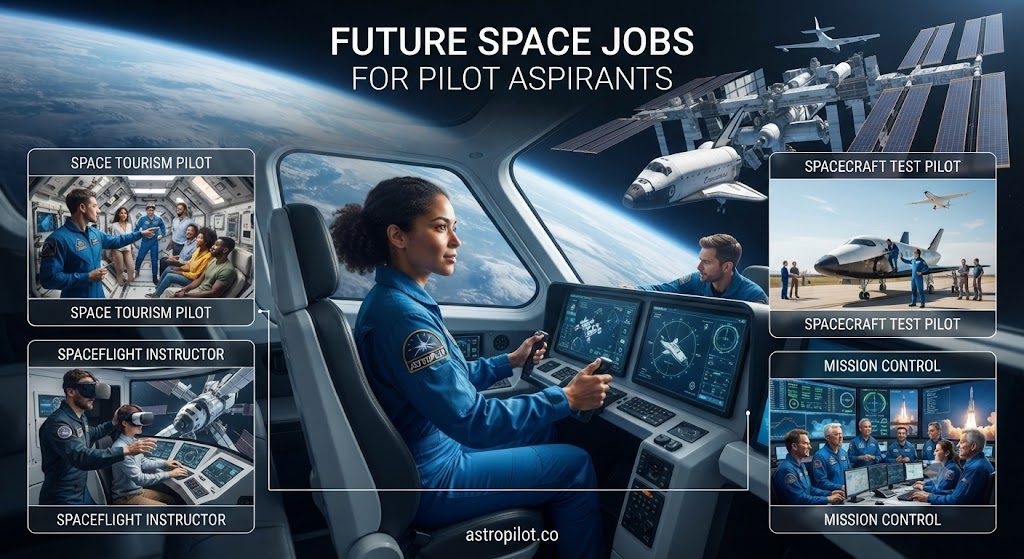
For pilot aspirants, this means the sky is no longer the final limit. The future may include flying spacecraft, supporting space tourism missions, operating orbital vehicles, training astronauts, testing next-generation aerospace systems, or working in mission control.
This blog explains the most exciting future space jobs for pilot aspirants, the skills required, the education path, and how students can begin preparing today.
What Is the Space Aviation Industry?
The space aviation industry combines aviation, aerospace engineering, spacecraft operations, human spaceflight, and advanced flight technologies. It includes both government-led and private commercial space programs.
This industry covers areas such as:
- Commercial spaceflight
- Space tourism
- Suborbital flights
- Orbital transportation
- Space station missions
- Lunar exploration
- Mars mission planning
- Space cargo delivery
- Astronaut training
- Spacecraft testing
- Mission control operations
Earlier, space careers were mainly available through national space agencies. Today, private companies are building reusable rockets, commercial spacecraft, orbital habitats, and passenger spaceflight systems. This shift is opening new doors for pilots, engineers, instructors, researchers, and mission specialists.
Why Pilots Will Play a Bigger Role in Future Space Missions
Pilots already have many qualities needed for space-related careers. They are trained to think clearly, manage risk, understand navigation, follow procedures, communicate with teams, and handle emergencies.
Future space missions will need professionals who can:
- Understand complex flight systems
- Make quick decisions under pressure
- Work with advanced cockpit technologies
- Manage passenger safety
- Support launch and re-entry operations
- Coordinate with mission control
- Handle high-risk environments
- Operate vehicles in unusual flight conditions
Even when spacecraft become more automated, trained pilots and flight specialists will remain important. Human judgment, leadership, emergency handling, and mission awareness cannot be fully replaced by machines.
Top Future Space Jobs for Pilot Aspirants
1- Commercial Space Pilot
A commercial space pilot may operate spacecraft used for private space missions, passenger flights, cargo missions, or orbital transport.
Responsibilities
- Assisting in spacecraft launch and flight operations
- Monitoring flight systems
- Supporting crew and passenger safety
- Managing emergency procedures
- Coordinating with mission control
- Handling manual control if required
Required Skills
- Strong aviation knowledge
- Understanding of spacecraft systems
- Excellent communication
- High medical fitness
- Emergency decision-making
- Advanced simulator training
Commercial space pilot careers may become more common as private spaceflight develops further.
2- Space Tourism Pilot
Space tourism is one of the most exciting future aviation fields. Space tourism pilots may help fly suborbital or orbital passenger missions.
Their role may include:
- Preparing passengers before flight
- Monitoring cabin safety
- Supporting launch and landing operations
- Explaining safety procedures
- Managing passenger comfort
- Responding to unusual situations
This career is ideal for pilot aspirants who are interested in both aviation and customer-facing space travel.
3- Orbital Vehicle Pilot
Orbital vehicle pilots may support missions that travel around Earth or connect with space stations. These vehicles may transport astronauts, researchers, cargo, or private passengers.
Key duties may include:
- Orbital navigation
- Docking support
- Space station approach operations
- Communication with mission control
- Vehicle monitoring
- Re-entry preparation
This role requires deep knowledge of orbital mechanics, spacecraft control, and mission procedures.
4- Lunar Mission Pilot
Future Moon missions may create new career opportunities for pilots and aerospace specialists. Lunar mission pilots may support spacecraft traveling between Earth orbit, lunar orbit, and lunar landing zones.
Possible responsibilities include:
- Supporting lunar transfer missions
- Monitoring spacecraft systems
- Assisting landing operations
- Coordinating with lunar mission teams
- Managing crew safety
- Supporting emergency return planning
As lunar bases and research stations develop, pilot-related jobs may become part of long-term space exploration.
5- Mars Mission Flight Specialist
Mars missions will be among the most complex future space programs. A Mars mission flight specialist may not fly like a traditional pilot, but the role will require advanced flight knowledge, mission planning, navigation awareness, and emergency management skills.
This role may involve:
- Deep-space mission support
- Long-duration crew operations
- Spacecraft systems monitoring
- Navigation planning
- Crew coordination
- Emergency response
Pilot aspirants with strong STEM education and aerospace training may find opportunities in future Mars exploration programs.
6- Spacecraft Test Pilot
A spacecraft test pilot helps test new aerospace vehicles before they are used for regular missions. This is one of the most challenging and respected roles in future space aviation.
Responsibilities
- Testing experimental spacecraft
- Evaluating flight performance
- Reporting technical issues
- Working with engineers
- Handling high-risk test conditions
- Supporting safety improvements
This career usually requires exceptional flying experience, technical knowledge, and strong physical and mental fitness.
7- Aerospace Research Pilot
Aerospace research pilots fly or support experimental aircraft, high-altitude vehicles, and advanced flight systems. Their work helps improve future aircraft and spacecraft designs.
They may work with:
- Prototype aircraft
- Supersonic vehicles
- High-altitude research aircraft
- Spaceplane concepts
- Advanced propulsion systems
- Automated flight systems
This role is suitable for pilot aspirants who enjoy technology, testing, research, and innovation.
8- Space Mission Operations Specialist
Not every space career requires physically flying a spacecraft. Many pilots can transition into mission operations because they understand flight planning, procedures, communication, and safety.
Mission operations specialists may work in mission control and support:
- Launch operations
- Flight monitoring
- Crew communication
- Emergency planning
- Mission timelines
- Data review
This is a strong career option for pilots who want to work in the space industry without becoming astronauts.
9- Space Flight Instructor
As commercial spaceflight grows, training will become extremely important. Space flight instructors may train future astronauts, commercial space pilots, space tourists, and mission crew members.
They may teach:
- Spacecraft systems
- Safety procedures
- Simulator operations
- Emergency response
- Crew communication
- Passenger preparation
Experienced pilots and instructors may find excellent opportunities in this field.
10- Aerospace Simulation Instructor
Simulation is a major part of aviation and space training. Aerospace simulation instructors help students and professionals practice complex spaceflight situations in a safe environment.
They may work with:
- Spacecraft simulators
- Virtual reality systems
- AI-based training tools
- Emergency training modules
- Docking simulations
- Re-entry training
This role is ideal for pilots who enjoy teaching, technology, and advanced training environments.
11- Space Safety Officer
Space missions involve high risk. Space safety officers help reduce that risk by planning, checking, and improving safety systems.
Responsibilities may include:
- Reviewing mission safety plans
- Checking emergency procedures
- Supporting crew readiness
- Monitoring risk factors
- Ensuring safety compliance
- Preparing response plans
Pilot training is useful in this role because pilots understand operational discipline and safety culture.
12- Autonomous Spacecraft Supervisor
Future spacecraft may use artificial intelligence and automation, but human supervision will still be needed. Autonomous spacecraft supervisors may monitor automated systems and take action when needed.
This role may include:
- Watching autonomous flight systems
- Reviewing AI decisions
- Managing system alerts
- Supporting manual override procedures
- Coordinating with technical teams
- Ensuring mission safety
Pilot aspirants who learn AI, robotics, and spacecraft systems may be well prepared for this future role.
13- Space Logistics Coordinator
As space stations, lunar bases, and orbital platforms grow, logistics will become a major career field. Space logistics coordinators may plan the movement of cargo, equipment, fuel, and crew.
They may help manage transportation between:
- Earth and orbit
- Space stations
- Lunar orbit
- Moon bases
- Research platforms
This job requires strong planning, aviation knowledge, technical awareness, and mission coordination skills.
Skills Needed for Future Space Careers
Pilot aspirants who want space careers should build a wide skill set. Flying knowledge alone may not be enough.
Important skills include:
- Aviation fundamentals
- Mathematics
- Physics
- Aerospace systems
- Navigation
- Communication
- Leadership
- Problem-solving
- Crew resource management
- Emergency decision-making
- Basic programming
- AI awareness
- Robotics basics
- Simulator training
- Physical fitness
- Mental resilience
- English communication
The best future candidates will combine pilot discipline with scientific and technical knowledge.
Educational Path for Pilot Aspirants
A possible path may look like this:
Step 1: Build a Strong School Foundation
Students should focus on mathematics, physics, English, and computer science. These subjects create the foundation for aviation and space careers.
Step 2: Choose Aviation or Aerospace Education
A degree in aerospace engineering, aviation, mechanical engineering, physics, computer science, or related STEM fields can be helpful.
Step 3: Start Pilot Training
Pilot aspirants may pursue private pilot training, commercial pilot training, or military aviation depending on their goals.
Step 4: Gain Flight Experience
Flight hours, simulator experience, and real-world aviation discipline are valuable for future space careers.
Step 5: Learn Space Systems
Students should study spacecraft systems, orbital mechanics, propulsion basics, human spaceflight, and mission operations.
Step 6: Use Advanced Simulators
Spaceflight simulators, VR tools, and aerospace training programs can help build practical understanding.
Step 7: Specialize in Space Aviation
Candidates can later focus on commercial spaceflight, mission operations, astronaut training, spacecraft testing, or aerospace research.
Difference Between Airline Pilot and Space Pilot
| Factor | Airline Pilot | Space Pilot |
|---|---|---|
| Work Environment | Earth atmosphere | Suborbital, orbital, or deep-space environment |
| Vehicle | Commercial aircraft | Spacecraft or spaceplane |
| Main Role | Passenger or cargo flight | Space mission operation |
| Training | Flight school and airline training | Aviation, aerospace, simulator, and space systems training |
| Navigation | Air routes and airports | Orbital paths, launch windows, docking, re-entry |
| Medical Standards | High | Extremely high |
| Mission Type | Regular scheduled flights | Specialized space missions |
| Technology | Aircraft systems | Spacecraft, robotics, AI, life-support systems |
| Risk Level | Highly controlled | More complex and mission-specific |
| Career Growth | Airlines, cargo, training, management | Space tourism, mission control, research, spacecraft testing |
Companies and Organizations Creating Future Space Careers
Several organizations are helping create future space career opportunities. Pilot aspirants should follow developments in both government and private sectors.
SpaceX
SpaceX is known for reusable rockets, crew transportation, cargo missions, and future deep-space plans. It creates opportunities in spacecraft operations, mission control, engineering, and commercial spaceflight.
Blue Origin
Blue Origin works on reusable launch systems and space tourism. Its projects may support future careers in passenger spaceflight, safety, and spacecraft operations.
Virgin Galactic
Virgin Galactic focuses on commercial space tourism. This area may create opportunities for pilots, instructors, passenger safety specialists, and training teams.
Sierra Space
Sierra Space is involved in spaceplane and commercial space station concepts. Such projects may create roles in spacecraft operations, testing, and mission support.
Axiom Space
Axiom Space works on commercial space station development and private astronaut missions. This may open opportunities in astronaut training, mission operations, and orbital activities.
Rocket Lab
Rocket Lab supports launch services and space systems. Future roles may include mission planning, launch operations, and aerospace technical careers.
NASA
NASA remains one of the most important organizations for human spaceflight, research, astronaut missions, and deep-space exploration.
ESA
The European Space Agency supports space science, exploration, astronaut programs, and international missions.
ISRO
ISRO plays a major role in space research, launch systems, satellite missions, and human spaceflight development.
JAXA
Japan’s space agency contributes to space exploration, research, technology development, and international mission cooperation.
Emerging Technologies Creating New Jobs
Future space jobs will grow because of new technologies. Pilot aspirants should understand these trends.
Artificial Intelligence
AI will help spacecraft monitor systems, detect risks, support navigation, and improve training.
Robotics
Robots will assist in space stations, lunar bases, Mars missions, and spacecraft maintenance.
Autonomous Spacecraft
Spacecraft will become more automated, but human supervision will remain essential.
Digital Twins
Digital twins can create virtual models of spacecraft for testing, training, and mission planning.
Virtual Reality Training
VR will help pilots and astronauts practice emergency situations and complex mission tasks.
Reusable Rockets
Reusable launch systems can reduce mission costs and increase flight frequency.
Advanced Propulsion
New propulsion concepts may support faster and more efficient space travel.
Human-Machine Collaboration
Future pilots may work closely with AI systems, automated controls, and robotic assistants.
Challenges Future Space Pilots Must Prepare For
Space careers are exciting, but they are not easy. Pilot aspirants must prepare for challenges such as:
- Strong competition
- Expensive training
- High medical standards
- Physical fitness requirements
- Advanced technical learning
- Long preparation timelines
- Rapid technology changes
- Limited early opportunities
- High responsibility
- Continuous skill upgrades
Success in this field requires patience, discipline, and long-term commitment.
How Students Can Start Preparing Today
Students do not need to wait for a space job opening to begin preparing. They can start now.
Practical steps include:
- Study mathematics and physics seriously
- Improve English communication
- Learn aviation basics
- Read about space missions
- Practice flight simulation
- Build physical fitness
- Learn basic coding
- Study robotics and AI concepts
- Join aerospace clubs or communities
- Follow space industry updates
- Develop leadership skills
- Practice problem-solving
- Learn teamwork and communication
Small steps taken early can create a strong foundation for future space aviation careers.
Future Outlook for Space Careers
The future of aviation is moving toward space. Commercial spaceflight, private astronaut missions, orbital stations, space tourism, lunar exploration, and Mars mission planning may create career paths that did not exist before.
Pilot aspirants may find opportunities in:
- Space tourism operations
- Commercial astronaut training
- Spacecraft testing
- Orbital transportation
- Mission control
- Lunar logistics
- Aerospace simulation
- Space safety
- AI-supervised spacecraft operations
- Human spaceflight support
The industry is still developing, but students who prepare early may have an advantage when these careers become more common.
Frequently Asked Questions
1. Can pilots become astronauts?
Yes, pilots can become astronauts if they meet the required education, medical, physical, and professional standards. Many astronauts have aviation backgrounds because pilots are trained in navigation, decision-making, emergency handling, and crew coordination. However, pilot experience alone is not enough. Candidates usually need strong academic qualifications, technical knowledge, physical fitness, and mission-related skills. A background in science, engineering, or aerospace can improve the chances.
2. Will commercial pilots be needed in space tourism?
Commercial pilots may have opportunities in space tourism, especially if they gain additional training in spacecraft systems, passenger safety, and high-altitude or suborbital operations. Space tourism vehicles may be highly automated, but trained pilots and flight specialists can still play an important role in safety, passenger management, and emergency response. Experienced pilots with strong communication and technical skills may be well suited for this field.
3. What degree is best for future space careers?
Useful degrees include aerospace engineering, mechanical engineering, aviation, physics, computer science, electrical engineering, and related STEM fields. The best degree depends on the career goal. Someone interested in spacecraft design may choose aerospace engineering, while someone interested in AI-supported spacecraft may study computer science. Pilot aspirants should combine aviation training with technical education for stronger future opportunities.
4. Is aerospace engineering necessary to become a space pilot?
Aerospace engineering is helpful, but it may not always be mandatory. Future space pilot roles may require a combination of flight experience, technical knowledge, simulator training, and spacecraft systems understanding. However, aerospace engineering can provide a strong advantage because it teaches aerodynamics, propulsion, structures, orbital concepts, and space systems. Students who cannot study aerospace engineering can still build relevant skills through aviation, physics, or other STEM paths.
5. How difficult is space pilot training?
Space pilot training is expected to be very challenging. It may include advanced simulator sessions, spacecraft systems training, emergency procedures, physical fitness preparation, medical checks, and mission operations practice. Candidates must be mentally strong, technically skilled, and able to perform under pressure. The training may be more demanding than regular flight training because space missions involve extreme conditions and complex systems.
6. Which companies may hire space pilots in the future?
Future space pilot and mission-related roles may come from private space companies, aerospace firms, government space agencies, research organizations, and commercial space tourism companies. Opportunities may exist in spacecraft operations, training, testing, safety, and mission control. Candidates should follow developments in commercial spaceflight, private astronaut programs, orbital stations, and space tourism because these areas may create new aviation-related jobs.
7. What skills are most valuable for space careers?
The most valuable skills include aviation knowledge, mathematics, physics, communication, leadership, emergency decision-making, technical problem-solving, simulator experience, and understanding of spacecraft systems. Future candidates may also benefit from coding, robotics, AI awareness, and systems thinking. Physical fitness and mental resilience are also important because space-related roles can be stressful and demanding.
8. Can airline pilots switch to space careers?
Yes, airline pilots may be able to switch to space-related careers if they develop additional technical and space-specific skills. Their experience in flight operations, crew coordination, safety procedures, and emergency handling can be useful. However, they may need further training in spacecraft systems, orbital operations, space medicine, simulator procedures, and mission control processes. Continuous learning is essential for making this transition.
9. Is AI replacing space pilots?
AI will support space pilots, but it is unlikely to remove the need for trained humans completely. Spacecraft may use automation for navigation, monitoring, and system control, but human judgment remains important in unusual situations, emergencies, passenger safety, and mission leadership. Future space pilots may work with AI rather than compete against it. Learning how AI systems function can make pilot aspirants more future-ready.
10. What is the future salary potential in space careers?
Salary potential in space careers can vary widely depending on the role, company, country, experience, and technical expertise. Highly specialized roles such as spacecraft test pilot, mission operations specialist, aerospace research pilot, or commercial spaceflight instructor may offer strong earning potential as the industry grows. However, students should focus first on building skills, education, and experience because space careers are highly competitive and skill-based.
Conclusion
Future space jobs for pilot aspirants are no longer just science fiction. The aviation industry is moving toward a new frontier where pilots, engineers, instructors, mission specialists, and safety professionals may work together to support commercial spaceflight and human exploration beyond Earth.
For students and aspiring pilots, this is the right time to start preparing. Strong aviation knowledge, STEM education, physical fitness, communication skills, simulator practice, and curiosity about space technology can build a powerful foundation.
The future pilot may not only fly aircraft between cities but may also support missions to orbit, the Moon, and beyond. For those who dream big, stay disciplined, and keep learning, space aviation can become one of the most exciting career paths of the future.
To explore more guides on space aviation careers, astronaut pathways, and future pilot opportunities, continue learning with astropilot.co.

