
Introduction
Modern plastic surgery is available in many parts of the world. Patients can now research hospitals, surgeons and treatment options across several countries before choosing where to have a procedure.
However, selecting a destination requires more than identifying a country known for cosmetic treatment. Hospital standards, surgeon qualifications, anesthesia care, emergency support, infection control, communication and aftercare may vary between facilities in the same country.
The latest completed global survey from the International Society of Aesthetic Plastic Surgery reported nearly 38 million surgical and non-surgical aesthetic procedures in 2024. More than 17.4 million of these were surgical procedures, showing the wide international availability of cosmetic treatment.
BestCosmeticHospitals.com helps patients organize this research by comparing cosmetic hospitals, surgeons, procedures, destinations and estimated treatment expenses. Its information should be used as a starting point, while all medical credentials and hospital claims must be independently verified.
Understanding Global Plastic Surgery Destinations
A global plastic surgery destination is a country or city that receives local and international patients for cosmetic, aesthetic or reconstructive procedures.
These destinations may offer:
- Specialist plastic surgery hospitals
- Private surgical centres
- Experienced procedure-specific surgeons
- Modern operating theatres
- International patient coordinators
- Translation assistance
- Diagnostic services
- Recovery facilities
- Treatment packages
- Virtual consultations
- Follow-up support
The presence of modern hospitals does not mean every clinic in a destination provides the same standard of care. Patients must evaluate the exact hospital, surgeon and operating location rather than judging safety from the country’s general reputation.
Why Patients Consider Plastic Surgery Abroad
People may explore cosmetic surgery abroad for several reasons.
Some want access to a surgeon who performs a particular procedure regularly. Others may be comparing treatment availability, waiting times, privacy, hospital services or estimated costs.
Common reasons include:
- Access to procedure-specific expertise
- Wider hospital and surgeon selection
- Different surgical techniques
- International patient support
- Potential cost differences
- Availability of combined services
- Easier appointment scheduling
- Cultural or language preferences
- Family connections in another country
Cost may influence the decision, but it should never become the only selection factor. ISAPS advises patients considering treatment abroad to research the country’s safety requirements, select a properly trained surgeon and create a clear plan for surgery and postoperative care.
What Makes a Strong Plastic Surgery Destination?
A responsible destination comparison should examine the complete healthcare environment.
Regulated Hospitals and Clinics
Hospitals should hold valid licences from the appropriate national or regional healthcare authority.
The licence should cover:
- The treatment facility
- Surgical services
- Anesthesia services
- Overnight care when provided
- Diagnostic services
- Emergency arrangements
Patients should confirm that the procedure will take place at the licensed location named in their documents.
Qualified Plastic Surgeons
A surgeon should have recognized training and registration in plastic, reconstructive or aesthetic surgery according to the country’s professional system.
The patient should confirm:
- Medical registration
- Specialist recognition
- Board certification or national equivalent
- Procedure-specific experience
- Hospital privileges
- Professional disciplinary status
- Continuing medical education
Certification systems differ internationally. ISAPS therefore recommends checking whether an overseas surgeon is certified or holds the recognized equivalent in that country and is properly trained for the planned procedure.
Modern Clinical Facilities
Modern facilities may include:
- Properly equipped operating theatres
- Digital patient records
- Advanced monitoring equipment
- Sterilization systems
- Diagnostic imaging
- Accredited laboratories
- Trained recovery nurses
- Intensive-care access
- Emergency transfer arrangements
- Infection-control teams
Technology is valuable, but equipment alone cannot prove safety. It must be supported by trained staff, maintenance, proper protocols and responsible clinical decisions.
International Patient Services
Hospitals treating overseas patients may provide:
- Language coordinators
- Remote consultations
- Visa documentation
- Airport assistance
- Accommodation guidance
- Written treatment plans
- Discharge summaries
- Postoperative communication
These services can make treatment easier to arrange, but they should not be confused with clinical quality.
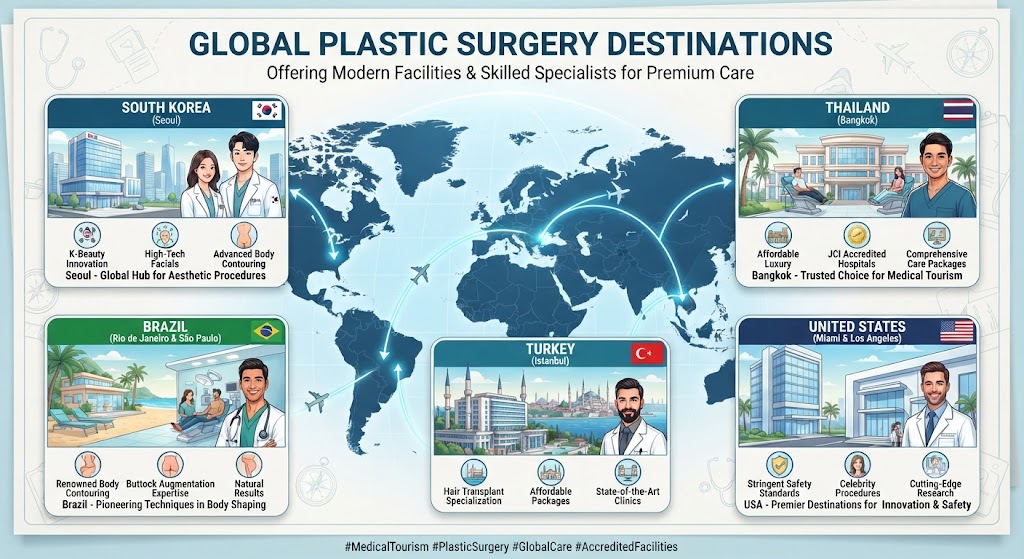
Prominent Plastic Surgery Destinations to Research
The following destinations represent established or growing international cosmetic treatment markets. They are not presented as a fixed ranking, and no country is automatically suitable for every patient.
United States
The United States recorded the highest total number of aesthetic procedures in the ISAPS 2024 survey. Patients can find large medical centres, independent surgical facilities and surgeons working across facial, breast, body and reconstructive procedures.
Patients should verify board certification, hospital privileges and facility accreditation. They should also request a complete cost estimate because fees for the surgeon, anesthesia, operating facility and follow-up may be listed separately.
Brazil
Brazil has a long-established plastic surgery sector and recorded the highest number of surgical aesthetic procedures in the ISAPS 2024 survey.
Patients may find specialists working across body contouring, breast surgery, facial procedures and reconstructive care. However, every surgeon’s individual qualifications, hospital access and complication-management process must still be checked.
International patients should also consider Portuguese-language communication, travel time and the length of stay required after surgery.
Japan
Japan ranked among the countries with the highest overall aesthetic procedure volume in the ISAPS global survey.
Patients researching Japan should compare hospital licensing, specialist registration, communication support and the availability of their specific procedure. Some facilities may focus mainly on non-surgical treatment, while others provide operations requiring anesthesia and structured recovery care.
Türkiye
Türkiye has become a widely researched destination for procedures such as rhinoplasty, hair transplantation, body contouring and breast surgery.
The ISAPS survey placed Türkiye among the countries reporting a high proportion of foreign patients.
Many providers offer combined treatment, accommodation and transport packages. Patients should separate travel conveniences from medical services and confirm:
- Who performs the procedure
- Where surgery takes place
- Who provides anesthesia
- What follow-up is included
- What happens if complications develop
- Whether the quoted price includes additional care
United Arab Emirates
The United Arab Emirates has private hospitals and specialist clinics serving a highly international population. It was also among the countries reporting a high proportion of foreign aesthetic patients in the ISAPS survey.
International patients may value multilingual staff, modern infrastructure and strong air connectivity. Nevertheless, hospital licensing, specialist registration and complete cost information must be verified before booking.
Colombia
Colombia has an active cosmetic surgery sector and was listed by ISAPS among the countries with a high proportion of overseas patients.
Patients commonly research body contouring, breast procedures and facial surgery. A careful comparison should include the surgeon’s credentials, operating facility, anesthesia provider, emergency support and the recommended period before flying home.
Tunisia
Tunisia also reported a high proportion of foreign aesthetic patients in the ISAPS survey.
Patients may encounter bundled medical travel arrangements combining surgery, accommodation and local assistance. Each part of the package should be reviewed separately, particularly clinical care, recovery supervision, emergency arrangements and revision policies.
South Korea
South Korea has developed systems for registering healthcare institutions that treat overseas patients. Medical Korea, operated through the Korea Health Industry Development Institute, provides information on registered facilities and the Korean Accreditation Program for Hospitals Serving Foreign Patients.
Patients should still check whether the facility is a full hospital or a smaller clinic, who provides anesthesia, whether emergency support is available and how postoperative communication will be managed after returning home.
Thailand
Thailand has promoted medical tourism for many years, including cosmetic surgery and other private healthcare services. Recent Thai government information continues to describe the country’s medical-hub strategy and international patient services.
Patients may find large private hospitals, international departments and multilingual coordinators. The exact surgeon, surgical facility, accreditation status and recovery plan remain more important than the destination’s general popularity.
Global Destination Comparison Table
| Destination | Why Patients Research It | Important Verification | Main Travel Consideration |
|---|---|---|---|
| United States | High procedure volume and broad specialist availability | Board certification, facility accreditation and complete fees | Potentially significant total treatment expenses |
| Brazil | Large surgical sector and varied procedure availability | Specialist registration and hospital privileges | Language, long-distance travel and recovery time |
| Japan | Established aesthetic treatment market | Procedure availability and communication support | Language and local care arrangements |
| Türkiye | International treatment packages and varied procedures | Surgeon identity, anesthesia and hospital licensing | Avoid selecting packages on price alone |
| UAE | International hospitals and multilingual services | Facility licence and specialist registration | Accommodation and total living expenses |
| Colombia | Active overseas-patient market | Emergency support and postoperative supervision | Long flights after body procedures |
| Tunisia | Medical travel packages and foreign-patient services | Clinical standards and revision terms | Separation of medical and tourism services |
| South Korea | Registered foreign-patient institutions and specialist clinics | Facility type, anesthesia and emergency systems | Communication after returning home |
| Thailand | Private hospitals and established international services | Accreditation and procedure-specific surgeon experience | Adequate recovery before tourism or flying |
This table provides an initial research framework, not a ranking or medical recommendation.
Matching the Destination to the Procedure
The best destination for one procedure may not be the right choice for another.
Patients should first identify the procedure they are considering and then search for hospitals and specialists with relevant experience.
Rhinoplasty
Rhinoplasty involves changing the structure or appearance of the nose. Some procedures may also address breathing or previous surgical problems.
When comparing rhinoplasty destinations, examine:
- Facial plastic or plastic surgery training
- Primary and revision rhinoplasty experience
- Functional breathing assessment
- Imaging or surgical planning
- Anesthesia support
- Follow-up after swelling changes
- Management of revision cases
A rhinoplasty cost-by-country comparison should include surgeon fees, anesthesia, hospital costs, medical tests and postoperative reviews.
Liposuction
Liposuction removes selected areas of fat to change body contour. It is not a treatment for general weight loss.
Important comparison factors include:
- Areas being treated
- Total volume planned
- Technology used
- Length of surgery
- Blood-clot prevention
- Compression garments
- Overnight monitoring
- Surgeon experience
- Emergency support
Liposuction cost by country may change according to the number of treatment areas and whether another operation is performed at the same time.
Breast Augmentation
Breast augmentation may use implants or, in selected cases, fat transfer.
Patients should research:
- Implant manufacturer
- Implant type and size
- Surgeon’s breast surgery experience
- Implant tracking records
- Hospital infection-control standards
- Long-term monitoring
- Revision and removal policies
- Management after returning home
Breast augmentation cost by country should be considered together with possible future expenses because implants may require monitoring or additional surgery.
Tummy Tuck Surgery
A tummy tuck removes selected excess skin and may involve repair of separated abdominal muscles.
Destination research should include:
- Body-contouring experience
- Blood-clot risk assessment
- Drain and wound care
- Length of hospital stay
- Mobility after surgery
- Emergency access
- Support at accommodation
- Travel restrictions
Tummy tuck cost by country may be affected by procedure complexity, hospital stay, muscle repair and combined liposuction.
Hair Transplantation
Hair transplantation usually involves moving follicles from a donor area to an area of hair loss.
Important considerations include:
- Diagnosis of the hair-loss cause
- Surgeon involvement
- Qualifications of technicians
- Donor-area planning
- Follicular unit extraction or other technique
- Sterile procedure environment
- Number of grafts
- Medication and aftercare
- Long-term hair-loss planning
Hair transplant cost by country may be quoted per graft or as a package. Patients should confirm which parts of the procedure are performed by the doctor and which are delegated.
Modern Facilities Do Not Automatically Guarantee Better Care
Marketing photographs often highlight advanced equipment, modern interiors and luxury recovery rooms.
These features may improve comfort, but they do not prove that the facility has:
- Proper clinical governance
- Qualified staff
- Strong infection control
- Safe anesthesia care
- Emergency readiness
- Reliable complication reporting
- Responsible patient selection
Hospital accreditation can provide additional evidence because accreditation standards may cover anesthesia, surgery, infection prevention, staff qualifications, medication management, patient rights and facility safety. JCI explains that its accreditation process includes an onsite survey to assess compliance with these areas.
Accreditation remains one part of the evaluation. Patients should check its scope, expiration date and whether it applies to the exact treatment location.
How to Evaluate a Skilled Plastic Surgery Specialist
The best cosmetic surgeons in the world are not defined only by social media popularity, celebrity patients or large numbers of followers.
A specialist should be evaluated through evidence.
Confirm Professional Registration
Search the official medical regulator in the country where the surgeon works.
Check:
- Full professional name
- Registration number
- Current licence
- Recognized specialty
- Restrictions or conditions
- Disciplinary records where available
Review Procedure-Specific Experience
Ask how regularly the surgeon performs the exact operation.
A surgeon may be experienced in one area of plastic surgery without having the same expertise in every procedure.
Examine Hospital Privileges
Hospital privileges mean the surgeon has formal permission to perform specific operations at a facility.
Ask whether the surgeon performs the same procedure in an accredited hospital, even when the planned operation is at an independent clinic.
Discuss Complications Openly
A qualified surgeon should explain:
- Common risks
- Less common serious risks
- Personal risk factors
- Warning signs
- Emergency treatment
- Revision possibilities
- Expected limitations
Be cautious when a surgeon promises perfection or describes the procedure as completely risk-free.
Ask About the Complete Medical Team
Safe surgery involves more than the operating surgeon.
Confirm the qualifications of:
- Anesthetist
- Assistant surgeon
- Surgical nurses
- Recovery nurses
- Wound-care team
- Emergency staff
ASPS patient-safety guidance emphasizes selecting a properly qualified plastic surgeon who operates in an accredited, licensed or otherwise appropriately certified surgical facility.
Surgical Safety Systems to Look For
Patients should ask whether the facility uses a structured surgical safety checklist.
The WHO Surgical Safety Checklist contains checks at three critical stages:
- Before anesthesia
- Before the surgical incision
- Before the patient leaves the operating room
Its purpose is to reduce preventable errors while improving teamwork and communication between surgical staff.
Additional safety systems may include:
- Correct patient and procedure confirmation
- Surgical-site marking
- Allergy checks
- Implant documentation
- Instrument counts
- Antibiotic protocols
- Blood-clot prevention
- Recovery-room monitoring
- Emergency drills
- Incident reporting
- Infection surveillance
Patients do not need to understand every clinical detail, but the hospital should be able to explain its safety process clearly.
Comparing Plastic Surgery Costs by Country
Plastic surgery cost by country can provide a useful starting point, but advertised prices may not represent the complete expense.
A full quotation should identify:
- Surgeon’s professional fee
- Assistant surgeon’s fee
- Anesthesia
- Hospital or operating-room charges
- Medical tests
- Implants or surgical materials
- Medication
- Compression garments
- Overnight stay
- Nursing care
- Follow-up visits
- Accommodation
- Local transport
- Flights
- Extended recovery
- Emergency treatment
- Revision surgery
Two quotations that appear very different may include different services.
Patients should request the information in writing and ask what happens financially when:
- Surgery is postponed
- A medical test identifies a problem
- An additional hospital night is required
- A complication develops
- Travel must be extended
- Revision treatment is recommended
All published price ranges should be treated as estimates rather than guaranteed personal quotations.
Planning Recovery in Another Country
Recovery should determine the travel schedule, not sightseeing plans or the cheapest flight date.
Before leaving for treatment, confirm:
- Recommended length of stay
- Location of postoperative appointments
- Availability of nursing support
- Accommodation accessibility
- Transport after surgery
- Medication instructions
- Wound-care arrangements
- Emergency contact numbers
- Fitness-to-fly guidance
- Follow-up after returning home
Long flights soon after surgery may be uncomfortable and may be unsafe for some patients. Individual travel advice should come from the treating surgeon and, where appropriate, the patient’s regular doctor.
Risks of Choosing a Destination Mainly Through Package Advertising
International treatment packages can be convenient, but they may combine very different services under one price.
A package may include:
- Surgery
- Hotel
- Transfers
- Translation
- Meals
- Tourism activities
The medical quality of a procedure cannot be judged from the hotel standard or transport service.
Warning signs include:
- Pressure to pay immediately
- No direct surgeon consultation
- Unclear surgeon identity
- Surgery approved only through photographs
- Guaranteed results
- Unverified qualifications
- No named anesthesia professional
- No emergency plan
- Tourism scheduled immediately after surgery
- No written complication policy
- No follow-up after departure
A travel coordinator may assist with logistics, but treatment suitability should be determined by a qualified medical professional.
Questions to Ask Before Choosing a Destination
- Is the hospital or clinic legally licensed for surgery?
- Does it hold current accreditation?
- Is the accreditation valid for the treatment location?
- Who will perform the operation?
- Is the surgeon registered as a plastic surgery specialist?
- How often does the surgeon perform this procedure?
- Who will provide anesthesia?
- Does the facility use a formal surgical safety checklist?
- What emergency equipment is available?
- Is intensive-care support available?
- How are infections monitored?
- What tests are required before surgery?
- How long must I stay in the country?
- What postoperative appointments are included?
- Who will manage complications after I return home?
- What is excluded from the quotation?
- What is the hospital’s written revision policy?
- Will I receive complete medical and implant records?
How BestCosmeticHospitals.com Supports Global Research
BestCosmeticHospitals.com offers a structured place to begin comparing:
- Global plastic surgery destinations
- Cosmetic hospitals
- Plastic surgeons
- Popular procedures
- Treatment-cost factors
- Hospital services
- Recovery expectations
- International patient support
- Safety questions
Patients can use these comparisons to create a shortlist before contacting hospitals directly.
The platform should not replace independent credential checks, an individual medical assessment or consultation with qualified professionals. No website can guarantee the safety, suitability or outcome of a cosmetic procedure.
Common Destination-Selection Mistakes
Patients should avoid:
- Choosing only by price
- Assuming every hospital in a popular country is safe
- Treating accreditation as a result guarantee
- Failing to verify the operating surgeon
- Confusing a coordinator with a medical professional
- Ignoring anesthesia qualifications
- Booking multiple procedures without proper assessment
- Planning tourism during early recovery
- Flying home too quickly
- Overlooking extra treatment expenses
- Accepting verbal revision promises
- Depending only on social media reviews
- Failing to plan local follow-up at home
Careful research may take longer, but it helps patients ask better questions and identify missing information before paying a deposit.
Final International Treatment Checklist
Before confirming cosmetic surgery abroad, ensure that you have:
- Verified the hospital licence
- Confirmed accreditation details
- Checked the surgeon’s registration
- Reviewed procedure-specific experience
- Identified the anesthesia professional
- Completed a medical suitability assessment
- Received a written treatment plan
- Understood all possible risks
- Received an itemized quotation
- Confirmed emergency support
- Reviewed the complication policy
- Reviewed the revision policy
- Planned enough recovery time
- Confirmed travel guidance
- Arranged support after discharge
- Planned follow-up at home
- Saved copies of all records and receipts
Frequently Asked Questions
1. Which country is considered the best for plastic surgery?
There is no single best country for every patient or procedure. The right option depends on hospital standards, surgeon expertise, personal health, procedure type, costs and follow-up requirements.
2. Are modern cosmetic hospitals automatically safer?
No. Modern equipment and attractive facilities are useful, but safety also depends on qualified staff, infection control, anesthesia care, patient selection and emergency systems.
3. How can patients verify an overseas plastic surgeon?
Patients should search the country’s official medical register and confirm specialist status, licence validity and disciplinary information. Professional society membership may provide additional evidence.
4. Is international hospital accreditation necessary?
Accreditation can be a useful quality indicator, but it is not the only acceptable system. Patients should also examine national licensing, inspections, emergency care and surgeon qualifications.
5. Why are plastic surgery costs different between countries?
Costs may vary because of professional fees, hospital expenses, local wages, medical regulation, implants, anesthesia, currency values and services included in the quotation.
6. Can surgery and a holiday be planned together?
Early recovery is generally not a suitable time for intensive tourism. Patients should prioritize rest, follow-up appointments and medical advice before planning recreational activities.
7. How long should a patient remain abroad after surgery?
The required stay depends on the procedure, health condition and recovery progress. The operating surgeon should provide individual guidance before travel is booked.
8. What happens when complications appear after returning home?
Patients should have written instructions, complete medical records and an overseas emergency contact. They should also arrange access to an appropriate doctor or hospital at home.
9. Are cosmetic surgery packages reliable?
Some packages may be well organized, but package convenience does not prove clinical quality. Every medical service, provider, facility and cost should be evaluated separately.
10. Should patients choose the destination before choosing the surgeon?
The procedure and qualified specialist should usually guide the search. Selecting a country first may cause patients to overlook a more suitable surgeon or facility elsewhere.
Conclusion
Global plastic surgery destinations can offer modern facilities, experienced specialists and international patient services. However, no destination should be chosen only because it is famous, affordable or widely promoted online.
The strongest decision combines four essential elements: a suitable patient, an appropriate procedure, a qualified surgeon and a properly equipped surgical facility. ISAPS describes these areas as central pillars of aesthetic surgery safety.
Patients should compare hospital licensing, accreditation, surgeon qualifications, anesthesia care, emergency resources, treatment costs and follow-up arrangements before travelling.
BestCosmeticHospitals.com can help organize comparisons across countries, hospitals, surgeons and procedures. Final decisions should be based on independently verified information and detailed consultations with qualified medical professionals.

