
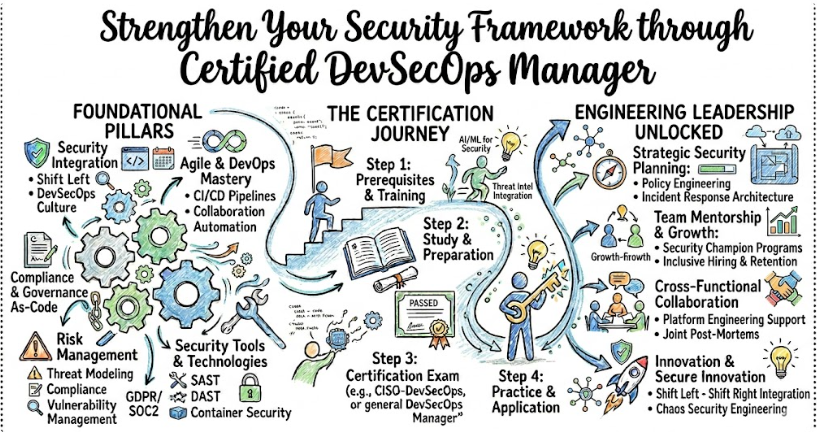
Introduction
The Certified DevSecOps Manager is more than just a credential; it is a validation of leadership in the modern engineering landscape. This guide is written for software engineers, security professionals, and technical leaders who want to master the integration of security into the DevOps lifecycle. As organizations scale their cloud-native infrastructures, the demand for individuals who can manage both speed and safety has reached an all-time high.
By following this comprehensive roadmap, you will learn how to navigate the complex world of platform engineering while ensuring compliance and security remain top priorities. This resource helps professionals make calculated career decisions by mapping the Certified DevSecOps Manager pathway to real-world responsibilities and industry expectations.
We will explore how to leverage the training provided by DevSecOpsschool to achieve long-term professional stability and leadership authority in a competitive global market.
What is the Certified DevSecOps Manager?
The Certified DevSecOps Manager represents a shift in how organizations perceive security within the software delivery pipeline. It is not merely a theoretical framework but a production-focused designation designed to bridge the gap between rapid development and robust defense. This certification exists to validate that a professional can oversee the cultural and technical transition required to “shift left” effectively. It ensures that security is no longer an afterthought or a final gate but a continuous, automated process that aligns with modern engineering workflows.
In an era of cloud-native technologies and container orchestration, the Certified DevSecOps Manager focuses on practical implementation. It moves away from traditional, siloed security practices and embraces the collaborative nature of DevOps. Managers holding this certification are equipped to handle enterprise-grade challenges, including automated vulnerability scanning, secrets management, and compliance as code. This program aligns with the needs of modern enterprises that require speed without sacrificing the integrity of their data or infrastructure.
Who Should Pursue Certified DevSecOps Manager?
This certification is specifically designed for working professionals who are already familiar with the software development lifecycle. Software engineers and DevOps practitioners looking to transition into management will find this credential highly beneficial. Site Reliability Engineers (SREs) and cloud architects who want to specialize in security governance will also see a direct impact on their career trajectory. It provides a structured path for technical leads to take on greater responsibilities in protecting organizational assets.
Engineering managers and technical directors who oversee large-scale delivery teams should pursue this certification to better understand the security risks inherent in modern pipelines. The curriculum is relevant for both beginners who have a baseline technical understanding and experienced professionals seeking to formalize their expertise. In the context of the Indian IT sector and the global market, there is a massive talent gap for managers who can speak both the language of development and the language of security.
Why Certified DevSecOps Manager is Valuable and Beyond
The value of the Certified DevSecOps Manager lies in its longevity and its alignment with the long-term goals of enterprise adoption. As cyber threats become more sophisticated, the demand for managers who can architect secure delivery systems will only increase. Unlike tool-specific certifications that may lose relevance as technology stacks change, this program focuses on principles and workflows that remain consistent. It helps professionals stay relevant by teaching them how to adapt security policies to any environment.
Furthermore, the return on investment for the Certified DevSecOps Manager is significant in terms of career longevity. Enterprises are moving away from reactive security models and investing heavily in proactive, managed security programs. By earning this certification, you position yourself as a leader who can save organizations millions of dollars by preventing breaches before they occur. It is an investment in your ability to lead high-performance teams that deliver secure, high-quality software consistently over time.
Certified DevSecOps Manager Certification Overview
The Certified DevSecOps Manager program is delivered via the official training portal and hosted on the primary website mentioned in the introduction. The program is structured into distinct levels that allow professionals to progress from foundational concepts to advanced strategic management. The assessment approach is rigorous, combining practical assignments with theoretical evaluations to ensure a deep understanding of the material. This structure ensures that candidates are not just memorizing facts but are capable of leading real-world projects.
The ownership of the certification lies with an industry-leading platform that maintains high standards for curriculum updates. The program covers a wide range of topics, including security automation, threat modeling, and regulatory compliance. It is designed to be accessible to global professionals while maintaining the depth required by top-tier engineering organizations. By completing this overview, candidates understand the time commitment and the technical rigor required to succeed in the certification process.
Certified DevSecOps Manager Certification Tracks & Levels
The certification is divided into three primary levels: Foundation, Professional, and Advanced. The Foundation level introduces core concepts of DevSecOps culture and toolchains, making it ideal for those new to the management side of security. The Professional level dives deeper into the technical orchestration of security tools within CI/CD pipelines. Finally, the Advanced level focuses on enterprise-wide governance, long-term strategy, and leading large-scale organizational change across multiple departments.
Beyond the core levels, there are specialization tracks that allow managers to align their certification with specific career goals. These tracks cover areas such as SRE-focused security, FinOps for security budgets, and AIOps for automated threat detection. This modular approach ensures that the certification remains relevant to your specific job role as you progress through your career. It maps directly to professional growth from a team lead to a C-level executive responsible for organizational security.
Complete Certified DevSecOps Manager Certification Table
| Track | Level | Who it’s for | Prerequisites | Skills Covered | Recommended Order |
| Core Management | Foundation | Aspiring Managers | Basic DevOps Knowledge | Culture, Basics of Scanning, Pipelines | 1 |
| Core Management | Professional | Mid-level Managers | 3+ Years Experience | Tool Integration, Secrets Mgmt, SCA | 2 |
| Core Management | Advanced | Senior Directors | 5+ Years Experience | Governance, Compliance, Strategy | 3 |
| SRE Integration | Specialist | SRE Leads | Reliability Background | Incident Response, Security SLOs | Concurrent |
| Cloud Security | Specialist | Cloud Architects | Cloud Fundamentals | IAM, VPC Security, Cloud Governance | Concurrent |
| FinOps Security | Specialist | Operations Leads | Financial Basics | Cost of Security, Tool Auditing | Concurrent |
Detailed Guide for Each Certified DevSecOps Manager Certification
Certified DevSecOps Manager – Foundation
What it is
This certification validates the candidate’s understanding of the fundamental shift required to integrate security into a DevOps culture. It covers the basic terminology and the “why” behind the movement.
Who should take it
It is suitable for junior team leads, senior engineers moving into management, and project managers who need to understand security’s role in the delivery lifecycle.
Skills you’ll gain
- Understanding the DevSecOps Manifest and cultural pillars.
- Identifying security bottlenecks in traditional pipelines.
- Basics of Static Application Security Testing (SAST).
- Communicating security requirements to development teams.
Real-world projects you should be able to do
- Create a roadmap for transitioning a team from DevOps to DevSecOps.
- Conduct a basic audit of existing CI/CD security checks.
Preparation plan
- 7-14 days: Review official course materials and attend introductory webinars.
- 30 days: Complete basic lab exercises on SAST tool integration.
- 60 days: Not typically required for Foundation level unless starting from scratch.
Common mistakes
- Focusing only on the tools and ignoring the cultural shift.
- Neglecting the collaborative aspect of shared responsibility.
Best next certification after this
- Same-track: Certified DevSecOps Manager – Professional
- Cross-track: Certified SRE Practitioner
- Leadership: Engineering Management Foundations
Certified DevSecOps Manager – Professional
What it is
This certification validates a professional’s ability to implement and orchestrate technical security controls across a complex software delivery ecosystem.
Who should take it
This is for current DevOps managers, security leads, and senior SREs who are responsible for the daily operation of secure pipelines.
Skills you’ll gain
- Implementing Dynamic Application Security Testing (DAST).
- Managing Software Composition Analysis (SCA) at scale.
- Container and Kubernetes security orchestration.
- Automated secrets management and rotation.
Real-world projects you should be able to do
- Integrate a full security suite into a multi-stage Jenkins or GitLab pipeline.
- Implement runtime security monitoring for a production Kubernetes cluster.
Preparation plan
- 7-14 days: Deep dive into specific tool integrations (Snyk, Aqua, etc.).
- 30 days: Hands-on labs focusing on automation and remediation workflows.
- 60 days: Review case studies on handling large-scale vulnerability debt.
Common mistakes
- Over-automating security gates without proper false-positive handling.
- Failing to align security metrics with business delivery goals.
Best next certification after this
- Same-track: Certified DevSecOps Manager – Advanced
- Cross-track: Cloud Security Architect
- Leadership: Strategic Technical Leadership
Certified DevSecOps Manager – Advanced
What it is
This level validates executive-level mastery of security governance, enterprise risk management, and the ability to lead security transformations at the organizational level.
Who should take it
Technical directors, CISOs, and senior managers who oversee multiple teams and are responsible for organizational compliance and long-term security posture.
Skills you’ll gain
- Designing enterprise-wide security governance frameworks.
- Implementing Compliance as Code for global regulations (GDPR, SOC2).
- Strategic budget management for security operations.
- Leading post-mortem analysis and incident response at scale.
Real-world projects you should be able to do
- Develop a three-year security strategy for a global enterprise.
- Build an automated compliance dashboard for executive leadership.
Preparation plan
- 7-14 days: Study regulatory frameworks and international security standards.
- 30 days: Focus on executive communication and risk management modeling.
- 60 days: Comprehensive review of organizational change management principles.
Common mistakes
- Losing touch with the technical implementation details of the teams.
- Focusing purely on compliance checklists rather than actual security.
Best next certification after this
- Same-track: Executive Security Leadership
- Cross-track: FinOps Certified Practitioner
- Leadership: MBA or Executive Management Program
Choose Your Learning Path
DevOps Path
The DevOps path focuses on the speed and efficiency of delivery while slowly introducing security gates. It is designed for engineers who want to ensure that security does not become a bottleneck for development. You will learn to treat security as code, ensuring that every deployment is scanned and verified automatically. This path is ideal for those who prioritize a seamless developer experience alongside system integrity.
DevSecOps Path
The core DevSecOps path is a balanced approach that gives equal weight to development, operations, and security. It is the most comprehensive route for those pursuing the Certified DevSecOps Manager title. You will learn how to build a shared responsibility model where every team member is empowered to contribute to security. This path prepares you for the complexities of managing modern, cloud-native application security.
SRE Path
The SRE path views security through the lens of reliability and system uptime. If a system is compromised, it is, by definition, unreliable. This path teaches you how to implement security service level objectives (SLOs) and manage security incidents like any other production outage. It is perfect for professionals who want to apply engineering rigor to the world of security operations.
AIOps Path
The AIOps path focuses on the future of security management through artificial intelligence and machine learning. You will explore how to use AI to detect anomalies, automate threat hunting, and reduce the noise in security logging. This path is designed for forward-thinking managers who want to leverage data-driven insights to protect their infrastructure. It emphasizes the shift from manual monitoring to automated, intelligent response systems.
MLOps Path
The MLOps path is specialized for securing machine learning pipelines and models. As organizations move more AI models into production, the need for securing the data and the model integrity becomes paramount. You will learn about the unique threats to ML systems, such as data poisoning and model inversion. This path is essential for managers overseeing data science and engineering teams in a production environment.
DataOps Path
The DataOps path prioritizes the security and governance of data pipelines. It focuses on ensuring that data is handled securely from ingestion to consumption, meeting all regulatory and privacy requirements. You will learn how to implement data masking, encryption at rest, and access controls within an automated pipeline. This path is crucial for managers in industries like finance and healthcare where data privacy is the top priority.
FinOps Path
The FinOps path for security managers focuses on the cost-effectiveness of security tools and infrastructure. Security can be expensive, and this path teaches you how to optimize your security spend without compromising your defense. You will learn how to audit tool usage, manage cloud security costs, and prove the ROI of your security investments. This is an excellent choice for managers who need to balance tight budgets with high security requirements.
Role → Recommended Certified DevSecOps Manager Certifications
| Role | Recommended Certifications |
| DevOps Engineer | Certified DevSecOps Manager – Foundation |
| SRE | Certified DevSecOps Manager – Professional |
| Platform Engineer | Certified DevSecOps Manager – Professional |
| Cloud Engineer | Certified DevSecOps Manager – Foundation |
| Security Engineer | Certified DevSecOps Manager – Advanced |
| Data Engineer | Certified DevSecOps Manager – Professional |
| FinOps Practitioner | Certified DevSecOps Manager – Foundation |
| Engineering Manager | Certified DevSecOps Manager – Advanced |
Next Certifications to Take After Certified DevSecOps Manager
Same Track Progression
Once you have mastered the management aspects, deep-diving into specific security architecture certifications can be beneficial. This might include advanced certifications in cloud-specific security (AWS/Azure/GCP) to complement your management skills. The goal is to remain a technical authority while expanding your influence over larger departments. This ensures that your strategic decisions are always grounded in technical reality.
Cross-Track Expansion
Expanding your expertise into SRE or Platform Engineering creates a more well-rounded professional profile. Understanding how security impacts system performance and developer self-service is a hallmark of a great leader. By pursuing cross-track certifications, you can bridge the gap between different engineering disciplines more effectively. This makes you a prime candidate for VP of Engineering or Chief Technology Officer roles.
Leadership & Management Track
For those moving away from day-to-day technical tasks, focusing on strategic leadership and business management is the next step. Certifications in project management, executive leadership, or even an MBA can complement your technical background. This path is for those who want to influence the business direction and overall risk posture of a corporation. It prepares you to handle board-level discussions regarding security and technology investment.
Training & Certification Support Providers for Certified DevSecOps Manager
DevOpsSchool
This provider has a long-standing reputation for delivering high-quality, hands-on training for DevOps and security professionals globally. Their curriculum for the Certified DevSecOps Manager is designed by industry experts with decades of real-world experience. They offer a blend of live sessions, recorded content, and extensive lab environments that simulate real production challenges. Students benefit from a strong community and expert mentorship that continues long after the certification is earned. Their focus on practical skills over mere theory makes them a top choice for serious career professionals.
Cotocus
Focusing on enterprise-level training and consulting, this organization provides tailored learning paths for teams and individuals alike. They emphasize the integration of security into large-scale, complex infrastructures and provide deep insights into container security. Their instructors are known for their ability to simplify complex topics and provide actionable advice for real-world scenarios. By choosing this provider, professionals gain access to advanced labs and specialized workshops that cover the latest trends in the industry. They are a preferred partner for many Fortune 500 companies looking to upskill their engineering leadership.
Scmgalaxy
As a comprehensive resource hub for DevOps and security, this platform offers a wealth of knowledge for those pursuing the Certified DevSecOps Manager. They provide detailed tutorials, open-source tool reviews, and community forums where professionals can share their experiences. Their certification support is highly regarded for its depth and its alignment with current industry standards. They focus on the technical nuances of the software supply chain, ensuring that candidates understand every step of the secure delivery process. Their community-driven approach fosters a collaborative learning environment for professionals at all levels.
BestDevOps
This training provider is dedicated to helping engineers and managers achieve excellence in the modern delivery landscape. They offer structured programs that guide candidates through the Foundation, Professional, and Advanced levels of the Certified DevSecOps Manager. Their curriculum is updated frequently to reflect the latest vulnerabilities and security toolsets. They provide excellent career support, including resume reviews and interview preparation for those looking to move into leadership roles. Their commitment to student success is evident in their high pass rates and positive alumni feedback from across the globe.
devsecopsschool
This is the official hosting site and the primary authority for the Certified DevSecOps Manager designation. The platform offers a seamless learning experience, with all the necessary tools and resources integrated into a single portal. They maintain the highest standards for certification integrity, ensuring that the credential remains a valuable asset for years to come. Candidates have access to the official curriculum, practice exams, and direct support from the certification body. It is the most direct path for any professional looking to formalize their expertise in DevSecOps management.
sreschool
Specializing in the intersection of reliability and operations, this provider offers specialized modules that complement the Certified DevSecOps Manager journey. They teach professionals how to build resilient systems that can withstand security incidents while maintaining high availability. Their training is deeply technical, focusing on monitoring, incident response, and the automation of operational tasks. For a manager, this provider offers the tools to quantify security in terms of system reliability. Their labs are designed to test your ability to maintain uptime during active security remediation.
aiopsschool
This provider is the leader in training for the next generation of automated operations and security management. They offer deep dives into how machine learning can be applied to the Certified DevSecOps Manager curriculum. Their courses cover everything from automated log analysis to predictive threat detection. Professionals who train here learn how to move beyond manual intervention and build self-healing, secure infrastructures. It is the go-to destination for managers who want to lead the AI-driven transformation within their organizations.
dataopsschool
Focusing on the critical area of data security, this provider helps managers navigate the complexities of data pipelines and privacy. Their training for the Certified DevSecOps Manager includes specialized modules on data masking, encryption, and secure data storage. They address the unique challenges of managing security in big data and analytics environments. Candidates learn how to balance the need for data accessibility with the strict requirements of regulatory compliance. This provider is essential for anyone managing data-intensive applications in a modern cloud environment.
finopsschool
This provider offers essential training on the financial management of cloud and security operations. They help the Certified DevSecOps Manager understand how to budget for security and measure the financial impact of their decisions. Their courses cover cloud cost optimization, security tool ROI, and financial governance. This training is vital for senior leaders who must justify security spending to stakeholders and executive management. By learning here, you gain the ability to run a secure operation that is also financially efficient and sustainable.
Frequently Asked Questions (General)
- What is the primary goal of the Certified DevSecOps Manager program?
The goal is to validate that a professional can lead the integration of security into the DevOps lifecycle at both technical and strategic levels. - How long does it typically take to complete the Professional level?
Most professionals with a solid background in DevOps spend about 3 to 4 months of consistent study and practice to master the material. - Are there any specific coding requirements for this certification?
While you don’t need to be a full-stack developer, a working knowledge of scripting and YAML for pipeline configuration is essential for success. - Is this certification recognized by major global employers?
Yes, it is highly valued by organizations looking to build out their platform engineering and security management teams. - Does the certification expire?
Most professional certifications require renewal or proof of continuing education every 2 to 3 years to ensure your skills remain up to date. - Can I take the exam online?
Yes, the certification body provides a secure online proctoring environment so you can take the exam from anywhere in the world. - Is there a discount for bulk corporate enrollments?
Most training providers offer customized pricing for teams and organizations looking to certify multiple employees at once. - What kind of support is available if I fail the exam?
Most providers offer a retake policy and additional coaching to help you identify and bridge your knowledge gaps before the next attempt. - How does this differ from a standard SRE certification?
While SRE focuses on reliability and performance, the Certified DevSecOps Manager specifically prioritizes security as a core component of the lifecycle. - Are the labs provided during the training?
Yes, high-quality training providers include access to cloud-based labs where you can practice tool integration without setting up your own infrastructure. - Do I need to be a manager already to take the Advanced level?
It is highly recommended that you have some leadership experience, as the curriculum focuses heavily on governance and strategic decision-making. - What is the difficulty level of the Certified DevSecOps Manager exam?
The exam is considered moderate to high difficulty, as it requires a mix of technical hands-on skills and managerial logic.
FAQs on Certified DevSecOps Manager
- Does this certification cover Kubernetes and Container security?
Yes, managing security for containerized workloads is a major component of the Professional and Advanced training levels. - Is there a focus on specific tools like Jenkins or GitHub Actions?
The program is designed to be tool-agnostic but uses popular platforms like Jenkins to demonstrate real-world implementation principles. - How does the curriculum handle regulatory compliance like GDPR or SOC2?
Compliance as Code is a core pillar, teaching managers how to automate the evidence collection and verification required for these standards. - Will I learn about Threat Modeling in this program?
Yes, threat modeling is included as a strategic skill to help managers identify risks during the design phase of the development lifecycle. - Does the program address the cultural challenges of DevSecOps?
Absolutely, it provides frameworks for managing team dynamics and breaking down the silos between development, operations, and security departments. - Are there real-world projects included in the assessment?
Yes, you will be expected to design and document a secure pipeline strategy as part of the higher-level certification requirements. - Is there coverage for mobile or embedded systems security?
The primary focus is on cloud-native and web application security, though the management principles can be applied to other domains. - Does this certification help with career progression in India?
The Indian IT market has a high demand for security leaders, making this certification a significant advantage for those looking for senior roles.
Final Thoughts: Is Certified DevSecOps Manager Worth It?
As a mentor who has watched the industry shift from manual deployments to automated cloud-native pipelines, I can say with certainty that the era of the “security specialist” working in a vacuum is over. The future belongs to leaders who understand that security is a core engineering discipline. The Certified DevSecOps Manager provides the structure and the credibility needed to lead this transition. It is not just about passing an exam; it is about adopting a mindset that prioritizes safety without compromising on the speed that modern business demands.
If you are looking to move beyond individual contributor roles and want to shape the security posture of an entire organization, this certification is a vital tool. It gives you the technical depth to earn the respect of engineers and the strategic breadth to earn the trust of executives. In a world where a single security breach can define a company’s future, being a Certified DevSecOps Manager makes you one of the most valuable assets in the professional market. My advice is to approach this learning path with curiosity and a commitment to continuous improvement, as the field is always evolving.

