
Introduction
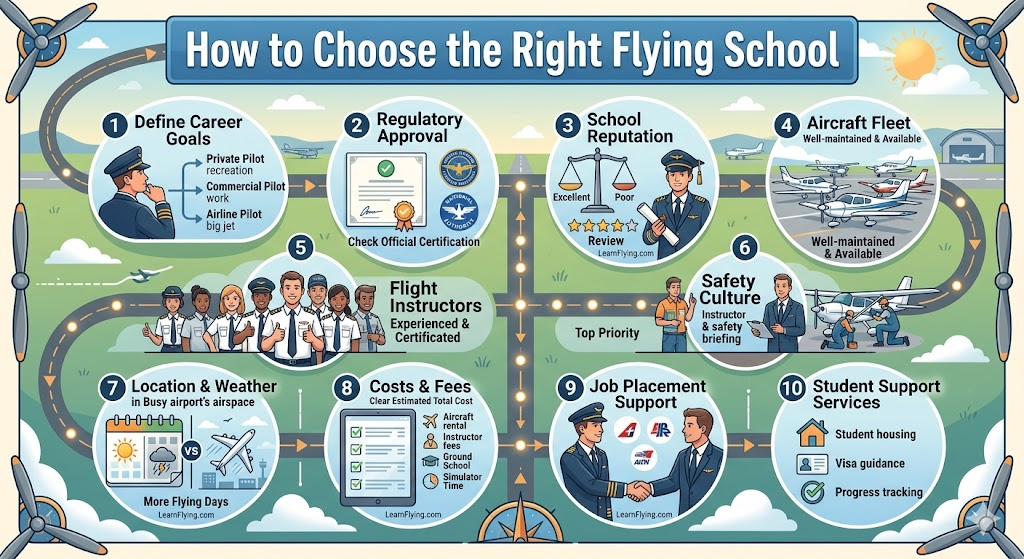
Choosing the right flying school is one of the most important decisions in your aviation journey. A good flying school does more than teach you how to operate an aircraft. It builds your confidence, discipline, safety mindset, decision-making ability, and long-term career foundation. Whether your goal is to become a private pilot, commercial pilot, airline pilot, flight instructor, cargo pilot, or corporate pilot, the school you choose can directly affect your training quality, total cost, licensing progress, and future opportunities.
For many students, flight training is a major financial and personal investment. That is why selecting a flying school should never be based only on low fees, attractive brochures, or quick promises. You need to evaluate the school’s approvals, aircraft fleet, instructors, safety culture, training structure, career support, location, and student experience. This guide from LearnFlying.com will help you understand what to check before enrolling and how to compare flight schools with confidence.
Why Your Flying School Matters
A flying school plays a major role in shaping your future as a pilot. The habits you develop during training often stay with you throughout your aviation career. If you learn in a disciplined, safety-focused environment, you are more likely to become a confident and responsible pilot.
A good flying school helps you with:
- Strong flying fundamentals
- Better safety awareness
- Proper exam preparation
- Faster licensing progress
- Professional communication skills
- Career planning support
- Realistic understanding of aviation life
A poor school, on the other hand, may lead to delays, extra costs, weak training, limited flying hours, and confusion during licensing. That is why research is essential before making your final decision.
Define Your Aviation Career Goals First
Before choosing a flying school, you should first understand what kind of pilot you want to become. Different career goals require different training paths.
Private Pilot
A private pilot usually flies for personal travel, recreation, or passion. If this is your goal, you may focus on safety, flexible scheduling, and cost-effective training.
Commercial Pilot
A commercial pilot trains to fly professionally. This requires stronger training standards, more flying hours, advanced ratings, and career-focused guidance.
Airline Pilot
If you want to work for an airline, you should choose a school with structured commercial pilot training, instrument training, multi-engine training, and career pathway support.
Cargo Pilot
Cargo pilots need strong operational discipline, navigation skills, and experience in different flying conditions. A school with strong real-world training exposure can be useful.
Corporate Pilot
Corporate aviation requires professionalism, communication skills, flexibility, and strong aircraft handling. Training quality and instructor mentorship matter a lot.
Flight Instructor
If you want to become a flight instructor, choose a school that offers instructor training and opportunities to build experience after graduation.
Helicopter Pilot
Helicopter training is different from fixed-wing aircraft training. If this is your goal, choose a school with dedicated helicopter programs, qualified instructors, and suitable aircraft.
Key Factors to Consider When Choosing a Flying School
1- Accreditation and Regulatory Approval
The first thing to check is whether the flying school is approved by the relevant aviation authority. Depending on the country, this may include authorities such as FAA, EASA, DGCA, or another national aviation regulator.
Regulatory approval matters because it confirms that the school follows required training standards, safety procedures, instructor qualifications, and aircraft maintenance rules. Never enroll in a school without verifying its official approval status.
2- School Reputation and Track Record
A school’s reputation tells you a lot about its training quality. Look for student reviews, graduate success stories, airline connections, alumni feedback, and industry recognition.
You should ask:
- How many students complete training successfully?
- Do graduates find aviation jobs?
- Are students satisfied with the instructors?
- Does the school have a history of delays or complaints?
- Does it have partnerships with airlines or aviation companies?
A strong track record is a positive sign, but always verify claims carefully.
3- Training Programs Offered
Different flying schools offer different programs. Make sure the school provides the licenses and ratings you need.
Common programs include:
- Private Pilot License
- Commercial Pilot License
- Instrument Rating
- Multi-Engine Rating
- Flight Instructor Training
- Airline Transport Pilot preparation
- Simulator-based training
- Ground school classes
If your goal is to become a professional pilot, choose a school that can support your complete training journey instead of only the first stage.
4- Fleet Quality and Aircraft Availability
Aircraft availability is one of the biggest factors that affects training speed. If a school has too few aircraft for too many students, your flying hours may be delayed.
Check:
- Number of training aircraft
- Aircraft age and condition
- Maintenance standards
- Backup aircraft availability
- Simulator access
- Scheduling flexibility
A well-maintained fleet shows that the school takes safety seriously. Modern aircraft and simulators can also improve learning quality.
5- Instructor Experience and Qualifications
Your flight instructor will have a major impact on your learning. A good instructor explains clearly, corrects mistakes patiently, builds confidence, and teaches safe decision-making.
Ask about:
- Instructor certifications
- Teaching experience
- Student-to-instructor ratio
- Instructor availability
- Instructor turnover
- Airline or commercial flying background
High instructor turnover can create training gaps, so choose a school where students receive consistent guidance.
6- Safety Culture
Safety should be the top priority in flight training. A professional flying school will openly discuss safety procedures, maintenance checks, weather limitations, emergency training, and risk management.
Look for signs of a strong safety culture:
- Clear safety briefings
- Proper aircraft inspections
- Transparent maintenance practices
- Weather-based decision-making
- Emergency procedure training
- No pressure to fly in unsafe conditions
Avoid any school that treats safety casually or avoids answering safety-related questions.
7- Training Location and Weather Conditions
Location can affect both your training quality and training speed. A school in an area with good weather may offer more flying days, while a school in complex airspace may provide valuable real-world experience.
Consider:
- Weather conditions
- Airport traffic levels
- Airspace complexity
- Runway facilities
- Distance from accommodation
- Local cost of living
There is no single perfect location. The best choice depends on your goals, budget, and preferred learning environment.
8- Costs and Financing Options
Flight training can be expensive, so you need a clear cost breakdown before enrolling. Do not judge a school only by the advertised fee. Ask for the full estimated cost.
Common expenses include:
- Admission fee
- Ground school fee
- Aircraft rental
- Instructor fee
- Simulator fee
- Exam fee
- Medical exam cost
- Study materials
- Uniforms
- Accommodation
- Transportation
- Retest or extra flying hour costs
Also ask whether the school offers scholarships, installment plans, student loans, or financing support.
9- Job Placement and Career Support
If your goal is to become a professional pilot, career support is very important. Some flying schools offer airline pathway programs, internship support, resume guidance, interview preparation, and alumni networking.
Ask:
- Does the school provide career counseling?
- Are there airline partnerships?
- Do graduates receive placement support?
- Are there instructor job opportunities after training?
- Does the school help with interview preparation?
Career support should not be confused with guaranteed jobs. Be careful with schools that make unrealistic employment promises.
10- Student Support Services
Student life matters, especially if you are moving to another city or country for training. A good school should support students beyond the cockpit.
Helpful services may include:
- Housing support
- Visa guidance for international students
- Academic support
- Mentorship
- Transport assistance
- Medical guidance
- Student progress tracking
Good support services can reduce stress and help you focus on training.
Questions to Ask Before Enrolling
Before joining any flying school, ask these important questions:
1- Is the school approved by the relevant aviation authority?
2- What licenses and ratings do you offer?
3- What is the total estimated cost of training?
4- Are there hidden or extra charges?
5- How many aircraft are available for training?
6- How often can students fly each week?
7- What is the student-to-instructor ratio?
8- What happens if an aircraft is unavailable?
9- What is the average training completion time?
10- Are simulators included in the program?
11- What is the school’s safety record?
12- How are aircraft maintained?
13- Do you provide ground school classes?
14- What career support do you offer?
15- Can I speak with current students or alumni?
16- Are accommodation and transport available?
17- What is your refund or cancellation policy?
18- Do you help international students with documentation?
Red Flags to Watch Out For
Not every flying school is the right choice. Be careful if you notice these warning signs:
- Unclear pricing
- Poor aircraft condition
- No proper regulatory approval
- Weak safety communication
- Unrealistic job guarantees
- High instructor turnover
- No written training plan
- Poor student reviews
- Limited aircraft availability
- Pressure to pay quickly
- Lack of transparency about delays
- No proper ground school support
If a school avoids your questions or gives vague answers, consider it a serious warning sign.
Online vs Traditional Flight Schools
Online aviation learning has become useful for ground school, theory preparation, and exam study. However, flying itself requires practical aircraft training with certified instructors.
Online Learning Is Useful For
- Aviation theory
- Exam preparation
- Navigation basics
- Weather concepts
- Aircraft systems
- Regulations
- Radio communication practice
Traditional Flight Schools Are Essential For
- Actual aircraft flying
- Instructor-led cockpit training
- Takeoff and landing practice
- Emergency procedures
- Checkride preparation
- Practical skill development
The best approach is often a combination of online study and traditional flight training.
How to Evaluate a Flying School During a Visit
Visiting a flying school in person can help you make a better decision.
During your visit:
1- Observe the campus environment.
2- Check the aircraft condition.
3- Speak with instructors.
4- Talk to current students.
5- Visit classrooms and simulator areas.
6- Ask about scheduling.
7- Review the training plan.
8- Ask for a written cost estimate.
9- Check safety procedures.
10- Understand refund and delay policies.
A personal visit gives you a real feel for the school’s professionalism.
Flying School Comparison Checklist
| Factor | School A | School B | School C |
|---|---|---|---|
| Regulatory approval | |||
| Total estimated cost | |||
| Aircraft availability | |||
| Instructor experience | |||
| Safety culture | |||
| Ground school quality | |||
| Simulator access | |||
| Training completion time | |||
| Student reviews | |||
| Career support | |||
| Accommodation support | |||
| Financing options | |||
| Location and weather | |||
| Alumni success | |||
| Overall suitability |
Common Mistakes Students Make When Choosing a Flying School
1- Choosing Only Based on Low Fees
The cheapest school is not always the best. Low advertised fees may not include extra flying hours, exam fees, materials, accommodation, or retesting costs.
2- Not Checking Regulatory Approval
A school without proper approval can create licensing problems. Always verify approval before enrolling.
3- Ignoring Aircraft Availability
If aircraft are not available regularly, your training may take much longer than expected.
4- Not Meeting Instructors
Your instructor affects your learning experience. Always try to meet instructors before joining.
5- Believing Guaranteed Job Claims
No school can honestly guarantee every student a job. Be cautious of unrealistic career promises.
6- Not Reviewing the Full Cost
Many students underestimate the total cost of flight training. Always request a detailed cost estimate.
7- Ignoring Safety Standards
Safety culture should never be compromised. Avoid schools that do not openly discuss safety.
8- Not Talking to Current Students
Current students can give honest feedback about scheduling, aircraft availability, instructors, and hidden issues.
9- Choosing the Wrong Location
Weather, airport traffic, and living costs can affect your training experience and budget.
10- Not Having a Career Plan
Your school choice should match your aviation goals. A private pilot student and airline career student may need different types of schools.
Which Flying School Is Right for You?
For Beginners
Choose a school with strong instructor support, beginner-friendly ground classes, and clear training structure.
For Career-Focused Students
Choose a school with commercial pilot training, instrument training, multi-engine training, career support, and strong alumni outcomes.
For Budget-Conscious Students
Look for transparent pricing, financing options, good aircraft availability, and realistic completion timelines.
For International Students
Choose a school that offers visa guidance, accommodation support, documentation help, and experience with international licensing requirements.
For Fast-Track Training
Choose a school with strong scheduling systems, reliable aircraft availability, good weather conditions, and enough instructors.
Frequently Asked Questions
1- How do I know if a flying school is good?
A good flying school should have proper regulatory approval, qualified instructors, well-maintained aircraft, transparent pricing, strong safety standards, and positive student feedback. You should also check whether the school offers the license or rating you need for your aviation goal.
2- What is the most important factor when choosing a flying school?
Safety and training quality are the most important factors. Cost matters, but it should not be the only deciding point. A school with strong safety culture, experienced instructors, and reliable aircraft availability is usually a better long-term choice.
3- Should I choose a flying school near my home?
A nearby school can reduce travel and accommodation costs, but it may not always be the best option. Compare training quality, weather, aircraft availability, approvals, and career support before deciding.
4- How much does flight training cost?
Flight training costs vary based on country, license type, aircraft rates, instructor fees, simulator use, exams, and extra flying hours. Always ask for a full written cost estimate before enrolling.
5- How long does it take to complete pilot training?
Training duration depends on the license, weather, aircraft availability, student performance, instructor availability, and regulatory requirements. Some students finish faster, while others take longer due to delays or additional practice needs.
6- Is aircraft availability important?
Yes, aircraft availability is very important. If a school has limited aircraft, students may face scheduling delays. More available aircraft usually means better training consistency.
7- Can I become an airline pilot from any flying school?
You can start your journey from many approved flying schools, but airline careers require proper licensing, required flying hours, ratings, medical fitness, exams, and interview preparation. A school with career support can be helpful.
8- Should I visit the school before enrolling?
Yes, visiting the school is highly recommended. You can inspect aircraft, meet instructors, talk to students, review facilities, and understand the school environment before making a financial commitment.
9- What are hidden costs in flight training?
Hidden costs may include extra flying hours, exam retakes, simulator sessions, books, uniforms, accommodation, transportation, medical checks, license processing, and aircraft fuel surcharge. Always ask for a complete cost breakdown.
10- Is online ground school enough?
Online ground school can help with theory and exam preparation, but it cannot replace practical flight training. You still need certified instructor-led aircraft training to become a licensed pilot.
11- What should international students check?
International students should check visa support, housing, licensing conversion rules, language requirements, medical requirements, cost of living, and whether the school has experience training foreign students.
12- What is the biggest mistake students make?
The biggest mistake is choosing a flying school too quickly without comparing approvals, costs, aircraft availability, instructors, safety standards, and student reviews. Flight training is a serious investment, so careful research is essential.
Conclusion
Choosing the right flying school is not just about finding a place to learn flying. It is about choosing the foundation for your aviation future. The best flying school for you should match your career goals, budget, learning style, location preference, and long-term ambitions. Before enrolling, compare multiple schools, visit campuses, speak with instructors and students, review total costs, check regulatory approvals, and study the school’s safety culture. A smart decision at the beginning can save you time, money, and stress later. If you are serious about becoming a pilot, take your time, ask the right questions, and choose a flying school that helps you grow with confidence. LearnFlying.com is here to help aspiring pilots understand their options, plan their training journey, and move closer to a successful aviation career.

