
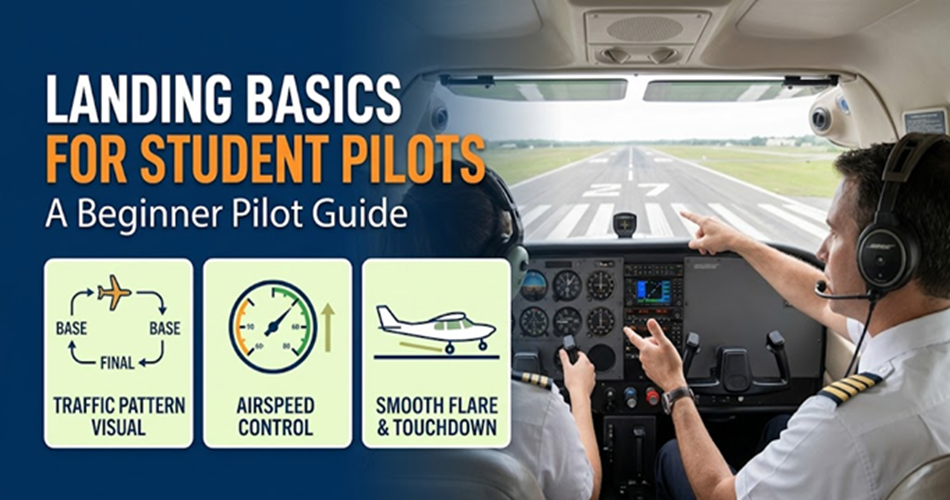
Introduction
Landing is one of the most important skills every student pilot must learn. For many beginners, takeoff feels exciting, but landing often feels more challenging because the pilot must bring the aircraft safely back to the runway with good control, correct speed, and proper judgment.
A good landing does not happen by chance. It is the result of planning, checklist discipline, stable approach, airspeed control, smooth flare, and correct touchdown technique. Student pilots must understand each step clearly before they can build confidence in landing practice.
For beginner pilots, landing may feel fast at first. The runway gets closer, the aircraft is descending, the instructor is giving guidance, and the student must control speed, direction, height, and aircraft attitude at the same time. That is why learning landing basics for student pilots step by step is very important.
This guide explains landing in simple language so new aviation learners can understand the basic process, common mistakes, safety tips, and the role of a flight instructor during landing training.
What Landing Means in Flying
Landing is the phase of flight where an aircraft descends from the air and safely touches down on the runway or landing surface.
In simple words, landing means bringing the aircraft from flight back to the ground in a controlled way.
During landing, the aircraft must slow down, descend at the correct rate, align with the runway, touch down smoothly, and then slow further during rollout. The pilot must manage power, pitch, airspeed, runway alignment, wind correction, and braking.
A normal landing usually includes:
- Approach planning
- Pre-landing checklist
- Downwind leg
- Base leg
- Final approach
- Airspeed control
- Flare
- Touchdown
- Rollout
Each part has a purpose. If one step is not done properly, the landing may become unstable. That is why instructors teach student pilots to focus on a stable approach before thinking about a smooth touchdown.
Why Landing Training Is Important for Student Pilots
Landing training is important because landing is a high-focus phase of flight. The aircraft is close to the ground, speed is reducing, and the pilot must make quick but calm corrections.
Student pilots must learn how to judge height, control airspeed, manage descent, correct runway alignment, and decide whether to continue landing or go around.
Landing training helps student pilots develop:
- Better aircraft control
- Strong runway awareness
- Good visual judgment
- Stable approach habits
- Proper airspeed management
- Confidence during descent
- Decision-making skills
- Safety discipline
Landing is also important because no two landings feel exactly the same. Wind, runway length, aircraft weight, traffic, and weather can all affect the landing. A student pilot must learn how to adjust carefully while still following safe procedures.
Basic Parts of a Landing
Landing is not one single action. It is a sequence of steps that starts before the aircraft reaches the runway.
Approach Planning
Approach planning means preparing for the landing before reaching the runway. The pilot checks wind direction, runway in use, traffic, aircraft configuration, and altitude.
Good approach planning helps the pilot avoid rushing.
Downwind Leg
The downwind leg is the part of the traffic pattern where the aircraft flies parallel to the runway, usually in the opposite direction of landing.
During downwind, the pilot normally completes checks, reduces power, and begins preparing the aircraft for landing.
Base Leg
The base leg is the turn from downwind toward final approach. It helps the pilot position the aircraft correctly before lining up with the runway.
On base leg, the pilot continues to manage speed, descent, and aircraft configuration.
Final Approach
Final approach is the straight path toward the runway before landing. The aircraft should be aligned with the runway centerline and descending steadily.
This is one of the most important parts of landing.
Airspeed Control
Airspeed control is critical during landing. If the aircraft is too fast, it may float above the runway. If it is too slow, it may become difficult to control safely.
Descent Rate
Descent rate means how quickly the aircraft is coming down. A stable landing needs a controlled descent rate.
If the aircraft is descending too quickly, the landing may become hard. If it is too high, the pilot may overshoot the desired touchdown point.
Flare
Flare is the action of gently raising the aircraft nose before touchdown. It reduces the descent rate and allows the aircraft to touch down more smoothly.
Touchdown
Touchdown is the moment when the wheels contact the runway. In many small training aircraft, the main wheels usually touch first, followed by the nose wheel.
Rollout
Rollout is the part after touchdown where the aircraft slows down and continues moving along the runway. The pilot keeps the aircraft straight and applies braking as needed.
Pre-Landing Checklist for Student Pilots
A checklist is a major part of safe flying. Student pilots must learn to use it properly before landing.
A pre-landing checklist helps confirm that the aircraft is ready to land. The exact checklist depends on the aircraft type and flight school procedure, but a basic student pilot checklist may include:
- Seat belts secured
- Fuel checked
- Mixture set as required
- Carburetor heat if applicable
- Flaps set as required
- Landing gear checked if applicable
- Instruments checked
- Landing light as required
- Runway identified
- Wind direction checked
- Radio communication completed
- Landing clearance received if required
Beginner pilots should never rush the checklist. A missed item can create unnecessary risk during landing.
A good habit is to complete the checklist early enough so the final approach is not overloaded with last-minute tasks.
Understanding the Traffic Pattern
The traffic pattern is a standard path aircraft follow near an airport for landing or takeoff. It helps pilots stay organized and predictable.
For student pilots, understanding the traffic pattern is very important because it gives structure to the landing process.
Downwind
The downwind leg is flown parallel to the runway. The aircraft is usually flying in the opposite direction of the landing runway.
This is where the pilot prepares for landing, checks spacing, and starts reducing speed.
Base
The base leg is the turn that brings the aircraft closer to the runway direction. It connects downwind to final approach.
During base, the pilot continues descent and checks whether the aircraft is too high, too low, too fast, or too slow.
Final Approach
Final approach is the last straight path toward the runway. The aircraft should be aligned with the runway centerline.
The goal on final is to maintain a stable approach with the correct speed, descent path, and runway alignment.
A student pilot should remember that a good landing usually starts with a good traffic pattern. Poor pattern planning often leads to a poor landing.
Airspeed Control During Landing
Airspeed control is one of the most important parts of landing basics for student pilots.
During landing, the aircraft must fly at the correct approach speed. This speed allows the aircraft to remain controllable while descending safely toward the runway.
If the aircraft is too fast:
- It may float above the runway
- It may use more runway distance
- The flare may become difficult
- The landing may feel rushed
If the aircraft is too slow:
- Control may become weaker
- The descent may become unstable
- The aircraft may approach stall conditions
- The instructor may need to correct immediately
Student pilots must learn to control airspeed using pitch and power under instructor guidance. In simple terms, pitch helps control speed, and power helps manage descent path, although both are connected.
A stable approach usually means the aircraft is:
- On correct speed
- On correct glide path
- Aligned with the runway
- Properly configured
- Descending smoothly
If the approach is not stable, the safest choice may be a go-around.
Flare and Touchdown Basics
The flare is one of the most talked-about parts of landing. Many student pilots find flare difficult at first because it requires timing, visual judgment, and smooth control.
Flare happens just before touchdown. As the aircraft gets close to the runway, the pilot gently raises the nose to reduce the descent rate. This allows the aircraft to slow down and touch the runway smoothly.
A good flare is:
- Smooth
- Timed correctly
- Not too aggressive
- Not too late
- Based on outside visual reference
If the pilot flares too early, the aircraft may float or lose speed too high above the runway.
If the pilot flares too late, the aircraft may touch down hard.
Student pilots should avoid looking directly at the area just in front of the nose. Instead, they should look farther down the runway. This helps judge height and attitude better.
Touchdown should be controlled, not forced. In many training aircraft, the main wheels touch first, and the nose wheel comes down gently after.
Common Landing Mistakes Student Pilots Make
Landing takes practice. It is normal for student pilots to make mistakes during early training. The goal is to identify them and improve with instructor guidance.
Coming Too High
If the aircraft is too high on approach, the pilot may have difficulty landing at the desired touchdown point. This can lead to floating or using too much runway.
Coming Too Low
If the aircraft is too low, the approach may become unsafe. The pilot may need to add power or go around.
Flying Too Fast on Final
Too much speed is a common student pilot mistake. It can cause the aircraft to float during flare and delay touchdown.
Flying Too Slow on Final
Flying too slow can reduce control and create a safety risk. Student pilots must maintain the correct approach speed.
Looking Too Close to the Runway
Many beginners look just ahead of the aircraft. This makes height judgment difficult. Looking farther down the runway helps improve flare timing.
Poor Flare Timing
Flaring too early or too late can lead to floating or hard touchdowns.
Over-Controlling the Aircraft
Large control movements can make the landing unstable. Smooth and small corrections are better.
Not Correcting for Crosswind
Wind from the side can push the aircraft away from the centerline. Student pilots must learn proper crosswind correction.
Forgetting Checklist Items
Skipping checklist steps can create unnecessary risk. Checklist discipline is essential.
Touching Down Too Hard
Hard landings often happen because of poor flare timing, high descent rate, or incorrect speed.
Safety Tips for Student Pilots During Landing
Landing safety depends on preparation, awareness, and good decision-making.
Here are important safety tips for student pilots:
- Complete the pre-landing checklist early
- Maintain the correct approach speed
- Keep the aircraft aligned with the runway
- Use small and smooth control inputs
- Watch wind direction and runway conditions
- Look farther down the runway during flare
- Do not force the aircraft onto the runway
- Listen carefully to instructor guidance
- Stay calm if the landing does not feel perfect
- Be ready to go around if the approach becomes unstable
- Review every landing after the flight
A student pilot should understand that a go-around is not a failure. It is a safe and professional decision when the landing approach is not right.
Good pilots do not try to save every landing. They make safe decisions.
Role of the Flight Instructor During Landing Training
The flight instructor plays a very important role in landing training. Landing can feel difficult for beginners, and the instructor helps the student understand what is happening.
During landing practice, the instructor may:
- Demonstrate the landing
- Explain the traffic pattern
- Help manage speed and descent
- Guide the student during turns
- Correct runway alignment
- Teach flare timing
- Help with crosswind correction
- Take control if needed
- Explain mistakes after landing
A good instructor also builds confidence. Many students feel nervous during landing practice, especially in the beginning. The instructor helps them stay calm and focused.
Student pilots should ask questions after each landing. They should try to understand what went well and what needs improvement.
Landing becomes easier when students practice with patience and proper feedback.
Landing in Different Conditions
As student pilots gain experience, they learn different types of landings. Each type has a purpose.
Normal Landing
A normal landing is used in standard conditions. This is usually the first landing type student pilots learn.
The focus is on stable approach, proper airspeed, smooth flare, touchdown, and rollout.
Crosswind Landing
A crosswind landing is used when wind is blowing from the side of the runway. This requires proper aileron and rudder control.
Crosswind landings are challenging for beginners, but they are very important in real flying.
Short-Field Landing
A short-field landing is used when runway length is limited. The pilot must use accurate speed control and aim for a specific touchdown area.
This type of landing requires discipline and careful training.
Soft-Field Landing
A soft-field landing is used on grass, dirt, or soft surfaces. The goal is to land gently and reduce stress on the landing gear.
Student pilots should practice soft-field technique only under instructor guidance.
Go-Around Decision
A go-around means stopping the landing attempt and climbing away for another approach.
A go-around may be needed if:
- The approach is unstable
- The aircraft is too high
- The aircraft is too low
- The speed is incorrect
- The runway is not clear
- The aircraft is not aligned properly
- The instructor decides it is safer
Student pilots should treat go-around as a normal safety procedure, not as a mistake.
Simple Example of a Student Pilot’s First Landing Experience
Imagine a student pilot flying in the traffic pattern with an instructor. The aircraft is on downwind, and the runway is visible out the side window.
The instructor says, “Complete your landing checklist.” The student checks fuel, flaps, instruments, seat belts, and runway position.
The aircraft turns base, and the student starts thinking about speed and descent. The instructor reminds them, “Small corrections. Do not chase the runway.”
Now the aircraft turns final. The runway is straight ahead. The student feels nervous but focused. The instructor says, “Keep your speed steady and look far down the runway.”
As the aircraft gets closer to the ground, the student gently begins the flare. The aircraft floats for a moment, then the main wheels touch the runway. It is not perfect, but it is safe.
The instructor smiles and says, “Good. Now keep it straight during rollout.”
That first landing teaches an important lesson: landing is not about one perfect movement. It is about many small decisions made at the right time.
Landing Checklist Table
| Checklist Item | Why It Matters |
|---|---|
| Seat belts secured | Keeps pilot and passengers safe during landing |
| Fuel checked | Confirms proper fuel supply for landing and go-around |
| Flaps set | Helps control approach speed and descent |
| Landing gear checked | Ensures gear is down if the aircraft has retractable gear |
| Instruments checked | Confirms aircraft systems are working properly |
| Runway identified | Helps avoid confusion during approach |
| Wind direction checked | Helps prepare for crosswind correction |
| Radio communication completed | Ensures clearance or traffic awareness |
| Landing light used as required | Improves visibility and safety |
| Approach speed confirmed | Helps maintain a stable and safe landing |
Beginner Landing Tips for Student Pilots
Landing improves with practice. Student pilots should focus on learning correctly instead of trying to make every landing perfect.
Here are simple landing tips:
- Plan the landing early
- Keep the traffic pattern organized
- Maintain correct airspeed
- Avoid rushing the final approach
- Look far down the runway during flare
- Use smooth control inputs
- Stay aligned with the runway centerline
- Do not force the aircraft down
- Go around when needed
- Listen carefully to instructor feedback
Every landing teaches something. Even experienced pilots continue to improve their landing skills throughout their flying life.
FAQs About Landing Basics for Student Pilots
1. Is landing difficult for student pilots?
Landing can feel difficult at first because it requires timing, speed control, and height judgment. With practice and instructor guidance, it becomes easier.
2. What is the most important part of landing?
A stable approach is one of the most important parts of landing. If the approach is stable, the landing becomes much easier and safer.
3. What does flare mean in landing?
Flare means gently raising the aircraft nose just before touchdown to reduce descent rate and allow a smoother landing.
4. Why do student pilots struggle with landing?
Many students struggle because landing requires coordination of airspeed, height, runway alignment, power, and flare timing.
5. What happens if the aircraft is too fast on landing?
If the aircraft is too fast, it may float above the runway and use more landing distance than expected.
6. What happens if the aircraft is too slow on landing?
If the aircraft is too slow, control may become weaker and the approach may become unsafe. Correct approach speed is very important.
7. Why is looking far down the runway important?
Looking far down the runway helps the pilot judge height, attitude, and flare timing more accurately.
8. Is a go-around a failure?
No. A go-around is a safe decision when the landing approach is not stable or conditions are not right.
9. How long does it take to learn landing?
It varies for every student pilot. Some students improve quickly, while others need more practice to build consistency and confidence.
10. Can a student pilot land alone?
A student pilot can land alone only after proper training, meeting required rules, and receiving instructor approval for solo flight.
Conclusion
Landing is one of the most important skills in pilot training. For student pilots, it may feel challenging in the beginning, but it becomes manageable when learned step by step.
A safe landing starts with good planning, checklist discipline, traffic pattern awareness, correct airspeed, stable final approach, smooth flare, and controlled touchdown. Student pilots should not focus only on making the landing smooth. They should focus on making the landing safe and controlled.
Understanding landing basics for student pilots helps beginners build confidence and develop strong flying habits. With proper instruction, regular practice, and patience, every student pilot can improve landing skills over time.
Landing is not about perfection on the first attempt. It is about learning, correcting, practicing, and respecting safety every time the aircraft approaches the runway.

