
Introduction
For many beginner pilots, the first takeoff is one of the most exciting moments in flight training. It is the point where the aircraft leaves the ground and begins flying. But behind that exciting moment, there is a careful process that every student pilot must learn step by step.
Takeoff is not just about pushing the throttle forward and lifting the aircraft into the air. It includes planning, checking the aircraft, communicating clearly, keeping the aircraft straight on the runway, watching airspeed, rotating at the correct speed, and climbing safely.
That is why understanding takeoff basics for beginner pilots is very important. A safe takeoff starts before the aircraft even enters the runway. Beginner pilots must learn how to prepare, stay calm, follow checklists, and listen carefully to their flight instructor.
This guide explains takeoff in simple language so new pilots can understand the basic steps, common mistakes, and safety habits needed during early flight training.
What Takeoff Means in Flying
Takeoff is the phase of flight where an aircraft moves along the runway, gains speed, creates lift, and becomes airborne.
In simple words, takeoff is the transition from ground movement to flight.
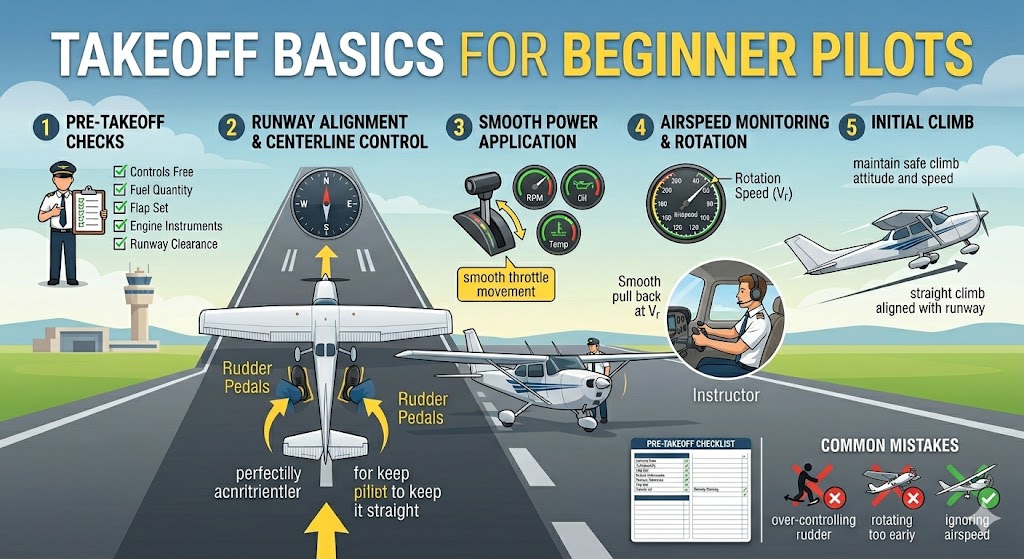
During takeoff, the aircraft engine produces power. The aircraft accelerates on the runway. As speed increases, air flows over the wings. When enough lift is created, the pilot gently raises the nose of the aircraft. This action is called rotation. After rotation, the aircraft leaves the runway and begins the initial climb.
A normal takeoff usually includes:
- Pre-takeoff checks
- Runway line-up
- Smooth power application
- Centerline control
- Airspeed monitoring
- Rotation
- Liftoff
- Initial climb
Each step must be done carefully. Even small mistakes during takeoff can affect safety, runway control, or climb performance.
Why Takeoff Training Is Important for Beginner Pilots
Takeoff training is one of the first major skills a student pilot learns. It builds confidence and teaches basic aircraft control.
A beginner pilot must understand that takeoff happens quickly. The aircraft moves faster every second, and the pilot must manage power, direction, speed, and attitude at the same time.
Takeoff training is important because it helps student pilots learn:
- How to control the aircraft on the runway
- How to use rudder pedals properly
- How to apply engine power smoothly
- How to monitor airspeed
- How to rotate at the correct speed
- How to maintain a safe climb attitude
- How to respond calmly if something feels wrong
Good takeoff training also builds discipline. Pilots learn not to rush. They learn to follow procedures, check instruments, and communicate clearly.
For beginner pilots, takeoff should always be practiced under the supervision of a qualified flight instructor.
Basic Parts of a Takeoff
A takeoff has several important parts. Each part has a clear purpose.
Pre-Takeoff Checks
Before entering the runway, pilots complete a pre-takeoff checklist. This helps confirm that the aircraft is ready for flight.
The checklist may include:
- Flight controls
- Fuel quantity
- Flap setting
- Trim setting
- Engine instruments
- Navigation lights
- Seat belts
- Doors and windows
- Radio communication
- Runway clearance
The exact checklist depends on the aircraft type and flight school procedure. Beginner pilots should always follow the aircraft checklist and instructor guidance.
Line-Up on the Runway
After receiving clearance or confirming the runway is safe, the pilot lines up the aircraft with the runway centerline.
This means the nose of the aircraft should point straight down the runway. Proper alignment is important because the aircraft will accelerate quickly after power is applied.
Applying Power
The pilot applies throttle smoothly. Sudden or rough power application can make the aircraft harder to control.
As power increases, the pilot checks engine instruments to make sure the engine is performing normally.
Maintaining Centerline
During the takeoff roll, the aircraft must stay close to the runway centerline. The pilot uses rudder pedals to keep the aircraft straight.
This is one of the most important skills for beginner pilots.
Airspeed Monitoring
As the aircraft accelerates, the pilot checks airspeed. Airspeed tells the pilot when the aircraft is ready for rotation.
The instructor will teach the correct rotation speed for the aircraft.
Rotation
Rotation is the moment when the pilot gently pulls back on the control yoke or stick to raise the aircraft nose.
Rotation must be smooth. Pulling too hard can create an unsafe attitude. Pulling too late can waste runway.
Initial Climb
After the aircraft lifts off, the pilot maintains the correct climb attitude and speed. The aircraft should climb steadily while staying aligned with the runway direction.
Pre-Takeoff Checklist for Student Pilots
A checklist is one of the best safety tools in aviation. It helps pilots avoid missed steps.
A beginner pilot should never treat the checklist as a formality. It is a serious part of flight preparation.
A simple student pilot pre-takeoff checklist may include:
- Controls: Free and correct movement
- Fuel: Correct quantity and selected tank
- Flaps: Set as required
- Trim: Set for takeoff
- Instruments: Checked and working
- Engine: Temperatures and pressures normal
- Doors and windows: Closed and locked
- Seat belts: Fastened
- Runway: Clear and suitable
- Radio: Correct frequency and clearance
- Wind: Checked for direction and strength
The exact order may change depending on the aircraft and training school, but the purpose remains the same: make sure the aircraft is ready before takeoff.
Understanding Runway Alignment and Centerline Control
Runway alignment means placing the aircraft straight on the runway before beginning the takeoff roll.
For beginner pilots, centerline control can be challenging at first. Many students focus too much on the cockpit instruments and forget to look outside. But during takeoff, outside visual reference is very important.
The runway centerline helps the pilot keep the aircraft straight.
If the aircraft starts drifting left or right, the pilot corrects using rudder pedals. The ailerons may also be used depending on wind conditions, especially in crosswind takeoffs.
Good centerline control shows that the pilot is managing direction properly.
Beginner pilots should remember:
- Look outside more than inside
- Use small rudder corrections
- Avoid over-controlling
- Keep the nose aligned with the runway
- Stay relaxed but focused
A straight takeoff roll makes rotation and liftoff smoother.
Power Application During Takeoff
Power application is a key part of the takeoff process. In most training aircraft, the pilot applies throttle smoothly until full takeoff power is reached.
Beginner pilots sometimes push the throttle too quickly. This can cause the aircraft to yaw or move away from the centerline. Smooth power application gives the pilot more control.
After applying power, the pilot checks important engine indications. These may include:
- RPM
- Oil pressure
- Oil temperature
- Engine sound
- Overall engine response
If the engine does not sound right or the instruments do not show normal readings, the takeoff may need to be rejected if still safe to do so. This decision must be made according to training procedures and instructor guidance.
Student pilots must learn that takeoff power is not just about speed. It is also about confirming that the aircraft engine is healthy before becoming airborne.
Airspeed and Rotation Basics
Airspeed is one of the most important things to monitor during takeoff. It tells the pilot how fast the aircraft is moving through the air.
During the takeoff roll, the aircraft accelerates. The pilot checks that the airspeed indicator is alive, meaning it has started showing movement.
As the aircraft reaches the correct rotation speed, the pilot gently raises the nose.
Rotation speed is usually called Vr. It is the speed at which the pilot begins rotating the aircraft for takeoff.
For example, in a small training aircraft, the rotation speed may be a specific value taught by the instructor and listed in the aircraft manual. Beginner pilots should never guess this speed.
A good rotation is:
- Smooth
- Controlled
- Not too early
- Not too late
- Based on the correct airspeed
Rotating too early can cause poor climb performance. Rotating too late can use more runway than needed.
The goal is to lift off safely and continue into a stable climb.
Common Mistakes Beginner Pilots Make During Takeoff
Takeoff is a skill that improves with practice. Many beginner pilots make common mistakes in the early stage of training. These mistakes are normal, but they must be corrected early.
Looking Inside the Cockpit Too Much
Some students keep looking at instruments and forget to look outside. During takeoff, outside reference is very important for runway alignment and aircraft attitude.
Poor Rudder Control
Many beginner pilots do not use enough rudder during takeoff. This can cause the aircraft to drift away from the runway centerline.
Applying Power Too Quickly
Sudden throttle movement can make the aircraft harder to control. Smooth power application is better.
Not Maintaining Centerline
Drifting left or right during takeoff is a common beginner issue. The pilot must use rudder corrections to stay aligned.
Rotating Too Early
If the pilot rotates before reaching the correct speed, the aircraft may struggle to climb.
Rotating Too Late
Waiting too long to rotate can waste runway and create unnecessary pressure.
Forgetting Checklist Items
Skipping checklist steps can lead to unsafe situations. Student pilots should build checklist discipline from the beginning.
Over-Controlling the Aircraft
Large and sudden control inputs can make the takeoff unstable. Small and smooth corrections are usually better.
Safety Tips for Beginner Pilots During Takeoff
Safety must always come before confidence or excitement. A beginner pilot should never rush a takeoff.
Here are some practical safety tips:
- Always complete the pre-takeoff checklist
- Confirm runway direction and wind condition
- Use smooth throttle movement
- Keep eyes mostly outside during the takeoff roll
- Stay aligned with the centerline
- Monitor airspeed carefully
- Rotate only at the correct speed
- Maintain the correct climb attitude
- Listen carefully to the instructor
- Be ready to reject takeoff if instructed or required
- Never continue a takeoff if something clearly feels unsafe
- Always follow the aircraft manual and school procedures
Beginner pilots should also understand that every aircraft behaves differently. A light training aircraft, a larger aircraft, and a high-performance aircraft will not feel the same during takeoff.
That is why training, repetition, and instructor supervision are essential.
Role of the Flight Instructor During Takeoff Training
The flight instructor plays a very important role in takeoff training. Beginner pilots are not expected to master takeoff immediately.
The instructor helps the student understand what to do, when to do it, and why it matters.
During early takeoff practice, the instructor may:
- Demonstrate the takeoff first
- Explain each step clearly
- Help with rudder control
- Monitor airspeed and engine performance
- Correct runway alignment
- Guide the rotation
- Take control if needed
- Explain mistakes after the flight
A good instructor does not only teach the physical steps. They also teach judgment, awareness, and decision-making.
For beginner pilots, the best approach is to stay calm, listen carefully, and learn from each takeoff.
Takeoff in Different Conditions
Not every takeoff is the same. As student pilots progress, they learn different types of takeoffs. Each type has a special purpose.
Normal Takeoff
A normal takeoff is used in standard runway and wind conditions. This is usually the first type of takeoff beginner pilots learn.
It focuses on smooth power, centerline control, correct rotation speed, and safe climb.
Crosswind Takeoff
A crosswind takeoff is used when wind is blowing from the side of the runway. This requires better control of rudder and ailerons.
Beginner pilots usually practice crosswind takeoffs after learning normal takeoffs.
Short-Field Takeoff
A short-field takeoff is used when the available runway is limited. It requires accurate performance planning and proper technique.
This type of takeoff must be practiced carefully with an instructor.
Soft-Field Takeoff
A soft-field takeoff is used on grass, dirt, or soft surfaces where the aircraft may have more rolling resistance.
The goal is to reduce stress on the landing gear and get the aircraft flying safely from a soft surface.
Each takeoff type has its own procedure. Student pilots should learn them slowly and only under proper instruction.
Simple Example of a Beginner Pilot’s First Takeoff Experience
Imagine a student pilot sitting in the left seat for one of the first takeoff lessons. The instructor is beside them, calmly explaining each step.
The aircraft is at the holding point. The student completes the checklist, checks the runway, and listens to the radio. The instructor says, “Line up with the centerline and keep your feet ready on the rudder pedals.”
The student moves onto the runway and aligns the aircraft. The runway looks long and straight ahead. The instructor reminds the student to apply power smoothly.
As the throttle moves forward, the aircraft begins accelerating. The student feels the aircraft pull slightly to one side, and the instructor says, “Small rudder correction.”
The airspeed increases. The instructor calls out the rotation speed. The student gently pulls back. The nose rises, the wheels leave the runway, and suddenly the aircraft is flying.
At first, the student feels excited and nervous. But with the instructor’s guidance, the aircraft climbs steadily. The student realizes that takeoff is not one single action. It is a series of small, controlled steps.
That is how confidence begins in flight training.
Takeoff Checklist Table
| Checklist Item | Why It Matters |
|---|---|
| Flight controls checked | Confirms the aircraft can be controlled properly |
| Fuel quantity checked | Ensures enough fuel is available for the flight |
| Flaps set | Helps achieve the correct takeoff performance |
| Trim set | Reduces control pressure during takeoff and climb |
| Engine instruments normal | Confirms the engine is ready for takeoff power |
| Doors and windows secured | Prevents distraction and safety issues during climb |
| Seat belts fastened | Keeps pilot and passengers secure |
| Runway checked | Confirms runway is clear and safe for departure |
| Wind checked | Helps pilot prepare for crosswind or correction |
| Radio communication complete | Ensures proper clearance or traffic awareness |
Beginner Pilot Takeoff Tips
A beginner pilot should focus on building good habits from the first lesson. Takeoff skills become stronger with repetition, but only if the pilot practices correctly.
Here are simple tips:
- Do not rush the checklist
- Keep your hand on the throttle during the takeoff roll
- Use your feet actively on the rudder pedals
- Look far down the runway
- Make small corrections early
- Avoid pulling back too aggressively
- Listen to engine sound and instructor guidance
- Stay calm if the aircraft does not feel perfect
- Review each takeoff after the lesson
- Ask questions when something is unclear
Every takeoff is a learning opportunity. Even experienced pilots continue to respect this phase of flight.
FAQs About Takeoff Basics for Beginner Pilots
1. Is takeoff difficult for beginner pilots?
Takeoff can feel challenging at first because many things happen quickly. With instructor guidance and regular practice, beginner pilots learn to manage the steps confidently.
2. What is the most important part of takeoff?
Every step matters, but centerline control, correct airspeed, smooth rotation, and safe climb are especially important for beginner pilots.
3. Why do pilots use rudder during takeoff?
Pilots use rudder to keep the aircraft straight on the runway. It helps control yaw and maintain alignment with the runway centerline.
4. What does rotation mean in takeoff?
Rotation means gently raising the nose of the aircraft at the correct airspeed so the aircraft can lift off from the runway.
5. Can a beginner pilot take off alone?
A student pilot can only take off alone after proper training, instructor approval, and meeting required aviation rules. Early takeoff practice is always done with an instructor.
6. Why is airspeed important during takeoff?
Airspeed tells the pilot when the aircraft has enough speed to safely rotate and climb. Rotating at the wrong speed can affect performance.
7. What happens if the aircraft drifts during takeoff?
The pilot uses rudder and proper control inputs to correct the drift. If the aircraft cannot be kept safely on the runway, the instructor may take control or stop the takeoff if needed.
8. What is a rejected takeoff?
A rejected takeoff means stopping the takeoff before becoming airborne because of a problem or unsafe condition. This must be done according to training and aircraft procedures.
9. How many lessons does it take to learn takeoff?
It varies for each student. Some students understand the basics quickly, while others need more practice to build confidence and consistency.
10. What should beginner pilots remember most during takeoff?
Beginner pilots should remember to stay calm, follow the checklist, apply power smoothly, maintain centerline, watch airspeed, rotate correctly, and follow instructor guidance.
Conclusion
Takeoff is one of the most important skills in flight training. For beginner pilots, it may feel fast and exciting, but it becomes easier when learned step by step.
The key to a safe takeoff is preparation, checklist discipline, smooth control, runway awareness, correct airspeed, and proper instructor guidance. A good takeoff does not happen by luck. It happens because the pilot follows a clear process.
Understanding takeoff basics for beginner pilots helps new aviation learners build confidence from the beginning. With practice, patience, and proper training, student pilots can learn to take off safely and smoothly.
Every pilot starts as a beginner. The goal is not to be perfect on the first attempt. The goal is to learn correctly, improve consistently, and respect safety every time the aircraft enters the runway.

