
Introduction
Deciding to pursue the Certified DevSecOps Professional qualification is a strategic move for any engineer aiming to lead in the modern software era. This handbook is built for practitioners and technical leads who want to master the art of blending security into fast-moving engineering cycles. By prioritizing a “security first” culture, specialists at DevSecOpsschool and throughout the global tech community can ensure that infrastructure is both resilient and safe.
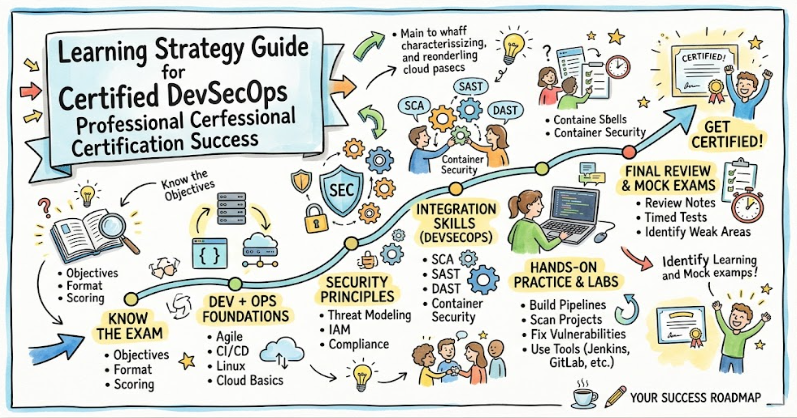
Modern cloud-native systems require more than just standard automation; they demand a proactive stance toward identifying and fixing risks long before code reaches the user. This guide is crafted to help you navigate different learning paths so you can make informed choices for your career advancement. Whether you are leading a team in India or working as a specialized engineer in an international market, understanding this roadmap is a key to long-term professional success.
Our objective is to simplify the often-confusing world of security engineering and provide a straightforward, practical plan for your growth. By following the advice shared here, you will be better prepared to manage the complexities of secure delivery in high-pressure production environments. This resource functions as a mentor, helping you identify which technical areas to focus on to remain a top-tier expert in a shifting job market.
What is the Certified DevSecOps Professional?
The Certified DevSecOps Professional is a high-level validation of an engineer’s ability to weave security measures into automated operational workflows. It moves past simple classroom study to focus on the hands-on use of security checks within a continuous delivery pipeline. This ensures that every update is verified and protected before it ever touches a live server environment.
This program exists because old-fashioned security methods are usually too slow to keep up with the pace of modern technical teams. It represents a fundamental shift toward a shared culture where security is part of every engineer’s job rather than a separate task for a different team. It aligns perfectly with the needs of large enterprises for faster, safer, and more consistent software updates.
By taking on this certification, you are learning how to use code and automation to defend systems against constantly changing cyber threats. It focuses on the use of real-world tools and defensive strategies used by the most successful tech companies today. The emphasis stays on building a workflow where security is a natural and helpful part of the daily development process.
Who Should Pursue Certified DevSecOps Professional?
This learning path is a great fit for DevOps engineers and SREs who want to add a deep layer of security knowledge to their existing technical skills. System administrators moving into cloud-centric roles will find these skills vital for protecting modern virtualized infrastructure. It fills the space between general operations and highly specialized security engineering tasks.
Security analysts and software developers who want to understand the operational side of delivery should also look into this program. It provides the necessary context to build software that is secure by design rather than trying to fix problems after they occur. For professionals in India’s tech centers and global markets, it is a powerful way to distinguish yourself in a crowded field.
Technical leads and engineering managers benefit by gaining a clearer understanding of how to run safe and efficient teams. It helps them select the best tools and processes to guard the business without creating bottlenecks for the development staff. Anyone wanting to protect their career in a landscape where data security is a top priority should consider starting this journey.
Why Certified DevSecOps Professional is Valuable and Beyond
The worldwide need for security experts continues to grow much faster than the number of trained people available to do the work. As companies move more of their core business to cloud platforms, the risks from small mistakes or hidden vulnerabilities become much larger. Holding this credential proves that you are ready to identify and reduce these risks in a professional way.
Unlike training that only teaches you how to use one specific piece of software, this program teaches the logic and strategy of secure automation. This means that even if the tools change or the industry moves to new platforms, your core understanding of security will remain useful. It offers a level of career stability that is very hard to find in the fast-paced world of technology.
Beyond just learning new skills, the certification provides a strong return on your effort through more job leads and better salary options. It shows potential employers that you are a dedicated professional who puts quality and safety at the center of your work. In a competitive market, it provides the authority needed to move into senior roles or technical leadership positions.
Certified DevSecOps Professional Certification Overview
The program is offered through Certified DevSecOps Professional and is officially hosted on DevSecOpsschool. It is designed as a practical learning experience that moves you from basic security concepts to advanced automated delivery steps. The focus is always on proving you can do the work through real-world technical tasks.
The curriculum is broken down into specific modules that cover different parts of the modern tech landscape, including container security, cloud APIs, and pipeline automation. This modular structure lets you learn one topic at a time, building a full picture of the entire secure ecosystem. It is updated frequently to ensure it covers the latest threats and the best defensive tools.
Your progress is measured by how well you can set up security gates, manage sensitive access keys, and fix security issues in a simulated lab. This ensures that anyone who completes the program is ready to help a production team right away. It is a tough but rewarding journey that builds real confidence in your ability to handle complex security challenges.
Certified DevSecOps Professional Certification Tracks & Levels
The certification is split into three main categories: Foundation, Professional, and Advanced. The Foundation level is built to introduce core ideas to those who are starting out or moving from other areas. It covers the basic philosophy and the common tools used to catch errors early in the development lifecycle.
The Professional level is where most engineers will focus their time, as it covers the actual setup of security tools in live pipelines. This level is technical and requires a good handle on automation and basic scripting logic. It is widely considered the industry standard for engineers working in active DevOps or SRE roles.
The Advanced level is for those who want to become technical architects or high-level strategic leads. It covers complex topics like company-wide compliance, deep threat modeling, and building custom security software. These levels are meant to grow with you as your career moves from individual tasks to leading entire departments.
Complete Certified DevSecOps Professional Certification Table
| Track | Level | Who it’s for | Prerequisites | Skills Covered | Recommended Order |
| Security Operations | Foundation | Junior Staff | Basic IT Knowledge | Security Logic, Tool Intro | 1st |
| DevSecOps Engineer | Professional | DevOps Engineers | CI/CD Foundations | Pipeline Defense, Scanning | 2nd |
| Security Architect | Advanced | Senior Leads | Scripting Proficiency | Threat Modeling, Governance | 3rd |
| Cloud Defense | Professional | Cloud Engineers | Cloud Basics | IAM Security, VPC Defense | 2nd |
| Compliance Lead | Advanced | Compliance Officers | Policy Logic | Policy as Code, Auditing | 3rd |
Detailed Guide for Each Certified DevSecOps Professional Certification
Certified DevSecOps Professional – Foundation
What it is
This certification confirms that you grasp the fundamental rules that make software delivery secure. It proves you understand why security matters in DevOps and can communicate clearly with technical teams.
Who should take it
It is a great choice for junior engineers, project managers, and even sales teams who need to understand technical security needs. It acts as a solid entry point for anyone moving into a security-focused role.
Skills you’ll gain
- Mastery of common DevSecOps terms and team culture.
- Understanding how automated security scans work.
- Recognizing the steps of a secure delivery process.
- Basic knowledge of risk management and compliance.
Real-world projects you should be able to do
- Designing a basic security plan for a small project.
- Running a simple vulnerability check on a sample app.
- Explaining why “shifting left” helps the business.
Preparation plan
- 7-14 Days: Read the core study guides and learn the primary definitions.
- 30 Days: Take an introductory course and follow the video demonstrations.
- 60 Days: Complete all practice tests and ensure you can explain the core ideas clearly.
Common mistakes
- Focusing only on the technology and ignoring the people and culture.
- Trying to learn complex tools before understanding the basic logic.
Best next certification after this
- Same-track option: Certified DevSecOps Professional – Professional Level
- Cross-track option: Cloud Infrastructure Foundations
- Leadership option: Professional Project Management
Certified DevSecOps Professional – Professional
What it is
This level proves your ability to practically use security tools in a real-world automation setting. It is the primary benchmark for engineers who are responsible for keeping live production pipelines safe.
Who should take it
This is for working DevOps engineers, SREs, and developers with some experience in automation. You should be comfortable using the command line and writing simple scripts in Bash or Python.
Skills you’ll gain
- Integrating security scanners into tools like Jenkins or GitLab.
- Setting up automated systems to manage passwords and keys.
- Securing Docker containers and Kubernetes environments.
- Using code to deploy and manage secure cloud systems.
Real-world projects you should be able to do
- Building a pipeline that stops if a high-risk bug is found.
- Setting up a secure vault for managing sensitive API access.
- Creating an automated report for security audits using live data.
Preparation plan
- 7-14 Days: Build a local lab with Docker and a pipeline tool to practice.
- 30 Days: Work through advanced lessons on specific security tool settings.
- 60 Days: Perform a “mock audit” of your own lab to find and fix gaps.
Common mistakes
- Making security checks so slow that they hinder the development team.
- Forgetting to update scanning rules as new threats appear.
Best next certification after this
- Same-track option: Certified DevSecOps Professional – Advanced Level
- Cross-track option: Kubernetes Administration (CKA)
- Leadership option: Team Lead or Engineering Manager
Certified DevSecOps Professional – Advanced
What it is
This level is for elite specialists who design and manage security for large, complicated systems. It proves you have the strategic vision and technical depth to lead a company’s entire security strategy.
Who should take it
Senior engineers, technical architects, and directors with years of practical experience should aim for this. You need to be comfortable with high-level design and complex policy management.
Skills you’ll gain
- Designing security architectures for large enterprise cloud systems.
- Using “Policy as Code” across multiple different cloud providers.
- Performing deep threat modeling and complex risk assessments.
- Leading a company’s response to major security incidents.
Real-world projects you should be able to do
- Architecting a zero-trust network for a microservices application.
- Writing custom rules for Kubernetes to enforce strict security.
- Leading a team through a simulated high-impact security breach.
Preparation plan
- 7-14 Days: Read advanced papers on zero-trust and security architecture.
- 30 Days: Practice writing complex rules using modern policy software.
- 60 Days: Mentor other engineers or contribute to open-source security tools.
Common mistakes
- Designing security rules that are too complex for a team to follow.
- Not keeping up with the very latest research in cloud vulnerabilities.
Best next certification after this
- Same-track option: Specialized Security Researcher
- Cross-track option: Master of Cloud Architecture
- Leadership option: CISO training and strategy
Choose Your Learning Path
DevOps Path
This path is for general engineers who want to make security a natural part of their daily automation tasks. You will focus on the tools that connect software building with software security. It is a great choice for those who want to remain versatile and work across the entire software development lifecycle.
DevSecOps Path
This is the specialist route for those who want to dedicate their professional life to security automation. You will become an expert in finding and fixing bugs before they ever reach production. This path is ideal for engineers who enjoy staying ahead of potential attackers and building unbreakable systems.
SRE Path
Site Reliability Engineers use this path to ensure that security problems do not impact the uptime or speed of their systems. You will learn how to build resilient infrastructure that can automatically recover from security-related issues. It’s about merging the ideas of reliability and safety into one task.
AIOps Path
In this specialized area, you explore how artificial intelligence can be used to monitor and secure vast IT environments. You will learn how to build systems that can predict potential threats based on patterns in system behavior. It is a modern path for those looking at the future of automated operations.
MLOps Path
This section focuses specifically on the security of machine learning models and the data used to train them. You will learn how to protect against data tampering and ensure that AI systems stay accurate and safe. It is critical for companies that rely on data-driven decision-making.
DataOps Path
Data security and privacy are the main focuses of this path. You will learn how to automate the protection of data throughout its entire journey, from collection to storage and analysis. This is essential for engineers working in fields with strict data rules, like finance or healthcare.
FinOps Path
This path looks at the security of cloud spending and financial operations. You will learn how to protect billing accounts and ensure that cost-management tools are not used for attacks. It combines financial management with security principles to protect a company’s budget and data.
Role → Recommended Certified DevSecOps Professional Certifications
| Role | Recommended Certifications |
| DevOps Engineer | Certified DevSecOps Professional – Professional |
| SRE | Certified DevSecOps Professional – Professional |
| Platform Engineer | Certified DevSecOps Professional – Advanced |
| Cloud Engineer | Certified DevSecOps Professional – Professional |
| Security Engineer | Certified DevSecOps Professional – Advanced |
| Data Engineer | Certified DevSecOps Professional – Professional |
| FinOps Practitioner | Certified DevSecOps Professional – Foundation |
| Engineering Manager | Certified DevSecOps Professional – Foundation |
Next Certifications to Take After Certified DevSecOps Professional
Same Track Progression
Moving forward within the same track allows you to transition from a practitioner to a technical architect or a subject matter expert. This deep focus is often what leads to the most respected and high-paying roles in the industry. It ensures you are the primary authority on secure automation within your company.
Cross-Track Expansion
Branching out into related areas like Kubernetes or specific cloud platforms can make you a more well-rounded engineer. Understanding how security works at different levels of the infrastructure makes you a better problem solver. This versatility is highly valued in modern, fast-moving technology companies.
Leadership & Management Track
For those interested in the human side of technology, a leadership track focuses on team building and strategic planning. You can move into roles like DevSecOps Manager or Director of Infrastructure Security. These positions require a balance of technical knowledge and business skills to be successful.
Training & Certification Support Providers for Certified DevSecOps Professional
DevOpsSchool
This provider is a leader in the technical training space, offering complete courses for engineers at every level of their career. They focus on giving practical, hands-on knowledge that can be used immediately in your daily job. Their instructors are industry experts who bring real-world experience into the classroom, making the learning process both interesting and effective. They offer a wide range of support options, including live labs and career guidance, to ensure that every student can reach their full potential in the DevOps field.
Cotocus
Known for its specialized training programs, this organization helps professionals master complex technical skills with ease. They provide a supportive learning environment with many resources to help students pass their certification exams and build technical confidence. Their approach is focused on long-term career success and helping engineers move into high-demand roles in the cloud and security sectors. By offering personalized feedback and practical projects, they ensure that learners are truly ready for the challenges of a modern production environment.
Scmgalaxy
This is an excellent resource for anyone looking to learn more about DevOps and security through community collaboration and shared knowledge. They offer a wide range of tutorials, articles, and forums where professionals can share tips and solve technical problems together. Their content is always updated to reflect the latest tools and trends in the industry, making it a reliable source for staying current. They emphasize a community-driven approach to learning, which helps engineers stay connected and informed about the best practices in the field.
BestDevOps
This organization prides itself on delivering high-quality educational content that fits the specific needs of today’s job market. They offer various courses that cover everything from basic automation to advanced infrastructure architecture and security. Their goal is to empower the next generation of technical leaders with the skills and knowledge they need to thrive in a competitive world. With a focus on real-world application and expert-led instruction, they help professionals turn their career goals into reality through structured learning and support.
devsecopsschool.com
As the main website for the Certified DevSecOps Professional program, this site is your primary source for all certification details and official materials. It provides everything from study guides and practice exams to official registration and community groups. It is the most direct and reliable path to achieving your certification goals successfully and staying updated on program changes. By focusing solely on the DevSecOps discipline, they provide a deep and specialized learning experience that is unmatched by more general training platforms.
sreschool.com
This provider focuses on the unique intersection of reliability and security, making it a perfect choice for Site Reliability Engineers. They offer specialized training that helps engineers build systems that are both fast and incredibly safe from attack. Their courses are designed to solve the real-world problems faced by large-scale engineering teams every day, focusing on uptime and resilience. By emphasizing the “Reliability” part of SRE alongside security, they help practitioners build infrastructure that can withstand both heavy traffic and malicious intent.
aiopsschool.com
For those interested in the future of automated operations, this site provides modern training on AIOps and machine learning. They teach you how to use artificial intelligence to manage and secure complex IT environments more effectively and with less manual effort. It is a vital resource for staying competitive in a data-driven technical world where manual monitoring is no longer enough. Their courses cover how to build intelligent systems that can identify security threats and performance issues before they impact the end users.
dataopsschool.com
This site focuses on the critical task of securing and managing data pipelines at scale, which is a key need for modern businesses. They provide the training needed to ensure that data is handled safely and efficiently as it moves throughout the company’s systems. Their courses are essential for anyone working in data engineering or data science who needs to ensure privacy and compliance. By applying DevOps principles to data management, they help organizations build faster and more secure data products for their customers.
finopsschool.com
This provider helps you master the financial side of cloud operations, ensuring that your infrastructure is both cost-effective and secure. They offer specialized training on cloud economics and billing protection, which is increasingly important for large organizations with high cloud costs. It is a great way to add a unique and very valuable skill to your resume that combines business sense with technical security. They teach you how to prevent unauthorized spending and ensure that your cloud resources are being used in the most efficient way possible.
Frequently Asked Questions (General)
1. Do I need an expensive computer to practice the labs?
No, a standard modern laptop with enough memory to run basic tools like Docker is usually fine. Many people also use free cloud accounts from major providers to practice their skills in a real setting.
2. How does this help with getting a promotion?
It provides verified proof that you have in-demand skills in security automation, which is a top priority for companies. This often leads to faster career growth and the chance to work on more important projects.
3. Is this certification good for software developers?
Yes, developers benefit a lot from learning how their code is secured and deployed in production. It helps them write better code and work more effectively with the security and operations teams.
4. Is the exam given in English?
Yes, the exam is conducted in English, using professional and technical language. However, the questions are kept simple so that engineers from all over the world can understand them clearly.
5. Can I skip the basic level and go straight to professional?
If you already have a lot of experience in DevOps and security, you might be able to start at the professional level. However, the basic level provides a very strong foundation that is helpful for everyone.
6. What is the average time needed to study for the professional level?
Most people find that spending 5 to 10 hours a week for about two months is enough to feel prepared. This allows for both reading the materials and doing plenty of practice in a lab environment.
7. How often do I need to renew the certification?
To keep your skills current, you may need to renew the certification every few years or move up to a higher level. This ensures you stay updated as security threats and tools continue to change.
8. What kind of help can I get while I am studying?
Most providers offer access to instructors, community forums, and support teams to answer your questions. This helps you move forward quickly if you get stuck on a difficult technical problem.
9. Is this certification recognized by large global companies?
Yes, many international corporations and Indian tech firms respect this certification as a mark of quality. It is seen as a sign that you understand how to implement secure automation at scale.
10. What do the hands-on labs focus on?
The labs focus on real tasks like setting up security scanners, managing sensitive passwords, and securing containerized apps. They are designed to be exactly like the work you would do on the job.
11. Do I need to be an expert in Linux to start?
You should be comfortable using the Linux command line, as most security tools are built for Linux. Knowing how to manage files, users, and permissions is very important for this path.
12. Can I study for this while working a full-time job?
Yes, the program is designed to be flexible for busy professionals who need to learn on their own time. You can learn at your own pace and take the exam whenever you feel ready.
FAQs on Certified DevSecOps Professional
1. What makes this certification different from others in the market?
It focuses specifically on the intersection of security and automation together, rather than treating them as separate topics. This makes it much more relevant for modern, fast-moving teams.
2. Does the program focus on one specific cloud provider like AWS?
The rules and logic you learn work on any cloud platform, but you will often use AWS, Azure, or GCP for your labs. This ensures you can apply your skills in any company.
3. Does the course cover mobile application security?
The main focus is on web applications and cloud infrastructure, which are the most common needs today. However, the core ideas of DevSecOps can be applied to mobile apps as well.
4. How are the practical parts of the exam graded?
Practical exams are usually graded based on whether your technical configurations work and whether you can solve a security challenge within the given time limit.
5. Can I get my money back if I change my mind after buying?
Refund rules vary by training provider, so it is very important to check the terms before you sign up for a course or purchase an exam voucher.
6. Is there a group for people who have finished the course?
Yes, many providers have alumni groups where you can connect with other certified professionals to share job leads, tips, and technical advice.
7. How often is the exam content updated?
The exam is reviewed and updated regularly to make sure it covers the latest security tools and the newest threats in the industry.
8. Is help available if I have technical issues during the exam?
Yes, there are usually support teams or proctors available to help you if you have any trouble with the testing platform during your scheduled exam.
Final Thoughts: Is Certified DevSecOps Professional Worth It?
From the perspective of a career mentor, the answer is a clear yes. We are in a time where security is no longer an extra feature—it is a basic requirement for any business that works online. By mastering these skills, you are not just getting a certificate; you are becoming a very valuable member of any technical team.
The best advice I can give is to approach this with a “hands-on” mindset. Don’t just study to pass the test; build things, see how they can be broken, and then learn how to fix them. The confidence you get from actual practice is what will really help you in a job interview and in your daily work.
As you move forward in your career, you will find that the ability to think about security while still delivering software quickly is a rare and valued talent. If you are willing to put in the effort, this certification will be the key to reaching new levels of professional success. Focus on the learning, and the career growth will follow naturally.

