
Introduction
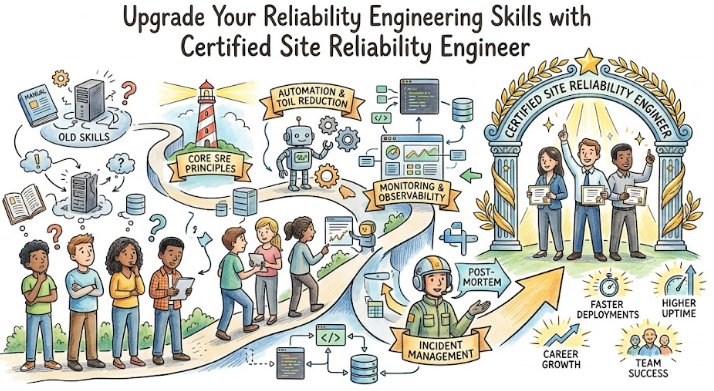
The Certified Site Reliability Engineer credential is a transformative benchmark for tech professionals dedicated to merging architectural engineering with operational stability. This manual is written for developers and infrastructure specialists who understand that contemporary digital platforms demand automated, self-healing, and high-performing systems.
As the industry pivots toward platform engineering and cloud-native frameworks, gaining expertise in SRE principles is essential for long-term professional growth. By utilizing the resources at sreschool, engineers can move away from reactive troubleshooting and toward a proactive design philosophy, ensuring their career choices are backed by industry-standard validation.
What is the Certified Site Reliability Engineer?
The Certified Site Reliability Engineer program is a technical validation initiative created to standardize the methodologies needed to operate complex, distributed services with high confidence. Rather than focusing on proprietary tool dashboards, this program prioritizes a software-centric approach to system administration. It was established to harmonize abstract DevOps ideals with the practical demands of live production environments where availability and performance metrics define business health. By centering on reliability, the certification confirms that an engineer can successfully deploy SLIs, SLOs, and error budgets within sophisticated enterprise ecosystems and automated release cycles.
Who Should Pursue Certified Site Reliability Engineer?
This certification is designed for a diverse range of technical roles, from backend developers wanting to master the operational side of their applications to legacy sysadmins seeking to modernize their expertise. Cloud architects, site reliability practitioners, and cybersecurity leads will find the curriculum indispensable for managing the intricacies of container orchestration and global infrastructure. In both the Indian tech sector and the international market, engineering directors also find value in this track as it offers a blueprint for scaling high-availability teams. Even those in data science or financial operations can utilize these strategies to maintain platform consistency during peak processing demands.
Why Certified Site Reliability Engineer is Valuable and Beyond
The requirement for skilled SREs consistently outstrips the available talent pool as businesses globally transition to permanent digital models. Earning this title showcases a dedication to operational excellence that remains relevant even as specific vendors or frameworks shift. It provides an excellent return on investment by teaching fundamental concepts—like toil reduction, observability, and incident response—that are universally applicable. Furthermore, as platforms grow in complexity, the capacity to manage system health while minimizing manual labor becomes a core competitive asset, ensuring certified professionals remain top candidates in the global job market.
Certified Site Reliability Engineer Certification Overview
The educational program is delivered through Certified Site Reliability Engineer and is managed on the sreschool site. The evaluation methodology goes beyond rote memorization, utilizing scenario-based challenges that mimic the high-stakes decisions required in actual production settings. The framework is built to be incremental, guiding students from basic reliability definitions to advanced structural engineering while allowing for self-paced progression. This professional credential is highly regarded for its technical depth, ensuring that those who qualify have a proven ability to maintain a balance between rapid feature deployment and the core stability of the environment.
Certified Site Reliability Engineer Certification Tracks & Levels
The curriculum is organized into three progressive stages: Foundation, Professional, and Advanced, providing a transparent roadmap for long-term career evolution. The Foundation tier establishes the essential terminology and cultural shifts needed for reliability, whereas the Professional tier focuses on the technical execution of error budgets and sophisticated monitoring.
Specialty tracks allow practitioners to merge SRE logic with specific domains like Security, FinOps, or DevOps, offering a personalized professional development journey. As individuals reach the Advanced tier, the focus transitions toward leadership and systemic architecture, grooming them for principal engineering or CTO-level responsibilities.
Complete Certified Site Reliability Engineer Certification Table
| Track | Level | Who it’s for | Prerequisites | Skills Covered | Recommended Order |
| Main SRE | Foundation | New Grads / Project Managers | Basic Computing & Web Logic | SLOs, SLIs, Toil, SRE Culture | 1 |
| Main SRE | Professional | Mid-Career DevOps / SREs | 2+ years Tech Experience | Observability, Budgets, Automation | 2 |
| Main SRE | Advanced | Senior Architects / Leads | 5+ years Cloud Experience | Scalability, Capacity, Design | 3 |
| SRE-FinOps | Specialist | Cloud Cost Analysts | Basic Financial Literacy | Economic Reliability & Spend | 4 |
| SRE-Sec | Specialist | Security Practitioners | Security Basics | Hardened Reliability & Safety | 4 |
Detailed Guide for Each Certified Site Reliability Engineer Certification
Certified Site Reliability Engineer – Foundation
What it is
This certification confirms a practitioner’s understanding of the primary pillars of Site Reliability Engineering and how it serves as a practical implementation of DevOps culture.
Who should take it
Suitable for junior developers, system administrators, or technical leads who require a high-level overview of modern uptime strategies without needing deep programmatic experience.
Skills you’ll gain
- Distinguishing SRE from legacy operations
- Identifying key service level indicators
- Recognizing and documenting manual toil
- Participating in incident management workflows
Real-world projects you should be able to do
- Designing a basic reliability dashboard for a web service.
- Auditing a manual deployment process to identify automation opportunities.
- Assisting in the creation of a blameless incident report.
Preparation plan
- 7–14 days: Study the core manifestos and complete the introductory video modules.
- 30 days: Engage with practice assessments and review case studies of successful SRE implementations.
- 60 days: Generally unnecessary for this level unless moving from a non-technical background.
Common mistakes
- Viewing SRE merely as a new name for the same old support role.
- Creating overly complex SLIs that do not reflect user experience.
- Failing to adopt the cultural requirement of psychological safety.
Best next certification after this
- Same-track option: Certified SRE Professional
- Cross-track option: Certified DevOps Associate
- Leadership option: Technical Team Lead Foundation
Certified Site Reliability Engineer – Professional
What it is
This intermediate credential validates the technical proficiency required to maintain enterprise-grade reliability through automation and data-driven decision-making.
Who should take it
Active DevOps practitioners or system engineers with a few years of experience who are responsible for the health and performance of live applications.
Skills you’ll gain
- Governing release velocity using Error Budgets
- Configuring full-stack observability and distributed tracing
- Developing automated self-healing scripts
- Managing complex incident lifecycles
Real-world projects you should be able to do
- Integrating a monitoring solution with automated alerting and paging.
- Implementing a “canary” deployment strategy based on real-time metrics.
- Leading a root cause analysis session after a simulated system failure.
Preparation plan
- 7–14 days: Intensive study of observability patterns and mathematical budget models.
- 30 days: Hands-on lab work focused on scripting and automated remediation.
- 60 days: Deep dive into distributed systems theory and high-availability design patterns.
Common mistakes
- Relying too heavily on tools without understanding the underlying logic.
- Ignoring the human elements of on-call rotations and burnout.
- Inaccurately calculating error budgets, leading to false alerts.
Best next certification after this
- Same-track option: Certified SRE Advanced
- Cross-track option: Certified DevSecOps Professional
- Leadership option: Principal Reliability Engineer
Choose Your Learning Path
DevOps Path
The DevOps learning route emphasizes the total lifecycle of software development, prioritizing the fluidity between writing code and deploying it. Students on this path discover how SRE practices act as a stabilizing force within fast-moving CI/CD environments. It is a perfect fit for engineers who thrive on building infrastructure as code and optimizing delivery pipelines for maximum efficiency.
DevSecOps Path
This specialized track ensures that security protocols are baked directly into the reliability framework rather than handled by a separate department. Candidates learn to automate vulnerability assessments and compliance gating as part of the standard SRE toolkit. This path is vital for those operating in sectors where data privacy and system integrity are paramount.
SRE Path
The primary SRE track focuses on the deep engineering required to keep global, high-traffic systems operational and efficient. It covers everything from low-level system performance to high-level traffic management and capacity planning. This is the ideal route for professionals who want to be the ultimate guardians of system availability and performance.
AIOps Path
The AIOps route investigates how machine learning can be applied to massive streams of operational data to predict outages before they happen. Engineers learn to move beyond static thresholds and toward intelligent, dynamic alerting systems. This path is designed for those who want to lead the next generation of autonomous infrastructure management.
MLOps Path
Focusing on the unique needs of artificial intelligence deployments, this path applies SRE rigor to the lifecycle of machine learning models. It addresses the reliability of data ingestion, model training, and production inference at scale. This is a crucial specialization for engineers supporting data science teams and AI-driven products.
DataOps Path
DataOps applies the principles of reliability to the complex world of big data and real-time analytical pipelines. Practitioners learn to ensure that data flows are consistent, accurate, and highly available for business stakeholders. It is the best choice for data architects who want to bring professional operational standards to their data lakes.
FinOps Path
The FinOps path merges financial accountability with technical reliability, teaching engineers how to optimize cloud spend without sacrificing performance. It treats cost as a primary engineering metric, similar to latency or error rates. This is an essential skill for professionals looking to demonstrate the fiscal value of their technical decisions to management.
Role → Recommended Certified Site Reliability Engineer Certifications
| Role | Recommended Certifications |
| DevOps Engineer | SRE Foundation, SRE Professional, DevOps Specialist |
| SRE | SRE Foundation, SRE Professional, SRE Advanced |
| Platform Engineer | SRE Professional, Cloud Architecture Specialist |
| Cloud Engineer | SRE Foundation, SRE Professional |
| Security Engineer | SRE Foundation, DevSecOps Specialist |
| Data Engineer | SRE Foundation, DataOps Specialist |
| FinOps Practitioner | SRE Foundation, FinOps Specialist |
| Engineering Manager | SRE Foundation, SRE Leadership |
Next Certifications to Take After Certified Site Reliability Engineer
Same Track Progression
After achieving professional status, moving toward advanced certifications allows you to tackle the most complex challenges in distributed computing. This involves mastering global load balancing, multi-cloud resiliency, and long-term infrastructure strategy. Pursuing this path marks you as a top-tier expert capable of leading the technical vision for an entire organization.
Cross-Track Expansion
Broadening your expertise into fields like DevSecOps or DataOps can make you a more versatile and indispensable asset to your company. Understanding how reliability interacts with security and data integrity allows you to bridge gaps between different technical teams. This expansion often leads to more holistic architectural roles and higher consulting value.
Leadership & Management Track
For those transitioning into oversight roles, the leadership track focuses on the human and organizational aspects of reliability. This includes learning how to build sustainable on-call cultures, negotiating SLOs with business stakeholders, and managing engineering budgets. It is the perfect path for those wanting to move into Director or VP of Engineering positions.
Training & Certification Support Providers for Certified Site Reliability Engineer
DevOpsSchool
This organization is a leading provider of technical training, offering a wide array of courses that span the entire DevOps and SRE spectrum. They are known for their hands-on approach and experienced instructors who bring real-world scenarios into the classroom. Their programs are designed to take a student from basic concepts to professional-level mastery.
Cotocus
Cotocus offers specialized consulting and training services tailored for modern engineering teams looking to implement advanced operational practices. They focus on providing deep technical insights that go beyond the surface level of tool usage. This provider is excellent for companies undergoing a serious digital transformation or SRE adoption.
Scmgalaxy
Scmgalaxy serves as a comprehensive hub for information and training related to software configuration and reliability engineering. They have a long history of supporting the tech community with resources, tutorials, and certification pathways. Their broad knowledge base makes them a trusted source for engineers at all stages of their careers.
BestDevOps
BestDevOps provides streamlined, high-quality educational content designed to help professionals master the most important tools in the modern cloud stack. Their curriculum is highly practical and updated regularly to match the latest industry trends. They are a great choice for individuals looking for focused, effective certification preparation.
devsecopsschool
This provider is the go-to resource for anyone looking to integrate security deeply into their SRE and DevOps workflows. They offer intensive courses on automating security testing and maintaining compliance in high-speed environments. Their training is essential for building resilient and secure modern platforms.
sreschool As the primary host for this certification track, sreschool provides the most direct and thorough path to becoming a certified SRE. Their curriculum is crafted specifically to meet the needs of the site reliability community, focusing on core engineering principles. This specialization ensures that their graduates are highly prepared for the demands of the job.
aiopsschool
Aiopsschool focuses on the cutting edge of operations, teaching engineers how to utilize artificial intelligence to improve system reliability. Their training covers the implementation of ML models for anomaly detection and automated problem resolution. It is the perfect place for engineers who want to stay ahead of the technology curve.
dataopsschool
This platform addresses the specific reliability and operational needs of the data engineering community. They provide training on how to apply SRE principles to data pipelines, ensuring that data is always available and trustworthy. It is an invaluable resource for anyone managing large-scale data infrastructure.
finopsschool
Finopsschool helps engineers and managers understand the financial implications of their cloud infrastructure decisions. Their courses teach the art of cloud cost optimization and how to build financially sustainable platforms. This training is key for professionals who want to align their technical work with business profitability.
Frequently Asked Questions (General)
1. Is the Certified Site Reliability Engineer exam proctored?
Yes, the examinations are typically conducted via an online proctored environment to maintain the integrity and global standards of the certification.
2. What is the main difference between an SRE and a DevOps Engineer?
DevOps is generally a set of cultural philosophies, while SRE is the specific job role and engineering methodology used to achieve those philosophical goals.
3. Do I need to be a developer to become a Certified Site Reliability Engineer?
You do not need to be a full-time developer, but you must be comfortable with scripting and understanding code logic to automate operational tasks effectively.
4. How long is the certification valid for?
Most professional certifications in this field are valid for two to three years, after which you may need to recertify to prove your knowledge is still current.
5. Are there any prerequisites for the Professional level?
While not always strictly enforced, having the Foundation certification and at least two years of operational experience is highly recommended.
6. Does the course cover specific cloud providers like AWS or Azure?
The core principles are cloud-neutral, but the practical labs often use major cloud platforms to demonstrate how to implement these concepts in the real world.
7. Can this certification help me switch from QA or Testing to SRE?
Yes, many professionals in QA find that their focus on system behavior and testing makes them excellent candidates for SRE roles after completing this training.
8. What kind of salary increase can I expect after certification?
While results vary, SREs are among the top-earning technical professionals, and certification often acts as a catalyst for significant salary negotiations.
9. Is the training available for corporate teams?
Yes, many of the listed providers offer group training sessions tailored to the specific needs and current tech stacks of entire engineering departments.
10. How much time should I dedicate to studying each week?
Most successful candidates dedicate between 5 and 10 hours a week over the course of a month to fully prepare for the professional-level exam.
11. What happens if I fail the exam on the first try?
Most programs allow for a retake after a short waiting period, though you should check the specific policy on the official website for details.
12. Is SRE relevant for small startups or just large enterprises?
Reliability is important at every scale; while the tools might differ, the principles of SLOs and automation are just as vital for a growing startup as a global corporation.
FAQs on Certified Site Reliability Engineer
1. What specifically does the Certified Site Reliability Engineer exam test?
The exam evaluates your ability to apply SRE concepts to real scenarios, including setting appropriate SLOs, managing error budgets, and using automation to reduce toil. It tests both your conceptual understanding and your ability to execute technical reliability tasks.
2. How does this certification help with career advancement in India?
As the Indian tech hub shifts toward high-end product engineering and global service delivery, SREs are in high demand. This certification provides the local and international validation needed to secure roles in top-tier multinational corporations.
3. What are the key benefits of joining the sreschool community?
By joining the community, you gain access to expert mentors, peer networking, and updated resources that help you stay current with the rapidly changing landscape of site reliability and platform engineering.
4. Are the labs in the Certified Site Reliability Engineer program self-paced?
Yes, the labs are designed to be completed at your own speed, allowing you to thoroughly practice and master each concept before moving on to the next module in the curriculum.
5. How is the “toil” concept addressed in the certification?
The program teaches you how to identify manual, repetitive work and provides the scripting and automation frameworks necessary to eliminate it, which is a core requirement of the SRE role.
6. Does the certification cover incident response?
Absolutely; incident management is a major component, focusing on how to organize teams, communicate during outages, and conduct effective, blameless post-mortems to prevent future issues.
7. Is there a focus on observability vs. simple monitoring?
Yes, the curriculum emphasizes observability, teaching you how to gain deep insights into system internals through logging, metrics, and tracing, rather than just checking if a server is up.
8. Can I use this certification to move into Platform Engineering?
SRE and Platform Engineering are closely related; the skills you learn in this certification, particularly around automation and infrastructure as code, are foundational for success in platform roles.
Final Thoughts: Is Certified Site Reliability Engineer Worth It?
As an industry veteran, my advice is to look at this certification as a structured investment in your technical maturity. The true power of the Certified Site Reliability Engineer path isn’t just the credential on your resume—it’s the shift in your perspective from someone who “fixes” systems to someone who “designs” reliability. In the current market, companies are no longer looking for people who can just keep the lights on; they want engineers who can build systems that stay on by themselves.
If you are ready to move beyond basic operations and enter the realm of high-scale engineering, this program provides the roadmap you need. It is a practical, rigorous, and highly rewarding way to ensure you remain at the top of your professional game.

