
Introduction
Runway entry and exit are important parts of safe aircraft operation. For beginner pilots, learning how to enter and leave a runway properly is just as important as learning takeoff, landing, or taxiing.
A runway is one of the busiest and most safety-sensitive areas of an airport. Aircraft may be taking off, landing, crossing, or waiting nearby. Because of this, pilots must follow clear procedures before entering or exiting a runway.
For new learners, runway movement may feel confusing at first. There are signs, markings, taxiways, holding points, radio instructions, and traffic to watch. But when the process is learned step by step, runway entry and exit become easier to understand.
This Runway Entry and Exit Guide for Beginners explains the basic procedures in simple language. It is written for student pilots, beginner pilots, aviation learners, and anyone who wants to understand safe runway operations.
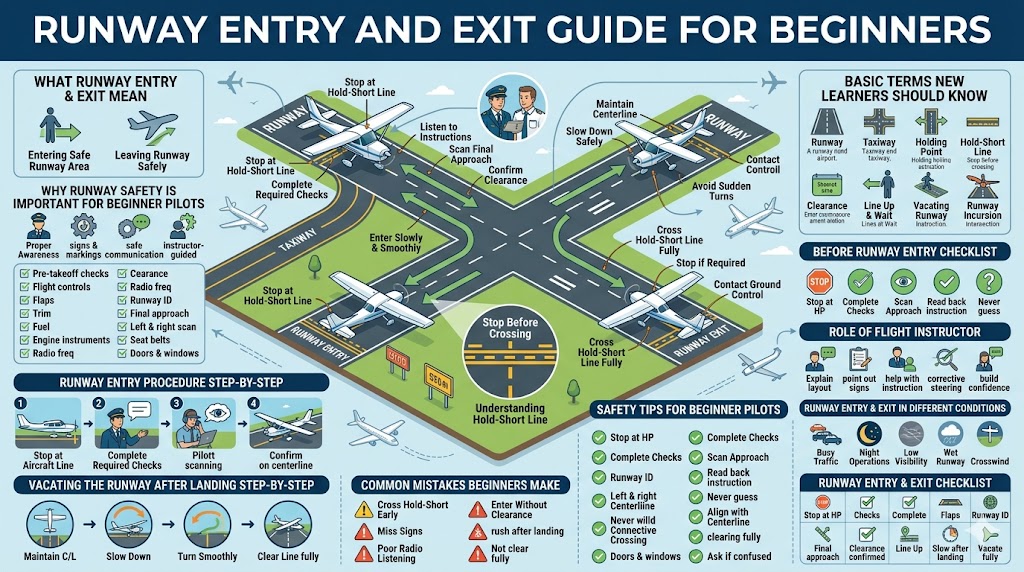
What Runway Entry and Exit Mean in Aviation
Runway entry means moving an aircraft from a taxiway or holding point onto the runway. This usually happens before takeoff or when crossing a runway.
Runway exit means leaving the runway after landing or after crossing it. The aircraft moves from the runway onto a taxiway and continues toward the parking area or another assigned location.
In simple words:
- Runway entry means entering the runway safely.
- Runway exit means leaving the runway safely.
- Both require awareness, communication, and correct positioning.
A beginner pilot must understand that entering a runway is not like entering a normal road. The runway is an active area where aircraft may be moving at high speed. That is why pilots must never enter a runway without proper clearance, instruction, or confirmed safety depending on the airport type.
Why Runway Safety Is Important for Beginner Pilots
Runway safety is important because mistakes on or near a runway can create serious risk. Even if the aircraft is moving slowly, entering the wrong area at the wrong time can become dangerous.
Beginner pilots must learn runway safety early because good habits start during training.
Runway safety helps student pilots learn:
- Proper airport awareness
- Correct use of taxiway signs and markings
- Safe communication habits
- Traffic scanning
- Holding point discipline
- Runway clearance understanding
- Calm decision-making
- Instructor-guided judgment
One important runway safety issue is called a runway incursion. This happens when an aircraft, vehicle, or person is incorrectly present on a runway protected area. Beginner pilots must learn how to avoid this by stopping at holding points, listening carefully, and confirming instructions.
Safe runway operation is not about rushing. It is about being clear, careful, and fully aware.
Basic Terms New Learners Should Know
Before learning runway entry and exit procedures, beginner pilots should understand some basic terms.
Runway
A runway is the long prepared surface used by aircraft for takeoff and landing. It may be made of asphalt, concrete, grass, or another suitable surface.
Runways have numbers, markings, lights, and signs to help pilots identify them.
Taxiway
A taxiway is a path used by aircraft to move around the airport on the ground. Taxiways connect runways, aprons, hangars, and parking areas.
Holding Point
A holding point is a location where aircraft must stop before entering or crossing a runway. It is usually marked with lines and signs.
Hold-Short Line
A hold-short line is a runway safety marking. It tells pilots where to stop before entering the runway area.
Beginner pilots must learn never to cross this line unless they have permission or clear instruction to do so.
Runway Clearance
Runway clearance is permission from air traffic control to enter, cross, line up, take off, or land on a runway at a controlled airport.
At uncontrolled airports, pilots do not receive ATC clearance, but they must still use traffic awareness and proper radio calls.
Line Up and Wait
“Line up and wait” means the pilot may enter the runway and align the aircraft with the runway centerline, but must wait before taking off.
The aircraft should not begin takeoff until takeoff clearance or proper instruction is received.
Vacating the Runway
Vacating the runway means leaving the runway after landing or crossing. The aircraft must move completely beyond the runway holding position marking.
Runway Incursion
A runway incursion is an unsafe or incorrect presence of an aircraft, vehicle, or person on the runway protected area.
Student pilots must learn procedures that help prevent runway incursions.
Before Runway Entry Checklist for Student Pilots
Before entering a runway, the pilot must make sure the aircraft is ready and the runway is safe.
A basic before runway entry checklist may include:
- Pre-takeoff checks completed
- Flight controls checked
- Flaps set correctly
- Trim set for takeoff
- Fuel checked
- Engine instruments normal
- Lights set as required
- Radio frequency selected
- Runway identified
- Final approach checked
- Runway checked left and right
- Clearance or instructor instruction confirmed
- Seat belts secured
- Doors and windows secured
This checklist may change depending on aircraft type, airport procedure, and flight school rules. Student pilots should always follow their aircraft checklist and instructor guidance.
A beginner pilot should not rush this stage. A few extra seconds of checking can prevent confusion and unsafe runway entry.
How to Enter a Runway Step by Step
Runway entry should be done slowly and carefully. Here is a simple step-by-step explanation for beginner pilots.
Step 1: Stop at the Holding Point
Before entering the runway, the aircraft must stop at the holding point unless the pilot has been clearly cleared or instructed to continue.
Stopping gives the pilot time to complete checks and confirm runway safety.
Step 2: Complete Required Checks
The pilot completes the before-takeoff or before-runway-entry checklist. This includes aircraft configuration, instruments, fuel, flaps, trim, and engine indications.
Step 3: Listen Carefully
At controlled airports, the pilot must listen carefully to air traffic control. At uncontrolled airports, the pilot must listen to traffic calls from other aircraft.
Poor listening can cause runway confusion.
Step 4: Scan Final Approach and Runway
Before entering, the pilot should look left, right, and along the final approach path.
This helps confirm that no aircraft is landing, taking off, or moving on the runway.
Step 5: Confirm Clearance or Instruction
At a controlled airport, the pilot must confirm runway clearance before entering. At a training airport, the instructor may also confirm the correct instruction.
At uncontrolled airports, the pilot must confirm traffic awareness before entering.
Step 6: Enter Slowly and Smoothly
The pilot uses gentle power and smooth steering to enter the runway.
There should be no sudden movement or sharp turn.
Step 7: Line Up with the Runway Centerline
Once on the runway, the aircraft should be aligned with the runway centerline. The nose should point straight down the runway before takeoff.
Step 8: Maintain Situational Awareness
Even after entering, the pilot must continue watching instruments, runway, traffic, and instructions.
Runway entry is not complete until the aircraft is correctly positioned and ready for the next phase.
Understanding Hold-Short Lines and Runway Markings
Hold-short lines and runway markings are very important for runway safety.
A hold-short marking usually has solid yellow lines and dashed yellow lines. When approaching from the taxiway side, the pilot must stop before the solid lines unless cleared or instructed to cross.
For beginner pilots, the most important rule is simple:
Do not cross a runway holding point unless you are sure you are allowed to cross or enter.
Runway and taxiway markings help pilots know:
- Where to stop
- Where the runway begins
- Which runway is ahead
- Which taxiway they are on
- Which direction to turn
- Where the centerline is
- Where aircraft should hold
Student pilots should practice reading signs and markings with their instructor during ground lessons and taxi practice.
Missing a sign or crossing a hold-short line by mistake is a serious error. Good pilots slow down, read signs carefully, and ask for clarification when unsure.
Runway Entry at Controlled and Uncontrolled Airports
Runway entry procedures can be different depending on the type of airport.
Controlled Airports
A controlled airport has air traffic control. Pilots must receive clearance before entering, crossing, taking off, or landing on a runway.
At controlled airports, student pilots must learn to:
- Listen carefully to ATC
- Read back important instructions
- Confirm the runway number
- Stop at holding points
- Enter only when cleared
- Ask for clarification if confused
Example instruction may include “line up and wait” or “cleared for takeoff.” Student pilots must understand the difference between these instructions.
Uncontrolled Airports
An uncontrolled airport does not have an operating control tower. Pilots use radio calls and visual scanning to maintain traffic awareness.
At uncontrolled airports, pilots must:
- Listen to other aircraft
- Make clear position calls
- Scan final approach and runway
- Follow standard traffic pattern procedures
- Enter the runway only when safe
Even without a control tower, runway safety remains very important.
How to Exit a Runway After Landing
After landing, the aircraft must exit the runway safely and efficiently. The pilot should not rush, but should also avoid staying on the runway longer than needed.
Step 1: Maintain Runway Centerline
After touchdown, the pilot keeps the aircraft aligned with the runway centerline during rollout.
Good directional control is important until the aircraft has slowed.
Step 2: Slow Down Safely
The pilot reduces speed using proper braking and control. Braking should be smooth, not harsh.
Step 3: Choose the Correct Exit Taxiway
The pilot exits using a suitable taxiway when the aircraft is slow enough to turn safely.
A beginner pilot should not attempt a fast turn just to exit early.
Step 4: Avoid Sudden Turns
Turning too quickly after landing can be unsafe. The aircraft should be under full control before leaving the runway.
Step 5: Cross the Hold-Short Line Fully
The aircraft is not fully clear of the runway until the entire aircraft has crossed beyond the runway holding position marking.
This includes the tail of the aircraft.
Step 6: Stop if Required
After vacating the runway, the pilot may stop if needed to complete after-landing checks or contact ground control.
The aircraft should not block the runway exit area unless required for safety.
Step 7: Contact Ground Control if Needed
At controlled airports, the pilot may contact ground control after leaving the runway. At uncontrolled airports, the pilot may continue taxiing while maintaining traffic awareness.
Common Mistakes Beginners Make During Runway Entry and Exit
Beginner pilots may make mistakes because runway operations require attention to many things at once. These mistakes can be corrected with practice and instructor guidance.
Crossing Hold-Short Lines Too Early
This is one of the most serious mistakes. Pilots must stop before the holding point unless they have confirmed clearance or instruction.
Missing Runway Signs
New learners may focus only on steering and miss important signs. Taxiing slowly helps the pilot read signs properly.
Poor Radio Listening
Runway instructions must be heard clearly. If a pilot is unsure, they should ask for clarification.
Entering Without Confirming Clearance
At controlled airports, entering a runway without clearance is unsafe. Student pilots must build strong clearance discipline.
Rushing After Landing
After touchdown, some beginners try to exit too quickly. The aircraft must be slowed and controlled before turning off the runway.
Turning Off Too Fast
Fast runway exits can cause poor control. Slow, smooth turns are safer.
Not Clearing the Runway Fully
The full aircraft must pass beyond the hold-short line after exiting. Stopping too early can leave part of the aircraft in the runway protected area.
Losing Situational Awareness
Runway operations require awareness of traffic, signs, markings, instructions, and aircraft position. Losing awareness can lead to unsafe decisions.
Safety Tips for Runway Entry and Exit
Safe runway operations depend on discipline and awareness.
Here are practical safety tips for beginner pilots:
- Stop at holding points unless cleared or instructed
- Complete checks before runway entry
- Listen carefully to radio instructions
- Confirm the correct runway
- Scan final approach before entering
- Read back important clearances clearly
- Never guess if unsure
- Enter the runway slowly and carefully
- Align properly with the centerline
- After landing, slow down before exiting
- Do not make sharp runway exit turns
- Clear the hold-short line fully after exit
- Ask the instructor when confused
- Treat every runway as active
- Stay calm and avoid rushing
One of the best habits a beginner pilot can learn is this: when unsure, stop safely and ask.
Role of the Flight Instructor During Runway Operations
The flight instructor plays a major role in teaching runway entry and exit. Student pilots are still learning how to manage aircraft control, communication, and airport awareness at the same time.
During runway operation training, the instructor may:
- Explain airport layout
- Point out runway signs and markings
- Help with radio communication
- Confirm ATC instructions
- Teach when to stop and when to enter
- Demonstrate runway scanning
- Correct taxi speed
- Guide runway lineup
- Help with runway exit after landing
- Take control if needed
The instructor also teaches decision-making. For example, if the student is unsure about clearance, confused about location, or not ready for takeoff, the instructor may tell the student to stop and clarify.
Good runway habits learned during training stay with pilots throughout their flying careers.
Runway Entry and Exit in Different Conditions
Runway entry and exit can become more challenging in different conditions.
Busy Airport Traffic
At busy airports, there may be many aircraft moving at the same time. Pilots must listen carefully, follow instructions, and avoid distractions.
Night Operations
At night, signs and lights become more important. Pilots must taxi slowly and confirm runway position carefully.
Low Visibility
In low visibility, it can be harder to see markings, signs, and other aircraft. Extra caution and strict procedure are required.
Wet Runway Conditions
After landing on a wet runway, braking may feel different. Pilots should slow down safely before attempting to exit.
Crosswind Conditions
Crosswind can affect aircraft control during takeoff, landing, and rollout. Pilots must maintain proper directional control before entering or exiting the runway.
New learners should practice these conditions only with proper instructor guidance.
Simple Example of a Beginner Pilot Entering and Exiting a Runway
Imagine a student pilot taxiing toward the runway with an instructor. The yellow taxiway centerline leads to the holding point.
The instructor says, “Stop before the hold-short line.”
The student stops the aircraft and completes the before-takeoff checklist. The instructor asks the student to look left, right, and check final approach.
The runway is clear. At a controlled airport, the tower gives clearance. The student reads back the instruction, releases the brakes, and slowly enters the runway.
The aircraft turns onto the runway and lines up with the centerline. The student takes a moment to confirm direction and runway alignment.
After takeoff practice and later landing, the aircraft touches down and slows on the runway. The instructor says, “Keep it straight and do not rush the exit.”
The student slows down, turns onto the taxiway, and continues past the hold-short line. The instructor says, “Now we are clear of the runway.”
This simple experience teaches an important lesson: runway safety is about patience, awareness, and correct procedure.
Runway Entry and Exit Checklist Table
| Checklist Item | Why It Matters |
|---|---|
| Stop at holding point | Prevents unsafe runway entry |
| Pre-takeoff checks complete | Confirms aircraft is ready before runway use |
| Runway identified | Helps avoid entering the wrong runway |
| Final approach scanned | Confirms no aircraft is landing |
| Clearance confirmed | Ensures permission at controlled airports |
| Lights set as required | Improves aircraft visibility |
| Line up with centerline | Prepares for safe takeoff roll |
| Slow after landing | Allows safe runway exit |
| Exit taxiway selected | Helps leave the runway safely |
| Hold-short line crossed fully | Confirms aircraft has vacated the runway |
FAQs About Runway Entry and Exit for Beginners
1. What does runway entry mean?
Runway entry means moving an aircraft from a taxiway or holding point onto the runway for takeoff, crossing, or positioning.
2. What does runway exit mean?
Runway exit means leaving the runway after landing or crossing and moving onto a taxiway.
3. Can a pilot enter a runway without clearance?
At a controlled airport, a pilot must not enter a runway without proper clearance. At uncontrolled airports, the pilot must confirm it is safe before entering.
4. What is a hold-short line?
A hold-short line is a runway safety marking where aircraft must stop before entering or crossing a runway unless cleared or instructed.
5. Why is runway safety important for student pilots?
Runway safety helps prevent runway incursions, traffic conflicts, and unsafe ground movement.
6. What should a beginner pilot check before entering a runway?
A beginner pilot should check aircraft readiness, runway identification, traffic, final approach, radio instructions, and instructor confirmation.
7. When is an aircraft fully clear of the runway?
An aircraft is fully clear only when the entire aircraft has crossed beyond the runway holding position marking.
8. Should pilots rush to exit the runway after landing?
No. Pilots should exit safely when the aircraft is slow and under control. Rushing can create unsafe turns or poor control.
9. What is “line up and wait”?
“Line up and wait” means the pilot may enter the runway and align with the centerline but must wait before takeoff.
10. What should a student pilot do if confused about runway instructions?
The student pilot should stop safely if needed and ask the instructor or air traffic control for clarification.
Conclusion
Runway entry and exit are essential skills for every beginner pilot. These procedures may seem simple, but they require attention, discipline, communication, and strong airport awareness.
This Runway Entry and Exit Guide for Beginners explains that safe runway movement starts before the aircraft enters the runway and continues until the aircraft has fully exited after landing.
Student pilots should learn to respect holding points, runway markings, clearance instructions, traffic scanning, and checklist use. They should never rush runway entry or exit. A careful and calm pilot is always safer than a hurried pilot.
With proper instructor supervision, regular practice, and clear understanding, beginner pilots can build strong runway safety habits from the start of their training.
Every safe flight begins and ends with correct runway awareness.

