
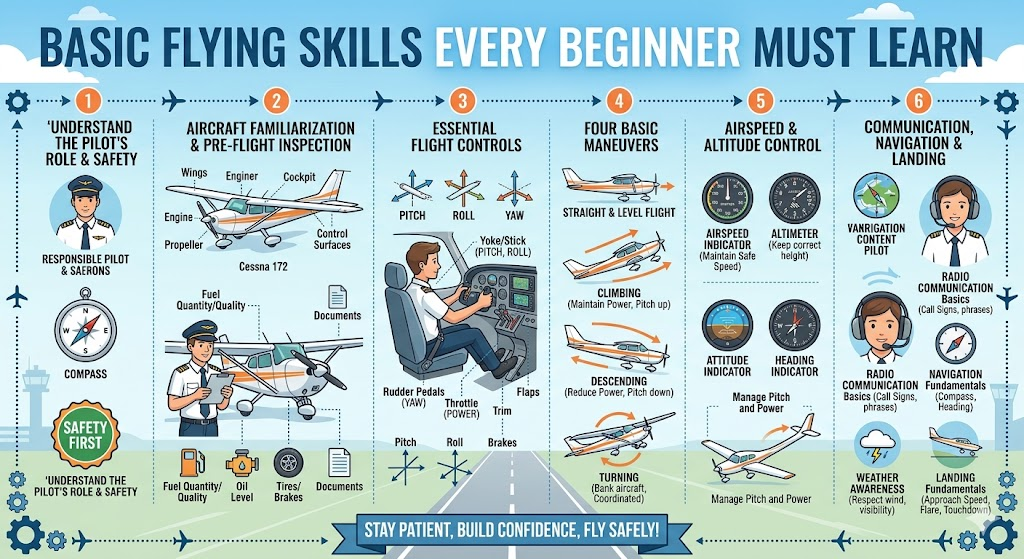
Introduction
Learning to fly is exciting, but it also requires discipline, patience, and strong basic skills. Every confident pilot begins with the fundamentals: understanding the aircraft, using flight controls smoothly, following checklists, communicating clearly, and making safe decisions. These early skills form the foundation for all future flight training. Whether a student wants to become a private pilot, commercial pilot, flight instructor, or aviation professional, mastering the basics is the first step toward safe and successful flying.
Why Basic Flying Skills Matter
Basic flying skills help student pilots become safe, calm, and confident in the cockpit. A beginner who understands aircraft control, weather awareness, communication, and safety procedures can learn faster and handle training more effectively.
These skills matter because they support:
- Flight safety during every stage of training
- Pilot confidence while handling the aircraft
- Better decision-making in normal and abnormal situations
- Faster learning progress during advanced lessons
- Aviation discipline through checklists and procedures
Flying is not only about moving an aircraft through the sky. It is about managing responsibility, risk, communication, and awareness.
Understanding the Pilot’s Role
A pilot is responsible for the safe operation of the aircraft. Even during training, student pilots must begin thinking like responsible aviation professionals.
A beginner pilot must learn:
- How to maintain situational awareness
- How to control the aircraft smoothly
- How to follow instructor guidance
- How to monitor weather and traffic
- How to use checklists correctly
- How to stay calm during pressure
- How to make safety-first decisions
A good pilot is not someone who rushes. A good pilot is someone who thinks clearly, follows procedures, and keeps learning.
Essential Flying Skills Every Beginner Must Learn
Aircraft Familiarization
Aircraft familiarization means understanding the basic parts, controls, instruments, and systems of the training aircraft. Before flying, beginners should know where important controls are located and what each control does.
This includes learning about the wings, tail, engine, propeller, cockpit controls, landing gear, fuel system, brakes, and communication equipment. Familiarity reduces confusion and builds confidence during training.
Pre-Flight Inspection Skills
Pre-flight inspection is a safety check completed before flying. Student pilots must learn how to inspect the aircraft carefully with their instructor.
A pre-flight inspection usually includes checking:
- Fuel quantity and quality
- Oil level
- Tires and brakes
- Control surfaces
- Propeller condition
- Lights and instruments
- Required documents
- General aircraft condition
This teaches students that safety begins before the aircraft leaves the ground.
Understanding Flight Controls
Beginners must learn how the main flight controls work. These include the yoke or control stick, rudder pedals, throttle, trim, flaps, and brakes.
The aircraft moves around three main axes:
- Pitch controls nose up and nose down movement
- Roll controls wing up and wing down movement
- Yaw controls nose left and nose right movement
Understanding these movements helps students control the aircraft smoothly.
Taxiing the Aircraft
Taxiing means moving the aircraft on the ground. It may look simple, but it requires coordination, awareness, and control.
Students must learn how to steer with rudder pedals, control speed with throttle and brakes, follow taxiway markings, communicate with control towers when required, and watch for other aircraft or vehicles.
Safe taxiing builds good habits before takeoff.
Straight and Level Flight
Straight and level flight is one of the first skills beginners learn. It means flying in a straight direction while maintaining a steady altitude.
This skill teaches students how to balance pitch, power, trim, and visual reference. It also helps them understand how small control inputs affect the aircraft.
Climbing Techniques
Climbing means gaining altitude. Students learn how to set the correct power, pitch attitude, and airspeed for a safe climb.
A good climb requires smooth control, engine monitoring, and awareness of traffic and airspace. Beginners should avoid pulling the nose too high because it can reduce airspeed.
Descending Techniques
Descending means reducing altitude in a controlled way. Students learn how to lower the nose, adjust power, maintain safe airspeed, and prepare for landing or approach.
A controlled descent helps pilots manage energy and position the aircraft correctly.
Turning Procedures
Turning is a basic but important flying skill. Students learn how to bank the aircraft, coordinate with rudder, maintain altitude, and roll out on the correct heading.
Smooth turns require coordination. Poorly coordinated turns can feel uncomfortable and may create unsafe habits.
Airspeed Management
Airspeed management is essential for safe flying. Beginners must learn how pitch and power affect airspeed.
For example, during takeoff and climb, the aircraft needs enough speed to remain safe. During landing, speed must be controlled carefully to avoid approaching too fast or too slow.
Altitude Control
Altitude control means keeping the aircraft at the correct height. Students learn to use pitch, power, trim, and instrument readings to maintain altitude.
Good altitude control shows discipline and improves overall aircraft handling.
Radio Communication Basics
Radio communication helps pilots speak with air traffic control, other aircraft, and airport teams. Beginners should learn standard aviation phrases, clear speaking, listening skills, and correct call signs.
Good communication improves safety and reduces confusion.
Navigation Fundamentals
Navigation means knowing where the aircraft is and where it is going. Beginners should learn basic map reading, compass use, headings, landmarks, GPS basics, and route planning.
Even with modern technology, pilots must understand basic navigation principles.
Weather Awareness
Weather is one of the most important parts of flying. Beginners must learn how wind, clouds, visibility, rain, storms, and turbulence affect flight.
Good weather awareness helps pilots make safer go or no-go decisions.
Landing Fundamentals
Landing is one of the most challenging skills for beginners. Students learn approach speed, runway alignment, descent control, flare, touchdown, and rollout.
A good landing begins before the aircraft reaches the runway. It depends on planning, stable approach, correct speed, and smooth control.
Takeoff Procedures
Takeoff requires proper checklist use, runway alignment, power application, airspeed monitoring, and rotation at the correct speed.
Beginners must learn to stay focused during takeoff because it is a busy phase of flight.
Emergency Awareness
Student pilots must understand basic emergency procedures. This does not mean beginners need to master every emergency immediately, but they should know how to stay calm and follow instructor guidance.
Emergency awareness includes engine failure basics, communication failure, unusual aircraft behavior, and safe landing options.
Decision-Making Skills
Good pilots make safe decisions. Beginners must learn when to continue, when to stop, when to ask for help, and when to avoid unnecessary risk.
Decision-making is not only for emergencies. It is used during weather checks, fuel planning, navigation, training limits, and airport operations.
Crew Resource Management Basics
Crew Resource Management means using all available resources, including instructors, checklists, instruments, radio, charts, and other crew members.
Even student pilots should learn teamwork and communication because aviation is rarely a solo effort.
Checklist Discipline
Checklists are essential in aviation. They help pilots avoid missing important steps.
Beginners must learn to use checklists during pre-flight, engine start, taxi, takeoff, cruise, descent, landing, shutdown, and emergencies. Good checklist discipline builds professional habits early.
Understanding Basic Flight Instruments
Airspeed Indicator
The airspeed indicator shows how fast the aircraft is moving through the air. It helps pilots maintain safe speeds during takeoff, climb, cruise, approach, and landing.
Altimeter
The altimeter shows aircraft altitude. Pilots use it to maintain assigned or planned altitudes and avoid terrain or airspace issues.
Attitude Indicator
The attitude indicator shows the aircraft’s nose and wing position compared to the horizon. It is especially useful when visibility is poor.
Heading Indicator
The heading indicator shows the aircraft’s direction. It helps pilots maintain the correct course during flight.
Vertical Speed Indicator
The vertical speed indicator shows whether the aircraft is climbing or descending and how quickly altitude is changing.
Turn Coordinator
The turn coordinator helps pilots understand turning and coordination. It supports smoother and safer turns.
Common Mistakes Beginner Pilots Make
Beginner pilots often make simple mistakes while learning, and that is normal. The important thing is to learn from them and improve with practice.
Common mistakes include:
- Overcontrolling the aircraft
- Forgetting to use trim properly
- Ignoring checklists
- Looking inside the cockpit too much
- Poor radio communication
- Weak weather understanding
- Rushing procedures
- Losing situational awareness
- Not asking questions
- Becoming nervous during landings
A good student pilot stays patient and accepts correction as part of learning.
How Flight Simulators Help Beginners
Flight simulators are useful tools for beginners. They allow students to practice cockpit procedures, instrument reading, radio communication, navigation, and emergency scenarios in a safe environment.
Simulators help students build confidence before applying skills in a real aircraft. They are also useful for reviewing lessons after training flights.
However, simulators should support real training, not replace proper instruction from a qualified flight instructor.
Importance of Aviation Safety Habits
Safety habits are the foundation of flying. Student pilots should build these habits from the first day of training.
Important safety habits include:
- Following checklists
- Respecting weather limits
- Listening to instructors
- Planning flights properly
- Managing fuel carefully
- Avoiding shortcuts
- Communicating clearly
- Staying calm under pressure
- Learning from mistakes
- Keeping a professional attitude
Aviation rewards discipline. Strong safety habits protect pilots, passengers, aircraft, and others in the airspace.
Building Confidence During Flight Training
Confidence comes through practice, preparation, and patience. Beginners should not expect perfection in the first few lessons. Flying is a skill that improves step by step.
Students can build confidence by:
- Reviewing lessons before each flight
- Asking questions freely
- Practicing regularly
- Staying calm after mistakes
- Listening carefully to feedback
- Studying aircraft procedures
- Using simulators when helpful
- Celebrating small progress
Every skilled pilot was once a beginner. Confidence grows with experience.
Training Path After Learning Basic Flying Skills
Student Pilot License
A Student Pilot License is often the first formal step in pilot training. It allows beginners to train under approved conditions and learn basic aircraft handling.
Private Pilot License
A Private Pilot License allows pilots to fly for personal purposes after meeting training, flight hour, exam, and skill requirements.
Advanced Flight Training
After basic training, students may learn instrument flying, night flying, cross-country navigation, advanced maneuvers, and more complex aircraft operations.
Commercial Pilot Pathway
Students who want an aviation career may continue toward commercial pilot training. This requires deeper technical knowledge, more flight hours, strong discipline, and professional-level skills.
Tips for Becoming a Better Student Pilot
- Study before each flight lesson
- Learn aviation terms early
- Practice checklist discipline
- Improve communication skills
- Stay patient with landings
- Understand weather basics
- Keep a training notebook
- Ask your instructor for feedback
- Avoid comparing your progress with others
- Focus on safety before performance
A good student pilot is not the one who learns fastest, but the one who learns correctly and safely.
Frequently Asked Questions
1- What are the first flying skills a student pilot learns?
Most student pilots begin with aircraft familiarization, pre-flight inspection, basic flight controls, taxiing, straight and level flight, climbs, descents, and turns. These skills help beginners understand how the aircraft responds to control inputs.
2- How long does it take to learn basic flying skills?
The time varies for each student. Some students become comfortable with basic controls within a few lessons, while others need more practice. Consistency, preparation, instructor quality, and confidence all affect learning speed.
3- Are flight simulators useful for beginners?
Yes, flight simulators are useful for practicing procedures, instruments, navigation, and radio communication. They help students build confidence, but they should be used along with real aircraft training and instructor guidance.
4- What is the hardest skill for new pilots?
Many beginners find landing the hardest skill because it requires speed control, runway alignment, descent management, flare timing, and smooth control. With practice and instructor feedback, landings gradually become easier.
5- Why is checklist discipline important?
Checklist discipline helps pilots avoid missing important steps. In aviation, small mistakes can become serious, so checklists support safety, consistency, and professional habits.
6- How do pilots improve situational awareness?
Pilots improve situational awareness by watching instruments, looking outside, listening to radio calls, tracking position, monitoring weather, and thinking ahead. Practice helps students understand what is happening around the aircraft.
7- What should beginners know about weather?
Beginners should understand wind, visibility, clouds, rain, turbulence, and storms. Weather affects safety, aircraft performance, navigation, and landing, so student pilots must learn to respect weather conditions.
8- How important is radio communication?
Radio communication is very important because it helps pilots coordinate with air traffic control, other aircraft, and airport operations. Clear communication reduces confusion and improves safety.
9- Can anyone learn basic flying skills?
Many people can learn basic flying skills with proper instruction, medical fitness, patience, and consistent practice. A strong safety mindset and willingness to learn are more important than natural talent.
10- What comes after mastering the basics?
After mastering basic flying skills, students can progress to cross-country flying, advanced maneuvers, instrument training, night flying, and license preparation depending on their aviation goals.
Conclusion
Basic flying skills are the foundation of every successful aviation journey. Before a beginner can move into advanced flight training, they must learn aircraft control, pre-flight inspection, takeoff, landing, navigation, communication, weather awareness, and checklist discipline. These skills build confidence, safety, and professional habits. Flying is not learned in one day, but with consistent practice, guidance, and patience, every student can improve. For anyone dreaming of becoming a pilot, the best place to begin is with strong fundamentals, a safety-first mindset, and a commitment to continuous learning.

