
1. Introduction
Learning to fly an aircraft is one of the most structured, disciplined, and rewarding journeys in the aviation world. It is not just about controlling an airplane—it is about understanding how flight works, making safe decisions in the sky, and developing the mindset of a responsible pilot.
Many students and aviation enthusiasts dream of becoming pilots because it offers a unique combination of adventure, technology, global travel, and professional respect. However, what most beginners do not realize is that flying an aircraft is a step-by-step learning process that requires proper training, certifications, practice hours, and strong mental discipline.
The journey usually begins with curiosity about aviation, followed by choosing the right flight school, completing ground training, learning simulator operations, and finally flying real aircraft under instructor supervision. Over time, students progress from basic controls to advanced navigation and commercial-level flying skills.
This guide will walk you through every important stage in detail so you can clearly understand how to start learning to fly an aircraft from scratch.
2. What Does It Mean to Learn to Fly an Aircraft?
Learning to fly an aircraft means developing both theoretical knowledge and practical flying skills required to safely operate an airplane in different conditions.
It includes understanding:
- How an aircraft generates lift and stays in the air
- How weather affects flight performance
- How to communicate with air traffic control
- How to handle emergency situations
- How to navigate using instruments and maps
There are two main learning paths:
Recreational Flying Path
This is for individuals who want to fly as a hobby or personal interest. It focuses on basic flying skills and safety.
Professional Pilot Path
This is a structured training path that leads to airline or commercial aviation careers. It requires more flying hours, advanced training, and multiple certifications.
Both paths begin with the same foundation but diverge in complexity and career outcomes.
3. Eligibility Requirements
Before starting flight training, candidates must meet basic eligibility criteria. These ensure that students are physically, mentally, and academically prepared for aviation training.
Age Requirement
Most flight schools allow students to start training at around 17 to 18 years of age. However, licensing eligibility for commercial pilots usually requires the candidate to be at least 18 years old.
Educational Qualification
For a professional pilot career, students are generally expected to complete 10+2 education with Physics and Mathematics. These subjects are important because aviation involves calculations, navigation, and technical understanding.
Medical Fitness
Aviation authorities require students to pass a medical examination conducted by certified aviation doctors. This includes:
- Vision and hearing tests
- Cardiovascular health checks
- General physical fitness assessment
- Mental health stability evaluation
Language Requirement
English is the global language of aviation. Basic fluency is required to communicate with air traffic control and understand international aviation procedures.
4. Steps to Start Learning to Fly an Aircraft
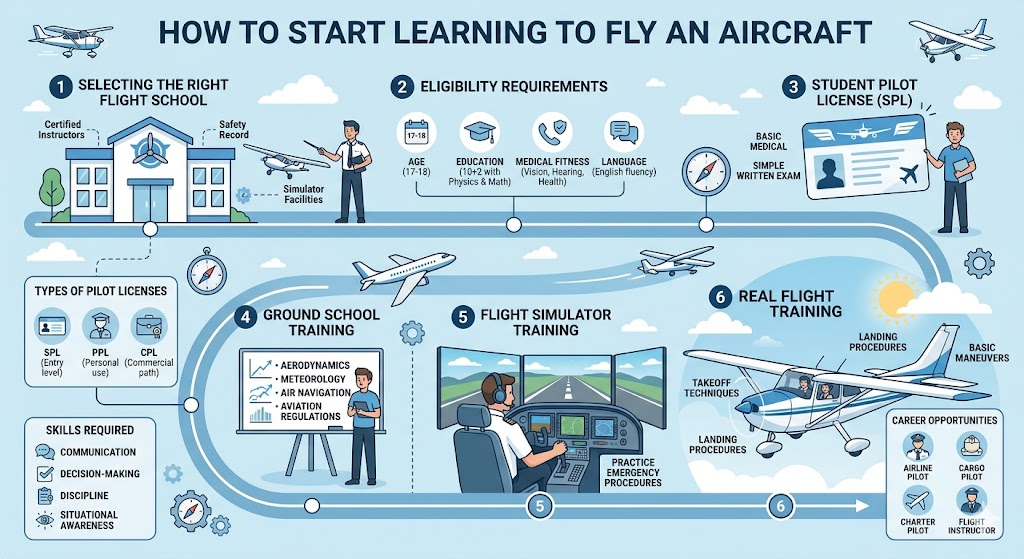
4.1 Selecting the Right Flight School
Choosing the right flight school is one of the most important decisions. A good school should have:
- Certified instructors
- Well-maintained aircraft fleet
- Simulator training facilities
- Strong safety record
- Structured training curriculum
The quality of your training depends heavily on the institution you choose.
4.2 Student Pilot License (SPL)
The Student Pilot License is the first official step into aviation. It allows beginners to start training flights under supervision.
To obtain it, students usually need:
- Basic medical clearance
- Minimum age requirement
- Simple written examination
This stage introduces students to real aviation environments for the first time.
4.3 Ground School Training
Ground school is the theoretical backbone of pilot training. Without it, flying cannot be safely understood.
Key subjects include:
- Aerodynamics (how flight works)
- Meteorology (weather science)
- Air navigation (route planning and maps)
- Aviation regulations (rules of flying)
- Aircraft systems (engines, controls, instruments)
This phase builds the intellectual foundation for safe flying decisions.
4.4 Flight Simulator Training
Before flying real aircraft, students practice on simulators. These simulate real flying conditions without risk.
Benefits include:
- Learning cockpit controls
- Practicing emergency procedures
- Understanding flight response
- Building confidence before real flight
Simulators help reduce mistakes during actual flying lessons.
4.5 Real Flight Training
This is the most exciting phase. Students fly actual aircraft under instructor supervision.
They learn:
- Takeoff techniques
- Landing procedures
- Basic flight maneuvers
- Airspace navigation
- Emergency handling
Over time, students gradually transition from simple flights to more complex navigation tasks.
5. Types of Pilot Licenses
Student Pilot License (SPL)
The entry-level license that allows supervised training flights.
Private Pilot License (PPL)
Allows individuals to fly aircraft for personal use but not for paid commercial work.
Commercial Pilot License (CPL)
The professional license required to work as a commercial pilot in airlines or aviation companies.
Each level requires increasing flight hours, exams, and practical assessments.
6. Cost of Learning to Fly
Flight training is a major investment. The total cost depends on several factors:
- Number of flight hours required
- Type of aircraft used for training
- Country and flight school fees
- Simulator usage
- Examination and licensing charges
Commercial pilot training can be expensive, but it opens doors to high-paying global aviation careers, making it a long-term investment in professional growth.
7. Skills Required to Become a Pilot
Becoming a pilot requires a combination of technical and personal skills:
- Strong communication skills for clear instructions
- Quick decision-making in critical situations
- High level of discipline and responsibility
- Focus and attention to detail
- Basic technical understanding of aircraft systems
- Situational awareness in changing environments
These skills are developed gradually throughout training.
8. Challenges in Pilot Training
Pilot training is rewarding but comes with challenges:
- High financial investment required
- Intensive academic and practical training schedule
- Strict discipline and performance standards
- Weather-dependent training delays
- Continuous exams and assessments
Despite these challenges, successful completion leads to a highly respected global profession.
9. Career Opportunities After Learning to Fly
After completing training and obtaining a commercial license, multiple career paths open:
Airline Pilot
Fly passenger aircraft for domestic or international airlines.
Cargo Pilot
Transport goods and logistics across regions and countries.
Charter Pilot
Operate private aircraft for business or personal clients.
Flight Instructor
Train new students while building flight experience.
Specialized Aviation Roles
Including medical evacuation flights, aerial photography, and surveillance operations.
10. Tips for Beginners
- Research aviation thoroughly before starting training
- Choose a certified and experienced flight school
- Focus strongly on ground school subjects
- Maintain physical fitness and mental alertness
- Practice consistency in study and training
- Stay patient—aviation is a long-term journey
- Learn from mistakes and instructor feedback
Success in aviation comes from discipline and persistence.
11. FAQs
1. Is it difficult to learn to fly an aircraft?
It is challenging but completely achievable with proper training and discipline. Most students learn step by step under instructor guidance.
2. How long does pilot training take?
It usually takes 18 months to 3 years depending on training pace, weather conditions, and flight hours completion.
3. Do I need strong science skills to become a pilot?
Basic understanding of Physics and Mathematics is helpful because aviation involves navigation, fuel calculation, and flight mechanics.
4. Can I become a pilot without prior experience?
Yes, flight training is designed for beginners. No prior flying experience is required to start.
5. What is the first step to become a pilot?
The first step is enrolling in a certified flight school and obtaining a Student Pilot License.
6. Is pilot training physically demanding?
Yes, pilots must maintain good physical and mental health as required by aviation medical standards.
7. Can I switch careers to become a pilot?
Yes, many people switch careers later in life if they meet eligibility and medical requirements.
8. What subjects are most important in pilot training?
Aerodynamics, navigation, meteorology, and aviation regulations are key subjects.
9. Are pilots in demand globally?
Yes, aviation continues to grow globally, increasing demand for trained commercial pilots.
10. What is the most important skill for a pilot?
Decision-making is one of the most critical skills, especially during unexpected situations.
12. Conclusion
Learning to fly an aircraft is a step-by-step journey that transforms a beginner into a skilled and responsible pilot. It starts with basic education and slowly progresses through ground training, simulator practice, and real flight experience.
Although the process requires time, dedication, and financial investment, it opens the door to one of the most respected and exciting careers in the world. Aviation is not just a profession—it is a lifestyle built on discipline, precision, and continuous learning.
For anyone passionate about flying, the first step is always the most important: start learning, stay consistent, and trust the process of becoming a pilot.

