
Introduction
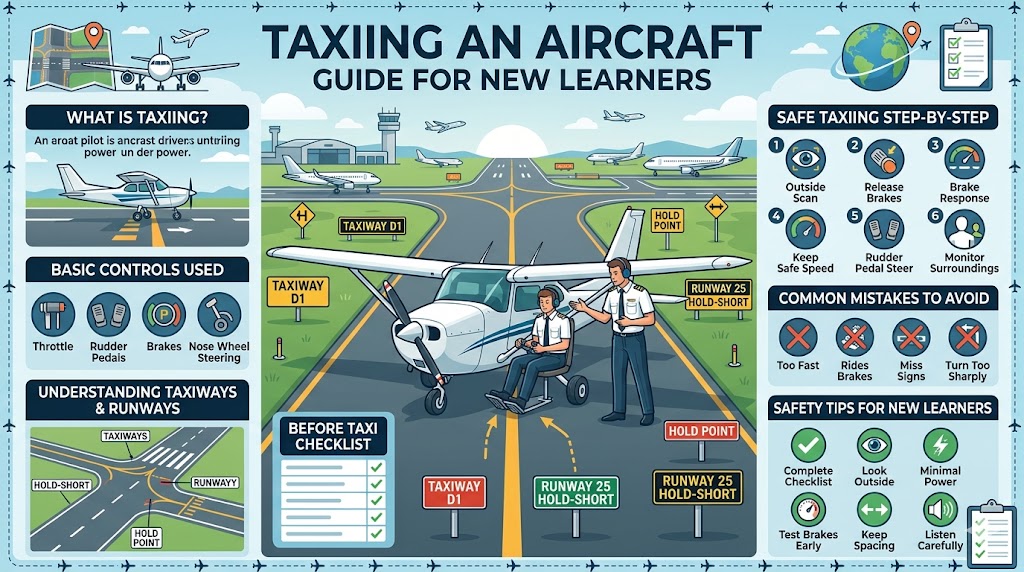
Before an aircraft takes off, it must move safely from the parking area to the runway. After landing, it must also move from the runway back to the parking area. This ground movement is called taxiing.
For new learners, taxiing may look simple from the outside. The aircraft is not flying yet, so many beginners think it is easy. But in real pilot training, taxiing is an important skill that needs focus, control, awareness, and discipline.
Taxiing teaches student pilots how to manage aircraft movement on the ground. It also helps them understand airport layout, taxiway markings, runway safety, radio communication, and safe spacing from other aircraft.
This Taxiing an Aircraft Guide for New Learners explains the basics in simple language. It is written for beginner pilots, student pilots, and aviation learners who want to understand how aircraft move safely on the ground.
What Taxiing Means in Aviation
Taxiing means moving an aircraft on the ground under its own power.
In simple words, taxiing is how a pilot drives the aircraft from one place to another at the airport before takeoff or after landing.
During taxiing, the aircraft moves slowly using engine power. The pilot controls direction with rudder pedals or nose wheel steering, depending on the aircraft type. The pilot also uses brakes to slow down or stop.
Taxiing may happen in areas such as:
- Apron or ramp area
- Taxiways
- Holding points
- Runway entry points
- Parking stands
- Maintenance areas
Even though the aircraft is on the ground, the pilot must stay alert. Airports can be busy places with aircraft, vehicles, people, signs, lights, and instructions from air traffic control or ground control.
A good pilot treats taxiing as a serious part of flying, not just a small step before takeoff.
Why Taxiing Training Is Important for New Learners
Taxiing training is important because safe flying begins on the ground. A student pilot must learn how to control the aircraft carefully before learning advanced flying skills.
Good taxiing helps new learners build:
- Ground control skills
- Airport awareness
- Safe movement habits
- Better use of rudder pedals
- Brake control
- Communication discipline
- Confidence before takeoff
- Awareness of other aircraft and vehicles
Taxiing is also important because mistakes on the ground can still be dangerous. Moving too fast, missing a hold-short line, turning too sharply, or not watching surroundings can create serious safety issues.
For new learners, taxiing should always be practiced under instructor supervision. The instructor explains how much power to use, when to brake, where to look, and how to follow taxiway instructions correctly.
Basic Controls Used During Taxiing
A student pilot must understand the basic controls used while taxiing. These controls may feel different from driving a car because aircraft do not move or turn in the same way.
Throttle
The throttle controls engine power. During taxiing, the pilot usually uses only a small amount of power.
Too much throttle can make the aircraft move too fast. New learners should use smooth and gentle throttle movements.
Rudder Pedals
Rudder pedals are used to control direction during taxiing. In many training aircraft, the rudder pedals are connected to nose wheel steering.
The pilot presses the left or right pedal to guide the aircraft along the taxiway.
Nose Wheel Steering
Some aircraft have nose wheel steering that helps the aircraft turn on the ground. In small training aircraft, this steering is often controlled through the rudder pedals.
New learners must avoid sharp or sudden steering movements.
Brakes
Brakes are used to slow down or stop the aircraft. Many small aircraft have toe brakes at the top of the rudder pedals.
Student pilots should avoid riding the brakes continuously. Using too much brake can create unnecessary wear and heat.
Control Yoke or Stick Positioning
The control yoke or stick may be positioned depending on wind direction while taxiing. This helps protect the aircraft from wind effects, especially in strong wind conditions.
The instructor will teach the correct control position for headwind, tailwind, and crosswind taxiing.
Parking Brake
The parking brake keeps the aircraft from moving when it is parked or stopped for a longer time.
Before taxiing, the pilot must make sure the parking brake is released.
Before Taxi Checklist for Student Pilots
A checklist helps pilots avoid missing important steps. Before taxiing, student pilots must confirm that the aircraft is ready to move safely.
A basic before taxi checklist may include:
- Seat belts fastened
- Doors and windows secured
- Brakes checked
- Parking brake released
- Flight controls checked
- Instruments checked
- Fuel quantity checked
- Radio frequency selected
- Taxi clearance received if required
- Area around aircraft clear
- Lights used as required
- Instructor confirmation received
The exact checklist depends on the aircraft type and flight school procedure. Student pilots should always follow the approved checklist for their aircraft.
Before moving, the pilot should look outside carefully. The area around the aircraft must be clear of people, vehicles, cones, equipment, and other aircraft.
Understanding Taxiways, Runways, and Holding Points
New learners must understand the difference between taxiways, runways, and holding points. This is a key part of airport ground safety.
Taxiways
Taxiways are paths used by aircraft to move around the airport. They connect parking areas, aprons, runways, and other airport sections.
Taxiways often have centerlines, edge markings, signs, and lights.
Runways
Runways are used for takeoff and landing. Because aircraft may be moving at high speed on runways, pilots must never enter a runway without proper clearance or confirmation.
Runway safety is one of the most important parts of taxi training.
Holding Points
Holding points are places where aircraft stop before entering or crossing a runway. These areas are marked with hold-short lines.
A student pilot must learn to stop before the hold-short line and wait for clearance or instructor instruction.
Taxiway Signs and Markings
Airport signs and markings help pilots know where they are and where they need to go.
Common markings include:
- Yellow taxiway centerlines
- Hold-short lines
- Runway signs
- Direction signs
- Location signs
- Runway entry markings
New learners should practice reading these signs with their instructor. Missing a sign or crossing a hold-short line by mistake can create serious risk.
How to Taxi an Aircraft Step by Step
Taxiing should be done slowly, smoothly, and with full attention. Here is a simple step-by-step explanation for new learners.
Step 1: Check the Area Outside
Before moving, the pilot looks left, right, and ahead. The area must be clear.
The pilot should also check behind if possible, especially near parking areas.
Step 2: Release the Brakes
The pilot releases the parking brake and keeps feet ready on the rudder pedals and brakes.
Step 3: Apply Small Power
The pilot gently increases throttle just enough to start the aircraft moving. Once the aircraft begins moving, power is usually reduced.
Step 4: Check Brake Response
Early in taxi, the pilot should gently test the brakes to confirm they are working.
This is an important safety habit.
Step 5: Keep Safe Taxi Speed
The aircraft should move slowly and carefully. Taxiing too fast makes it harder to stop or turn safely.
Step 6: Steer with Rudder Pedals
The pilot uses rudder pedals to follow the taxiway centerline. Corrections should be small and smooth.
Step 7: Follow Taxiway Centerline
The taxiway centerline helps keep the aircraft properly positioned. The pilot should keep the nose wheel close to the centerline.
Step 8: Stop at Holding Points
Before entering or crossing a runway, the pilot must stop at the holding point unless cleared or instructed to continue.
Step 9: Monitor Surroundings
The pilot must keep looking outside. Aircraft, vehicles, people, and airport signs can appear from different directions.
Taxiing requires continuous awareness.
Taxi Speed and Safe Ground Movement
Taxi speed should always be slow and controlled. The aircraft should never feel rushed on the ground.
A common rule for beginners is to taxi at a speed where the aircraft can be stopped safely without heavy braking. On turns, the speed should be even slower.
Fast taxiing can create problems such as:
- Poor steering control
- Longer stopping distance
- Sharp or unsafe turns
- Brake overheating
- Risk near other aircraft
- Difficulty following taxiway markings
New learners must remember that aircraft wings are wide. Even if the nose seems clear, the wingtip may be close to another aircraft, building, vehicle, or obstacle.
Safe taxiing means looking beyond the nose and being aware of the full aircraft.
Common Taxiing Mistakes New Learners Make
Taxiing mistakes are common during early training. With practice and instructor guidance, student pilots can correct these habits.
Taxiing Too Fast
Many beginners move faster than needed. Taxiing should be slow enough to stop safely.
Using Too Much Power
Too much throttle can make the aircraft accelerate quickly. Small power changes are better.
Riding the Brakes
Keeping pressure on the brakes while adding power is not good practice. It can cause brake wear and heat.
Poor Centerline Control
Some learners struggle to keep the aircraft on the taxiway centerline. This usually improves with rudder pedal practice.
Not Checking Both Sides Before Moving
A pilot must always check surroundings before starting taxi. Airport ramps can be busy.
Missing Taxiway Signs
New learners may focus only on steering and miss signs or markings. Pilots must divide attention between aircraft control and airport navigation.
Poor Radio Listening
Taxi instructions must be heard clearly. Student pilots should listen carefully and ask the instructor if unsure.
Turning Too Sharply
Sharp turns can be uncomfortable and unsafe. Smooth, wide, controlled turns are better.
Forgetting Wing Clearance
The aircraft wings may extend far from the pilot’s seat position. New learners must judge wingtip clearance carefully.
Safety Tips for Taxiing an Aircraft
Safe taxiing depends on slow speed, clear thinking, and awareness.
Here are practical safety tips for new learners:
- Always complete the before taxi checklist
- Look outside before moving
- Use minimum power needed for movement
- Keep taxi speed slow
- Test brakes early
- Follow the taxiway centerline
- Watch taxiway signs and markings
- Stop before hold-short lines
- Avoid sudden braking or sharp turns
- Keep enough distance from other aircraft
- Listen carefully to radio instructions
- Ask the instructor when unsure
- Be extra careful near people, vehicles, and buildings
- Stay calm and do not rush
A student pilot should never feel embarrassed about taxiing slowly. Safe taxiing is more important than moving quickly.
Role of the Flight Instructor During Taxi Training
The flight instructor plays an important role during taxi training. New learners are still developing control sense and airport awareness, so instructor guidance is essential.
During taxi training, the instructor may:
- Explain the taxi route
- Demonstrate brake use
- Teach rudder pedal control
- Help manage taxi speed
- Point out taxiway signs
- Explain hold-short lines
- Monitor other aircraft and vehicles
- Correct steering mistakes
- Take control if needed
- Build learner confidence
The instructor also teaches judgment. For example, when to slow down, when to stop, how to turn safely, and how to handle busy airport areas.
Student pilots should use taxi training as a chance to learn airport discipline. Good ground habits support safe flight habits.
Taxiing in Different Conditions
Taxiing can feel different depending on wind, weather, surface, and airport traffic.
Taxiing in Wind
Wind can affect aircraft movement on the ground, especially in light training aircraft. The pilot may need to position the control yoke or stick correctly to reduce wind impact.
Taxiing in Rain
Rain can reduce visibility and make surfaces slippery. Taxi speed should be slow, and braking should be gentle.
Taxiing at Night
At night, pilots must rely more on airport lights, signs, and careful visual scanning. Taxiing should be done slowly and carefully.
Taxiing at Busy Airports
Busy airports require strong awareness and good communication. New learners must listen carefully to instructions and follow the assigned taxi route.
Taxiing on Soft or Uneven Surfaces
Grass, dirt, or uneven surfaces can make taxiing more challenging. The aircraft may need more power to move, but the pilot must still avoid excessive speed.
All these conditions should be practiced only with proper instructor supervision.
Simple Example of a New Learner’s First Taxi Experience
Imagine a student pilot sitting in the aircraft for one of the first ground lessons. The engine is running, and the instructor says, “Before we move, look outside and check the area.”
The student looks left, right, and ahead. The area is clear.
The instructor says, “Release the parking brake and add a little power.”
The aircraft begins to move slowly. The student feels surprised because steering is done with the feet, not the hands like in a car.
The instructor reminds the student, “Use small pedal inputs. Keep it on the yellow line.”
The aircraft moves along the taxiway. The student gently presses the pedals and follows the centerline. At the holding point, the instructor says, “Stop before the line.”
The student reduces power and applies brakes smoothly. The aircraft stops safely.
The first taxi lesson may feel simple, but it teaches an important lesson: safe flying starts before takeoff.
Aircraft Taxiing Checklist Table
| Checklist Item | Why It Matters |
|---|---|
| Seat belts fastened | Keeps pilot and passenger secure during movement |
| Doors and windows closed | Prevents distraction and safety issues |
| Brakes checked | Confirms the aircraft can stop properly |
| Parking brake released | Allows the aircraft to move safely |
| Instruments checked | Confirms basic systems are working |
| Fuel checked | Ensures proper fuel supply before flight |
| Radio set | Helps receive taxi instructions or communicate |
| Area clear | Prevents collision with people, vehicles, or objects |
| Taxi clearance received | Required at controlled airports before taxiing |
| Lights used as required | Improves visibility to others on the ground |
FAQs About Taxiing an Aircraft for New Learners
1. Is taxiing an aircraft difficult for beginners?
Taxiing can feel unusual at first because aircraft are controlled with rudder pedals on the ground. With instructor guidance and practice, it becomes easier.
2. How does a pilot steer an aircraft while taxiing?
In many training aircraft, the pilot steers using rudder pedals connected to the nose wheel steering system.
3. Why should aircraft taxi slowly?
Aircraft should taxi slowly because slow speed gives the pilot more time to react, stop, and avoid obstacles.
4. Do pilots use brakes while taxiing?
Yes, pilots use brakes to slow down or stop. However, they should avoid riding the brakes continuously.
5. What is a taxiway?
A taxiway is a marked path used by aircraft to move around the airport between runways, parking areas, and other airport sections.
6. What is a hold-short line?
A hold-short line is a runway safety marking where aircraft must stop before entering or crossing a runway unless cleared or instructed.
7. Can student pilots taxi alone?
Student pilots taxi under instructor supervision during early training. Solo movement depends on training progress, school rules, and instructor approval.
8. Why is brake check important during taxi?
A brake check confirms that the aircraft can stop properly before continuing taxi.
9. What is the biggest taxiing mistake beginners make?
One of the biggest mistakes is taxiing too fast. Safe taxiing should always be slow and controlled.
10. Why is outside scanning important during taxi?
Outside scanning helps the pilot avoid other aircraft, vehicles, people, signs, and obstacles.
Conclusion
Taxiing is one of the first practical skills new learners experience in pilot training. Although the aircraft is still on the ground, taxiing requires focus, smooth control, airport awareness, and strong safety habits.
This Taxiing an Aircraft Guide for New Learners shows that taxiing is not just moving an aircraft like a car. It involves throttle control, rudder pedal steering, brake use, taxiway awareness, runway safety, and communication discipline.
Student pilots should learn taxiing slowly and carefully with instructor supervision. They should focus on checklist use, safe speed, centerline control, signs, markings, and surrounding awareness.
Good taxiing builds confidence before takeoff and supports safe habits throughout pilot training. Every safe flight begins with careful movement on the ground.

