
Introduction
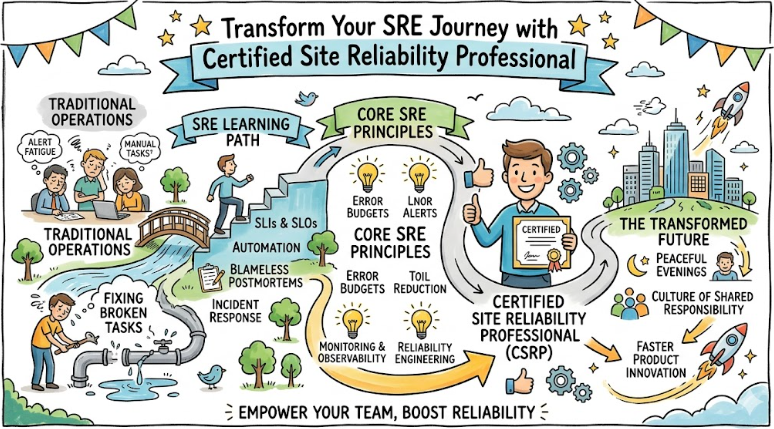
In the current landscape of high-scale computing, the demand for resilient and highly available systems has moved from a luxury to a fundamental business requirement. For engineers aiming to validate their expertise in maintaining these complex environments, the Certified Site Reliability Professional designation represents a critical benchmark of technical proficiency and operational maturity. This guide is designed for software engineers, systems administrators, and technical leaders who are navigating the transition from traditional operations to automated, reliability-focused engineering.
By exploring the curriculum hosted at sreschool, professionals can gain a structured understanding of how to balance the velocity of feature delivery with the stability of production environments. As organizations increasingly adopt cloud-native architectures, the role of an SRE becomes central to the health of the entire digital ecosystem. This guide provides a clear roadmap to help you evaluate the certification’s relevance to your specific career goals, ensuring you make an informed decision about your professional development.
What is the Certified Site Reliability Professional?
The Certified Site Reliability Professional is a comprehensive validation program designed to bridge the gap between software development and systems operations through the lens of site reliability engineering. Unlike generic cloud certifications, this program focuses specifically on the principles of engineering for reliability, emphasizing the use of software to solve operational problems. It represents a shift in mindset where manual intervention is replaced by automated, repeatable processes that scale with the needs of the business.
This certification exists to formalize the diverse skillset required to manage production environments at scale, covering everything from incident response to performance tuning. It emphasizes real-world application, ensuring that practitioners are not just memorizing definitions but are capable of implementing Service Level Objectives and managing error budgets. By aligning with modern enterprise practices, it prepares engineers to handle the high-pressure demands of modern distributed systems and microservices architectures.
Who Should Pursue Certified Site Reliability Professional?
The Certified Site Reliability Professional program is ideally suited for software engineers who want to move deeper into the operational side of the lifecycle without losing their focus on coding and automation. DevOps practitioners and cloud engineers will find it particularly beneficial as it provides the structured framework necessary to advance into senior SRE roles. Furthermore, systems administrators looking to modernize their skillsets will find this certification a powerful tool for transitioning into the world of infrastructure as code and automated monitoring.
Beyond individual contributors, technical managers and engineering leaders should pursue this certification to better understand the metrics and cultural shifts required to build a reliable organization. It is equally relevant for security professionals and data engineers who must ensure their specific domains remain available and performant under load. Whether you are operating in the Indian tech hubs or within a global enterprise, this certification provides a globally recognized standard for operational excellence that is highly valued by hiring managers.
Why Certified Site Reliability Professional is Valuable and Beyond
The value of the Certified Site Reliability Professional lies in its focus on longevity and fundamental principles rather than just specific, transient toolsets. While tools change, the core concepts of monitoring, alerting, incident management, and capacity planning remain constant across all cloud providers and on-premise environments. By mastering these principles, professionals ensure their relevance in an industry that is constantly evolving, making them indispensable to organizations that cannot afford downtime.
Enterprise adoption of SRE practices continues to accelerate as companies realize that uptime is directly linked to revenue and customer trust. Holding this certification demonstrates a commitment to the “reliability first” philosophy, which is a major differentiator in a competitive job market. The return on investment is seen not just in salary increases, but in the ability to lead high-impact projects that transform how a company handles production traffic. It provides a clear path for career progression into principal engineering and architectural roles.
Certified Site Reliability Professional Certification Overview
The Certified Site Reliability Professional program is a structured learning journey delivered via the official platform at Certified Site Reliability Professional. It is hosted on sreschool, a dedicated platform that focuses on specialized training for site reliability and production engineering. The program is designed to be rigorous, utilizing a combination of theoretical knowledge assessments and practical, hands-on evaluations to ensure a candidate’s readiness for production environments.
The ownership and structure of the certification are rooted in industry best practices, ensuring that the content is updated to reflect the latest trends in observability and automation. It avoids the pitfalls of purely academic certifications by requiring candidates to demonstrate how they would handle real-world failures and performance bottlenecks. This practical approach ensures that the certification holds weight with technical interviewers and senior leadership who prioritize demonstrable skills over paper qualifications.
Certified Site Reliability Professional Certification Tracks & Levels
The certification is structured into three distinct tiers: Foundation, Professional, and Advanced, allowing professionals to enter at the level that matches their current experience. The Foundation level focuses on the core vocabulary and concepts of SRE, such as SLIs and SLOs, making it perfect for those new to the field. The Professional level dives deep into implementation, automation, and incident response strategies, targeting those already working in DevOps or cloud environments.
For those aiming for leadership or specialized roles, the Advanced level offers tracks in SRE Architecture, FinOps integration, and AIOps implementation. These tracks allow practitioners to specialize in areas that align with their specific career interests or the needs of their current organization. This tiered approach ensures a logical progression, helping engineers build a solid base before tackling the complex architectural challenges found at the expert levels.
Complete Certified Site Reliability Professional Certification Table
| Track | Level | Who it’s for | Prerequisites | Skills Covered | Recommended Order |
| Core SRE | Foundation | New SREs, Developers | Basic Linux, Cloud awareness | SLOs, SLIs, Error Budgets, SRE Culture | 1 |
| Core SRE | Professional | DevOps Engineers, SREs | Foundation level, 2+ yrs Exp | Automation, Incident Mgmt, Observability | 2 |
| Engineering | Advanced | Lead SREs, Architects | Professional level, 5+ yrs Exp | Distributed Systems, Scalability, DR | 3 |
| Specialized | Expert | Senior Leaders, Specialists | Advanced level | Capacity Planning, Chaos Engineering | 4 |
Detailed Guide for Each Certified Site Reliability Professional Certification
Certified Site Reliability Professional – Foundation
What it is
This certification validates a candidate’s understanding of the core tenets of Site Reliability Engineering. it ensures the professional can speak the language of reliability and understands the cultural shift required to implement SRE.
Who should take it
Entry-level engineers, developers transitioning to operations, and managers who need to oversee SRE teams. It is designed for those with a basic understanding of IT infrastructure who want to formalize their knowledge.
Skills you’ll gain
- Defining Service Level Indicators (SLIs) and Service Level Objectives (SLOs).
- Understanding the concept of Error Budgets and how to use them for decision making.
- Identifying the differences between traditional operations and SRE.
- Basic understanding of monitoring versus observability.
Real-world projects you should be able to do
- Draft a basic SRE charter for a small development team.
- Calculate an error budget based on a 99.9% availability target.
- Set up a basic dashboard reflecting service health metrics.
Preparation plan
- 7-14 Days: Focus on reading the SRE Workbook and understanding core definitions and vocabulary.
- 30 Days: Complete the online modules and take practice exams to identify knowledge gaps in metric calculation.
- 60 Days: Participate in community forums and apply SLO concepts to a personal or lab project to see how they behave in practice.
Common mistakes
- Confusing SLIs with SLOs during the examination process.
- Underestimating the importance of the cultural aspects of SRE in favor of technical tools.
Best next certification after this
- Same-track option: Certified Site Reliability Professional – Professional
- Cross-track option: Certified DevOps Professional
- Leadership option: Engineering Management Foundation
Certified Site Reliability Professional – Professional
What it is
The Professional level validates the ability to implement and manage SRE practices in a production environment. It focuses on the technical execution of automation, incident handling, and building resilient systems.
Who should take it
Experienced DevOps engineers, current SREs with at least two years of experience, and cloud architects. It is intended for those who are responsible for the uptime and performance of live services.
Skills you’ll gain
- Implementing advanced observability stacks using metrics, logs, and traces.
- Automating toil through Python, Go, or specialized automation frameworks.
- Managing complex incident response cycles and conducting blameless post-mortems.
- Designing and executing load tests and performance tuning strategies.
Real-world projects you should be able to do
- Automate a manual recovery process that reduces Mean Time to Repair (MTTR).
- Design an alerting strategy that minimizes alert fatigue for an on-call rotation.
- Perform a detailed post-mortem for a multi-service outage and implement preventive actions.
Preparation plan
- 7-14 Days: Review advanced automation techniques and deep-dive into observability platform configurations.
- 30 Days: Work through hands-on labs focusing on incident simulation and automated remediation scripts.
- 60 Days: Focus on architectural patterns for high availability and disaster recovery across multiple regions.
Common mistakes
- Focusing too much on a single tool (like Prometheus) instead of general observability principles.
- Neglecting the “Toil Management” aspect of the certification, which is a key differentiator.
Best next certification after this
- Same-track option: Certified Site Reliability Professional – Advanced
- Cross-track option: Certified DevSecOps Professional
- Leadership option: Principal SRE Architect
Choose Your Learning Path
DevOps Path
The DevOps path focuses on the seamless integration of development and operations, emphasizing the CI/CD pipeline. Professionals on this path use SRE principles to ensure that automated deployments do not compromise system stability. It is ideal for those who enjoy building delivery platforms that empower developers while maintaining high standards of reliability. The focus is on bridging the gap between “code complete” and “running in production” through automation and testing.
DevSecOps Path
This path integrates security into the heart of the SRE lifecycle, ensuring that reliability and security are treated as two sides of the same coin. Practitioners learn how to automate security checks within the production environment without creating bottlenecks for the engineering team. It emphasizes the concept of “Security as Code” and ensures that incident response includes security forensics. This path is critical for organizations operating in highly regulated industries like finance or healthcare.
SRE Path
The pure SRE path is for those who want to specialize deeply in the science of production engineering and system internals. It focuses on the deep technical aspects of distributed systems, kernel tuning, and complex network architectures. Professionals here spend their time engineering solutions that allow systems to self-heal and scale horizontally with minimal human intervention. This is the primary path for those aiming to work at hyper-scale technology companies.
AIOps Path
AIOps practitioners focus on using machine learning and artificial intelligence to enhance operational decision-making and automate complex patterns. This path involves training models to detect anomalies in telemetry data before they lead to service-impacting incidents. It represents the cutting edge of SRE, where human intervention is supplemented by intelligent systems capable of processing vast amounts of data. This is ideal for professionals with an interest in data science and automated operations.
MLOps Path
The MLOps path is specialized for those managing the lifecycle of machine learning models in production environments. It applies SRE principles like monitoring and versioning specifically to the unique challenges of ML pipelines and model drift. Practitioners ensure that the infrastructure supporting AI models is as reliable as the software itself. As more companies integrate AI into their core products, the demand for MLOps-focused SREs is seeing massive growth.
DataOps Path
DataOps focuses on the reliability and performance of data pipelines and large-scale data processing systems. Engineers on this path ensure that data flows accurately and timely from sources to analytical platforms, applying SLOs to data quality and latency. It bridges the gap between data engineering and traditional site reliability. This path is essential for organizations that rely on real-time data for business intelligence and customer-facing features.
FinOps Path
The FinOps path combines SRE practices with financial accountability to optimize the cost of cloud operations. Practitioners learn how to build cost-aware architectures that maintain performance while minimizing waste and unnecessary cloud spend. It involves creating a culture where engineers take responsibility for the financial impact of their infrastructure choices. This is becoming a high-priority track for senior leadership looking to maximize cloud investment returns.
Role → Recommended Certified Site Reliability Professional Certifications
| Role | Recommended Certifications |
| DevOps Engineer | CSRP Foundation, CSRP Professional |
| SRE | CSRP Professional, CSRP Advanced |
| Platform Engineer | CSRP Professional, Advanced Architecture |
| Cloud Engineer | CSRP Foundation, CSRP Professional |
| Security Engineer | CSRP Foundation, DevSecOps Specialist |
| Data Engineer | CSRP Foundation, DataOps Specialist |
| FinOps Practitioner | CSRP Foundation, FinOps Specialist |
| Engineering Manager | CSRP Foundation, Leadership Track |
Next Certifications to Take After Certified Site Reliability Professional
Same Track Progression
Once you have mastered the professional and advanced levels of the Certified Site Reliability Professional, the logical next step is to pursue specialized architecture certifications. These programs often dive into specific domains like Chaos Engineering or High-Scale Distributed Databases. Deepening your expertise in these niche areas allows you to become a subject matter expert within your organization. It ensures that you remain at the forefront of technical innovation in the SRE space.
Cross-Track Expansion
If you have completed the core SRE certifications, expanding into DevSecOps or FinOps provides a more holistic view of the engineering ecosystem. Understanding how security vulnerabilities or cloud costs impact reliability allows you to make better architectural decisions. This cross-pollination of skills makes you a more versatile engineer, capable of leading cross-functional teams. It is particularly valuable for those working in startups where engineers often wear multiple hats.
Leadership & Management Track
For those looking to transition away from hands-on keyboard roles, moving into the leadership track is a natural progression. This involves certifications focused on engineering management, organizational psychology, and strategic planning. You will learn how to build SRE cultures, manage budgets, and align technical reliability goals with business objectives. This path is for those who want to influence the direction of the company at a departmental or executive level.
Training & Certification Support Providers for Certified Site Reliability Professional
DevOpsSchool
DevOpsSchool is a premier institution that provides extensive training for various engineering disciplines, including the Certified Site Reliability Professional. They offer a blend of live instructor-led sessions and self-paced modules designed to cater to working professionals. Their curriculum is highly practical, focusing on the tools and methodologies that are currently in high demand across the industry. With a strong presence in the Indian market, they have helped thousands of engineers transition into high-paying DevOps and SRE roles through their structured mentorship and job assistance programs.
Cotocus
Cotocus specializes in high-end technical consulting and corporate training, making them an excellent choice for teams looking to adopt SRE practices collectively. They focus on real-world scenarios and provide hands-on labs that simulate actual production environments. Their trainers are industry veterans who bring years of field experience into the classroom, ensuring that students learn more than just theory. Cotocus is known for its customized training approach, tailoring the Certified Site Reliability Professional curriculum to meet the specific technological stacks used by their corporate clients.
Scmgalaxy
Scmgalaxy is a well-known community-driven platform that offers a wealth of resources for those pursuing the Certified Site Reliability Professional designation. It serves as a central hub for technical blogs, tutorials, and certification guides that are invaluable for self-study. Their training programs are designed to be accessible and comprehensive, covering the entire software configuration management and reliability spectrum. For engineers who prefer a community-centric learning environment with plenty of peer support, Scmgalaxy provides the tools and networking opportunities needed to succeed.
BestDevOps
BestDevOps focuses on providing high-quality, streamlined training for modern engineering certifications. Their approach to the Certified Site Reliability Professional program is built around intensive bootcamps and practical lab exercises that prepare candidates for the rigors of the exam. They prioritize the most impactful skills, ensuring that students can apply what they learn immediately in their professional roles. BestDevOps is particularly suited for individuals who want an accelerated learning path without sacrificing the depth of technical understanding required for senior-level roles.
devsecopsschool
devsecopsschool provides a specialized focus on the intersection of security and operations, making it a vital resource for SREs who want to broaden their expertise. Their training for the Certified Site Reliability Professional includes unique modules on how to integrate security into the reliability lifecycle. They emphasize the automation of security audits and the implementation of secure-by-default infrastructure. For professionals aiming to become specialists in the growing field of DevSecOps, this provider offers the most relevant and up-to-date curriculum available in the market today.
sreschool
sreschool is the primary hosting platform for the Certified Site Reliability Professional and offers the most direct and authoritative training available. Because they own the certification standard, their courses are perfectly aligned with the exam objectives and the latest industry requirements. They provide an immersive learning experience with advanced simulators that replicate complex cloud outages. Engineers choosing sreschool benefit from the most current content and a direct path to certification, supported by a faculty of practicing site reliability engineers.
aiopsschool
aiopsschool is dedicated to the future of operations, providing specialized training in using artificial intelligence to manage large-scale systems. Their support for the Certified Site Reliability Professional track includes deep dives into predictive analytics and automated anomaly detection. As organizations move toward self-healing systems, the skills taught here become increasingly valuable. Aiopsschool is the go-to provider for SREs who want to stay ahead of the curve by mastering the tools and algorithms that are defining the next generation of operational excellence.
dataopsschool
dataopsschool focuses on the reliability of data infrastructure, providing essential training for SREs who work closely with data science and analytics teams. Their curriculum for the Certified Site Reliability Professional highlights the unique challenges of maintaining high-availability data lakes and streaming platforms. They teach how to apply SRE principles to data pipelines, ensuring that data integrity and latency are maintained at scale. For engineers in data-heavy organizations, dataopsschool provides the specialized knowledge required to ensure that the data foundation is always robust.
finopsschool
finopsschool addresses the critical need for financial management in the cloud, offering training that integrates cost optimization with reliability engineering. Their contribution to the Certified Site Reliability Professional learning path focuses on building cost-efficient architectures and tracking the financial impact of infrastructure changes. They provide engineers with the vocabulary and tools needed to communicate with finance departments effectively. As cloud budgets continue to grow, the expertise provided by finopsschool is essential for any senior SRE looking to deliver maximum value to their organization.
Frequently Asked Questions (General)
- How difficult is the Certified Site Reliability Professional exam?
The exam is considered moderately difficult as it requires a balance of theoretical knowledge and practical application. Candidates with a strong background in Linux and automation typically find it manageable with 30 to 60 days of dedicated study. - What are the prerequisites for the Foundation level?
There are no formal prerequisites, but a basic understanding of software development life cycles and cloud computing concepts is highly recommended. Familiarity with at least one programming language like Python is also beneficial. - Does this certification expire?
The certification is valid for three years, after which professionals are encouraged to recertify or progress to a higher level to ensure their skills remain current with evolving technology. - Is there a lab component in the examination?
Yes, the professional and advanced levels typically include a lab-based assessment where you must solve real-world reliability issues in a simulated production environment. - How does this certification compare to others like the Google SRE?
While Google offers excellent resources, the Certified Site Reliability Professional provides a broader industry perspective that is applicable across various cloud providers and enterprise environments. - Can I skip the Foundation level?
If you have more than three years of direct experience in an SRE or DevOps role, you may be eligible to challenge the Professional level exam directly, though it is usually recommended to follow the track. - What is the typical salary increase after obtaining this certification?
While results vary by region, professionals often see a 20% to 35% increase in salary when moving into specialized SRE roles that require this level of validated expertise. - Is the exam available online?
Yes, the exam can be taken online through a proctored environment, allowing professionals from all over the world to participate without the need for travel. - What happens if I fail the exam?
Most tracks allow for a retake after a specific cooling-off period, though you should check the official policy on the website for the specific rules regarding retake fees. - How long does it take to get the results?
For standard multiple-choice sections, results are often available immediately, while lab-based assessments may take several business days for manual review and grading. - Are there group discounts for corporate teams?
Yes, providers like sreschool and Cotocus often offer group rates for organizations looking to certify their entire engineering department simultaneously. - Does the certification provide job placement assistance?
Many of the associated training providers offer career coaching and job placement support as part of their comprehensive training packages to help you leverage your new credentials.
FAQs on Certified Site Reliability Professional
- What makes the Certified Site Reliability Professional unique in the market?
It focuses on the “Engineer” in SRE, emphasizing software solutions for operational problems rather than just using tools. - Is the curriculum updated regularly?
Yes, the board reviews and updates the curriculum annually to include emerging trends like serverless SRE and advanced observability. - Can a manager benefit from the Professional level?
While the Foundation level is better for general awareness, the Professional level helps managers understand the technical constraints their teams face daily. - What is the primary programming language used in the labs?
Python and Go are the most common, but the principles are language-agnostic and focus on the logic of automation. - Are there any community forums for candidates?
Yes, sreschool hosts an active community where candidates can share study tips and discuss complex SRE challenges. - Is the certification recognized globally?
Absolutely, it is designed to meet international standards for site reliability and is recognized by major tech firms worldwide. - Does it cover multi-cloud strategies?
Yes, the advanced levels specifically address the reliability challenges of running services across different cloud providers like AWS, Azure, and GCP. - How much time should I dedicate daily for preparation?
For most working professionals, dedicating 1 to 2 hours a day over a period of two months is sufficient to pass the Professional level.
Final Thoughts: Is Certified Site Reliability Professional Worth It?
In my experience as a principal engineer, I have seen many certifications come and go, but those that focus on foundational engineering principles always stand the test of time. The Certified Site Reliability Professional is one of those programs. It doesn’t just teach you how to click buttons in a cloud console; it teaches you how to think like a reliability engineer. It forces you to consider the trade-offs between speed and stability, which is the most critical skill in modern technology.
If you are looking for a shortcut to a high salary, no certification alone will give you that. However, if you are looking for a structured way to deepen your technical expertise and gain the respect of your peers in the production environment, then this certification is absolutely worth the investment of your time and effort. It provides the framework you need to move from reactive firefighting to proactive engineering, which is the hallmark of a truly senior professional.

