
Introduction
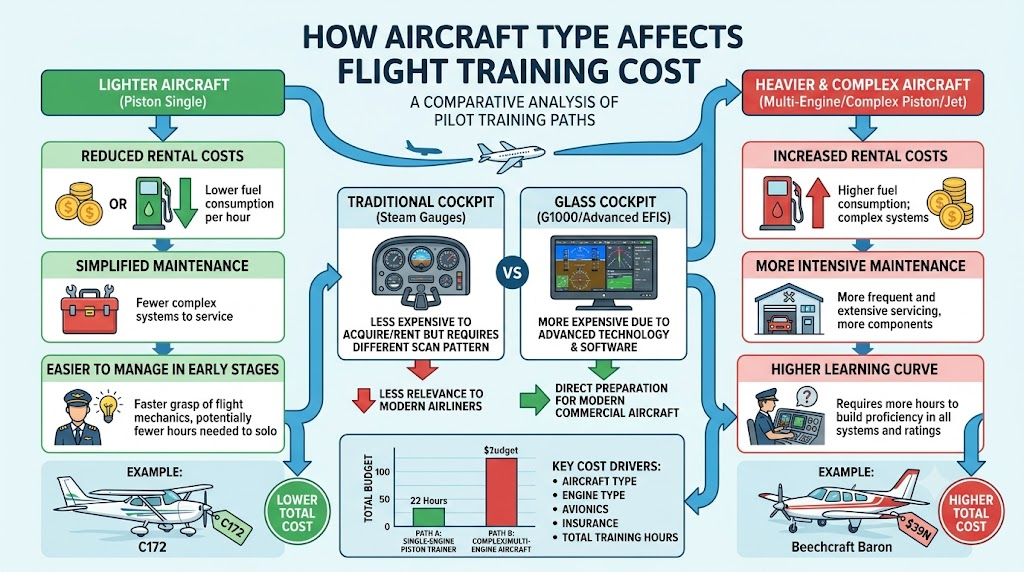
Choosing the right aircraft for flight training can have a noticeable effect on the overall cost of learning to fly. Different aircraft have different fuel needs, maintenance requirements, operating expenses, and rental rates. A basic trainer may be less expensive to operate, while a complex or multi-engine aircraft can require a larger training budget. Understanding these differences can help students plan their finances more realistically and compare flight-training options more carefully.
Why Aircraft Type Matters in Flight Training
The aircraft is one of the main resources used during practical flight training, so its operating cost naturally becomes part of the student’s training expenses.
Flight schools usually calculate aircraft charges based on factors such as aircraft ownership or leasing costs, fuel, maintenance, insurance, engine operating expenses, and other operational requirements. These expenses contribute to the aircraft’s hourly rental rate.
A simple trainer with one engine and relatively basic systems may cost less to operate than a more advanced aircraft with multiple engines, sophisticated avionics, retractable landing gear, or higher-performance engines.
However, the cheapest aircraft per hour is not automatically the cheapest option overall. A student’s total cost also depends on how many hours are required, instructor charges, aircraft availability, weather, and individual learning progress.
Different Types of Training Aircraft
Flight training can involve different aircraft depending on the student’s licence, training stage, and goals.
Single-engine trainer aircraft are commonly used for basic training. They are generally simpler to operate and maintain, making them suitable for learning fundamental skills such as takeoffs, landings, circuits, navigation, and emergency procedures.
Advanced single-engine aircraft may introduce students to more complex systems or higher-performance characteristics. These aircraft can have higher operating costs than basic trainers.
Multi-engine aircraft are used when students need multi-engine training. They have two or more engines and additional systems that require specialized training. Their operating and maintenance costs are generally higher.
Complex aircraft may include features such as retractable landing gear, constant-speed propellers, turbocharged engines, or advanced avionics. These features can increase training capability but may also increase operating expenses.
Aircraft Cost Comparison
| Aircraft category | Typical training purpose | Operating complexity | General cost tendency |
|---|---|---|---|
| Basic single-engine trainer | Initial and basic flight training | Lower | Generally lower |
| Advanced single-engine aircraft | More advanced training | Moderate | Generally moderate |
| Complex single-engine aircraft | Advanced aircraft handling | Higher | Generally higher |
| Multi-engine trainer | Multi-engine licence and advanced training | High | Generally higher |
The actual cost depends on the aircraft model, location, fuel prices, maintenance condition, flight school, and other factors.
How Single-Engine Aircraft Affect Training Costs
Single-engine trainers are often the starting point for students because they provide a practical platform for developing fundamental flying skills.
Their cost advantage can come from having one engine, relatively simple aircraft systems, and lower fuel consumption compared with larger or multi-engine aircraft. Maintenance can also be less complex, although the exact expenses depend on the aircraft model and its condition.
Students still need to consider more than the aircraft rental rate. Instructor charges, landing fees, navigation charges where applicable, ground training, examinations, and other expenses may be separate.
For this reason, students should ask the flight school for a complete breakdown of costs instead of assuming that a lower aircraft rate represents the entire training expense.
How Multi-Engine Aircraft Increase Training Expenses
Multi-engine training usually costs more because operating an aircraft with two engines involves additional fuel, maintenance, systems, and training requirements.
Students must learn how to manage two engines, understand engine-out procedures, handle asymmetric thrust, and operate additional aircraft systems. The aircraft itself can therefore have a higher hourly operating cost.
Maintenance is another consideration. Two engines mean additional engine-related maintenance and inspection requirements. Other systems associated with multi-engine operation can also add complexity.
Multi-engine training is often a later stage of professional pilot development, so students should include these expenses when preparing their complete training budget.
Aircraft Age and Its Effect on Cost
Aircraft age can influence operating costs, but it does not provide a simple indication of whether an aircraft will be cheaper to train in.
An older aircraft may have a lower rental rate, but it could require more frequent maintenance or experience greater downtime. Parts availability can also affect maintenance scheduling for some older aircraft.
On the other hand, a newer aircraft may have modern systems, improved interiors, updated avionics, or different operating characteristics. These benefits may come with higher acquisition, insurance, or rental costs.
The condition and maintenance history of an aircraft can therefore matter as much as its age.
Students should ask how frequently the aircraft is available, whether scheduled maintenance affects training schedules, and how the school handles aircraft downtime.
Fuel Consumption and Aircraft Operating Cost
Fuel is an important part of aircraft operating expenses.
An aircraft with a larger engine or higher fuel consumption will generally use more fuel during each hour of operation than a smaller, more efficient trainer. Changes in fuel prices can therefore influence the cost of flight training.
Aircraft weight, engine type, power settings, weather, altitude, and flight conditions can also affect fuel consumption.
However, fuel is only one part of the total aircraft operating cost. Maintenance, insurance, engine reserves, inspections, parking, and other expenses can also contribute to the hourly rate.
Students should therefore avoid comparing aircraft based solely on fuel consumption.
Maintenance and Aircraft Type
Aircraft design has a direct relationship with maintenance requirements.
A basic trainer with relatively simple systems may have fewer components requiring specialized maintenance than a complex or multi-engine aircraft. More engines and additional aircraft systems naturally create more components that must be inspected and maintained.
Maintenance costs can include:
- Engine inspections and maintenance
- Propeller inspections
- Avionics maintenance
- Landing gear maintenance
- Scheduled inspections
- Replacement of aircraft components
- Unexpected repairs
Maintenance can also affect training indirectly. If an aircraft becomes unavailable for several days, students may have fewer opportunities to fly. This can disrupt training consistency and potentially increase the time needed to regain proficiency.
Avionics and Technology: Does More Technology Mean Higher Cost?
Modern training aircraft may use digital displays, GPS navigation, electronic flight instruments, autopilot systems, and other advanced avionics.
These technologies can provide useful training experience, especially for students who expect to operate modern aircraft later in their careers. However, advanced equipment can also increase acquisition, maintenance, and replacement costs.
That does not mean traditional instruments or older avionics are necessarily inferior for basic training. The best choice depends on the student’s training objectives and the requirements of the licence or rating being pursued.
Students should consider whether the equipment is actually required for their training rather than assuming that more technology always provides better value.
Aircraft Type and the Number of Training Hours
Aircraft type can influence training efficiency, but it does not determine how many hours every student will need.
Two students using the same aircraft can require different amounts of training because learning ability, consistency, preparation, instructor support, and flying frequency vary.
Weather can also have a major effect. Frequent cancellations can create long gaps between flights, while limited aircraft availability can make it harder for students to maintain a consistent schedule.
A student who flies regularly may progress differently from someone who flies only occasionally. As a result, comparing aircraft solely by hourly rental cost can give an incomplete picture.
Comparing Hourly Cost With Total Training Cost
One of the most important financial lessons for student pilots is to distinguish between hourly aircraft cost and total training cost.
A flight school may advertise an aircraft rate, but other charges may apply. Depending on the training program, students may also pay for instructor time, ground classes, examinations, medical requirements, books, equipment, simulator sessions, licence fees, and other expenses.
A useful comparison should therefore consider the complete training pathway.
For example, an aircraft that costs slightly more per hour might offer better availability and allow a student to maintain a consistent training schedule. Another aircraft with a lower hourly rate might experience frequent maintenance downtime.
The final financial result depends on the entire training experience rather than one price.
Practical Example: How Aircraft Choice Changes a Training Budget
Consider a hypothetical student comparing three aircraft categories.
Suppose a basic single-engine trainer has the lowest hourly operating cost. An advanced single-engine aircraft costs more per hour, while a multi-engine aircraft costs considerably more.
If the student uses the basic aircraft for foundational training, the hourly aircraft expense may remain relatively low. The advanced aircraft could become relevant later when the student needs more complex training. Multi-engine training would normally be limited to the portion of the course that specifically requires a multi-engine aircraft.
The following example uses illustrative figures only and does not represent standard market prices.
| Hypothetical aircraft | Illustrative aircraft rate per hour | Example training hours | Illustrative aircraft-only expense |
|---|---|---|---|
| Basic single-engine trainer | $150 | 80 | $12,000 |
| Advanced single-engine aircraft | $220 | 20 | $4,400 |
| Multi-engine trainer | $450 | 15 | $6,750 |
This example shows why students should consider both hourly rate and required hours. The final training budget would also need to include instructor charges and other applicable expenses.
Actual rates vary substantially between countries, cities, flight schools, aircraft models, fuel markets, and training programs.
What Students Should Check Before Choosing an Aircraft
Before selecting a flight school or training aircraft, students should ask detailed questions about the complete cost structure.
Useful questions include:
- What aircraft will I use during the majority of my training?
- What is the aircraft’s hourly rental rate?
- Is fuel included in that rate?
- Is the instructor charged separately?
- Are landing or navigation fees additional?
- How frequently is the aircraft available?
- How is aircraft maintenance handled?
- What happens if my scheduled aircraft becomes unavailable?
- How old are the aircraft?
- What avionics and instruments are installed?
- Are there additional charges for specific aircraft?
- How does the school estimate the total number of training hours?
These questions can help students identify costs that may not be obvious when looking at a basic hourly rate.
Common Mistakes Students Should Avoid
Choosing Only by the Lowest Hourly Rate
A low aircraft rate may look attractive, but it does not necessarily mean lower total training expenses.
Ignoring Instructor Charges
Aircraft rental and instructor fees may be calculated separately. Students should understand both before estimating their budget.
Focusing Too Much on Aircraft Age
Age alone does not determine aircraft quality or cost. Maintenance condition and availability are also important.
Assuming Expensive Aircraft Are Always Better
A more expensive aircraft may provide advanced capabilities, but those features may not be necessary during every stage of training.
Ignoring Maintenance Downtime
Frequent aircraft unavailability can interrupt training and affect progress.
Forgetting Other Training Expenses
Books, examinations, medical requirements, equipment, simulator sessions, and licence-related expenses can add to the total budget.
Comparing Aircraft Without Considering Training Requirements
A multi-engine aircraft should not be compared directly with a basic trainer without considering what each aircraft is being used to accomplish.
Key Aircraft-Cost Considerations
| Cost consideration | Why it matters | What students should check |
|---|---|---|
| Hourly aircraft rate | Directly affects flight expenses | What exactly is included? |
| Fuel | Changes with aircraft and market prices | Is fuel included in the rate? |
| Maintenance | Can affect both price and availability | How is downtime handled? |
| Instructor fee | Adds to the cost of each training flight | Is it charged separately? |
| Aircraft availability | Affects training consistency | How often can students book it? |
| Avionics | Advanced systems may increase costs | Are they required for the course? |
| Engine configuration | Multiple engines generally increase complexity | When is multi-engine training required? |
| Training hours | More hours increase total expenses | How is the estimate calculated? |
Important Considerations
Aircraft type is important, but it is only one part of flight-training cost.
Location can make a major difference. Fuel prices, airport charges, maintenance expenses, instructor availability, and local operating conditions vary between regions.
Weather can also affect the budget. Poor weather may cancel flights and create gaps in training.
Aircraft availability deserves particular attention. A flight school with several well-maintained training aircraft may provide more scheduling flexibility than one operating a limited fleet.
Training consistency matters as well. Students who fly regularly may be able to maintain their skills more effectively than students who have long breaks between lessons.
Individual progress is another major factor. Students should treat estimated training hours as planning figures rather than guarantees.
For international students, currency exchange rates can also affect the final budget when training expenses are paid in a different currency.
Frequently Asked Questions
1. Why does aircraft type affect flight training cost?
Different aircraft have different fuel consumption, maintenance requirements, insurance costs, systems, and operating expenses. These differences influence their hourly rental rates.
2. Is single-engine training cheaper than multi-engine training?
It is generally less expensive because a single-engine aircraft has fewer engines and is usually simpler to operate and maintain. However, actual costs depend on the aircraft and flight school.
3. Does a newer aircraft always cost more to train in?
Not necessarily. Aircraft age is only one factor. Operating costs, maintenance condition, equipment, fuel consumption, and school pricing policies also matter.
4. How does fuel consumption affect flight training expenses?
Aircraft that consume more fuel can have higher operating costs. Fuel prices and aircraft operating conditions can also influence the final hourly cost.
5. Can aircraft maintenance increase training costs?
Yes. Maintenance contributes to operating expenses and can also reduce aircraft availability. Delays may affect training schedules and consistency.
6. Does aircraft type affect the number of hours a student needs?
It can influence training, but it does not determine the required hours by itself. Student progress, instructor quality, weather, practice frequency, and training consistency also matter.
7. Should students always choose the cheapest training aircraft?
No. Students should compare the complete cost, aircraft availability, maintenance, training suitability, instructor charges, and other expenses instead of focusing only on the lowest hourly rate.
8. What should students ask about aircraft rental charges?
They should ask whether fuel, instructor time, landing fees, navigation charges, and other operating expenses are included or billed separately.
9. Are advanced avionics worth the additional training cost?
Advanced avionics can be useful for certain training objectives, but they are not automatically necessary for every student or every stage of training. Their value depends on the student’s goals and course requirements.
10. How can students estimate their total flight-training budget?
Students can start by estimating required flight hours, aircraft rates, instructor charges, and other mandatory expenses. They should also maintain a financial buffer for additional training hours or unexpected costs.
Conclusion
Aircraft type can have a meaningful impact on flight-training costs because different aircraft have different fuel requirements, maintenance needs, operating complexity, and rental rates. Basic single-engine trainers are generally simpler and less expensive to operate, while advanced and multi-engine aircraft usually require a larger budget.
The most useful approach is to look beyond the hourly aircraft rate. Students should compare aircraft availability, maintenance, instructor charges, training requirements, expected flight hours, and other expenses before choosing a training program. A clear understanding of these factors can make flight-training financial planning more realistic and help students avoid unexpected costs.

