
Introduction
Spin awareness is an essential part of flight training because a spin can develop rapidly when an aircraft stalls in an uncoordinated condition. Flying students must understand how spins begin, which situations increase the risk, and how disciplined aircraft control can prevent them.
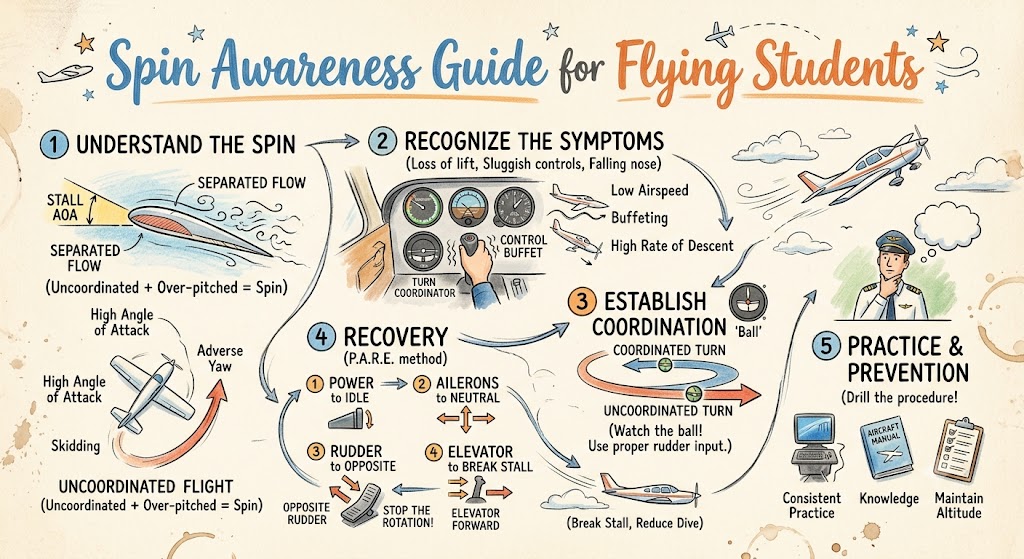
A spin is not simply a steep turn or spiral descent. It is an aerodynamic condition in which both wings are stalled, but one wing is more deeply stalled than the other. This imbalance causes the aircraft to rotate while descending.
The safest approach is always prevention. Students should maintain coordinated flight, manage airspeed carefully, avoid excessive control inputs, and recognize stall warnings early.
Practical spin demonstrations or recovery training must only be conducted with a qualified flight instructor in an aircraft approved for the exercise. Pilots must follow the aircraft flight manual, operating handbook, approved checklist, and applicable aviation regulations.
What Is an Aircraft Spin?
An aircraft spin is an autorotative descending condition that develops after a stall when yaw is present.
During a spin:
- Both wings are stalled
- One wing is more deeply stalled
- The aircraft rotates around a vertical or near-vertical axis
- The nose is generally below the horizon
- Altitude decreases rapidly
- Airspeed may remain relatively low compared with a spiral dive
- Normal control responses may be reduced
A spin usually requires two main conditions:
- The aircraft exceeds its critical angle of attack.
- The aircraft is yawing or uncoordinated.
A stall alone does not always result in a spin. The combination of a stall and yaw creates the greater danger.
Why Spin Awareness Matters
Spin awareness helps student pilots recognize situations that could lead to loss of control.
Spin risk is particularly important during:
- Takeoff and initial climb
- Low-speed manoeuvring
- Slow flight
- Stall practice
- Base-to-final turns
- Overshooting the runway centreline
- Go-arounds
- Steep or poorly coordinated turns
- Emergency manoeuvres
- Flight in turbulence
A spin near the ground is especially dangerous because there may not be enough altitude available for recovery.
For this reason, flying students must focus on preventing stalls and maintaining coordination during every phase of flight.
The Aerodynamics of a Spin
Understanding the basic aerodynamics makes spin awareness easier.
The Aircraft Stalls
A stall occurs when the wing exceeds its critical angle of attack.
When this happens:
- Smooth airflow separates from the wing
- Lift decreases
- Drag increases
- Control effectiveness may reduce
- The aircraft may begin descending
Yaw Creates Unequal Wing Conditions
If yaw is present during the stall, one wing moves through the air differently from the other.
The descending or more deeply stalled wing generally experiences:
- A higher angle of attack
- More drag
- Less lift
The other wing may experience:
- A lower angle of attack
- Less drag
- More lift
This difference causes the aircraft to roll and yaw in the same direction.
Autorotation Develops
Once rotation becomes established, the aerodynamic imbalance can continue feeding the spin.
The aircraft may keep rotating until:
- The pilot applies the approved recovery procedure
- The aerodynamic conditions change
- The aircraft reaches the ground
This is why quick recognition and correct action are essential.
Stall Versus Spin
A stall and a spin are related, but they are not the same condition.
Stall
A stall occurs when the critical angle of attack is exceeded.
Possible signs include:
- Stall warning activation
- Airframe buffet
- Reduced control effectiveness
- Nose drop
- Increased sink rate
Spin
A spin develops when a stalled aircraft also has significant yaw.
Possible signs include:
- Rapid rotation
- One wing dropping
- Nose-low attitude
- Continued descending motion
- Reduced effectiveness of normal control inputs
A pilot can prevent many spins by recovering from the stall before strong yaw and rotation develop.
Spin Versus Spiral Dive
Students sometimes confuse a spin with a spiral dive.
Spin Characteristics
A spin generally involves:
- Stalled wings
- Relatively low airspeed
- Rotation with a nose-low attitude
- High rate of descent
- Different recovery actions from a spiral dive
Spiral Dive Characteristics
A spiral dive generally involves:
- Wings that are not stalled
- Rapidly increasing airspeed
- Increasing load factor
- Steep bank angle
- Rapid altitude loss
Applying the wrong recovery technique can worsen the situation. Students must learn to identify the condition correctly through instructor-led training.
Stages of a Spin
A spin may be described in several stages.
Incipient Stage
The incipient stage begins when the aircraft stalls and starts rotating.
During this stage:
- The rotation is developing
- The flight path is changing
- The aircraft may not yet have stable spin characteristics
- Prompt recovery may stop the spin before it becomes fully established
The incipient phase may last only a few seconds.
Developed Spin
In a developed spin:
- Rotation becomes more consistent
- The nose attitude may stabilize
- Airspeed and descent rate may become more predictable
- The aircraft continues losing altitude rapidly
The exact characteristics depend on the aircraft design, loading, power setting, and configuration.
Recovery Stage
The recovery stage begins when the pilot applies the approved recovery procedure and the rotation stops.
The aircraft may then enter a steep dive. The pilot must recover from the dive smoothly while avoiding excessive airspeed and load factor.
Common Causes of Accidental Spins
Uncoordinated Stall
The most common spin-producing condition is a stall combined with yaw.
This can result from:
- Excessive rudder
- Insufficient rudder
- Cross-controlled inputs
- Poor coordination during a turn
- Abrupt control movement
Base-to-Final Overshoot
A dangerous situation can develop when a pilot overshoots the final approach path.
The pilot may try to correct by:
- Applying excessive inside rudder
- Using opposite aileron to limit bank
- Pulling back to maintain altitude
- Allowing airspeed to decrease
This creates a cross-controlled, high-angle-of-attack condition that can lead to a rapid spin entry.
A go-around is safer than forcing the aircraft back toward the runway.
Excessive Pitch During Climb
During takeoff or climb, a pilot may raise the nose too much.
If airspeed decreases and coordination is poor, the aircraft may stall and begin rotating.
Improper Rudder Use
Excessive rudder near a stall can produce strong yaw.
Insufficient rudder can also allow the aircraft to become uncoordinated, especially when high engine power is used.
Distraction
A distracted pilot may fail to notice:
- Decreasing airspeed
- Increasing bank
- Poor coordination
- Excessive back pressure
- Stall warning signs
Good cockpit discipline reduces this risk.
Abrupt Control Inputs
Sudden pitch or rudder movement can increase the angle of attack or create yaw rapidly.
Smooth control inputs help keep the aircraft within safe limits.
Spin Risk During the Traffic Pattern
The traffic pattern is a high-risk area because the aircraft operates relatively close to the ground.
Climbing Turn After Takeoff
During the initial climb, the aircraft may be:
- At a low airspeed
- Using high power
- In a nose-high attitude
- Close to the ground
Poor rudder coordination or excessive bank can increase stall and spin risk.
Base-to-Final Turn
This is one of the most important spin-awareness situations.
Risk increases when:
- The aircraft overshoots the runway centreline
- The pilot uses excessive rudder
- Airspeed is low
- Bank angle increases
- The pilot pulls back to avoid losing altitude
- The aircraft becomes cross-controlled
The correct decision is often to go around rather than continue an unstable approach.
Final Approach
On final approach, a pilot should avoid:
- Flying below the recommended speed
- Large control corrections
- Excessive bank
- Uncoordinated flight
- Continuing an unstable approach
Spin Risk During Go-Around
A go-around involves high workload and rapid configuration changes.
The aircraft may yaw when power is applied. If the pilot raises the nose excessively without correcting the yaw, the aircraft could approach a stall in an uncoordinated condition.
Students should:
- Apply power smoothly
- Establish the recommended attitude
- Use proper rudder
- Maintain safe airspeed
- Retract flaps according to procedure
- Avoid excessive pitch
Warning Signs Before Spin Entry
A spin is often preceded by stall and coordination warnings.
Students should recognize:
- Decreasing airspeed
- Increasing back pressure
- High angle of attack
- Stall warning horn or light
- Airframe buffet
- Soft control response
- Yawing motion
- One wing beginning to drop
- Slip or skid indication
- Increasing rudder pressure
- Difficulty maintaining altitude
Early corrective action can prevent the spin from developing.
Understanding Coordinated Flight
Coordinated flight means that the aircraft is not slipping or skidding excessively.
Pilots monitor coordination using:
- Outside visual references
- Aircraft feel
- Turn coordinator or slip indicator
- Rudder pressure
- Flight-path awareness
The familiar instruction to “step on the ball” means applying rudder toward the side where the slip-skid ball is displaced, but students must use smooth and appropriate inputs.
Coordination becomes especially important during:
- Slow flight
- Climbing turns
- Descending turns
- Stall practice
- Traffic-pattern operations
- High-power, low-speed flight
Cross-Controlled Flight
Cross-controlled flight occurs when aileron and rudder are applied in opposite directions.
Not every cross-controlled condition immediately causes a spin, but it can become dangerous near a stall.
A common example is:
- Excessive inside rudder to increase the turn
- Opposite aileron to prevent excessive bank
- Back pressure to maintain altitude
This combination can cause one wing to stall more deeply and produce rapid rotation.
Spin Prevention Techniques
Maintain Safe Airspeed
Use the recommended speeds for:
- Takeoff
- Climb
- Traffic pattern
- Approach
- Landing
- Manoeuvring
Adjust airspeed when required for weight, wind, turbulence, and aircraft procedures.
Maintain Coordination
Use proper rudder throughout the flight.
Pay particular attention during:
- High-power climbs
- Slow flight
- Turns
- Stall training
- Go-arounds
Avoid Excessive Back Pressure
Pulling back increases the angle of attack.
Avoid abrupt or excessive back pressure, especially during low-speed turns.
Limit Bank at Low Altitude
Steep bank angles increase load factor and stall speed.
Use conservative bank angles in the traffic pattern and follow instructor guidance.
Recognize an Unstable Approach
A go-around should be considered when:
- Airspeed is not controlled
- The aircraft is not aligned
- The bank angle becomes excessive
- Descent rate is unstable
- Configuration is incorrect
- Workload becomes too high
Use Smooth Controls
Smooth control inputs reduce sudden changes in angle of attack, yaw, and load factor.
Practise Stall Recognition
Spin prevention begins with stall awareness.
Students should recognize the aircraft’s:
- Stall warning
- Buffet
- Control softness
- Pitch attitude
- Yaw behaviour
- Coordination changes
General Spin Recovery Awareness
The exact spin recovery procedure differs between aircraft. Some aircraft use a standard sequence, while others require a specific manufacturer-approved technique.
A commonly taught awareness mnemonic is PARE:
- Power: Reduce power as specified.
- Ailerons: Position as recommended, commonly neutral.
- Rudder: Apply full rudder opposite the direction of rotation.
- Elevator: Move as required to reduce the angle of attack.
After rotation stops, the pilot normally:
- Neutralizes the rudder
- Recovers from the resulting dive
- Avoids excessive airspeed
- Avoids excessive load factor
- Returns to controlled flight
This mnemonic must never replace the approved aircraft procedure. Some aircraft may require different control positions or may not be approved for intentional spins.
Why Power Is Often Reduced
Engine power can sometimes increase yawing forces or flatten the spin.
Reducing power may help remove the forces that support rotation. However, the approved procedure for the aircraft must always be followed.
Why Ailerons Are Commonly Neutralized
Using ailerons during a spin may change the stall condition on each wing and can worsen rotation in some aircraft.
Many procedures therefore require neutral ailerons, but students must follow the exact instructions for their aircraft.
Why Opposite Rudder Is Used
Opposite rudder works against the direction of yaw and rotation.
Students must first identify the direction of rotation correctly. Incorrect rudder application may maintain or worsen the spin.
Why the Angle of Attack Must Be Reduced
The aircraft cannot recover fully while the wings remain stalled.
Moving the elevator as specified reduces the angle of attack and helps restore normal airflow.
Recovering From the Dive
After rotation stops, the aircraft may be in a steep nose-down attitude.
The pilot should:
- Neutralize controls as required
- Check that rotation has stopped
- Allow the aircraft to regain effective airflow
- Recover from the dive smoothly
- Avoid abrupt back pressure
- Avoid exceeding airspeed limits
- Avoid excessive load factor
Pulling too aggressively can cause a secondary stall or structural stress.
Common Student Mistakes
Confusing a Spin With a Spiral Dive
A spin and spiral dive require different responses.
Students must identify whether the wings are stalled and whether airspeed is low or rapidly increasing.
Failing to Reduce the Angle of Attack
Trying to stop altitude loss by pulling back can keep the aircraft stalled.
Using the Wrong Rudder
Applying rudder in the direction of rotation can worsen the spin.
Using Excessive Aileron
Aggressive aileron input can deepen the stall on one wing.
Delaying Recovery
A delayed response increases altitude loss.
Recovering From the Dive Too Abruptly
Excessive back pressure can cause:
- A secondary stall
- High load factor
- Excessive structural stress
Ignoring Aircraft Limitations
Not every aircraft is approved for intentional spins.
Pilots must confirm:
- Aircraft certification
- Weight limits
- Centre-of-gravity limits
- Approved configuration
- Required equipment
- Operational restrictions
Weight and Balance Effects
Aircraft loading can significantly affect spin behaviour.
Forward Centre of Gravity
A forward centre of gravity generally provides greater pitch stability, although it may require more elevator force during recovery.
Aft Centre of Gravity
An aft centre of gravity can:
- Reduce pitch stability
- Make stall behaviour more sensitive
- Make spin recovery more difficult
- Reduce the effectiveness of nose-down elevator control
The aircraft must always be operated within approved weight-and-balance limits.
Configuration Effects
Spin behaviour can change with:
- Flap position
- Landing-gear position
- Power setting
- Aircraft weight
- Centre of gravity
- External equipment
Students should never assume that an aircraft will behave the same way in every configuration.
Weather and Environmental Factors
Turbulence
Turbulence can cause rapid angle-of-attack changes.
A strong gust may bring an aircraft closer to a stall, particularly during slow flight.
Wind Shear
Wind shear can cause sudden changes in airspeed and flight path during takeoff or landing.
Visual Illusions
Poor visibility, sloping terrain, or unusual horizons may cause pilots to misjudge bank and pitch.
Disorientation
Rapid rotation can cause confusion and disorientation.
Students must rely on training, approved procedures, and disciplined control inputs.
Safety Requirements for Spin Training
Intentional spin training should only take place when:
- A qualified instructor is present
- The aircraft is approved for intentional spins
- Weight and balance are within the approved spin envelope
- The weather is suitable
- Adequate recovery altitude is available
- The training area is clear
- Loose objects are secured
- Seat belts and harnesses are fastened
- The recovery procedure has been reviewed
- The exercise complies with local regulations
Students should never attempt intentional spins without proper authorization and instruction.
Practical Spin-Awareness Tips
Keep the Aircraft Coordinated
Monitor the slip-skid indicator and use smooth rudder pressure.
Respect Stall Warnings
Recover at the first clear indication of an approaching stall unless the instructor directs otherwise during an approved exercise.
Avoid Forced Runway Alignment
Go around when the aircraft overshoots the final approach path.
Control Pitch During High-Power Flight
Do not allow the nose to rise excessively during takeoff, climb, or go-around.
Practise Chair Flying
Review the recognition and recovery sequence on the ground.
Mentally rehearse:
- Recognizing rotation
- Identifying direction
- Applying the approved controls
- Confirming rotation has stopped
- Recovering from the dive
Debrief Every Exercise
Discuss:
- What caused the spin entry
- Which warning signs appeared
- Whether the aircraft was coordinated
- How quickly rotation developed
- Which recovery inputs were effective
- How much altitude was lost
- What should be improved
Spin Awareness Checklist
Before Flight
- Aircraft approved for the exercise
- Weight and balance checked
- Weather suitable
- Minimum recovery altitude confirmed
- Training area clear
- Loose items secured
- Procedure reviewed
- Instructor briefing completed
During Stall-Prone Flight
- Monitor airspeed
- Maintain coordination
- Avoid excessive pitch
- Use smooth controls
- Watch for stall warnings
- Monitor bank angle
- Maintain situational awareness
If Rotation Begins
- Recognize the spin
- Identify the rotation direction
- Apply the approved recovery procedure
- Reduce the stall condition
- Stop the rotation
- Recover smoothly from the dive
- Check altitude and aircraft condition
Frequently Asked Questions
What causes an aircraft to enter a spin?
A spin usually develops when an aircraft stalls while yawing or flying in an uncoordinated condition.
Can an aircraft spin without stalling?
A true aerodynamic spin requires the wings to be stalled. A spiral dive may look similar but does not involve stalled wings.
Why is the base-to-final turn dangerous?
Low airspeed, excessive rudder, opposite aileron, increased bank, and back pressure can combine to create a cross-controlled stall and spin.
Can every aircraft be intentionally spun?
No. Only aircraft specifically approved for intentional spins should be used for spin training.
What is an incipient spin?
An incipient spin is the early stage during which rotation is developing but has not yet become fully established.
What is the difference between a spin and a spiral dive?
A spin involves stalled wings and generally lower airspeed. A spiral dive involves flying wings and rapidly increasing airspeed.
Why are ailerons often kept neutral during recovery?
Aileron input may worsen the unequal stall between the wings in some aircraft. Pilots must follow the manufacturer-approved procedure.
Why is opposite rudder used?
Opposite rudder helps stop the yaw and rotation that sustain the spin.
How much altitude is lost during a spin?
Altitude loss depends on the aircraft, spin stage, loading, pilot response, and recovery technique. This is why adequate training altitude is essential.
Can student pilots practise spin recovery alone?
Intentional spin practice should only be conducted under proper authorization, with suitable instruction, and in an approved aircraft.
Conclusion
Spin awareness teaches flying students how stalls, yaw, and poor coordination can combine to create rapid rotation and altitude loss. By maintaining safe airspeed, using coordinated controls, recognizing unstable situations, and following aircraft-specific procedures, pilots can prevent most accidental spins and improve overall flight safety.

