
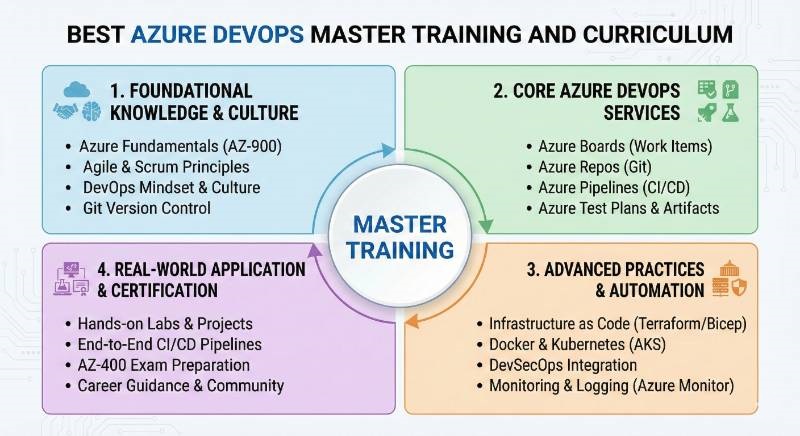
In the world of technology, things move fast. One day you are a developer writing code, and the next, you are expected to know how that code gets deployed, how it scales, and how it stays secure. This shift isn’t just a trend; it’s the new standard. I’ve spent years watching tools come and go, but the core challenge remains the same: how do we deliver value to users without breaking everything in the process? This is where Master Azure DevOps shines. It isn’t just a set of tools; it is a way of working that bridges the gap between ideas and reality.
If you are a software engineer or a manager looking to stay relevant, mastering this domain is no longer optional. This guide is built to help you navigate that journey with a focus on practical wisdom.
Why Master in Azure DevOps Matters
Azure has grown into a massive ecosystem. For an engineer, being “good at Azure” isn’t enough. You need to be a master of the lifecycle. This means understanding how to automate infrastructure, secure the pipeline, and monitor performance in real-time.
The Master in Azure DevOps program is designed to take you from a basic understanding to being the person who can architect an entire delivery system. It’s about moving from “it works on my machine” to “it works for millions of users.”
Complete Certification Overview
To help you plan your journey, here is a breakdown of the key certification tracks within the Azure and DevOps ecosystem.
Certification Roadmap Table
| Track | Level | Who it’s for | Prerequisites | Skills Covered | Recommended Order |
| DevOps Core | Master | Engineers & Managers | Basic IT knowledge | Pipelines, Git, IaC, Docker, K8s | 1st |
| Administration | Professional | Cloud Admins | Azure Fundamentals | Identity, Networking, Governance | 2nd |
| Engineering | Expert | SREs & DevOps | AZ-104 or AZ-204 | CI/CD, Instrumentation, Security | 3rd |
| Architecture | Advanced | Solutions Architects | Extensive Experience | Design, Business Continuity, Data | 4th |
Deep Dive: Master in Azure DevOps
This is the flagship program for anyone serious about this career path. It isn’t just an exam; it’s a comprehensive training that covers the real-world tools you need every day.
What it is
The Master in Azure DevOps is an expert-level program that combines several critical tracks—Fundamentals, Administration, and DevOps Engineering—into one cohesive learning path. It focuses on the end-to-end automation of software delivery using the Azure ecosystem.
Who should take it
- Software Engineers who want to master the “Ops” side of the house.
- Systems Administrators looking to transition into modern Cloud Engineering.
- Engineering Managers who need to understand the technical workflows of their teams.
Skills you’ll gain
- Designing a robust Source Control strategy using Git.
- Building complex CI/CD Pipelines that scale.
- Implementing Infrastructure as Code (IaC) with Terraform and ARM templates.
- Managing Containers and Orchestration with Docker and Kubernetes (AKS).
- Setting up Monitoring and Feedback loops for production stability.
Real-world projects you should be able to do
- Architect a zero-downtime deployment pipeline for a microservices app.
- Automate the creation of an entire environment (Dev/Staging/Prod) in minutes.
- Integrate automated security scanning into the code check-in process.
- Build a self-healing system that restarts services based on health metrics.
60-Day Master in Azure DevOps Preparation Plan
Phase 1: The Foundation (Days 1–15)
Goal: Understand the “Cloud Mindset” and Azure Core Services.
- Days 1–5 (Azure Fundamentals): Master the differences between IaaS, PaaS, and SaaS. Get comfortable with the Azure Portal and CLI. Focus on Resource Groups and Subscriptions.
- Days 6–10 (Identity & Networking): This is where most people fail. Deep dive into Microsoft Entra ID (formerly Azure AD) and Virtual Networks (VNETs). You cannot automate what you don’t understand.
- Days 11–15 (Governance & Cost): Learn about Azure Policy, RBAC (Role-Based Access Control), and Cost Management. A true master saves the company money.
Phase 2: Infrastructure & Administration (Days 16–30)
Goal: Learn to manage and scale resources (AZ-104 level).
- Days 16–20 (Compute & Storage): Practice deploying Virtual Machine Scale Sets (VMSS) and configuring Azure Storage Accounts (Blobs, Files).
- Days 21–25 (App Services & Databases): Move away from VMs. Learn to host web apps using Azure App Service and manage Azure SQL databases.
- Days 26–30 (Monitoring & Backup): Set up Azure Monitor and Log Analytics. Practice restoring a “deleted” resource.
Phase 3: The DevOps Engine (Days 31–45)
Goal: Master the Azure DevOps Toolset (AZ-400 level).
- Days 31–35 (Azure Boards & Repos): Learn Agile project management in Boards. Master Git branching strategies (GitFlow vs. Trunk-based) in Azure Repos.
- Days 36–40 (CI/CD Pipelines): Stop using the Classic editor. Learn to write YAML-based multi-stage pipelines. Focus on variables, secrets, and task groups.
- Days 41–45 (Artifacts & Test Plans): Learn how to manage private NuGet/npm packages and automate basic unit testing within your pipeline.
Phase 4: Modern Tooling & Automation (Days 46–60)
Goal: Specialized automation and Infrastructure as Code (IaC).
- Days 56–60 (Real-World Capstone): Build an end-to-end project: Code in Repos -> Automated CI Pipeline -> Security Scan -> CD Pipeline -> Deployment to AKS -> Monitoring.
- Days 46–50 (Containers & Kubernetes): Build Docker images, push them to Azure Container Registry (ACR), and deploy them to Azure Kubernetes Service (AKS).
- Days 51–55 (Infrastructure as Code): Master Terraform or Bicep. You should be able to “code” your entire environment so it can be rebuilt in minutes
Common Mistakes
- Only using the Portal: Real masters use the CLI and code to manage resources.
- Ignoring Networking: You can’t be a DevOps expert if you don’t understand how traffic flows between VNETs.
- Skipping Security: Never build a pipeline without thinking about secret management and compliance.
Best next certification after this
Once you have mastered the core, the Certified DevSecOps Professional is the natural progression to ensure your automated systems are unhackable.
Choose Your Path: 6 Specialized Tracks
DevOps is a broad field. Depending on your interest, you can specialize in one of these six modern disciplines:
- DevOps Path:
The standard route. Focuses on speed, automation, and bridging the gap between developers and IT operations. - DevSecOps Path:
For those who love security. You integrate security audits and vulnerability scanning into every single step of the pipeline. - SRE Path:
Site Reliability Engineering. You treat operations like a software problem, focusing on scalability and high availability. - AIOps/MLOps Path:
The future of automation. You use AI to predict system failures and automate the lifecycle of Machine Learning models. - DataOps Path:
he financial side. You focus on cloud cost optimization, ensuring the company isn’t wasting money on unused resources.
Role → Recommended Certifications
Not every role requires the same path. Here is how to map your career to the right certifications:
- DevOps Engineer: Master in Azure DevOps → Certified Kubernetes Administrator (CKA).
- SRE: Master in Azure DevOps → Certified Site Reliability Professional.
- Platform Engineer: Master in Azure DevOps → Terraform Associate → CKA.
- Cloud Engineer: Azure Administrator (AZ-104) → Master in Azure DevOps.
- Security Engineer: Master in Azure DevOps → Certified DevSecOps Professional.
- Data Engineer: Azure Data Engineer → Master in Azure DevOps (DataOps focus).
- FinOps Practitioner: Master in Azure DevOps → Certified FinOps Architect.
- Engineering Manager: Master in Azure DevOps → Certified DevOps Manager.
Next Certifications to Take
Once you finish your Master in Azure DevOps, where do you go? Here are three distinct options based on your goals:
- Same Track (Specialization): Move into Advanced Kubernetes or specialized Azure Architecture (AZ-305) to deepen your technical roots.
- Cross-Track (Expansion): If you are a DevOps expert, look at DevSecOps or SRE. Expanding your breadth makes you indispensable.
- Leadership (Management): For those looking to lead, the Certified DevOps Manager or Engineering Manager paths focus on people, processes, and business value.
Top Institutions for Training and Certification
Finding the right mentor is half the battle. These institutions are recognized for their hands-on approach and industry-aligned curriculum:
- DevOpsSchool:
Known as the premier choice for the Master in Azure DevOps program. They offer 200+ hours of training and lifetime support, focusing heavily on making you “job-ready.” - Cotocus:
Excellent for corporate training. They specialize in helping existing teams transition to modern DevOps practices through customized workshops. - Scmgalaxy:
A community-driven platform. They provide a wealth of free resources and affordable training options for those who prefer a self-started approach. - BestDevOps:
Focuses on the practical side of things. Their training is built around “learning by doing,” with intensive lab environments. - devsecopsschool.com:
This is for the “Security First” engineer. They focus on shifting security to the left—meaning you learn how to integrate vulnerability scanning, compliance checks, and secret management directly into your Azure pipelines. It’s perfect if you want to become a Security Engineer or DevSecOps Architect. - sreschool.com:
If you care about “uptime” and “reliability,” this is your home. Site Reliability Engineering (SRE) is about treating operations as a software problem. You’ll learn about Service Level Objectives (SLOs), Error Budgets, and how to build self-healing systems on Azure. - aiopsschool.com:
The future of operations is driven by data. This school teaches you how to use AI and Machine Learning to predict outages before they happen and automate root-cause analysis. It is the bridge between Data Science and Systems Engineering. - dataopsschool.com:
Data is the new oil, but it needs a pipeline. DataOps focuses on bringing DevOps agility to data engineering. You’ll learn how to manage data quality, automate data pipelines, and ensure that your data teams can deploy models as fast as your software teams. - finopsschool.com: As companies scale on Azure, the cloud bill becomes a massive headache. FinOps is the discipline of cloud financial management. Here, you learn how to optimize costs, drive accountability, and ensure the business gets the most value out of every dollar spent on the cloud.
General FAQs: Career & Outcomes
1. How difficult is the Master in Azure DevOps certification?
It is challenging because it covers a broad range of topics. It requires you to be comfortable with both coding and infrastructure.
2. How much time does it take to complete?
Most professionals finish the core training in 2 to 3 months, assuming they can dedicate 10–12 hours a week.
3. Are there any prerequisites?
While anyone can start, having a basic understanding of Linux and at least one programming language (like Python or C#) helps immensely.
4. What is the recommended sequence of exams?
Start with Azure Fundamentals (AZ-900), followed by Administration (AZ-104), and then the DevOps Expert (AZ-400).
5. What is the market value of this certification?
In India and globally, this is one of the highest-paying domains. Companies are desperate for people who can manage their cloud environments efficiently.
6. Will I get a job after this?
Certification proves you have the knowledge, but the hands-on projects you do during the Master program are what will actually get you hired.
7. Is coding required for Azure DevOps?
You don’t need to be a full-stack developer, but you must be able to read and write scripts (Bash/PowerShell) and understand YAML.
8. Is this certification recognized globally?
Yes. Azure is used by a huge percentage of Fortune 500 companies worldwide.
9. Can I transition from a non-tech role?
It is possible, but you will need to spend extra time on the “Fundamentals” phase before diving into the Master level.
10. How often do I need to renew my certification?
Most Microsoft certifications require a free online renewal every year to ensure you are up to date with new features.
11. Does the program include hands-on labs?
Yes, the best programs (like at DevOpsSchool) are almost 70% lab-based. You cannot learn this by just reading books.
12. What is the difference between a DevOps Engineer and an SRE?
DevOps focuses on the speed of delivery and automation. SRE focuses on the stability and reliability of those systems once they are in production.
Specific FAQs: Master in Azure DevOps
1. Is the “Master” program different from the AZ-400 exam?
Yes. The AZ-400 is a single exam. The Master program includes extra tools like Docker, Kubernetes, and Terraform which are essential in a real job.
2. Is there a mandatory prerequisite for the Master certification?
To be officially recognized by Microsoft as an “Expert,” you must have either the AZ-104 (Admin) or AZ-204 (Developer) certificate first.
3. What happens if I fail the exam?
You can retake it after 24 hours, but we recommend going back to the labs for at least a week before trying again.
4. Are the training sessions recorded?
Most professional institutions like DevOpsSchool provide lifetime access to recorded sessions so you can learn at your own pace.
5. Can I attend a demo class first?
Yes, most top providers offer demo sessions so you can see if the trainer’s style matches your learning preference.
6. Is there job placement assistance?
Many programs offer interview preparation kits and resume building as part of the Master track.
7. What is the average salary after finishing this program in India?
While it varies, certified Azure DevOps professionals often see a 30% to 50% jump in their salary packages.
8. Can I manage AWS or GCP after learning Azure DevOps?
The concepts (CI/CD, IaC, Containers) are the same across all clouds. Once you master them in Azure, moving to another cloud is much easier.
Conclusoin
To wrap this up, becoming a Master in Azure DevOps isn’t just about adding a line to your resume or collecting a digital badge. It is about changing how you think about software. In my time watching this industry evolve, I’ve seen that the most successful engineers aren’t the ones who just memorize commands—they are the ones who understand how to build systems that people can actually trust.
Whether you are an engineer looking to level up or a manager trying to steer a team toward better efficiency, this path offers a clear roadmap. The tools like Docker, Terraform, and Kubernetes will change, but the principles of automation, security, and reliability will stay with you for the rest of your career.

