
Introduction
Starting an online blog can feel confusing when you are new to digital publishing. You may have ideas to share but feel uncertain about website design, hosting, coding, domain names, content organisation, or the publishing process. These technical concerns often stop new writers before they publish their first article.
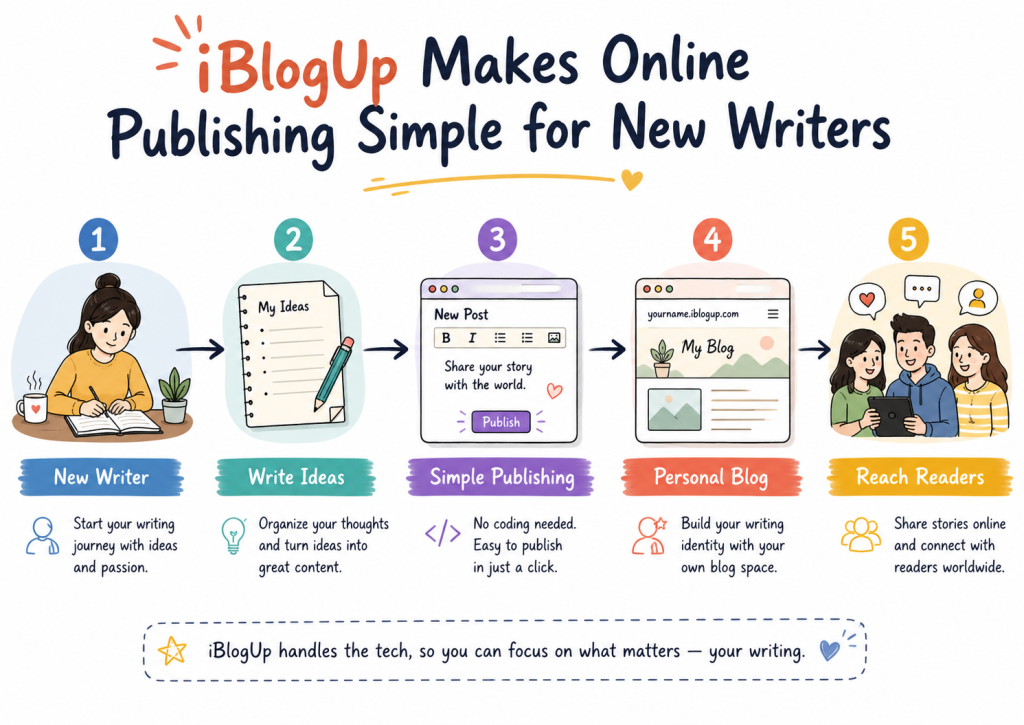
A simple blogging platform removes many of these early barriers. It gives beginners a clear space to write, edit, publish, and organise their work without building a website from the ground up. Instead of spending weeks learning technical tools, writers can concentrate on developing useful ideas and communicating them clearly.
iBlogUp offers a beginner-friendly environment for people who want to start publishing without handling complicated website management. This article explains how simple online publishing works, which platform qualities matter to new writers, how to prepare your first article, and how consistent blogging can help you develop a meaningful online writing identity.
Online Publishing Without Technical Pressure
Online publishing means making written content available to readers through the internet. This content may include educational articles, professional insights, personal experiences, travel stories, opinions, poetry, tutorials, or creative writing.
In the past, starting a blog often required several separate steps. A writer had to purchase hosting, register a domain, install publishing software, select a theme, and manage technical settings. Although these options are still useful for some experienced website owners, they can feel overwhelming to beginners.
A free blogging platform simplifies this process by providing the main publishing tools in one place. Writers can create an account, prepare their profiles, write articles, and publish their work without developing a complete website independently.
Several terms are useful for beginners to understand:
- Blogging platform: An online service that provides tools for writing and publishing blog posts.
- Blog hosting: The service that stores blog content and makes it available online.
- Subdomain: A personal web address connected to the main platform’s domain.
- No-code publishing: A process that allows people to publish without programming knowledge.
- Publishing identity: The name, profile, subject focus, and writing style through which readers recognise a writer.
A simple online blogging platform combines these elements into an accessible publishing experience.
The Importance of Simplicity for New Writers
Beginners usually need encouragement, clarity, and room to practise. A complicated publishing system can distract them from their main purpose: writing something valuable.
More attention remains on writing
When writers do not have to manage hosting configurations or website code, they can spend more time researching, outlining, drafting, and editing their articles. This creates a healthier starting point for building a consistent writing routine.
The first article becomes easier to publish
Many new writers delay publishing because they believe their first post must be perfect. A simple publishing workflow reduces this pressure. Writers can begin with a clear topic, prepare a useful article, review it carefully, and publish it without managing dozens of technical steps.
Beginners can learn gradually
New writers do not need to understand every aspect of blogging before they begin. They can first learn how to write readable articles, choose effective titles, organise paragraphs, and communicate with readers. More advanced publishing knowledge can develop later.
Ideas can become a public portfolio
A personal blog creates an organised record of a writer’s knowledge and interests. Students may publish educational projects, professionals may share industry insights, and storytellers may present original creative work.
Over time, these articles can demonstrate communication ability, subject knowledge, curiosity, and consistency.
Publishing builds confidence
Private writing is valuable, but public writing develops additional skills. Writers learn to explain ideas for unfamiliar readers, provide context, organise information, and edit with greater care.
Each completed article makes the publishing process feel more familiar.
Qualities of a Simple Blogging Platform for Beginners
Not every platform offers the same experience. New writers should examine several practical qualities before selecting a place to publish.
Clear account creation
The registration process should be understandable and should not require unnecessary technical knowledge. New users should be able to identify how to create an account and access their writing space.
No-code publishing tools
A no-code blogging platform allows writers to prepare content without using HTML, CSS, or other programming languages. This is especially helpful for students, educators, independent writers, and professionals who want to publish but do not want to become website developers.
An uncomplicated writing interface
The publishing area should keep attention on the article. Writers need a comfortable place to add a title, organise paragraphs, review their content, and complete the publishing process.
Too many complicated controls can interrupt creativity and make basic tasks feel difficult.
Personal subdomain availability
A free blog with a subdomain gives the writer an individual publishing address under the platform’s main domain. This can help separate one writer’s blog from other publications on the platform.
A personal subdomain also supports a clearer online identity because the writer can direct readers toward a dedicated space containing their published work.
Readability across devices
Readers may discover articles on laptops, tablets, and mobile phones. A suitable blogging platform should present content in a readable way across different devices.
Writers should also use short paragraphs, descriptive headings, and clear sentence structures to improve the reading experience.
Community discovery
Publishing is not only about placing an article online. Writers also benefit from discovering other voices and understanding how different people communicate ideas.
A community blogging platform may provide shared spaces where readers can find content from independent writers. This can create opportunities for learning and meaningful interaction, although audience development still requires patience and consistent effort.
Support for future collaboration
A beginner may start with a personal blog and later invite other people to contribute. Multi-author support can be useful for student groups, professional teams, educators, community organisations, and collaborative publications.
Writers who expect to work with contributors should consider this possibility when selecting a platform.
A Practical Publishing Process for First-Time Writers
A reliable process makes online publishing less stressful. The following steps can help beginners move from an idea to a completed article.
1. Decide the purpose of your blog
Begin by identifying why you want to write publicly. Your purpose may be to share knowledge, practise writing, create a portfolio, document experiences, publish stories, or explain professional subjects.
A clear purpose helps you choose suitable topics.
2. Select a focused subject
Avoid trying to cover every possible topic from the beginning. Choose a subject you understand or genuinely want to explore.
For example, instead of writing generally about technology, you could focus on beginner-friendly software guides, digital productivity, cybersecurity awareness, or cloud learning.
3. Identify your intended reader
Think about the person who should benefit from your article. A student, working professional, traveller, parent, educator, or beginner may need different explanations.
Writing for a defined reader makes your content more useful and easier to organise.
4. Choose a suitable blogging platform
Look for a blogging website for beginners that matches your current needs. Consider cost, ease of use, subdomain availability, publishing simplicity, community discovery, and collaboration support.
Do not choose a platform only because it has the largest number of features. Select one that helps you complete your actual publishing goals.
5. Create a recognisable writing identity
Use a clear display name and write a short profile description. Explain the subjects you plan to cover and the type of value readers can expect.
Your writing identity should be honest and specific. Avoid presenting yourself as an expert in subjects where you have limited knowledge.
6. Plan the first article
Write the main idea of your article in one sentence. Then prepare a simple outline with an introduction, several supporting sections, practical examples, and a conclusion.
An outline prevents repetition and keeps the article focused.
7. Prepare the first draft
Write the complete draft before trying to perfect every sentence. Concentrate on explaining the idea clearly.
Use simple language, short paragraphs, and examples that help the reader understand the subject.
8. Edit with the reader in mind
Review the article after taking a short break. Remove repeated statements, correct grammar, improve unclear sentences, and confirm that each section supports the main topic.
Check whether a beginner can understand any technical terms you have used.
9. Create an accurate title
The title should clearly represent the article. Avoid exaggerated promises or misleading claims created only to attract attention.
A descriptive title helps readers decide whether the content is relevant to them.
10. Publish and review the result
After publishing, read the article again in its final format. Check paragraph spacing, heading order, and overall readability.
Use any mistakes you notice as lessons for your next article rather than reasons to stop publishing.
11. Follow a realistic schedule
A beginner does not need to publish every day. A manageable routine is more valuable than an ambitious schedule that quickly becomes exhausting.
Choose a frequency that allows enough time for research, writing, editing, and improvement.
Useful Publishing Paths for Different New Writers
Online publishing can support many personal, educational, and professional goals.
Students building portfolios
Students can publish research summaries, project reflections, book reviews, learning notes, and explanations of subjects they are studying.
A blog can demonstrate written communication and independent learning. Students should avoid sharing confidential academic information or presenting copied material as original work.
Professionals sharing practical knowledge
Professionals can write about industry lessons, workplace practices, career development, leadership, tools, and problem-solving methods.
These articles can help readers understand the writer’s areas of interest and experience. Sensitive company information and private client details should never be published.
Educators creating learning resources
Teachers and trainers can use a personal blogging platform to publish explanations, study tips, lesson summaries, reading suggestions, and educational articles.
Clear organisation makes these resources easier for learners to revisit.
Storytellers publishing creative work
A story publishing platform can give creative writers a place to share short stories, poetry, personal essays, and fictional series.
Creative writers should maintain ownership records of their original drafts and respect the intellectual property of others.
Hobbyists documenting interests
People can write about gardening, cooking, books, photography, sports, travel, crafts, or other interests. Personal enthusiasm often creates relatable content because the writer can combine practical knowledge with real experience.
Teams creating shared publications
A multi-author blogging platform can support groups that want to publish under one shared identity. Contributors may cover different categories while following common editorial standards.
Teams should define contributor roles, topic responsibilities, review procedures, and publishing expectations before inviting multiple writers.
Common Early Problems and Practical Solutions
Uncertainty about the first topic
New writers often have many ideas but cannot decide where to begin.
Solution: Select one small problem you can explain clearly. A focused article is usually more useful than a broad article containing many incomplete ideas.
Trying to sound overly professional
Some beginners use complex words because they believe formal language creates authority. This can make the article difficult to read.
Solution: Write as though you are explaining the subject to an intelligent friend who is unfamiliar with it.
Publishing without editing
A first draft may contain repeated ideas, missing context, and unclear sentences.
Solution: Complete at least one careful editing round. Reading the article aloud can reveal awkward wording and overly long sentences.
Expecting immediate attention
A new blog may not attract many readers immediately. Audience development often takes time and depends on topic usefulness, consistency, clarity, and responsible sharing.
Solution: Measure early progress by the quality of your work and your improvement as a writer, not only by views.
Using too many keywords
Keywords can help describe the subject, but excessive repetition damages readability.
Solution: Use phrases such as free blogging platform, publish articles online free, or start a personal blog for free only where they fit naturally.
Copying the style of another writer
Learning from strong writers is useful, but copying their words, structure, or personal voice prevents originality.
Solution: Study how effective articles explain ideas, then create your own outline, examples, and conclusions.
Abandoning the blog too early
Many writers stop after publishing only a few posts because they do not see fast results.
Solution: Set a small initial goal, such as completing five well-developed articles. Review what you learned before deciding the future direction of your blog.
Writing Habits That Make Publishing Easier
Simple habits can improve both writing quality and publishing consistency.
- Keep a list of possible article ideas.
- Choose one main purpose for every article.
- Research facts before making specific claims.
- Use headings that describe the content below them.
- Begin paragraphs with clear points.
- Include examples when explaining unfamiliar concepts.
- Remove sentences that do not support the subject.
- Check spelling, grammar, and punctuation.
- Avoid copying material from other sources.
- Maintain a realistic publishing routine.
- Respect readers with accurate titles and honest explanations.
- Review older articles to identify areas for improvement.
A successful writing habit does not depend on producing a large amount of content quickly. It develops through repeated planning, drafting, editing, and learning.
iBlogUp as a Simple Publishing Option
iBlogUp is a free blogging platform designed for writers who want an accessible way to publish online. Its no-code publishing environment can help beginners focus on writing instead of technical website management.
Writers can establish an individual publishing identity through a personal iBlogUp subdomain. Google-based sign-in provides a familiar way to access the platform, while the shared discovery feed helps readers explore articles from different independent voices.
The platform also supports multiple contributors, making it relevant to people who may eventually create a collaborative or multi-author publication. Its reading experience is designed to work across different devices, which is important because audiences may access articles from various screen sizes.
These features make iBlogUp a practical option for new writers, students, educators, professionals, and storytellers. However, writers still need to develop original ideas, edit carefully, publish consistently, and build reader trust through useful content.
Frequently Asked Questions
1. Can someone with no blogging experience use iBlogUp?
Yes. iBlogUp provides a simple no-code publishing experience, making it suitable for people who have never created a blog. Beginners can focus on preparing and publishing articles without learning website programming. They should still spend time understanding their audience, organising ideas, proofreading content, and developing a realistic publishing schedule.
2. Is coding required to start publishing articles?
Coding is not required when using a no-code blogging platform such as iBlogUp. The platform provides an interface for writing and publishing content without manually creating web pages. Basic digital skills are helpful, but users do not need to understand programming languages to begin sharing articles or stories.
3. What is a personal blog subdomain?
A subdomain is a personal online address connected to the main platform’s domain. It gives an individual blog a separate identity within the larger blogging platform. A personal iBlogUp subdomain can help writers organise their published articles in one dedicated space and make that space easier to share with readers.
4. Which subjects can new writers publish?
New writers can publish content related to technology, business, education, travel, lifestyle, careers, personal experiences, poetry, opinions, professional knowledge, creative writing, and storytelling. The best subject is usually one the writer understands, researches carefully, and can explain honestly without copying or making unsupported claims.
5. Can students use a free blog as a portfolio?
Students can use a personal blog to organise project reflections, educational articles, research summaries, and examples of written work. This can demonstrate communication skills and subject interests. Students should publish original content, respect academic rules, and avoid sharing confidential information from institutions, teachers, or classmates.
6. Can multiple people contribute to one publication?
iBlogUp supports multiple contributors, allowing writers to build a shared publication. This can be useful for educational groups, professional teams, community projects, and collaborative blogs. Before inviting contributors, the group should establish topic guidelines, review responsibilities, writing standards, and a clear process for approving content.
7. How often should a beginner publish?
A beginner should choose a schedule that can be maintained without reducing quality. Publishing one carefully prepared article every week or every few weeks may be more effective than posting frequently without proper research and editing. Consistency means following a realistic routine, not publishing as quickly as possible.
8. How can new writers attract readers responsibly?
Writers can attract readers by publishing useful original content, choosing clear titles, writing for a specific audience, and participating respectfully in relevant communities. They may also share their work through appropriate personal or professional channels. Audience growth is rarely immediate, so writers should concentrate on trust, clarity, and long-term improvement.
Conclusion
Online publishing becomes more approachable when new writers have a clear process and a simple blogging platform. Beginners do not need advanced technical skills to begin sharing useful ideas, personal experiences, educational knowledge, or creative work. They need a focused subject, an understanding of their intended readers, a practical writing routine, and the patience to improve through experience.
iBlogUp helps reduce common technical barriers by offering free access, personal subdomains, no-code publishing, a shared discovery feed, and support for multiple contributors. These features can provide a useful starting environment, but the writer remains responsible for the quality, originality, and accuracy of every article.

