
Introduction
Modern IT environments have become increasingly complex. Organizations today manage hybrid cloud infrastructures, containerized applications, microservices, distributed systems, and thousands of interconnected devices. Traditional IT operations methods often struggle to keep pace with this growing complexity.
This is where AIOps comes into the picture.
AIOps, or Artificial Intelligence for IT Operations, combines artificial intelligence, machine learning, big data analytics, and automation to improve IT operations management. By leveraging intelligent algorithms, AIOps platforms can analyze vast amounts of operational data, identify anomalies, correlate events, determine root causes, and automate remediation processes.
As organizations accelerate digital transformation initiatives, the demand for professionals with AIOps skills continues to rise. Companies are actively seeking engineers and IT leaders who understand AI-driven operations, observability, automation, and predictive analytics.
Whether you are a DevOps Engineer, Site Reliability Engineer, Cloud Engineer, IT Operations Professional, or a beginner exploring modern IT careers, learning AIOps can significantly enhance your technical capabilities and career opportunities.
In this comprehensive guide, you’ll learn:
- What AIOps is
- Why organizations are adopting AIOps
- Key AIOps components and use cases
- Popular AIOps tools
- AIOps vs DevOps
- AIOps vs MLOps
- AIOps training roadmap
- AIOps certification options
- Career opportunities in AIOps
- The future of AI-driven IT operations
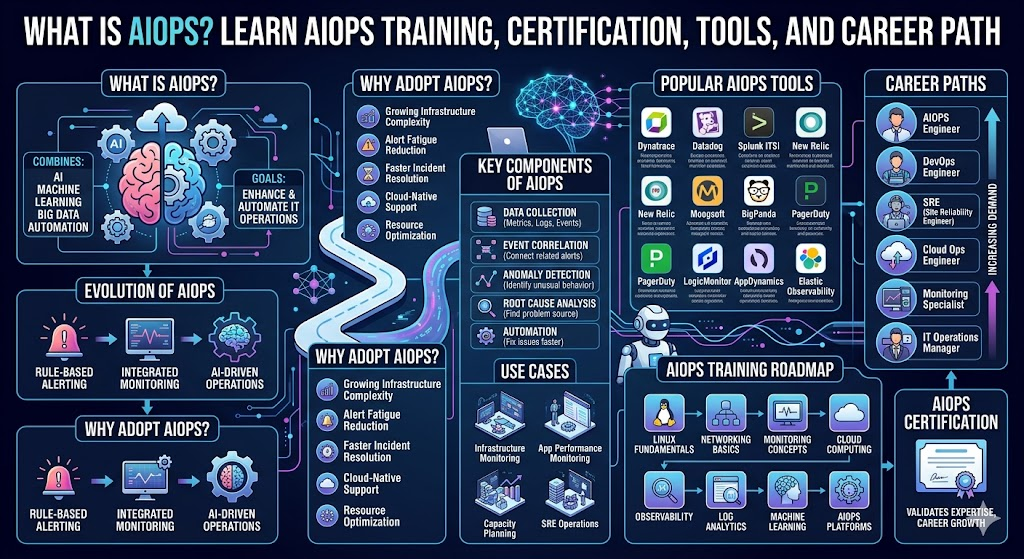
What is AIOps?
AIOps stands for Artificial Intelligence for IT Operations.
It refers to the application of artificial intelligence, machine learning, data analytics, and automation technologies to enhance and automate IT operations processes.
The term AIOps was introduced to describe platforms that can ingest large volumes of operational data from various sources and automatically identify patterns, anomalies, incidents, and performance issues.
Evolution of AIOps
Traditional IT operations relied heavily on manual monitoring and reactive troubleshooting. As infrastructure became more distributed and cloud-native, organizations needed intelligent systems capable of processing enormous volumes of operational data.
AIOps emerged as a solution that combines:
- Machine Learning
- Big Data Analytics
- Event Correlation
- Predictive Analytics
- Automation
- Observability
Core Principles of AIOps
The foundation of AIOps includes:
Data Aggregation
Collecting logs, metrics, traces, events, alerts, and performance data from multiple systems.
Intelligent Analytics
Using machine learning algorithms to identify patterns and anomalies.
Event Correlation
Connecting related alerts to reduce noise and improve visibility.
Root Cause Analysis
Determining the actual source of incidents quickly.
Automated Remediation
Triggering automated actions to resolve issues before they impact users.
Why Organizations Need AIOps
Modern enterprises face significant operational challenges.
Monitoring Complexity
Organizations manage thousands of applications, servers, databases, cloud services, and network components.
Cloud-Native Environments
Containers, Kubernetes, and microservices generate enormous operational data volumes.
Alert Fatigue
Operations teams often receive thousands of alerts daily, making it difficult to identify critical issues.
Faster Incident Resolution
Businesses require rapid detection and resolution of incidents to maintain service availability.
Cost Reduction
AIOps helps reduce downtime, improve resource utilization, and optimize operational efficiency.
Key Components of AIOps
Data Collection
Gathering metrics, logs, traces, events, and telemetry data.
Event Correlation
Connecting related alerts into meaningful incidents.
Anomaly Detection
Identifying unusual behavior before failures occur.
Root Cause Analysis
Pinpointing the exact source of operational issues.
Predictive Analytics
Forecasting future incidents and performance bottlenecks.
Automation and Remediation
Automatically resolving known issues through workflows and scripts.
Observability
Providing complete visibility into systems, applications, and infrastructure.
AIOps Use Cases
Infrastructure Monitoring
Monitoring servers, storage, databases, and network devices.
Application Performance Monitoring
Tracking application health and user experience.
Incident Management
Accelerating incident detection and response.
Capacity Planning
Predicting infrastructure requirements before demand increases.
Security Operations
Detecting suspicious activities and security anomalies.
Network Operations
Improving network reliability and troubleshooting.
Cloud Operations
Managing multi-cloud and hybrid cloud environments efficiently.
SRE Operations
Supporting reliability engineering practices through automation and intelligence.
AIOps for SRE Teams
Site Reliability Engineering teams use AIOps to improve reliability and operational efficiency.
Benefits include:
- Reduced Mean Time to Detect
- Reduced Mean Time to Resolve
- Intelligent Alerting
- Improved Reliability
- Proactive Incident Prevention
AIOps helps SRE teams focus on innovation rather than repetitive operational tasks.
Popular AIOps Tools
Dynatrace
AI-powered observability and application performance monitoring platform.
Datadog
Cloud monitoring and analytics platform with machine learning capabilities.
Splunk ITSI
Advanced event correlation and incident intelligence solution.
New Relic
Full-stack observability and performance monitoring platform.
Moogsoft
AI-driven event management and noise reduction platform.
BigPanda
Event correlation and incident automation solution.
PagerDuty
Incident response and intelligent automation platform.
LogicMonitor
Infrastructure monitoring with predictive insights.
AppDynamics
Application performance management and business observability.
Elastic Observability
Unified observability platform powered by Elasticsearch.
AIOps vs DevOps
| Area | AIOps | DevOps |
|---|---|---|
| Goal | Intelligent Operations | Faster Software Delivery |
| Focus | IT Operations Optimization | Development and Operations Collaboration |
| Monitoring | AI-Driven | Traditional Monitoring |
| Automation | Intelligent Automation | Pipeline Automation |
| Incident Response | Predictive | Reactive and Automated |
| Users | Operations Teams | Development and Operations Teams |
AIOps vs MLOps
| Area | AIOps | MLOps |
|---|---|---|
| Purpose | Improve IT Operations | Manage ML Lifecycle |
| Primary Users | IT Operations Teams | Data Scientists |
| Focus | Infrastructure and Applications | Machine Learning Models |
| Data Sources | Logs, Metrics, Events | Training Data |
| Outcomes | Reliability and Automation | Model Deployment and Monitoring |
AIOps Training Roadmap
A structured AIOps Training path should include:
- Linux Fundamentals
- Networking Basics
- Monitoring Concepts
- Cloud Computing Fundamentals
- Observability
- Log Analytics
- Incident Management
- Automation Fundamentals
- Machine Learning Basics
- AIOps Platforms and Tools
AIOps Course Curriculum
A comprehensive AIOps Course typically covers:
- Foundations of AIOps
- Monitoring and Observability
- Event Correlation
- Root Cause Analysis
- Predictive Analytics
- Incident Response
- Automation and Remediation
- Enterprise Use Cases
- Hands-on Labs
- Real-world Projects
AIOps Certification Guide
Why Certification Matters
Certification validates your expertise and demonstrates commitment to professional growth.
Benefits of AIOps Certification
- Industry Recognition
- Enhanced Credibility
- Better Job Opportunities
- Higher Salary Potential
- Structured Learning
AIOps Foundation Certification
An AIOps Foundation Certification introduces candidates to:
- AIOps Fundamentals
- AI and Machine Learning Concepts
- Event Correlation
- Observability
- Automation
- Operational Intelligence
Preparation should include practical exercises, case studies, and hands-on platform experience.
Career Opportunities in AIOps
Professionals with AIOps expertise can pursue roles such as:
AIOps Engineer
Design and manage intelligent operations platforms.
Site Reliability Engineer
Improve system reliability and operational performance.
DevOps Engineer
Integrate monitoring, automation, and operational intelligence.
Platform Engineer
Build scalable and observable infrastructure platforms.
Cloud Operations Engineer
Manage cloud-native environments using AI-driven operations.
Monitoring Specialist
Implement observability and performance monitoring solutions.
IT Operations Manager
Lead operational transformation initiatives.
Skills Required to Become an AIOps Engineer
Key skills include:
- Linux Administration
- Networking
- Cloud Computing
- Python Programming
- Automation
- Monitoring Tools
- Observability Platforms
- Machine Learning Fundamentals
- Incident Management
Future of AIOps
The future of AIOps is driven by advancements in artificial intelligence and automation.
Key trends include:
Generative AI in Operations
AI assistants helping engineers troubleshoot issues faster.
Autonomous IT Operations
Systems capable of self-management and optimization.
Self-Healing Infrastructure
Automated detection and remediation without human intervention.
Intelligent Automation
Smarter workflows and operational decision-making.
Predictive Operations
Preventing incidents before they impact services.
Why Learn AIOps from AIOpsSchool
AIOpsSchool provides a structured and practical learning path designed for modern IT professionals.
Benefits include:
- Industry-Focused Curriculum
- Expert-Led Training
- Practical Hands-On Labs
- Real-World Projects
- Certification Preparation
- Career-Oriented Learning Approach
Frequently Asked Questions
1. What is AIOps?
AIOps uses AI and machine learning technologies to improve and automate IT operations.
2. Is AIOps a good career?
Yes. Demand for professionals skilled in AI-driven operations continues to grow rapidly.
3. How long does it take to learn AIOps?
Most learners can build foundational skills within three to six months of focused study.
4. Which certification is best for beginners?
An AIOps Foundation Certification is typically the best starting point.
5. Is programming required for AIOps?
Basic Python knowledge is highly beneficial but not always mandatory.
6. What are the best AIOps tools?
Popular tools include Dynatrace, Datadog, Splunk ITSI, New Relic, and Moogsoft.
7. What is the difference between AIOps and DevOps?
DevOps focuses on software delivery while AIOps focuses on intelligent operations management.
8. What is the difference between AIOps and MLOps?
AIOps improves IT operations while MLOps manages machine learning lifecycle processes.
9. Can beginners learn AIOps?
Yes. A structured learning roadmap makes AIOps accessible to beginners.
10. What industries use AIOps?
Finance, healthcare, telecommunications, retail, government, and technology sectors.
11. Does AIOps replace IT professionals?
No. It enhances productivity and enables professionals to focus on higher-value tasks.
12. Is cloud knowledge important for AIOps?
Yes. Most modern AIOps implementations operate within cloud-native environments.
13. What role does observability play in AIOps?
Observability provides the data foundation required for intelligent analytics.
14. Are hands-on labs important?
Absolutely. Practical experience is essential for mastering AIOps technologies.
15. What is the future demand for AIOps professionals?
Demand is expected to continue increasing as organizations invest in automation and AI-driven operations.
Conclusion
AIOps is transforming how organizations manage modern IT environments. By combining artificial intelligence, machine learning, observability, automation, and predictive analytics, AIOps enables faster incident detection, smarter troubleshooting, improved operational efficiency, and reduced downtime. As enterprises continue adopting cloud-native technologies and complex distributed architectures, the need for skilled AIOps professionals will only grow. Investing in AIOps Training, gaining practical experience with leading AIOps tools, and earning an AIOps Certification can help professionals build future-ready careers while helping organizations achieve more reliable, efficient, and intelligent IT operations. For anyone looking to enter the next generation of IT operations, now is the ideal time to start the AIOps learning journey.

