
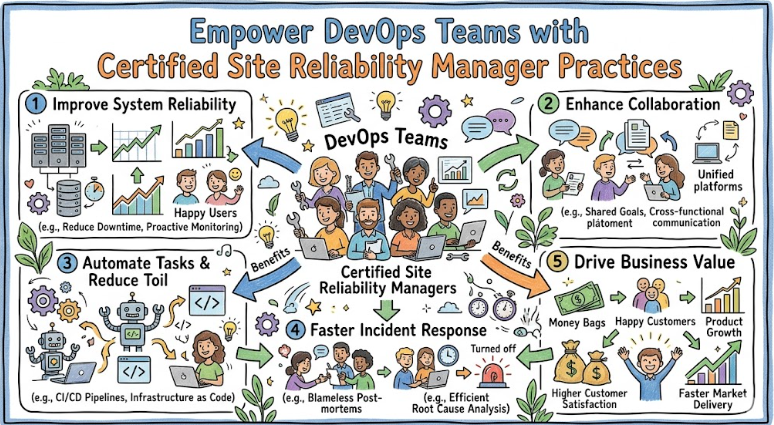
Introduction
The Certified Site Reliability Manager is a specialized leadership program designed to bridge the gap between technical reliability and engineering management. This guide is written for software engineers, platform specialists, and current technical leads who aim to navigate the complexities of modern cloud-native environments. As organizations shift toward decentralized infrastructure, understanding how to manage reliability at scale is no longer optional for those in leadership roles. This comprehensive guide helps professionals evaluate the strategic impact of the certification, ensuring they can make better career decisions while moving into senior DevOps or platform engineering leadership. You can learn more about the Certified Site Reliability Manager through sreschool.
What is the Certified Site Reliability Manager?
The Certified Site Reliability Manager represents a professional standard for individuals tasked with overseeing the stability, scalability, and performance of production systems. It exists to formalize the management layer of Site Reliability Engineering, moving beyond just writing scripts to managing service-level objectives and error budgets. This program emphasizes production-focused learning, ensuring that managers can navigate real-world incidents and complex architectural trade-offs. It aligns perfectly with modern engineering workflows where reliability is a shared responsibility between development and operations teams.
Who Should Pursue Certified Site Reliability Manager?
This path is ideal for senior software engineers, current SREs, and cloud professionals who want to transition into a management or lead architect role. Engineering managers and technical leaders will find it beneficial for learning how to quantify technical debt and justify reliability investments to business stakeholders. It is also highly relevant for beginners who want to understand the governance side of infrastructure before diving deep into specialized tools. Both the Indian tech ecosystem and the global market have a high demand for leaders who can handle high-traffic, production-grade environments with a data-driven mindset.
Why Certified Site Reliability Manager is Valuable and Beyond
The demand for reliable systems is permanent, making this certification a long-term asset for any technical career. As enterprises adopt increasingly complex distributed systems, the ability to manage reliability ensures that a professional stays relevant regardless of which specific cloud provider or tool is currently in fashion. It offers a significant return on time because it teaches systemic thinking and governance, which are harder to automate than basic coding tasks. Investing in this credential signals to employers that you can handle the responsibility of maintaining critical business uptime and managing modern engineering talent.
Certified Site Reliability Manager Certification Overview
The program is officially delivered via Certified Site Reliability Manager and hosted on the specialized sreschool platform. The certification structure is designed around practical assessments rather than just theoretical multiple-choice questions. It follows a modular approach, allowing professionals to own their learning journey from foundational concepts to expert-level strategic management. The curriculum is maintained by industry practitioners who ensure that the ownership of the learning material stays current with enterprise practices and cloud-native standards.
Certified Site Reliability Manager Certification Tracks & Levels
The certification is categorized into three main tiers: foundation, professional, and advanced. The foundation level introduces the core vocabulary of SRE, while the professional level focuses on operational metrics and incident command structures. The advanced level is dedicated to organizational culture, capacity planning, and long-term reliability strategy. Specialization tracks are also available for those focusing on specific domains like FinOps, DevSecOps, or DataOps. These levels align with a typical career progression from a Senior Engineer to a Lead, and finally to an Engineering Manager or Director.
Complete Certified Site Reliability Manager Certification Table
| Track | Level | Who it’s for | Prerequisites | Skills Covered | Recommended Order |
| Core SRE | Foundation | Junior Leads / Aspiring SREs | Basic Cloud Knowledge | SLOs, SLIs, Toil Reduction | 1 |
| Management | Professional | Team Leads / Managers | 3+ Years Experience | Incident Response, Error Budgets | 2 |
| Leadership | Advanced | Directors / Heads of SRE | Professional Level | SRE Culture, Strategic Planning | 3 |
| Operations | Specialist | Platform Engineers | Foundation Level | Automation, Observability | 4 |
Detailed Guide for Each Certified Site Reliability Manager Certification
Certified Site Reliability Manager – Foundation Level
What it is
This certification validates the fundamental understanding of SRE principles and the manager’s role in maintaining system health. It focuses on the basic building blocks of reliability.
Who should take it
Senior engineers and new team leads who need a formal introduction to the SRE framework should start here. It is perfect for those moving from traditional operations into a leadership role.
Skills you’ll gain
- Understanding the difference between DevOps and SRE
- Defining and measuring SLIs and SLOs
- Identifying and eliminating operational toil
- Basics of blameless post-mortem culture
Real-world projects you should be able to do
- Draft a basic service level agreement for an internal tool
- Conduct a toil audit for a specific engineering team
- Create a simple monitoring dashboard based on golden signals
Preparation plan
- 7-14 Days: Focus on reading the core SRE handbook and understanding the definitions of SLOs and SLIs through online modules.
- 30 Days: Work through practical exercises on calculating error budgets and attending virtual training sessions to clarify architectural concepts.
- 60 Days: Implement a mock SRE framework in a lab environment and review case studies of large-scale outages to understand recovery patterns.
Common mistakes
- Confusing SRE with a rebranding of the traditional System Administrator role.
- Over-complicating SLOs with too many metrics that do not reflect user experience.
Best next certification after this
- Same-track option: Professional Site Reliability Manager
- Cross-track option: DevSecOps Management
- Leadership option: Technical Program Manager
Certified Site Reliability Manager – Professional Level
What it is
This certification moves into the operational aspects of managing a live production environment. it focuses on the mechanics of incident response and team governance.
Who should take it
Current SRE leads and engineering managers who are responsible for the uptime of critical services. It requires a solid grasp of architectural trade-offs and team management.
Skills you’ll gain
- Managing incident command systems and communication
- Implementing error budget policies to balance speed and safety
- Designing scalable observability stacks
- Managing on-call rotations and preventing engineer burnout
Real-world projects you should be able to do
- Lead a complex incident response and write the final post-mortem
- Negotiate error budgets between product and engineering teams
- Build a capacity planning model for a growing cloud service
Preparation plan
- 7-14 Days: Deep dive into incident management protocols and the specific mathematics behind error budget consumption and alerting.
- 30 Days: Practice hands-on troubleshooting in simulated production environments and refine your ability to communicate technical issues to non-technical stakeholders.
- 60 Days: Participate in peer-led review sessions and complete a comprehensive project that demonstrates the ability to manage a team during a high-pressure outage.
Common mistakes
- Failing to automate the communication path during incidents, leading to information silos.
- Treating error budgets as a punishment rather than a tool for data-driven risk management.
Best next certification after this
- Same-track option: Advanced Site Reliability Manager
- Cross-track option: FinOps Practitioner
- Leadership option: Director of Platform Engineering
Choose Your Learning Path
DevOps Path
This path is for those who want to focus on the speed of delivery and the continuous integration/continuous deployment cycle. It emphasizes the manager’s role in creating a culture of shared responsibility and automated testing. Managers here focus on removing bottlenecks in the development pipeline while ensuring that every release meets a baseline of stability.
DevSecOps Path
The DevSecOps path integrates security into the heart of the reliability management process. It is designed for leaders who need to ensure that reliability and security are not traded off against each other. Managers learn how to oversee automated security scanning, compliance as code, and secure secret management within the SRE framework.
SRE Path
The SRE path is the core journey for those dedicated to the science of reliability. It focuses heavily on the technical governance of production systems and the data-driven approach to maintaining uptime. This path is essential for those managing infrastructure that requires 99.9% or higher availability and complex scaling.
AIOps Path
This path explores how artificial intelligence and machine learning can be used to improve system reliability. Managers learn to oversee the implementation of intelligent alerting, automated root cause analysis, and predictive maintenance. It is a forward-looking path for leaders in data-heavy organizations.
MLOps Path
The MLOps path focuses on the reliability of machine learning models in production. It addresses the unique challenges of data drift, model retraining, and the specialized infrastructure required for AI workloads. Managers here ensure that the machine learning lifecycle is as robust and repeatable as a standard software pipeline.
DataOps Path
DataOps is for those managing data pipelines and data-driven applications where reliability means data quality and consistency. It applies SRE principles to the world of big data, ensuring that data flows are monitored and managed with the same rigor as traditional software services.
FinOps Path
The FinOps path merges reliability management with cloud cost optimization. It is critical for managers who need to ensure that their systems are not only reliable but also cost-effective. This path teaches how to manage cloud spend without sacrificing the performance or stability of the platform.
Role → Recommended Certified Site Reliability Manager Certifications
| Role | Recommended Certifications |
| DevOps Engineer | Foundation Level + Automation Specialist |
| SRE | Professional Level + Advanced SRE Track |
| Platform Engineer | Foundation Level + Infrastructure as Code |
| Cloud Engineer | Foundation Level + Multi-Cloud Management |
| Security Engineer | DevSecOps Specialist + Foundation Level |
| Data Engineer | DataOps Specialist + Foundation Level |
| FinOps Practitioner | FinOps Management + Professional Level |
| Engineering Manager | Advanced Level + Strategic Leadership |
Next Certifications to Take After Certified Site Reliability Manager
Same Track Progression
Deep specialization within the SRE domain involves pursuing advanced credentials in observability, chaos engineering, or performance tuning. These certifications help a manager become a top-tier architect capable of handling the world’s largest distributed systems. It is the best path for those who want to remain deeply technical while staying in a leadership position.
Cross-Track Expansion
Skill broadening into adjacent areas like DevSecOps or FinOps allows a manager to have a holistic view of the engineering organization. Understanding how security and cost impact reliability makes you a much more versatile leader. This expansion is often the key to moving from a team lead to a departmental head or VP role.
Leadership & Management Track
For those looking to move into executive roles, the next step is focusing on organizational behavior and high-level business strategy. Certifications that focus on digital transformation and executive leadership complement the technical rigor of SRE. This path helps in bridging the final gap between the data center and the boardroom.
Training & Certification Support Providers for Certified Site Reliability Manager
DevOpsSchool
This provider is a global leader in providing hands-on training for DevOps and SRE professionals. They offer a massive library of resources and expert-led sessions that focus on real-world tool implementation and cultural transformation. Their programs are highly regarded for their practical approach and industry alignment.
Cotocus
Focusing on high-end technical consulting and training, this provider helps organizations and individuals master complex cloud-native technologies. They offer specialized bootcamps that are designed to prepare managers for the rigors of production-grade reliability and architectural excellence across various domains.
Scmgalaxy
This is a comprehensive platform for learning everything related to software configuration management and DevOps. It serves as a community-driven resource where professionals can find tutorials, tool guides, and certification support for various engineering roles and specialized management tracks.
BestDevOps
Dedicated to providing high-quality educational content, this provider focuses on the most current trends in the DevOps landscape. Their training modules are designed to be concise and effective, making them ideal for working professionals who need to upgrade their skills quickly.
devsecopsschool
This organization focuses specifically on the intersection of security and operations. They provide the deep technical training required to manage security in a modern SRE environment, ensuring that leaders can protect their systems without compromising on speed or reliability.
sreschool
As the primary hosting site for the Certified Site Reliability Manager, this provider offers the most direct path to the certification. Their curriculum is built specifically around the SRE framework, providing the exact skills needed to excel in this specialized management role.
aiopsschool
This provider is at the forefront of the shift toward intelligent operations. They help managers understand how to integrate AI and machine learning into their monitoring and incident response workflows, preparing them for the future of automated reliability management.
dataopsschool
Focusing on the unique needs of data-driven organizations, this provider offers specialized training in managing the reliability of data pipelines. They help leaders apply traditional SRE principles to the complex world of big data and real-time analytics.
finopsschool
This organization provides the specialized training required to manage the financial aspects of cloud computing. Their courses help managers understand how to optimize their infrastructure spending while maintaining the high levels of reliability required by modern business applications.
Frequently Asked Questions (General)
- How long does it take to get certified?
Most professionals can complete the preparation and exam within 30 to 60 days, depending on their existing experience level. - Is there a prerequisite for the professional level?
Yes, it is generally recommended to complete the foundation level or have significant verified industry experience in a lead role. - What is the passing score for the exam?
Typically, a score of 70% or higher is required to demonstrate a professional understanding of the management principles. - Does this certification help with salary growth?
Certified managers often report a significant increase in compensation as they move into high-demand leadership roles in the tech industry. - Is the exam based on specific tools like Jenkins or Kubernetes?
The exam is tool-agnostic and focuses on the principles of reliability management, though practical examples may reference common industry tools. - Can I take the exam online?
Yes, the certification is designed to be accessible globally through a secure online proctoring system. - How often is the curriculum updated?
The content is reviewed annually by a committee of senior industry experts to ensure it reflects current enterprise standards and cloud practices. - Is this certification recognized globally?
Yes, it is respected by major technology firms and enterprises in India, the US, Europe, and beyond. - What kind of support is available during the training?
Learners have access to community forums, expert mentors, and hands-on lab environments to practice the concepts they are learning. - Do I need to be a coder to pass this certification?
While you don’t need to be a full-time developer, you must understand the software development lifecycle and be able to read and interpret technical documentation. - What happens if I fail the exam?
Most providers offer a retake policy, though a small cooling-off period is usually required to ensure you have time for additional study. - Are there corporate training options available?
Yes, many providers offer customized training packages for entire engineering teams looking to standardize their reliability practices.
FAQs on Certified Site Reliability Manager
- What makes this different from a standard DevOps certification?
While DevOps focuses on the lifecycle of code, this certification focuses specifically on the management and governance of system reliability. - How does this certification address on-call burnout?
It teaches managers how to structure rotations and implement toil reduction strategies to keep engineering teams healthy and productive. - Is there a focus on the business impact of downtime?
Yes, the professional and advanced levels focus heavily on translating technical outages into financial and reputational impact for the company. - Does it cover multi-cloud reliability strategies?
The program addresses the complexities of maintaining consistency and reliability across different cloud providers and hybrid environments. - How are error budgets used in the curriculum?
Learners are taught how to negotiate error budgets with product managers and use them as a decision-making framework for release velocity. - Is the culture of blamelessness a significant part of the training?
Yes, cultural transformation is a core pillar, teaching managers how to build teams that learn from failure rather than fearing it. - Can I use this to move from QA to SRE Management?
Yes, if you have a strong understanding of testing and quality, this certification provides the operational context needed to manage reliability. - What is the role of automation in this certification?
Automation is treated as the primary tool for reducing toil and ensuring that reliability practices are scalable across large organizations.
Final Thoughts: Is Certified Site Reliability Manager Worth It?
In my experience as a mentor, the transition from a senior contributor to a manager is where most careers either accelerate or stall. The Certified Site Reliability Manager provides the technical and strategic foundation needed to ensure your career accelerates. It is a practical, no-fluff credential that respects the complexity of modern engineering leadership. If you are responsible for the uptime of a platform and the growth of a team, this program offers the structure you need to succeed. It is an honest investment in your ability to lead with data and manage with empathy in a high-pressure industry.

