
Introduction
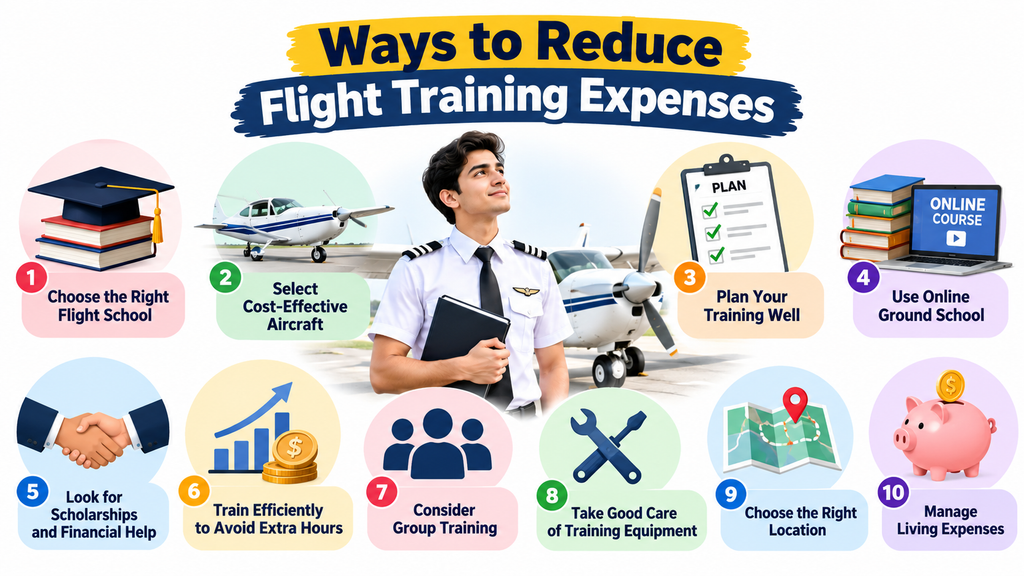
Becoming a pilot is an exciting goal, but flight training can cost a lot of money. Students must pay for flying lessons, instructors, exams, equipment, and other expenses. These costs can increase when training takes longer than planned. However, careful budgeting and good preparation can help students manage their spending.
Understanding the Main Costs of Flight Training
Before looking for ways to save money, students should understand where their money goes. Flight training involves several expenses beyond the advertised course fee.
Aircraft rental and instructor fees often make up a large part of the budget. Students may also pay for ground school, simulator sessions, medical examinations, written tests, and practical skill tests. Other expenses can include headsets, books, uniforms, accommodation, food, and travel.
Some flight schools include certain services in their training packages. Others charge separately for them. Therefore, students should ask for a complete breakdown of all expected costs before enrolling.
It is also important to understand that training expenses vary by country, school, aircraft type, and licensing requirements. A budget that works for one student may not work for another.
1. Compare Flight Schools Carefully
Choosing the right flight school is one of the first steps toward controlling training expenses. However, the cheapest advertised rate does not always mean the lowest total cost.
One school may offer a low aircraft rental rate but charge extra for ground lessons, examinations, or equipment. Another school may have a higher initial price but include more services.
Compare the full training package before making a decision. Ask each school for a written estimate covering aircraft rental, instructor fees, ground school, examinations, and other expected charges.
Also, consider the following factors:
- Aircraft availability and maintenance standards.
- Instructor experience and availability.
- Training schedules and expected waiting times.
- Included services and additional charges.
- Refund policies and payment terms.
- Approval or certification by the relevant aviation authority.
A school with reliable aircraft access may help students maintain a more consistent training schedule. However, actual progress depends on several factors, including weather, instructor availability, and individual performance.
The goal is to find a suitable school that offers transparent pricing, safe operations, and quality instruction.
2. Choose the Right Training Path
Your career goal should guide your training decisions. Different pilot licenses have different purposes, costs, and requirements.
For example, a Private Pilot License (PPL) generally allows eligible pilots to fly for private purposes, subject to applicable restrictions. A Commercial Pilot License (CPL) is designed for pilots who meet the requirements to exercise commercial flying privileges.
Students who want an airline career should research the complete training pathway before spending money. They should understand the required licenses, ratings, examinations, medical certification, and other qualifications.
Avoid paying for training that does not support your intended goal. At the same time, do not skip qualifications that are required for your chosen career.
Speak with qualified instructors and check the applicable licensing rules before enrolling. A clear plan can help prevent unnecessary changes later.
3. Prepare Before Every Flight Lesson
Good preparation can help students use their flying lessons more effectively. Every lesson should have a clear learning goal.
Before arriving at the airport, review the previous lesson and study the next planned exercise. Read the relevant procedures, checklists, and theory materials. Write down any questions you want to discuss with your instructor.
For example, a student preparing for a lesson on turns can review the relevant flight principles and instructor-provided procedures beforehand. This preparation can help the student understand the exercise more clearly.
After each flight, review the instructor’s feedback. Identify areas that need improvement and practise the related theory before the next lesson.
Preparation cannot remove the need for required flying hours. However, it can support learning and reduce avoidable confusion during training.
Never rush an exercise or skip instruction to save money. The priority should always be safe, effective learning.
4. Study Ground School Materials in Advance
Ground school teaches the knowledge pilots need before and during flight training. Topics may include navigation, meteorology, aircraft systems, flight principles, regulations, and flight planning.
Students who study regularly may find it easier to connect classroom knowledge with practical flying. This can also make lessons more productive.
Create a weekly study plan and divide large subjects into smaller sections. Use approved learning materials, instructor notes, practice questions, and suitable study groups.
Free resources can sometimes help explain difficult concepts. However, check their accuracy and relevance before relying on them. Official materials and instructor guidance should remain your main references for required knowledge.
Students should also avoid buying several books that cover the same material. First, check which books and resources the flight school recommends.
A steady study routine can help students prepare for examinations and understand flight lessons better.
5. Maintain Consistent Training Progress
Long breaks between lessons can affect how well students remember procedures and practical skills. After a lengthy gap, a student may need extra revision before continuing with planned exercises.
Whenever possible, develop a realistic training schedule with your instructor. Consider your budget, study commitments, weather conditions, and aircraft availability.
Consistency does not mean flying every day. It means choosing a schedule that supports learning and that you can afford to maintain.
For example, a student who can comfortably afford two lessons each week may plan around that schedule instead of booking several lessons and then stopping for a long period.
Keep some money available for unexpected delays or additional training. Flight training does not always progress at the same speed for every student.
Never fly when you are unwell, fatigued, or otherwise unfit. Saving money is never more important than safety.
6. Use Flight Simulators Where Appropriate
Flight simulators can support learning by helping students practise certain procedures and understand aircraft instruments. Approved training devices may also count toward specific training requirements when permitted by the applicable rules.
Students can ask their instructors whether simulator sessions are useful for their current training stage. This is especially relevant when learning procedures, instrument concepts, and cockpit familiarization.
However, not every simulator has the same training value. A home computer simulator may help with basic concepts, but it cannot automatically replace professional instruction or actual aircraft time.
Before paying for simulator sessions, confirm what the school offers and whether the device is suitable for your training objectives.
Use simulators as a learning aid, not as a shortcut around required practical training.
7. Select an Aircraft That Fits Your Training Requirements
Aircraft rental costs can differ based on the aircraft model, operating expenses, fuel consumption, and local availability. The aircraft used for training can therefore affect the overall budget.
Ask your flight school which aircraft are available for your course and how their rates differ. Find out whether the quoted rate includes fuel, instructor time, and other charges.
A less expensive aircraft may be a sensible choice when it meets the training requirements. However, the aircraft must also be suitable for the planned lessons and approved where required.
Do not choose an aircraft based only on its hourly price. Consider availability, maintenance standards, instructor familiarity, and the school’s training plan.
A suitable aircraft can support consistent learning while helping students understand their expected expenses.
8. Avoid Unnecessary Equipment Purchases
New students may feel that they need to buy every aviation product immediately. In reality, some items may be provided by the school, while others may not be needed until a later training stage.
Start by asking for a list of required equipment. This may include a headset, flight bag, logbook, navigation tools, and study materials, depending on the course.
Compare prices before purchasing. Suitable second-hand books or equipment may be useful when they meet the school’s requirements and remain in good condition.
Avoid buying expensive optional accessories simply because other students use them. A premium product is not always necessary for basic training.
You should also check whether your school provides access to navigation tools, learning software, or reference materials.
Purchase essential items first and add other equipment only when a clear training need arises.
9. Plan Accommodation and Daily Travel
Living expenses can become a significant part of a flight training budget, especially when students move to another city or country.
Before choosing a school, estimate the cost of accommodation, food, transport, utilities, and other daily needs. Compare these expenses alongside the training fees.
Shared accommodation may reduce rent and utility costs. Public transport, meal planning, and a location closer to the airport may also help manage spending.
However, a cheaper room far from the training centre could increase travel costs and make it harder to attend lessons on time. Consider the full cost rather than rent alone.
International students should also investigate visa requirements, insurance, currency exchange charges, and other relevant expenses before relocating.
A realistic living budget helps students focus on their training without facing avoidable financial pressure.
10. Understand Payment Plans and Financing
Some flight schools offer installment plans or staged payments. Education loans may also be available, depending on the country, lender, course, and applicant’s eligibility.
Before accepting any financing option, calculate the total amount you will pay. Check the interest rate, repayment period, processing fees, late-payment charges, and other conditions.
Do not compare payment plans only by their monthly installments. A smaller installment may result in a longer repayment period and a higher overall cost.
Ask the school what happens if training is delayed, interrupted, or cancelled. Review the refund policy and understand which payments are refundable.
Students should also consider how they will cover living expenses and loan repayments if their training takes longer than expected.
Borrow only after reviewing the risks and available alternatives. A clear financial plan can help prevent unnecessary debt.
11. Budget for Examinations, Medicals, and Retakes
Flight training expenses include more than aircraft rental and classroom instruction. Students must also plan for the examinations and certifications required for their training pathway.
Depending on the licensing system, these expenses may include aviation medical examinations, written tests, practical skill tests, license applications, and additional ratings.
Some students may also need to pay for retakes or further instruction. These costs are not always included in the initial training estimate.
Ask your flight school which fees are included and which must be paid separately. Confirm current requirements and charges with the relevant aviation authority.
Prepare for examinations early and seek help with difficult topics. Strong preparation may reduce avoidable setbacks, although passing an examination can never be guaranteed.
Keep a separate amount in your budget for unexpected fees and additional training.
12. Track Every Training Expense
A simple budget can help students understand how much they spend and what remains available.
Record your aircraft rental, instructor fees, ground school charges, examination fees, equipment purchases, accommodation, and transport expenses.
Review your spending at the end of each month. Compare actual costs with your original estimate and adjust your plan when needed.
For example, if travel costs are higher than expected, consider whether a different transport option would be practical. If equipment purchases are increasing, review which items are genuinely necessary.
Keep copies of receipts, invoices, and payment confirmations. These records can help you check charges and plan upcoming payments.
It is also wise to maintain an emergency fund. Weather delays, unexpected travel, and additional training can affect the budget.
Tracking expenses will not eliminate every financial challenge, but it can help you make better decisions throughout training.
A Practical Flight Training Budget Example
Consider an Indian student who has set aside ₹1,00,000 for a particular stage of training and its related expenses. This is a hypothetical planning example, not an estimate of the actual cost of a pilot license or a typical training package.
The student could begin by dividing the available money into separate categories:
- Flight lessons and instructor charges: ₹55,000.
- Ground school and study materials: ₹10,000.
- Travel and daily expenses: ₹15,000.
- Equipment and administrative fees: ₹10,000.
- Emergency reserve: ₹10,000.
These figures are illustrative and should be adjusted to match the student’s actual course, location, and fees. They do not imply that ₹1,00,000 is sufficient to complete a specific flight training program.
Next, the student can compare the budget with the flight school’s written estimate. If the expected training fees exceed the available amount, the student should review the plan before committing to payments.
The student might reduce optional equipment purchases, use suitable study resources already available, or choose more affordable accommodation. However, the student should not reduce required training hours or ignore safety-related expenses.
The most useful budget is one based on real quotations, realistic living costs, and a reserve for unexpected expenses.
Common Mistakes Students Should Avoid
Small financial mistakes can create larger problems over time. Students should watch for these common issues.
- Choosing a school only because it has the lowest hourly rate. Compare the complete cost and training quality before enrolling.
- Ignoring additional fees. Ask about examinations, medical checks, equipment, and administrative charges.
- Buying unnecessary equipment. Purchase what your training requires and postpone optional items.
- Taking long breaks without planning. Discuss a manageable training schedule with your instructor.
- Arriving unprepared. Review lesson materials and instructor feedback before each flight.
- Underestimating living costs. Include rent, food, travel, and emergency expenses in your budget.
- Accepting financing without checking the terms. Calculate the total repayment amount, not just the monthly payment.
- Trying to save money by skipping required training. Follow all applicable licensing and safety requirements.
Avoiding these mistakes can make training expenses easier to manage. It also helps students focus on developing the knowledge and skills they need.
Important Considerations
Flight training is a major financial commitment, so students should make decisions carefully.
First, training costs and licensing requirements differ between countries. Always confirm current rules with the relevant aviation authority.
Second, minimum flight hours do not guarantee that every student will qualify within those hours. Some students need additional practice to meet the required standard.
Third, weather, aircraft availability, instructor schedules, and individual progress can affect the training timeline. Keep enough flexibility in your budget to manage delays.
Fourth, never compromise aircraft maintenance standards, instructor quality, medical requirements, or required training to reduce expenses.
Finally, compare the complete cost of each training option. A realistic estimate should include direct training fees, living expenses, examinations, equipment, and a contingency fund.
Careful planning can make financial decisions easier, but safe and effective training must remain the priority.
Frequently Asked Questions
1. What is the best way to reduce flight training expenses?
Start by comparing complete training packages and preparing a realistic budget. Study before lessons, maintain a manageable schedule, and avoid unnecessary purchases. Always protect training quality and safety.
2. How can students prepare for flight lessons before arriving at the airport?
Review the previous lesson, study the next exercise, and read the relevant checklists and theory materials. Write down questions for your instructor and review feedback after each flight.
3. Does choosing a cheaper flight school always save money?
No. A school with lower hourly rates may charge extra for other services or have limited aircraft availability. Compare the total expected cost, training quality, maintenance standards, and instructor availability.
4. Can flight simulators reduce practical training costs?
Suitable simulators can support procedural practice and help students understand instruments. However, only qualifying training devices and activities may count toward required training under applicable rules. Simulators cannot automatically replace aircraft training.
5. How do long breaks affect flight training expenses?
Long breaks can affect skill retention and may require additional revision. A consistent, affordable schedule can help students maintain progress, although weather and other factors may cause interruptions.
6. What additional costs should student pilots budget for?
Students should consider medical examinations, theory tests, skill tests, equipment, study materials, travel, accommodation, and administrative fees. They should also keep a reserve for unexpected expenses.
7. Is it possible to work while completing flight training?
It may be possible, depending on the training schedule, workload, and personal circumstances. Students should ensure that employment does not interfere with study, rest, attendance, or safe flying. International students must also check applicable work restrictions.
8. How can students compare flight school payment plans?
Compare deposits, installment amounts, interest, additional charges, refund policies, and the total amount payable. Check what happens if training is delayed or interrupted before signing an agreement.
9. Should students buy their own aviation equipment?
Buy equipment that is required or genuinely useful for the current training stage. Ask the school what it provides and compare suitable products before spending money on optional accessories.
10. Can flight training be completed at the minimum required hours?
Some students may meet the required standard at the minimum hours, while others need additional training. The actual requirement depends on the licensing system, and students must demonstrate the necessary skills before qualifying.
Conclusion
Reducing flight training expenses starts with careful planning and informed decisions. Students can manage costs by comparing flight schools, preparing for lessons, studying regularly, and avoiding unnecessary purchases.
A realistic budget should include training fees, examinations, living expenses, and unexpected costs. Students should also understand their licensing requirements before committing to a training program.
Most importantly, saving money should never mean skipping required lessons or compromising safety. The best approach is to manage expenses while building strong flying skills and sound aviation knowledge.
With a clear plan, consistent preparation, and careful spending, aspiring pilots can make their training journey more manageable and work toward their goals with greater financial confidence.

