
Introduction
Joining a flying school is a major step for anyone who dreams of becoming a pilot. It is not just an educational decision; it is a career investment that affects your training quality, confidence, safety habits, licensing progress, and future aviation opportunities. Before you enroll, you should carefully understand what the school offers, how it trains students, what it costs, and whether it matches your long-term goals.
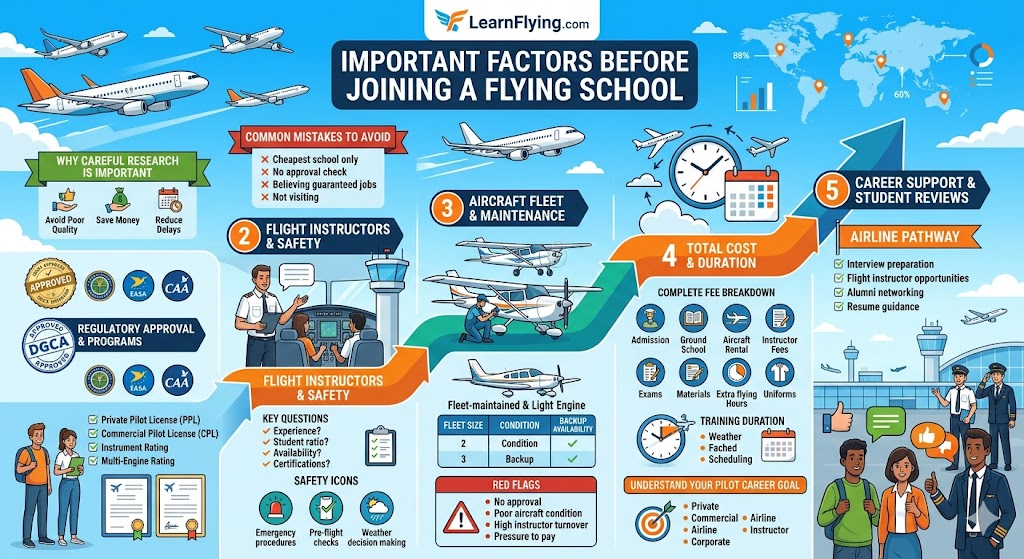
Many students choose a flying school based only on location, low fees, or attractive promises. This can lead to delays, extra expenses, weak training, and frustration later. A good flying school should provide proper approvals, qualified instructors, well-maintained aircraft, strong safety standards, transparent pricing, and reliable student support. This guide from LearnFlying.com explains the most important factors to check before joining a flying school.
Why Careful Research Is Important
Flight training requires time, discipline, money, and commitment. Unlike many other courses, pilot training depends heavily on aircraft availability, weather, instructor quality, maintenance standards, and regulatory requirements. If any of these areas are weak, your training may become slower or more expensive.
Careful research helps you:
- Avoid poor-quality training
- Understand the real cost of becoming a pilot
- Choose a school that matches your goals
- Reduce unnecessary delays
- Build strong aviation fundamentals
- Train in a safer environment
- Plan your career with confidence
Understand Your Pilot Career Goal First
Before joining a flying school, decide what type of pilot career you want. Your goal will help you choose the right training path.
Private Pilot
If you want to fly for personal interest or recreation, you may need a school that offers flexible schedules, good instructors, and safe basic training.
Commercial Pilot
If you want to earn money as a pilot, you need a structured commercial pilot training program with strong ground school, flight training, instrument training, and career guidance.
Airline Pilot
Aspiring airline pilots should choose a school that offers professional training, multi-engine exposure, simulator access, and career support.
Flight Instructor
If you want to become a flight instructor, check whether the school offers instructor training and possible teaching opportunities after completion.
Corporate or Charter Pilot
For corporate aviation, professionalism, communication, and strong aircraft handling skills are important. Choose a school that focuses on discipline and real-world flying standards.
1- Regulatory Approval and Accreditation
The first factor to check is whether the flying school is officially approved by the relevant aviation authority. Depending on the country, this may include FAA, EASA, DGCA, CASA, CAA, or another national aviation regulator.
Approval matters because it shows that the school follows required training, safety, instructor, and aircraft maintenance standards. Never rely only on marketing claims. Ask for proof of approval and verify it through official channels if possible.
2- Training Programs Offered
Different flying schools offer different programs. Make sure the school provides the license and ratings you need.
Common programs include:
- Private Pilot License
- Commercial Pilot License
- Instrument Rating
- Multi-Engine Rating
- Flight Instructor Training
- Airline Transport Pilot preparation
- Ground school training
- Simulator training
If your goal is to become a professional pilot, choose a school that can support your full journey instead of only the first license.
3- Quality of Flight Instructors
Flight instructors are one of the most important parts of your training. A good instructor helps you understand concepts clearly, corrects mistakes patiently, and builds your confidence step by step.
Before joining, ask:
- How experienced are the instructors?
- What certifications do they hold?
- What is the student-to-instructor ratio?
- Are instructors available regularly?
- Is there high instructor turnover?
- Can students change instructors if needed?
A school with qualified and stable instructors usually provides a better learning experience.
4- Aircraft Fleet and Maintenance Standards
Aircraft quality and availability directly affect your training progress. If the school has too few aircraft or poor maintenance standards, your flying hours may be delayed.
Check:
- Number of aircraft available
- Type of aircraft used for training
- Aircraft condition
- Maintenance schedule
- Aircraft downtime
- Backup aircraft availability
- Simulator availability
A well-maintained fleet shows that the school takes safety seriously. Do not ignore aircraft condition during your visit.
5- Safety Culture
Safety should always come first in aviation. A good flying school will openly explain its safety procedures, emergency training, weather decision-making, and aircraft maintenance practices.
Signs of a strong safety culture include:
- Clear pre-flight checks
- Regular safety briefings
- Proper maintenance records
- Emergency procedure training
- No pressure to fly in unsafe weather
- Transparent incident reporting
- Professional instructor behavior
Avoid schools that treat safety questions casually or avoid giving clear answers.
6- Total Cost and Hidden Charges
Flight training can be expensive, so you must understand the full cost before enrolling. Do not choose a school only because the advertised fee looks low.
Ask for a complete cost breakdown, including:
- Admission fees
- Ground school fees
- Aircraft rental charges
- Instructor fees
- Simulator fees
- Exam fees
- Medical test costs
- Books and study materials
- Uniforms
- Accommodation
- Transportation
- Extra flying hours
- Retest fees
- License processing charges
Always keep a budget buffer because many students need extra hours before becoming fully ready for exams or flight checks.
7- Training Duration and Scheduling
The advertised course duration may not always match reality. Training can be affected by weather, aircraft availability, instructor availability, student performance, and regulatory requirements.
Ask:
- How often can students fly each week?
- What is the average completion time?
- Are flights scheduled regularly?
- What happens during bad weather?
- How are delays handled?
- Is there a waiting list for aircraft or instructors?
Consistent flying is important because long gaps between lessons can slow your progress.
8- Ground School Quality
Flying is not only practical training. Ground school helps you understand aviation theory, regulations, navigation, meteorology, aircraft systems, radio communication, and flight planning.
A strong ground school should include:
- Experienced theory instructors
- Structured classroom sessions
- Exam preparation
- Study materials
- Practice tests
- Doubt-clearing sessions
- Clear progress tracking
Good theory knowledge makes practical flying safer and easier.
9- Location and Weather Conditions
The location of a flying school can affect training speed and quality. Some locations offer good weather for regular flying, while others provide experience in more challenging conditions.
Consider:
- Weather patterns
- Airport traffic
- Airspace complexity
- Runway facilities
- Distance from your accommodation
- Local cost of living
- Transport availability
A school in a busy airport may give valuable communication experience, while a quieter airport may help beginners learn with less pressure.
10- Career Support and Placement Guidance
If you want to become a professional pilot, career support is very important. A flying school should guide students beyond license completion.
Useful career support includes:
- Resume guidance
- Interview preparation
- Airline pathway information
- Internship guidance
- Alumni networking
- Flight instructor opportunities
- Career counseling
Be careful with schools that promise guaranteed airline jobs without clear conditions. Good schools provide support, but employment depends on your skills, qualifications, market conditions, and hiring requirements.
11- Student Reviews and Alumni Feedback
Before joining, speak with current students and alumni. They can give honest information about training quality, instructor behavior, aircraft availability, hidden costs, and delays.
Ask students:
- Are flights scheduled regularly?
- Are instructors helpful?
- Are costs transparent?
- Is the school professionally managed?
- Are aircraft available on time?
- Would they recommend the school?
Reviews are useful, but do not rely on one opinion only. Compare multiple sources.
12- Accommodation and Student Support
If you are moving to another city or country, student support becomes important. A good school should help students settle comfortably.
Check whether the school offers:
- Hostel or housing assistance
- Transport support
- Visa support for international students
- Medical guidance
- Mentorship
- Academic counseling
- Progress monitoring
Strong student support helps you focus better on training.
13- Medical Fitness Requirements
Before investing in flight training, check the medical requirements for your chosen pilot license. Professional pilot training usually requires a higher medical fitness standard than private flying.
You should complete the required aviation medical examination before making a major financial commitment. This helps avoid problems later if you are found medically unfit for your intended license.
14- Training Environment and Discipline
A flying school should feel professional, organized, and disciplined. Aviation requires punctuality, responsibility, communication, and attention to detail.
During your visit, observe:
- Staff behavior
- Classroom environment
- Aircraft handling
- Student discipline
- Instructor professionalism
- Safety procedures
- Administrative support
A professional environment builds professional pilots.
15- Documentation and Contract Terms
Before paying fees, carefully read all documents. Do not sign anything without understanding the terms.
Check:
- Fee structure
- Refund policy
- Training timeline
- Cancellation rules
- Extra charges
- Payment schedule
- Student responsibilities
- School responsibilities
- License processing support
Ask for written confirmation of important promises.
Important Questions to Ask Before Joining
1- Is the school approved by the aviation authority?
2- What licenses and ratings do you offer?
3- What is the total estimated cost?
4- Are there any hidden charges?
5- How many aircraft are available?
6- How many students are currently enrolled?
7- What is the student-to-instructor ratio?
8- How often can I fly each week?
9- What is the average completion time?
10- What happens if aircraft are unavailable?
11- Do you provide simulator training?
12- What ground school support is included?
13- What is your safety record?
14- Do you offer career guidance?
15- Can I speak with current students or alumni?
16- Is accommodation available?
17- What is the refund policy?
18- Do you help with license paperwork?
Red Flags Before Joining a Flying School
Avoid or be cautious if you notice:
- No clear regulatory approval
- Poor aircraft condition
- Unclear fee structure
- Unrealistic job promises
- High instructor turnover
- Weak safety communication
- No proper training plan
- Bad student reviews
- Long aircraft waiting times
- Pressure to pay immediately
- No written agreement
- Poor administrative response
A professional school should be transparent and willing to answer your questions.
Flying School Comparison Table
| Factor | What to Check | Why It Matters |
|---|---|---|
| Approval | Aviation authority certification | Ensures legal and standard training |
| Instructors | Qualification and availability | Affects learning quality |
| Aircraft | Fleet size and maintenance | Impacts safety and scheduling |
| Safety | Procedures and records | Protects students and aircraft |
| Cost | Full fee breakdown | Helps avoid hidden expenses |
| Ground School | Theory classes and materials | Supports exam success |
| Location | Weather and airport environment | Affects training speed |
| Career Support | Placement and guidance | Helps professional pilot planning |
| Reviews | Student and alumni feedback | Shows real experience |
| Support | Housing, visa, mentoring | Improves student life |
Common Mistakes Students Make
1- Choosing Only the Cheapest School
Low fees may look attractive, but poor training, delays, and hidden charges can make the final cost higher.
2- Not Checking Approval
Training at an unapproved school can create licensing problems and waste time.
3- Ignoring Safety Standards
Never compromise on safety. Aircraft maintenance and safety culture are more important than discounts.
4- Not Asking About Aircraft Availability
Limited aircraft can delay your flying hours and increase training duration.
5- Believing Guaranteed Job Claims
Be careful with unrealistic promises. A school can support your career, but it cannot guarantee success without conditions.
6- Not Understanding Total Cost
Many students forget to include extra flying hours, exams, accommodation, and materials.
7- Not Visiting the School
A visit helps you see the real condition of facilities, aircraft, and training environment.
8- Ignoring Ground School
Weak theory knowledge can affect exams and practical flying confidence.
9- Not Talking to Students
Current students can reveal practical issues that brochures may not mention.
10- Joining Without a Career Plan
Your school choice should match your long-term aviation goal.
Final Checklist Before You Join
Before enrolling, make sure you have checked:
- Regulatory approval
- License and rating options
- Instructor qualifications
- Aircraft condition
- Maintenance standards
- Safety culture
- Full cost estimate
- Training duration
- Ground school quality
- Student reviews
- Career support
- Accommodation support
- Refund policy
- Medical requirements
- Written agreement
Conclusion
Joining a flying school is an exciting step, but it should be taken with careful research and planning. The right flying school can help you build strong flying skills, safety habits, confidence, and a clear path toward your aviation goals. Before making a decision, compare multiple schools, visit the campus, inspect the aircraft, meet instructors, speak with students, review costs, and verify regulatory approvals. Do not rush because of discounts or attractive promises. A good flying school should be transparent, safe, professional, and aligned with your future plans. With the right preparation, your journey from student pilot to confident aviator can begin on a strong foundation.

