Introduction
Have you ever wondered how your phone recognizes a mobile operator while travelling or switching networks? Mobile devices rely on specific identification codes to understand which network they detect.
Three important terms help explain this process: MCC, MNC, and PLMN. They support mobile network identification and help telecom systems manage connections across different regions.
These identifiers also play a role in roaming, SIM services, eSIM connectivity, and network troubleshooting. Although they relate to the same system, each term has a distinct meaning.
This guide explores their functions, differences, practical uses, and common mistakes in simple language.
Why Mobile Networks Need Identification Codes
Mobile operators serve millions of users across many locations. A single country may have several operators, and travellers often encounter networks from unfamiliar providers.
Phones need a consistent way to identify these networks. Operator names alone cannot handle every technical requirement because names may change or appear similar.
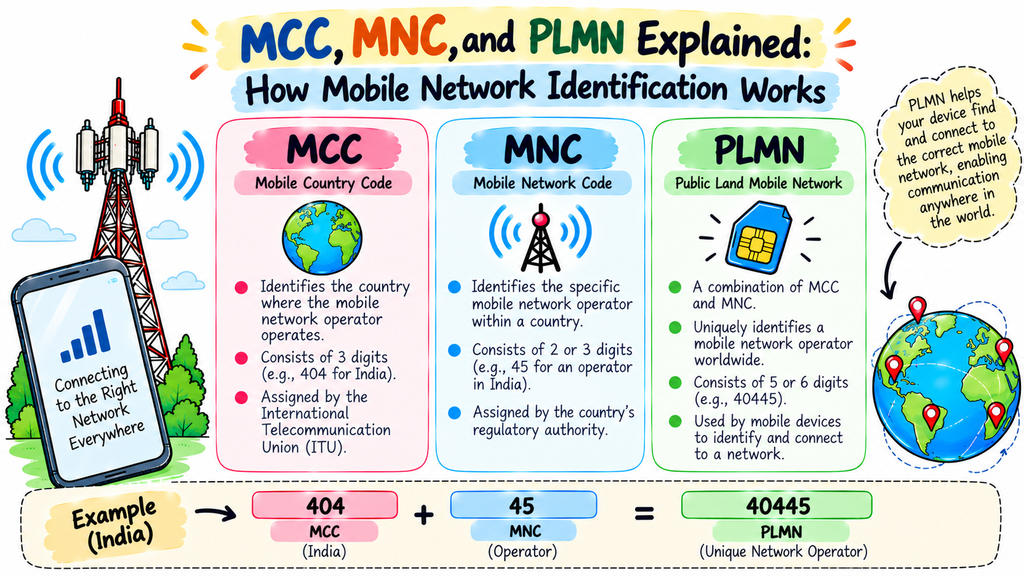
Telecom systems use structured codes to distinguish networks. MCC identifies the country-related assignment, while MNC distinguishes a network within the relevant MCC arrangement. Together, these values form a PLMN identifier.
This structure helps devices and telecom systems interpret network information. However, a device still needs permission, compatible technology, and sufficient coverage to establish a connection.
Mobile Country Code (MCC)
MCC stands for Mobile Country Code. It normally contains three digits and identifies the country or geographical numbering assignment associated with a mobile network.
Phones and telecom systems use MCC as one part of the network identification process.
What Does MCC Help Identify?
MCC provides the country-related component of a network identity. It helps systems distinguish network assignments associated with different countries or geographical areas.
Common uses include:
- Supporting mobile network identification.
- Helping devices evaluate available networks.
- Contributing to roaming procedures.
- Organizing operator information in technical databases.
- Assisting engineers who investigate network identification problems.
MCC identifies a network assignment rather than an individual mobile subscriber. It also does not provide a precise location for a phone or its owner.
Mobile Network Code (MNC)
MNC stands for Mobile Network Code. It distinguishes a mobile network within the relevant MCC arrangement.
Unlike MCC, an MNC may contain two or three digits, depending on the numbering plan. Telecom systems interpret it alongside MCC to identify the intended network.
Why Is MNC Necessary?
Several mobile networks may operate within the same country. MNC helps systems distinguish one network from another.
For example, imagine two fictional operators that share an illustrative MCC but use different MNC values. Their combined identifiers would distinguish their networks.
Telecom systems use MNC to support:
- Network identification.
- Operator record management.
- Mobile network selection.
- Roaming-related procedures.
- Technical investigation of connection issues.
Always consider the associated MCC when reading an MNC. The MNC alone may not identify the intended network accurately.
Public Land Mobile Network (PLMN)
PLMN stands for Public Land Mobile Network. The term describes a mobile telecommunications network that provides services to the public.
A PLMN identifier combines the MCC and MNC. This combination helps devices and telecom systems distinguish a particular mobile network.
How the Identification Process Works
When a phone searches for service, it can detect network information from nearby mobile networks. The device uses this information to recognize available options.
The MCC provides the country-related component, while the MNC distinguishes the network within the relevant arrangement. Their combination identifies the PLMN.
The phone then applies network-selection rules and checks whether it can register with the selected network.
A valid identifier does not guarantee access. The operator may reject a connection if the subscription lacks permission or the device does not meet the network’s requirements.
Comparing MCC, MNC, and PLMN
Each term has a separate role in mobile network identification.
| Feature | MCC | MNC | PLMN |
|---|---|---|---|
| Full form | Mobile Country Code | Mobile Network Code | Public Land Mobile Network |
| Purpose | Identifies the country-related assignment | Distinguishes a network within the MCC arrangement | Describes a public mobile network |
| Format | Normally three digits | Two or three digits, depending on the numbering plan | Identifier combines MCC and MNC |
| Typical role | Country-related network identification | Network identification within the relevant arrangement | Identifying a specific mobile network |
Remember that MCC and MNC are code components. PLMN refers to the public mobile network, while its identifier combines those two values.
How Mobile Devices Use Network Identifiers
A phone evaluates available networks before selecting a suitable connection. MCC and MNC help the device recognize the network identities it encounters.
However, the phone considers several other factors before connecting. These include signal strength, supported network technologies, SIM details, subscription permissions, and operator settings.
For example, a phone may detect multiple networks in a busy city. The device follows its network-selection rules and checks which networks it can use.
The phone may prefer its home network when available. During travel, it may connect to another permitted network if its home operator supports roaming.
Network identification helps guide this process, but it does not determine every connection decision by itself.
The Importance of MCC and MNC in Roaming
Roaming allows mobile subscribers to use compatible networks outside their home operator’s usual service area. International travel provides a common example.
When a subscriber enters another country, the phone may detect several local networks. MCC and MNC help the device identify those networks.
The phone and the relevant operators then follow the required procedures to determine whether the subscriber can register and use services.
Successful roaming depends on several factors:
- The home operator supports a suitable roaming agreement.
- The visited network accepts the subscriber.
- The mobile plan permits roaming.
- The phone supports the available network technology.
- The visited network provides adequate coverage.
MCC and MNC help identify the networks involved. They do not replace the authorization and compatibility checks that roaming requires.
Practical Uses Across Telecom Systems
Network identifiers support many tasks beyond helping phones recognize operators.
Network Registration
Mobile devices use network identification information during procedures that establish a connection with an operator.
Roaming Management
Telecom systems use network identities to distinguish home and visited networks during roaming operations.
Technical Troubleshooting
Support teams may inspect MCC and MNC when a phone connects to an unexpected network or fails to register.
Network Databases
Operators maintain records that connect network identifiers with operator information and technical configurations.
Mobile Connectivity Services
Network identifiers may appear in records related to SIM cards, eSIM profiles, and connectivity services. These systems also rely on other information to configure and authorize access.
Finding MCC and MNC on Your Phone
The available methods depend on your device, operating system, and diagnostic tools.
Check Mobile Network Settings
Open your phone’s SIM or mobile network settings. Some devices show detailed operator information, while others display only the carrier name and basic subscription details.
Try a Network Diagnostic Application
Certain applications display MCC, MNC, signal strength, and network technology. Choose a reputable tool and review its permissions before installing it.
Consult Your Mobile Operator
Your carrier may provide network details through official documentation or technical support. This can help when you need to confirm a specific network identifier.
Check the context before using any code list. Network configurations can vary, and outdated information may cause incorrect conclusions.
MCC, MNC, and eSIM Connectivity
An eSIM stores a digital mobile subscription profile on a compatible device. It allows users to add a mobile plan without inserting a physical SIM card.
The phone still needs to recognize a supported network and establish a connection. MCC and MNC can help identify the network, but they do not activate an eSIM on their own.
A successful eSIM setup may require:
- A compatible device.
- A valid subscription profile.
- Correct installation and activation.
- Support from the mobile operator.
- Adequate network coverage.
- Appropriate roaming settings when necessary.
If you are exploring mobile data options for international trips, eSIMGlobe offers information about travel eSIM services for different destinations. Before choosing a plan, review the supported countries, data allowance, validity period, device compatibility, and service conditions.
When an eSIM fails to connect, network information can help with diagnosis. Still, activation errors, subscription restrictions, or poor coverage may cause the problem.
Common Misunderstandings About Mobile Network Codes
A few errors can make network information difficult to interpret.
Confusing MCC with MNC: MCC identifies the country-related assignment, while MNC distinguishes the network within that arrangement.
Reading MNC without its context: The associated MCC helps systems interpret the MNC correctly.
Treating PLMN as a country code: PLMN refers to a public mobile network. Its identifier combines MCC and MNC.
Assuming a network identifier grants access: A device may recognize a network without having permission to connect.
Ignoring digit lengths: MCC normally contains three digits, while MNC may contain two or three digits.
Using unverified information: Outdated or incorrect code lists can cause mistakes in network records and troubleshooting.
Understanding these differences helps users and technical teams read network data more accurately.
Best Practices for Network Identification
Follow these recommendations when working with MCC, MNC, and PLMN information.
- Use trusted references: Check reliable telecom sources or official operator documentation.
- Keep related codes together: Record MCC and MNC accurately when documenting a network identifier.
- Preserve the original format: Avoid removing leading zeros or changing the number of digits.
- Record the context: Include relevant operator, technology, and date details when investigating an issue.
- Check other connection factors: Review coverage, subscription status, device compatibility, and network settings.
- Protect technical records: Network codes identify networks, but diagnostic logs may contain other sensitive information.
These steps help improve documentation and support more effective network troubleshooting.
Frequently Asked Questions
What is an MCC in mobile communication?
MCC stands for Mobile Country Code. It normally contains three digits and identifies the country or geographical numbering assignment associated with a mobile network.
What does MNC identify?
MNC stands for Mobile Network Code. It distinguishes a mobile network within the relevant MCC arrangement.
What is the relationship between MCC, MNC, and PLMN?
MCC provides the country-related component, and MNC distinguishes the network within that arrangement. Their combination forms the PLMN identifier.
Does an MNC always contain two digits?
No. An MNC may contain two or three digits, depending on the numbering plan.
Do these codes help phones select a network?
Yes. They help devices recognize network identities. The phone also considers signal strength, subscription permissions, compatibility, and network-selection rules.
Can MCC and MNC help with international roaming?
Yes. They help identify home and visited networks. Roaming still depends on operator agreements, subscription permissions, and network availability.
Do MCC and MNC reveal a phone owner’s identity?
No. These codes identify mobile networks rather than individual subscribers. Other information in technical records may still contain personal details.
Why can my phone detect a network but fail to connect?
The network may not authorize your subscription. Poor coverage, incompatible technology, incorrect settings, or SIM problems can also prevent a connection.
Are MCC and MNC sufficient for eSIM activation?
No. They help with network identification, but eSIM activation also requires a valid profile, compatible hardware, and the correct subscription setup.
Where can I verify mobile network identifiers?
Check official operator documentation, reliable telecom references, or a reputable network diagnostic application. Confirm that the information matches the network you want to investigate.
Final Thoughts
Mobile network identification relies on several codes that perform different but related jobs. MCC identifies the country-related assignment, MNC distinguishes a network within that arrangement, and the combined values identify a PLMN.
These concepts help explain how phones recognize operators, how roaming systems identify networks, and how engineers investigate connection problems.
Once you understand the relationship between MCC, MNC, and PLMN, mobile network information becomes easier to interpret. You can also approach eSIM connectivity and network troubleshooting with a clearer understanding of the identification process.