
Introduction
Learning to fly is both a practical and mental journey that requires concentration, patience, discipline, and confidence.
For student pilots, staying mentally prepared can make it easier to absorb new information, respond to challenges, and learn from mistakes.
Stress, fatigue, nervousness, and self-doubt can sometimes affect the learning experience if they are not managed properly.
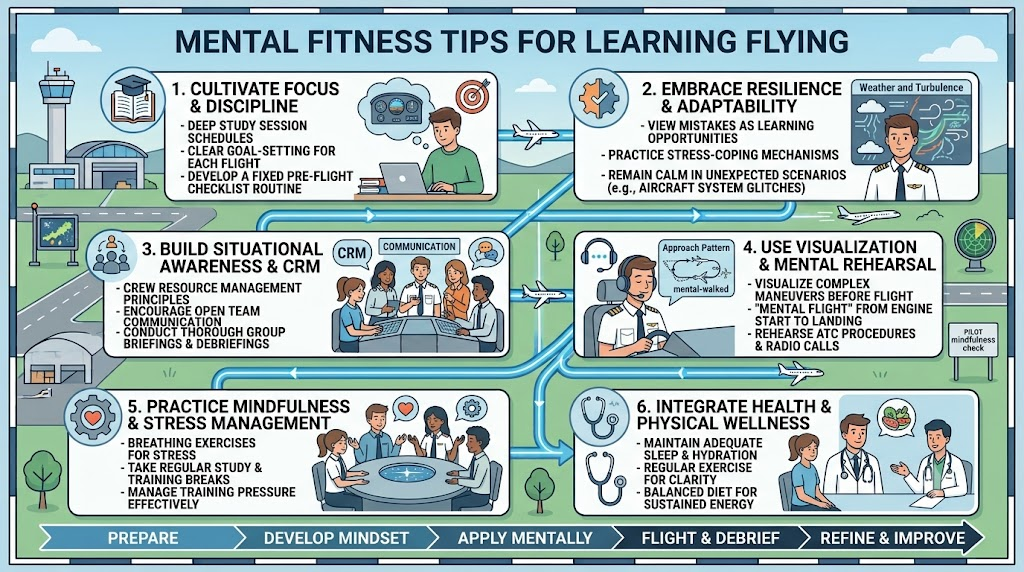
This guide explains practical mental fitness tips that can help students approach flight training with a focused, balanced, and responsible mindset.
Main Content
Understanding Mental Fitness in Flight Training
Mental fitness refers to a person’s ability to remain focused, manage normal pressure, make sensible decisions, and adapt to challenges. In flight training, these abilities are particularly important because students are learning new procedures while developing practical skills.
Mental fitness does not mean that a student should never feel nervous or make mistakes. Feeling uncertain during the early stages of training is normal. What matters is learning how to respond constructively to those experiences.
A student pilot may need to listen carefully to an instructor, remember procedures, monitor different aspects of a flight, communicate clearly, and respond appropriately to changing situations. A prepared and focused mind can support this learning process.
Why Mental Fitness Matters for Student Pilots
Flight training involves both classroom learning and practical application. Students need to understand information and then apply it during training.
Mental readiness can support:
- Concentration during lessons.
- Retention of new information.
- Clear communication with instructors.
- Awareness of the surrounding situation.
- Responsible decision-making.
- Confidence during training.
- Ability to learn from mistakes.
- Better management of normal training pressure.
Mental fitness should be viewed as part of overall preparation rather than as a separate skill that only matters during difficult flights.
Managing Stress During Flight Training
Stress can occur for many reasons during pilot training. Students may feel pressure before an examination, progress check, first solo experience, or an unfamiliar exercise.
Some level of nervousness is normal, but students should learn how to manage it rather than allowing it to dominate their attention.
Several simple habits can help:
- Prepare for lessons in advance.
- Break difficult subjects into smaller learning goals.
- Take a few slow breaths when feeling tense.
- Focus on the current task instead of worrying about everything at once.
- Ask the instructor for clarification when something is unclear.
- Avoid placing unrealistic expectations on yourself.
Students should remember that struggling with a particular lesson does not necessarily mean they are unsuitable for aviation. Learning speeds differ from person to person.
Building Concentration and Focus
Concentration is an important part of learning to fly. Students need to listen to instructions, understand procedures, observe relevant information, and respond appropriately.
Good preparation can make concentration easier. Reviewing material before a lesson means the student is less likely to encounter every concept for the first time during the training session.
Students can improve their focus by:
- Getting adequate rest.
- Preparing study material before lessons.
- Reducing unnecessary distractions.
- Paying close attention during briefings.
- Taking notes when appropriate.
- Focusing on the current learning objective.
- Asking questions when attention or understanding has been lost.
Concentration is not about forcing yourself to remain focused indefinitely. Regular rest and sensible preparation are also important.
Building Confidence Without Becoming Overconfident
Confidence develops gradually through knowledge, practice, experience, and feedback.
A student who understands a procedure and has practiced it repeatedly may naturally become more confident. However, confidence should not lead to ignoring limitations or procedures.
Healthy confidence means being comfortable with what you know while recognizing what you still need to learn.
Students can build confidence by:
- Setting realistic learning goals.
- Recognizing gradual improvement.
- Practicing consistently.
- Accepting constructive feedback.
- Asking questions.
- Reviewing mistakes without excessive self-criticism.
- Keeping track of areas that are improving.
Overconfidence is different. Assuming that you are ready for something simply because a previous lesson went well can lead to poor judgment. Training and safety procedures should always remain the priority.
Dealing With Mistakes During Flight Training
Mistakes are a natural part of learning a complex skill. A student may forget a step, misunderstand an instruction, or struggle with a particular exercise.
The important thing is what happens after the mistake.
Instead of becoming overly frustrated, students can ask:
- What happened?
- Why did it happen?
- What can I learn from it?
- What feedback did my instructor provide?
- How can I avoid repeating the same mistake?
This approach turns a difficult experience into a learning opportunity.
Students should also avoid comparing every mistake with the progress of another student. Flight training is an individual learning process, and different people may require different amounts of practice.
Managing Fear and Nervousness
For someone who is new to aviation, nervousness can be expected. New environments, unfamiliar procedures, and the responsibility associated with flying can all contribute to anxiety.
The goal should not be to pretend that nervousness does not exist. Instead, students should learn to recognize it and manage normal nervousness responsibly.
Preparation is one of the most effective ways to become more comfortable. Knowing what will be covered in a lesson, reviewing relevant material, and practicing previously learned skills can reduce uncertainty.
Simple techniques such as controlled breathing, maintaining a steady pace, and focusing on the task at hand can also help manage temporary nervousness.
If a student feels that stress or another personal issue is significantly affecting their ability to train safely, they should communicate appropriately with their instructor and follow the guidance of their flight school or relevant professionals.
Decision-Making and Mental Clarity
Good decision-making requires the ability to process information without becoming unnecessarily rushed or distracted.
Students can develop better decision-making habits by learning to:
- Consider relevant information before acting.
- Follow established procedures.
- Recognize personal limitations.
- Avoid unnecessary pressure to continue when something is unclear.
- Ask for guidance when appropriate.
- Prioritize safety over convenience.
Student pilots should not feel that asking for help is a sign of weakness. Knowing when to seek guidance is an important part of responsible learning.
Handling Pressure During Training
Students may experience pressure when preparing for tests, practical assessments, solo flights, or important stages of training.
Pressure can become more difficult when students compare their progress with classmates or expect themselves to perform perfectly every time.
A healthier approach is to focus on individual progress. Instead of asking whether someone else is progressing faster, students can consider whether they understand something better today than they did previously.
Setting smaller learning goals can also make challenging training periods feel more manageable.
Sleep, Rest, and Mental Readiness
Adequate rest is an important part of being mentally prepared for learning. Fatigue can make it harder to concentrate, remember information, communicate clearly, and respond effectively.
Students should avoid treating lack of sleep as a normal part of serious training.
Before a flight lesson, students should consider whether they are sufficiently rested and mentally prepared to participate safely. They should follow the guidance and requirements of their instructor, flight school, and applicable aviation rules regarding fitness for flight.
Rest is not wasted time. It supports the learning process and helps students approach training with greater alertness.
Developing a Positive Learning Mindset
A positive learning mindset does not mean believing that every lesson will be easy. It means being willing to learn, accept feedback, and continue improving when something is difficult.
Useful qualities for student pilots include:
- Patience.
- Discipline.
- Curiosity.
- Self-awareness.
- Responsibility.
- Willingness to ask questions.
- Openness to constructive feedback.
Students should understand that progress may not always happen at the same speed. Some lessons may feel easy, while others may require additional practice. Both experiences are normal parts of learning.
Practical Mental Fitness Preparation
Mental preparation can become part of a student’s normal flight-training routine. Small habits before and after each lesson can make it easier to stay organized and focused.
Before the Lesson
Students can prepare mentally by reviewing the material relevant to the upcoming lesson and identifying any areas they do not understand.
It is also useful to arrive with realistic expectations. The purpose of training is to learn, not to demonstrate perfection at every stage.
Students should make sure they have adequate rest and are prepared to communicate honestly with their instructor.
During the Lesson
During training, students should focus on the current task and listen carefully to instructions.
If something is unclear, they should communicate rather than silently guessing. When an instructor provides feedback, students should treat it as part of the learning process rather than as personal criticism.
Staying calm after a mistake is also important. A single mistake should not cause a student to lose focus on everything that follows.
After the Lesson
After training, students can spend a few minutes reviewing what they learned.
They can think about:
- What went well.
- What was difficult.
- What feedback they received.
- What they need to practice.
- What questions they should ask during the next lesson.
Keeping brief learning notes can help students recognize progress over time.
Mental Fitness Habits for Student Pilots
| Mental Fitness Area | Practical Tip | Why It Helps |
|---|---|---|
| Concentration | Reduce distractions and focus on the current learning objective | Helps maintain attention during training |
| Stress management | Prepare in advance and use simple breathing techniques when tense | Can make normal training pressure easier to manage |
| Confidence | Track progress and learn from feedback | Builds realistic confidence over time |
| Rest | Prioritize adequate sleep and recovery | Supports alertness and learning |
| Preparation | Review relevant material before lessons | Reduces uncertainty and improves readiness |
| Mistakes | Review what happened and identify what can be learned | Turns errors into learning opportunities |
| Communication | Speak up when something is unclear | Helps prevent misunderstandings |
| Self-awareness | Recognize personal limitations and readiness | Supports responsible decisions |
Common Mental Fitness Mistakes Students Should Avoid
Ignoring Fatigue
Students may sometimes feel that they should continue training even when they are excessively tired. Fatigue can affect attention and learning, so students should take fitness for training seriously.
Hiding Confusion
Some students hesitate to admit that they do not understand something because they are afraid of appearing unprepared.
Asking a question is a normal part of learning. Clear communication with an instructor is more useful than pretending to understand.
Comparing Progress With Others
Every student has a different background, learning style, and pace. Constant comparison can create unnecessary pressure.
Students should focus on their own progress and the feedback provided by their instructor.
Being Too Self-Critical
Making a mistake does not mean that a student is incapable of learning to fly. Excessive self-criticism can make it harder to concentrate on improvement.
A better approach is to identify the problem, understand the reason, and work on the relevant skill.
Depending Only on Confidence
Confidence without preparation can create a false sense of readiness. Students should build confidence through knowledge, practice, feedback, and responsible behavior.
Studying Without Rest
Spending excessive hours studying without sufficient recovery can be counterproductive. Effective learning requires a balance between study, practice, and rest.
Ignoring Personal Concerns
Students should not ignore significant issues that may affect their ability to train safely. When appropriate, they should communicate with their instructor and seek suitable professional guidance.
Mental Preparation Checklist Before a Flight Lesson
| Before the Lesson | What to Check |
| Rest | Have I had adequate sleep and recovery? |
| Preparation | Have I reviewed the relevant material? |
| Concentration | Can I focus properly on today’s training? |
| Emotional state | Am I calm enough to participate responsibly? |
| Questions | Do I have anything I need to clarify with my instructor? |
| Distractions | Have I reduced unnecessary distractions? |
| Time management | Have I allowed enough time to arrive and prepare? |
| Communication | Am I prepared to communicate openly with my instructor? |
Important Considerations
Mental fitness is not something a student develops in a single day. It develops through consistent habits, self-awareness, training experience, and a willingness to learn.
Students should also understand the difference between normal training pressure and problems that require additional attention. Feeling nervous before an important lesson can be normal, but significant or persistent difficulties should not simply be ignored.
Flight training organizations and instructors have their own procedures and requirements regarding a student’s fitness to participate in training. Students should follow those requirements and communicate appropriately if they are not ready to train.
Mental fitness should also never be treated as a replacement for proper aviation training. Good mental habits work alongside instruction, procedures, technical knowledge, practical skills, and safety practices.
Most importantly, students should remember that asking for help is part of responsible learning. A student who recognizes a limitation and communicates it appropriately is demonstrating self-awareness rather than weakness.
Frequently Asked Questions
1. Why is mental fitness important when learning to fly?
Mental fitness can support concentration, learning, communication, decision-making, and the ability to manage normal training pressure. These qualities can help students approach flight training in a more organized and responsible way.
2. How can student pilots manage stress during flight training?
Students can prepare in advance, break difficult tasks into smaller goals, maintain healthy rest habits, use simple relaxation techniques, and communicate with their instructor when something is unclear.
3. Is it normal to feel nervous during flight training?
Yes. Nervousness can be a normal response to unfamiliar situations and important training milestones. Preparation and experience can make many students more comfortable over time.
4. How can I improve my concentration while learning to fly?
Adequate rest, preparation before lessons, reducing distractions, listening carefully, and focusing on the current learning objective can help support concentration.
5. How can I build confidence as a student pilot?
Confidence develops through consistent practice, learning from feedback, understanding procedures, and recognizing gradual progress. Confidence should always be balanced with awareness of personal limitations.
6. What should I do after making a mistake during a flight lesson?
Stay calm, listen to your instructor’s feedback, understand what happened, and identify what you can do differently next time. Mistakes can provide valuable learning opportunities.
7. How does lack of sleep affect flight training?
Insufficient rest can make concentration, learning, alertness, and decision-making more difficult. Students should take adequate rest seriously and follow applicable fitness requirements before training.
8. How can I prepare mentally before a flying lesson?
Review the relevant material, get adequate rest, identify questions you need to ask, arrive with enough time to prepare, and set realistic expectations for the lesson.
9. Should I tell my instructor if I feel distracted or unprepared?
If something is affecting your ability to participate safely or effectively, appropriate communication with your instructor is important. Your instructor can provide guidance based on the circumstances and applicable procedures.
10. How can I maintain a positive mindset during difficult flight training?
Focus on gradual improvement rather than perfection. Accept constructive feedback, learn from mistakes, recognize progress, and remember that different students may develop skills at different rates.
Conclusion
Mental fitness is an important part of learning to fly because aviation training requires concentration, communication, self-awareness, discipline, and responsible decision-making. Students do not need to be free from stress or nervousness; they need to learn how to manage normal challenges appropriately.
Getting enough rest, preparing for lessons, building realistic confidence, learning from mistakes, and communicating openly with instructors can help students approach training with a healthier mindset. Progress may not always be consistent, and difficult lessons are a normal part of developing a new skill.
The most useful approach is to treat mental fitness as an ongoing part of flight training. By developing good habits and recognizing their own limitations, student pilots can create a stronger foundation for learning while keeping safety and responsible decision-making at the center of their training.

