
Introduction
A company can depend on dozens or even thousands of digital systems. Employees use business apps, customers open websites, and teams store important information in databases and cloud services.
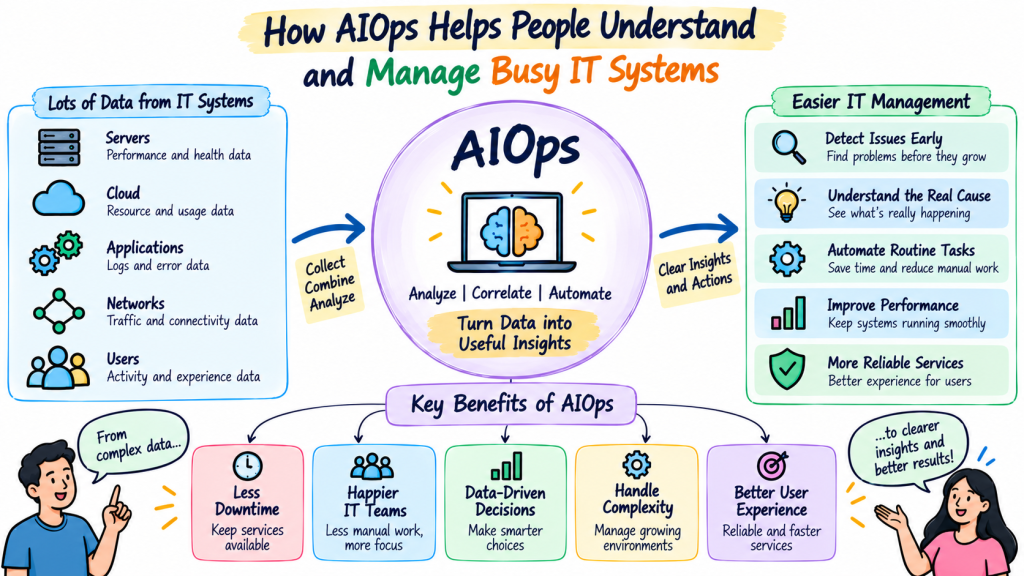
All these systems produce data. They send logs, metrics, traces, events, and alerts. As an IT environment grows, this information can become difficult for people to review quickly.
AIOps gives IT teams a way to organize and understand this information. It combines Artificial Intelligence for IT Operations with machine learning, observability, analytics, and automation.
TheAIOps.com helps learners and organizations explore these ideas in simple language. It covers skills, tools, implementation, consulting, services, and career knowledge for modern IT operations.
AIOps Starts with Better Visibility
Before teams can fix a problem, they need to know what happens inside their systems. Monitoring provides basic information, while observability gives teams deeper clues about system behavior.
Logs can show events. Metrics can show changes in system performance. Traces can show how a request moves through different services.
AIOps can bring these signals together. This connection helps engineers look at an incident from more than one angle.
For example, an application may slow down while database traffic increases. AIOps can compare these events and help the team investigate whether they connect.
Better visibility gives engineers a stronger starting point when they troubleshoot.
Reducing the Problem of Alert Overload
An IT team may receive many alerts during one incident. Several messages can describe the same problem from different systems.
For example, one network failure can create alerts from applications, servers, databases, and monitoring tools. If engineers investigate every message separately, they may spend too much time on the same issue.
AIOps can analyze related events and group them into a clearer picture. This process can reduce noise and help engineers focus on the incident that matters.
The goal does not involve hiding alerts. Instead, the team needs useful context so it can understand which signals deserve attention first.
Starting with AIOps Training
People can build their knowledge through AIOps Training. Beginners should start with familiar IT concepts before moving into advanced topics.
A practical training path can explain monitoring, observability, operational data, incident management, anomaly detection, event correlation, root-cause analysis, predictive analytics, and automation.
Hands-on tasks can make each concept easier. For example, learners can study sample system data and identify unusual behavior.
A useful training plan can cover:
- IT operations basics
- Linux and infrastructure
- Monitoring
- Observability
- Logs and metrics
- Event correlation
- Anomaly detection
- Incident management
- Automation
- Predictive analytics
Learners can build stronger skills when they practice each concept instead of only reading about it.
Using AIOps Certification as a Learning Target
An AIOps Certification can give professionals a structured learning goal. However, learners should focus on understanding the subject rather than only preparing for an exam.
Certification preparation can cover AIOps architecture, data sources, monitoring, observability, analytics, event correlation, anomaly detection, and automation.
Practical projects can strengthen this knowledge. A learner can study a group of alerts, identify relationships, and explain a possible response.
Before selecting a certification, candidates should review the curriculum and assessment method. They can also check whether the program includes practical exercises.
Certification can support professional development, but real skills grow through regular practice.
Making Progress Through an AIOps Course
An AIOps Course can help learners follow a logical path. This structure can make a broad technical subject easier to understand.
The course can begin with AIOps fundamentals and basic IT operations. Then, it can move toward observability, operational data, machine learning, anomaly detection, event correlation, root-cause analysis, and automation.
Real examples should appear throughout the learning process. A simple incident can show how several signals can point toward one underlying problem.
Learners should also understand common challenges. Poor data, duplicate events, weak integrations, and unclear processes can affect AIOps results.
A balanced course teaches both the useful features and the limits of the technology.
Choosing AIOps Tools Around a Real Problem
Organizations can find many AIOps Tools, but teams should not select a tool just because it offers many features.
Instead, teams can start with one clear challenge. Maybe engineers spend too much time checking alerts. Maybe the company needs better visibility across cloud services.
Teams can then compare tools based on practical needs.
| Area to check | Useful question |
|---|---|
| Data | What information can the tool collect? |
| Integration | Can it connect with current systems? |
| Observability | Can it show useful system details? |
| Correlation | Can it connect related events? |
| Analytics | Can it identify useful patterns? |
| Automation | Can it perform safe actions? |
| Usability | Can engineers understand the results? |
Testing a tool with real operational examples can help teams make a better decision.
Getting a Wider View with an AIOps Platform
An AIOps Platform can collect information from different parts of an IT environment. It may connect applications, servers, networks, databases, cloud services, and monitoring systems.
The platform can then analyze the information and identify relationships. For example, it may connect several application alerts with a database problem.
Some platforms also support predictive analysis. They may identify patterns that suggest a possible future issue.
Automation can provide another useful capability. However, teams should create clear rules and test automated actions before they use them on important services.
A platform should match the organization’s data, technology, security requirements, workflows, and team skills.
Making AIOps Implementation More Manageable
Teams can make AIOps Implementation easier by starting small. A focused project gives people a chance to test ideas before they expand them.
Suppose a company wants to reduce repeated application alerts. The team can first study the alert data and identify common patterns.
Next, engineers can connect related events and check the results. After testing, they can introduce a low-risk automated action.
A practical process can look like this:
- Select one important problem.
- Define a clear goal.
- Review the current workflow.
- Gather relevant data.
- Improve data quality.
- Connect useful systems.
- Test the solution.
- Add safe automation.
- Measure the results.
This method helps teams learn from real results instead of making large changes without enough evidence.
Finding Direction Through AIOps Consulting
Organizations sometimes need help turning an AIOps idea into a practical plan. AIOps Consulting can support this work.
Consultants can review existing infrastructure, monitoring, data sources, incident processes, integrations, and automation opportunities.
For example, a company may have different teams using different monitoring systems. A consultant can help the organization understand how these systems work together and where useful improvements may exist.
Good consulting should explain the reasoning behind recommendations. Organizations should understand the problem, proposed solution, risks, dependencies, and measurement plan.
Teams should also consider their existing skills before choosing a technical approach.
Matching AIOps Services to Business Needs
AIOps Services can support different operational goals. Some organizations need planning help, while others need support with integration, analytics, monitoring, or automation.
Possible service areas include:
- Environment assessment
- Technology planning
- Data integration
- Observability improvements
- Event analysis
- Incident management
- Automation
- Implementation support
The organization should define its main goal first.
For example, a company that struggles with poor visibility may focus on observability. A team with too many repeated alerts may focus on event correlation.
This problem-first approach helps organizations avoid adding technology without a clear purpose.
Building the Right Skills for an AIOps Engineer
The AIOps Engineer role brings several technical areas together. Professionals may work with cloud systems, monitoring, observability, automation, data, and incident management.
A learner can build these skills gradually. Linux and networking provide a strong starting point. Cloud platforms, scripting, monitoring, and troubleshooting can come next.
After that, learners can study machine learning concepts and AIOps workflows.
| Skill | What it supports |
|---|---|
| Linux | System management |
| Networking | System communication |
| Cloud | Modern infrastructure |
| Monitoring | System health checks |
| Observability | Deeper system understanding |
| Scripting | Repeatable tasks |
| Automation | Faster routine actions |
| Data analysis | Pattern discovery |
| Troubleshooting | Incident investigation |
Small projects can help learners combine these skills in a practical setting.
A Practical Story from a Busy IT Environment
Imagine a company that runs a popular online service. One morning, users start reporting slow pages.
The monitoring system creates several alerts. The servers show high activity. Database requests increase. Application errors also rise.
An engineer could inspect every alert separately. However, an AIOps system can compare the signals and highlight possible relationships.
The team can then investigate whether database pressure causes the application slowdown. If engineers confirm the cause, they can choose a suitable response.
This example shows how AIOps can help people move from individual alerts toward a wider incident view.
What Real Experience Can Teach
Real projects often expose problems that simple tutorials do not show. Teams may discover duplicate alerts, missing logs, inconsistent timestamps, or incomplete system connections.
These issues can affect analysis. Therefore, teams should improve their operational data before they depend on advanced automation.
Case studies can provide useful lessons. A strong case study should explain the original problem, the chosen approach, the results, and the challenges.
Personal stories can also make technical learning easier. Engineers can explain what surprised them, what failed, and what they changed.
These details help learners understand that AIOps involves both technology and careful human decision-making.
Looking at Research and Industry Data
Industry statistics can help readers understand common IT operations challenges. However, people should always check how researchers collected the data.
Different studies may examine different industries, company sizes, system types, and definitions. Therefore, one statistic may not match every organization.
Teams can create their own baseline instead. They can track:
- Alert volume
- Incident frequency
- Detection time
- Resolution time
- Manual effort
- False alerts
- Automation success
- Service availability
Teams can compare these numbers before and after an AIOps project.
This approach helps organizations understand actual changes instead of relying only on general industry numbers.
Comparing Human-Led Monitoring with AIOps
Human engineers remain central to IT operations. Traditional monitoring gives them alerts based on rules, thresholds, and known conditions.
AIOps adds more data analysis and context. It can connect events, find patterns, detect unusual behavior, and support automation.
| Area | Human-led traditional monitoring | AIOps-supported operations |
|---|---|---|
| Alerts | Often rule-based | Rules plus data analysis |
| Context | Engineers gather information | System can connect signals |
| Event correlation | Often manual | Can automate relationships |
| Pattern detection | Human analysis | Machine learning can assist |
| Response | Mostly human-led | Can support automation |
| Decision-making | Human | Human with system support |
AIOps does not need to replace traditional monitoring. Teams can use both approaches together.
A Simple Framework for Better AIOps Work
A team can use the Observe, Understand, Test, Improve framework.
First, Observe the current environment. Collect the information needed to understand the problem.
Next, Understand the data. Look for patterns, repeated events, and possible relationships.
Then, Test a small solution. Finally, Improve the workflow based on the results.
This framework keeps the project practical and measurable.
Expert interviews can strengthen this process. Professionals can share lessons about data quality, implementation, automation, and operational challenges.
Teams should still compare expert advice with their own systems and goals.
Making AIOps Information Easier to Discover
Technical content should answer questions in a clear and direct way. Modern readers use search engines, answer systems, and generative tools to find information.
AEO, or Answer Engine Optimization, helps content answer specific questions clearly. GEO, or Generative Engine Optimization, helps content work well in generative search environments.
LLMO, or Large Language Model Optimization, focuses on clear structure, useful context, and understandable information. AISEO, or AI Search Optimization, supports visibility across newer search experiences.
E-E-A-T adds another important idea. It focuses on experience, expertise, authoritativeness, and trust.
AIOps content can support these ideas through practical tutorials, real examples, case studies, research data, detailed comparisons, expert interviews, and original insights.
Frequently Asked Questions
What does AIOps mean for an IT team?
AIOps helps teams use data, analytics, machine learning, and automation to understand IT systems and manage operational problems.
Why can AIOps reduce alert overload?
AIOps can examine related alerts and events together. This approach can help teams focus on larger incidents instead of checking every message separately.
Can beginners start AIOps Training?
Yes. Beginners can start with IT operations, monitoring, cloud basics, observability, and automation before studying advanced AIOps topics.
What can an AIOps Course teach?
An AIOps Course can cover fundamentals, architecture, monitoring, observability, operational data, anomaly detection, event correlation, analytics, and automation.
Does AIOps Certification guarantee practical expertise?
No. Certification can demonstrate structured knowledge, while projects and hands-on work can show practical ability.
How should companies choose AIOps Tools?
Companies should identify a real problem first and then compare data support, integrations, analytics, correlation, automation, usability, and security.
Why would a company use an AIOps Platform?
An AIOps Platform can combine operational information from different systems and help teams analyze events, patterns, incidents, and possible causes.
What makes AIOps Implementation successful?
A focused problem, good data, careful testing, clear ownership, safe automation, and useful measurements can support a stronger implementation.
When can AIOps Consulting provide value?
AIOps Consulting can help organizations assess their environment, identify opportunities, create roadmaps, connect systems, and plan operational improvements.
What can AIOps Services support?
AIOps Services can support assessment, planning, integration, observability, analytics, incident workflows, automation, and implementation.
What does an AIOps Engineer work with?
An AIOps Engineer can work with cloud systems, Linux, monitoring, observability, data, scripting, automation, incident management, and troubleshooting.
How does TheAIOps.com support AIOps learning?
TheAIOps.com brings together practical knowledge around AIOps Training, AIOps Certification, AIOps Course, AIOps Tools, AIOps Platform, AIOps Implementation, AIOps Consulting, and AIOps Services.
Final Thought
IT teams face growing amounts of data, alerts, and connected systems. AIOps can help them make sense of that information without removing the human role.
The approach works best when teams begin with strong monitoring and useful data. From there, they can add event correlation, anomaly detection, analytics, and carefully tested automation.
Professionals can build their knowledge through AIOps Training, an AIOps Course, and AIOps Certification. Organizations can explore AIOps Tools, an AIOps Platform, AIOps Consulting, and AIOps Services according to their goals.
TheAIOps.com provides a practical place to explore these subjects and build a clearer understanding of modern IT operations.
Start small, solve a real problem, test every change, measure the outcome, and use each lesson to make the next step better.

