
Introduction
Data drives every modern business. If you work in tech, you already know this. Companies everywhere, from India to the global market, collect huge amounts of data every day. But raw data is useless on its own. It needs to be moved, cleaned, and stored safely so people can actually use it.
This is exactly what a Data Engineer does. I am writing this guide directly for working engineers, software developers, and managers who want to understand this critical role. Having spent a long time building and managing systems in the tech industry, I have seen the demand for skilled data professionals grow faster than almost any other role.
My goal is to give you the clear facts about the AWS Certified Data Engineer – Associate program. This certification proves you know how to build real data pipelines on the cloud.
This guide will show you what the certification covers, how to prepare for it, and how it fits into your long-term career path. I will keep the language simple and direct so you get exactly what you need to know.
The Certification at a Glance
Before we dive deep, let us look at the core details of this certification. The table below gives you a clear summary of what to expect.
| Feature | Details |
| Track | Data Engineering |
| Level | Associate |
| Who it’s for | Software Engineers, Data Engineers, Cloud IT Professionals |
| Prerequisites | Basic AWS knowledge, simple Python, basic SQL skills |
| Skills covered | Data Ingestion, Transformation, Storage, Security, Troubleshooting |
| Recommended order | Take after AWS Cloud Practitioner, before Data Specialty |
| Official Link | AWS Certified Data Engineer – Associate |
| Provider | DevOpsSchool |
Deep Dive: AWS Certified Data Engineer – Associate
What it is
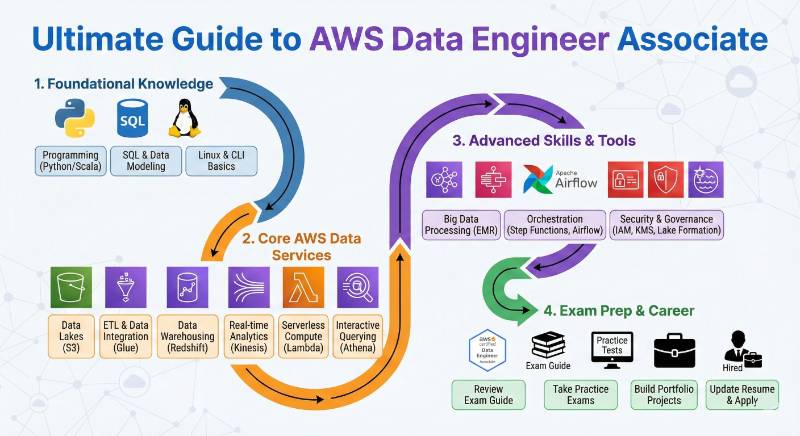
This certification proves you can build, manage, and secure data pipelines on Amazon Web Services (AWS). It tests your practical ability to move data, change its format, and store it safely using core AWS services like S3, Glue, and Athena.
Who should take it
- Software Engineers: If you want to move from writing application code to managing the data that powers those applications.
- Current Data Professionals: If you work with on-premise data and want to prove you can do the same work in the AWS cloud.
- Engineering Managers: If you need to understand cloud data workflows to better guide your technical teams.
- IT Support Staff: If you want to break into a higher-paying, specialized technical role.
Skills you’ll gain
When you study for and pass this exam, you will not just get a piece of paper. You will build real muscle in these areas:
- AWS Data Storage: You will know exactly when to use Amazon S3, Amazon Redshift, or Amazon DynamoDB.
- Data Integration: You will learn how to use AWS Glue to clean and transform messy data into useful formats.
- Streaming Data: You will understand how to catch real-time data using Amazon Kinesis.
- Querying Data: You will master Amazon Athena to ask questions of your data directly from your storage buckets using SQL.
- Security and Compliance: You will learn how to lock down your data using IAM (Identity and Access Management) and AWS KMS (Key Management Service).
- Workflow Orchestration: You will learn how to schedule data jobs using AWS Step Functions or Amazon Managed Workflows for Apache Airflow.
Real-world projects you should be able to do after it
Passing the exam means you are ready to build things. Here are projects you can confidently tackle:
- Build a Serverless Data Lake: You can set up an S3 bucket, catalog the data with AWS Glue, and query it with Athena without managing a single server.
- Create a Real-Time Dashboard: You can stream live click data from a website using Kinesis and push it to a visual dashboard.
- Automate Data Cleaning: You can write a script that automatically takes daily CSV files, cleans out the errors, and saves them in a fast, readable format like Parquet.
- Secure Patient Data: You can design a storage system that strictly controls who can see sensitive information, using proper encryption.
Preparation plan
Everyone learns at a different pace. Choose the plan that fits your current job and life schedule.
The 7–14 Days Plan (For experienced AWS users):
- Focus: Filling the gaps.
- Action: Take a practice exam on day one. Find out what you do not know. Spend the next week only reading about those weak spots. Take two more practice exams before the real test.
The 30 Days Plan (The standard approach):
- Week 1: Study core AWS storage and databases (S3, DynamoDB, RDS).
- Week 2: Master data ingestion and transformation tools (Glue, Kinesis).
- Week 3: Focus heavily on security, IAM policies, and performance tuning.
- Week 4: Do hands-on labs and take full-length practice tests every other day.
The 60 Days Plan (For beginners):
- Days 1-20: Learn the basics of cloud computing and basic Python/SQL.
- Days 21-40: Follow a video course specifically for the AWS Data Engineer exam. Build small projects alongside the videos.
- Days 41-60: Read AWS whitepapers, review service FAQs, and take multiple practice exams until you score over 80%.
Common mistakes
I have watched many smart people fail cloud exams. Avoid these common traps:
- Ignoring Security: AWS tests heavily on IAM roles and policies. You must know the difference between resource policies and user policies.
- Skipping Hands-on Practice: Reading documentation is not enough. If you do not open the AWS console and build a pipeline, you will forget the small details.
- Confusing Similar Services: You must know exactly when to choose Kinesis Data Streams versus Kinesis Data Firehose. They sound alike but do different jobs.
- Rushing the Questions: Exam questions are often long. Take your time to read the final sentence, which usually contains the actual requirement.
Best next certification after this
Once you pass this Associate exam, your learning should not stop. The best logical step is the GCP Professional Data Engineer if you want to be multi-cloud, or moving into a broader architectural role to design whole systems.
Next Certifications to Take
Building a great career means planning your next moves carefully. Based on industry data and top training paths, here are three directions you can take after your AWS Data Engineer Associate certification.
1. Same Track (Deepen your data skills):
If you love data and want to become an absolute master in this single domain, stay on the data track.
- Recommended: DataOps Certified Professional (DOCP) or Certified DataOps Architect (CDOA). These will teach you how to apply agile and DevOps practices to data pipelines.
2. Cross-Track (Broaden your cloud skills):
If you want to be flexible and highly valuable, learn how data works across different clouds or infrastructure models.
- Recommended: GCP Professional Data Engineer to understand Google’s powerful data tools, or Hashicorp Certified Terraform Associate to learn how to deploy your data infrastructure as code.
3. Leadership (Move into management):
If you want to stop writing code and start leading teams, you need management credentials.
- Recommended: CDOM – Certified DataOps Manager or Certified DevOps Manager (CDM). These teach you how to manage budgets, lead engineers, and plan large-scale data strategies.
Choose Your Path
The tech world is wide. Data engineering is just one piece of the puzzle. Depending on your interests, you might want to pivot or combine your skills with other practices. Here are 6 distinct learning paths you can choose from.
1. DevOps
DevOps is about breaking down the walls between software developers and IT operations.
- The Mindset: Automate everything. Deliver software fast and safely.
- The Focus: You will learn CI/CD pipelines, containerization, and configuration management. You will make sure code goes from a developer’s laptop to production without breaking.
2. DevSecOps
DevSecOps takes DevOps and adds a heavy layer of security from the very start.
- The Mindset: Security is everyone’s job, not just an afterthought.
- The Focus: You will learn how to scan code for vulnerabilities automatically. You will build secure networks and ensure compliance standards are met every time a change is deployed.
3. SRE (Site Reliability Engineering)
SRE is what happens when you ask a software engineer to design an operations team.
- The Mindset: Systems will fail. Let us plan for it and measure it.
- The Focus: You will focus on uptime, latency, and performance. You will write code to manage massive systems and keep websites running smoothly even during huge traffic spikes.
4. AIOps / MLOps
This is the bridge between data science and operations.
- The Mindset: Machine learning models need to run in the real world reliably.
- The Focus: You will learn how to take a data scientist’s model and deploy it so thousands of users can access it. You will monitor the model to make sure its predictions stay accurate over time.
5. DataOps
DataOps brings the speed of DevOps to data engineering teams.
- The Mindset: Data should flow quickly and without errors from the source to the business user.
- The Focus: You will build automated testing for data. If bad data enters the system, your pipelines will catch it before it ruins a business report.
6. FinOps
FinOps is about bringing financial accountability to the variable spend of the cloud.
- The Mindset: Cloud computing is great, but it can waste a lot of money if not watched closely.
- The Focus: You will bridge the gap between engineering and finance. You will track cloud costs, find wasted resources, and help teams build cost-effective architectures.
Role → Recommended Certifications Mapping
If you already have a job title in mind, it is very helpful to know exactly which certifications employers respect. Here is a clear mapping of common engineering roles to top industry certifications.
| DevOps Engineer: | Certified DevOps Engineer (CDE) |
| Hashicorp Certified Terraform Associate | |
| SRE (Site Reliability Engineer): | Site Reliability Engineering Certified Professional (SRECP) |
| Platform Engineer: | Kubernetes Certified Administrator & Developer (KCAD) |
| Cloud Engineer: | GCP Professional Cloud Architect |
| Security Engineer: | DevSecOps Certified Professional (DSOCP) |
| Data Engineer: | DataOps Certified Professional (DOCP) |
| GCP Professional Data Engineer | |
| FinOps Practitioner: | Certified FinOps Engineer |
| Engineering Manager: | Certified DevOps Manager (CDM) |
| CDOM – Certified DataOps Manager |
Institutions for Training & Certification
Studying alone is hard. Finding a good training partner makes a huge difference. Here are some of the top institutions that provide excellent training and certification help for software professionals.
This is a top global platform for hands-on technical learning. They focus heavily on practical skills rather than just theory. Their trainers are working professionals who bring real problems to the classroom. They are an excellent choice for AWS and DevOps training.
Cotocus
Cotocus specializes in consulting and corporate training. They are known for helping large teams adopt new technologies quickly. Their bootcamps are intense and highly effective for working engineers.
Scmgalaxy
A strong community-driven platform. They offer a massive library of tutorials, forums, and guided courses. It is a great place to learn the core fundamentals of software configuration and build management.
BestDevOps
As the name suggests, they focus purely on the best practices of DevOps and cloud delivery. They provide focused, short-term courses that are perfect for busy professionals who need to learn a specific tool fast.
devsecopsschool.com
This institution is entirely dedicated to security in the cloud. If you want to master tools like SonarQube, check for vulnerabilities, and understand secure pipelines, their specific training paths are outstanding.
sreschool.com
If your goal is to keep systems running at scale, SRE School is the place. They teach the Google method of operations. You will learn about Service Level Objectives (SLOs) and how to manage incidents calmly.
aiopsschool.com
This is a unique training center focused on the future of operations. They teach you how to use artificial intelligence to monitor logs and predict system failures before they happen.
dataopsschool.com
Perfect for data engineers who want to work faster. They teach you how to apply version control, automated testing, and continuous delivery directly to data analytics workflows.
finopsschool.com
Cloud bills can grow out of control easily. FinOps School trains professionals to understand cloud billing, optimize costs, and build a culture of financial responsibility within engineering teams.
FAQs Specifically on AWS Certified Data Engineer – Associate
1. How difficult is the AWS Certified Data Engineer – Associate exam?
It is considered a medium-to-hard associate exam. It is harder than the Cloud Practitioner but very manageable if you have a few months of hands-on practice with AWS data tools.
2. How much time do I need to prepare?
If you study 1-2 hours a day, a solid 30 to 45 days is usually enough for a working software engineer. Beginners should plan for 60 to 90 days.
3. What are the strict prerequisites to take the exam?
AWS has no mandatory prerequisites. You can book the exam today. However, knowing basic SQL, simple Python, and general AWS navigation is highly recommended before you start studying.
4. Do I need to know deep programming to pass?
No. You do not need to be a master software developer. However, you must be able to read and understand basic Python scripts and write SQL queries.
5. Is this certification valued by employers?
Yes, highly. Data engineering is a massive growth area. Having the official AWS stamp on your resume helps your profile pass HR filters and proves your baseline knowledge to technical managers.
6. What is the format of the exam?
It is a multiple-choice and multiple-response test. You will take it either at a testing center or online from your home while being supervised by a proctor through your webcam.
7. Does this certification expire?
Yes. All AWS certifications are valid for three years. After three years, you must take a recertification exam to prove you are up to date with the newest AWS features.
8. Will this help me get a job if I have no experience?
A certification alone does not guarantee a job. However, the projects you build while studying for it will help. Use the certification to get the interview, and use your practice projects to pass the interview.
9. What sequence of certifications is best for a complete beginner?
Always start with the AWS Certified Cloud Practitioner to learn the language of the cloud. Next, take this Data Engineer Associate. Finally, aim for a Professional or Specialty level cert after gaining one year of job experience.
10. How does Data Engineering differ from Data Science?
A Data Engineer builds the pipes and cleans the water. A Data Scientist drinks the water to predict the future. Engineers move and prepare data; scientists analyze it for business insights.
11. What is the salary outcome of this career path?
While salaries vary by region (India vs. US vs. Europe), Data Engineers consistently rank in the top bracket of IT salaries. Cloud expertise naturally pushes your earning potential higher than on-premise roles.
12. Should I learn AWS, Azure, or GCP for data?
AWS has the largest market share, making it the safest first choice for jobs. GCP is famous for having incredible data tools. Learning AWS first and GCP second is a very strong career strategy.
13. Do I need to learn FinOps as a Data Engineer?
It is highly recommended. Data processing can become very expensive quickly. A data engineer who knows how to run pipelines cheaply is much more valuable to a company than one who wastes money.
Conclusion
Stepping into the world of cloud data engineering is one of the smartest career moves you can make today. The demand for skilled professionals who can manage data securely and efficiently is only going to grow.
The AWS Certified Data Engineer – Associate certification is your perfect starting point. It forces you to learn the right tools, builds your confidence, and shows the global market that you are a serious professional. Remember to focus on hands-on practice, take your time to understand the core concepts, and do not rush the process.
Plan your learning path, choose the right training partners, and start building your real-world projects today. I wish you the absolute best on your learning journey!
