
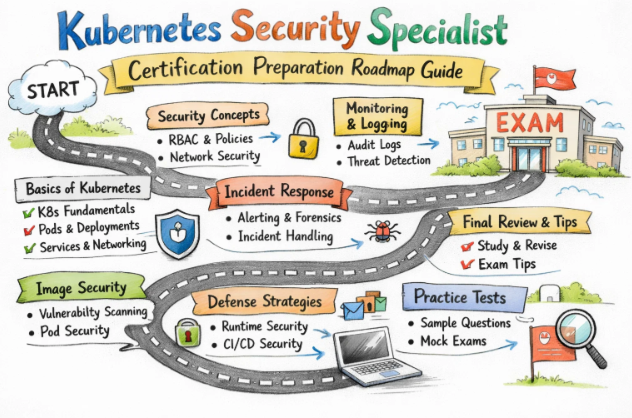
Introduction
Kubernetes is widely used to run container-based applications in modern cloud environments. As more companies move to cloud-native systems, managing and securing these environments has become very important. Without proper security, Kubernetes clusters can be exposed to risks like unauthorized access, data leaks, and system failures.
The Certified Kubernetes Security Specialist (CKS) certification helps professionals learn how to secure Kubernetes infrastructure and protect applications. It focuses on real-world security practices such as access control, network protection, and vulnerability management, making it valuable for engineers working with cloud and DevOps systems.
What is Certified Kubernetes Security Specialist (CKS)?
The Certified Kubernetes Security Specialist (CKS) is a performance-based certification exam that tests domain knowledge of enterprise-level security for Kubernetes clusters. It covers the entire lifecycle of a container—from the initial build to the production runtime.
Who should take it
This is essential for Security Engineers, DevSecOps Professionals, and Senior SREs. Because it requires a valid CKA as a prerequisite, it is intended for those who already have a deep understanding of cluster administration and want to specialize in hardening.
Skills you’ll gain
- Cluster Setup: Securing the API server, using Network Policies, and managing CIS benchmarks.
- Cluster Hardening: Restricting access to the API and using Role-Based Access Control (RBAC) effectively.
- System Hardening: Reducing the attack surface of the host OS and kernels.
- Microservice Security: Implementing mTLS and managing secrets securely.
- Supply Chain Security: Scanning images for vulnerabilities and signing artifacts.
- Monitoring and Logging: Detecting runtime threats using tools like Falco.
Real-world projects you should be able to do
- Perform a full audit of a Kubernetes cluster against CIS Benchmarks.
- Implement an Admission Controller to block “root” containers from being deployed.
- Configure Falco to alert on suspicious shell execution inside a production pod.
- Set up automated container image scanning in a CI/CD pipeline using Trivy.
Preparation Plan
Preparing for the Certified Kubernetes Security Specialist (CKS) certification requires both concept understanding and hands-on practice. Since the exam is practical, you must focus on working directly with Kubernetes clusters and security tools.
7–14 Day Fast Track Plan
This plan is suitable for professionals who already have strong Kubernetes experience.
Week 1
Focus on Kubernetes security basics, cluster architecture, and access control. Learn role-based access control (RBAC), authentication, and authorization.
Week 2
Practice network policies, container security, and runtime protection. Work on real scenarios like securing clusters, scanning images, and troubleshooting security issues.
30 Day Preparation Plan
This plan is best for professionals with basic Kubernetes knowledge.
Week 1
Learn Kubernetes fundamentals and security concepts like RBAC and authentication.
Week 2
Focus on network security, policies, and secure communication between services.
Week 3
Study container security, image scanning, and vulnerability management.
Week 4
Practice real-world scenarios, solve mock exams, and review weak areas.
60 Day Deep Learning Plan
This plan is ideal for beginners or professionals transitioning into Kubernetes security.
Month 1
Understand Kubernetes architecture, containers, networking, and basic security concepts.
Month 2
Focus on advanced security topics like runtime protection, cluster hardening, and monitoring. Practice hands-on labs and real cluster security setups
Common Mistakes
- Losing the CKA Basics: Since this is a CLI exam, if your
kubectlskills are rusty, you’ll fail on time alone. - Ignoring the Prerequisites: You cannot take the CKS without a valid, active CKA.
- Overcomplicating Policies: Writing a Network Policy that blocks everything including the control plane is a classic error.
- Slow Documentation Search: You are allowed one tab of documentation; if you don’t know the keywords, you will waste precious minutes.
Best Next Certification
Same Track
Advanced Kubernetes and security-focused certifications
If you want to continue in the same domain, you can explore advanced Kubernetes or container security certifications. This helps you deepen your expertise in securing cloud-native environments and handling complex security challenges.
Cross Track
Cloud security or DevOps certifications
You can expand your skills by moving into related areas like cloud security or DevOps. This helps you understand how security works across the entire infrastructure, not just Kubernetes.
Leadership Track
Cloud architecture or security architect certifications
If your goal is to move into leadership roles, you can choose architecture-level certifications. These focus on designing secure and scalable systems and preparing you for roles like security architect or cloud architect.
Cloud Native Certification Landscape
| Track | Level | Who it’s for | Prerequisites | Skills Covered | Recommended Order |
| CKA | Associate | Admins/SREs | Linux Basics | Setup, Networking | 1st |
| CKAD | Associate | Developers | App Design | Deployments, Pods | 1st or 2nd |
| CKS | Expert | Security/DevSecOps | Active CKA | Hardening, Auditing | After CKA |
Choose Your Path: 6 Specialized Domains
Security looks different depending on where you sit in the organization. Here is how CKS principles apply across different tracks:
1. The DevOps Path
Focus on automating the “secure build.” Use your CKS knowledge to ensure that every container pushed to the registry is automatically scanned and compliant with your organization’s policies.
2. The DevSecOps Path
This is your “home” track. Here, you focus on the “Shift Left” movement—moving security checks as close to the developer’s workstation as possible.
3. The SRE Path
In SRE, security is a component of reliability. A compromised cluster is an unreliable cluster. Focus on runtime security and ensuring that security patches don’t cause downtime.
4. The AIOps/MLOps Path
Protecting data models is critical. Use CKS techniques to isolate sensitive training data and ensure that ML workloads don’t have excessive permissions to the rest of the network.
5. The DataOps Path
Concentrate on data encryption at rest and in transit within the cluster. Secure the stateful layers where your databases live.
6. The FinOps Path
Believe it or not, security impacts cost. Unsecured clusters can be used for “cryptojacking.” Hardening your cluster ensures your compute costs stay strictly related to your business.
Role → Recommended Certifications Mapping
- DevOps Engineer: CKA → CKS → HashiCorp Vault.
- SRE: CKA → CKS → Certified Prometheus Professional.
- Platform Engineer: CKA → CKS → Terraform Associate.
- Cloud Engineer: CKA → CKS → AWS Certified Security.
- Security Engineer: CKA → CKS → CISSP.
- Data Engineer: CKA → CKS → Google Professional Data Engineer.
- FinOps Practitioner: CKA → FinOps Certified Practitioner.
- Engineering Manager: CKA → CKS (for strategy) → PMP.
Top Institutions for Certified Kubernetes Security Specialist (CKS) Training
Choosing a good training platform can make your preparation easier and more effective for the Certified Kubernetes Security Specialist (CKS) certification. The right provider helps you understand concepts clearly and gain practical experience.
- DevOpsSchool
DevOpsSchool is well known for its hands-on training approach. It focuses on real-world labs, Kubernetes security practices, and practical implementation, which helps learners build strong technical skills. - Cotocus
Cotocus offers industry-oriented training programs designed around real business use cases. Their training helps professionals understand how Kubernetes security is applied in real production environments. - ScmGalaxy
ScmGalaxy provides learning resources and training for DevOps and cloud technologies. It is especially helpful for understanding automation tools, Kubernetes basics, and infrastructure concepts. - BestDevOps
BestDevOps is known for fast and focused certification training. It is a good option for professionals who want structured preparation with practical scenarios and exam-focused content. - DevSecOpsSchool
DevSecOpsSchool focuses on combining security with DevOps practices. It teaches how to secure applications, CI/CD pipelines, and cloud infrastructure from the beginning of development. This is useful for professionals moving into DevSecOps and Kubernetes security roles. - SRESchool
SRESchool is dedicated to Site Reliability Engineering. It helps professionals learn how to build stable, reliable, and high-performance systems. The training covers monitoring, incident handling, and system reliability. - AIOpsSchool
AIOpsSchool focuses on using automation and artificial intelligence in IT operations. It teaches how to detect issues early, automate responses, and improve system performance using smart tools. - DataOpsSchool
DataOpsSchool focuses on managing data systems and pipelines. It helps professionals learn how to handle data workflows, storage, and processing in a secure and efficient way. - FinOpsSchool
FinOpsSchool focuses on cloud cost management and financial control. It teaches how to optimize cloud spending, manage budgets, and improve resource usage in cloud environments.
Next Certifications to Take
After achieving the CKS, consider these three paths to round out your expertise:
- Same Track (Specialization): HashiCorp Vault Associate. Managing secrets is half the battle in security; Vault is the industry standard for this.
- Cross-Track (Infrastructure): Terraform Associate. If you can secure the cluster but the infrastructure it sits on is open, you’re still at risk.
- Leadership (Management): Certified Cloud Manager. This helps you translate technical security risks into business risks for executive stakeholders.
FAQs: Mastering the CKS
On CKS Specifically
- How hard is the CKS compared to the CKA? I
t is significantly harder because it assumes you already know the CKA and adds complex security tools on top. - Can I take CKS if my CKA has expired?
No. You must have an active CKA to take the CKS exam. - Does CKS cover cloud-specific security?
No, it focuses on the Kubernetes software layer, though many concepts apply to EKS/GKE/AKS. - What tools should I practice?
Focus on Falco, Trivy, OPA, AppArmor, and Seccomp. - How long is the exam? I
t is a 2-hour performance-based exam. - What is the passing score?
You need 67% or higher. - Is there a free retake?
Generally, yes, if you purchase directly through the Linux Foundation or authorized partners. - How long is the certification valid?
It is valid for 2 years.
On Career & Strategy
- Is CKS worth it for managers?
It is vital for managers in high-compliance industries (Finance, Healthcare) to understand what “secure” actually looks like. - What is the salary impact?
CKS holders are among the highest-paid individuals in the cloud-native ecosystem due to the scarcity of the skill. - How much time is needed if I already have my CKA?
About 30-40 hours of dedicated lab time is usually sufficient. - Is it better to take CKAD or CKS?
They serve different roles. CKAD is for developers; CKS is for those who build and defend the platform. - Will CKS help with DevSecOps roles?
Absolutely; it is arguably the most important certification for that specific career path. - What are the common prerequisites?
Beyond the CKA, a solid grasp of Linux system administration and basic networking is required. - Is it recognized in India?
- Yes, the Indian tech market heavily values the CKS for global outsourcing projects that require strict security compliance.
- What’s the best sequence?
CKA → CKS → AWS Security Specialty.
Conclusion
The Certified Kubernetes Security Specialist (CKS) certification is an important step for professionals who want to build strong expertise in securing Kubernetes environments. It helps you understand how to protect clusters, manage access control, secure workloads, and handle real-world security challenges in cloud-native systems.
For engineers, this certification builds advanced skills that are highly valued in DevOps and cloud roles. For organizations, skilled professionals help reduce risks, improve system security, and ensure stable operations.
As Kubernetes continues to grow across industries, the need for security-focused professionals is also increasing. By learning Kubernetes security and gaining practical experience, you can open strong career opportunities and play a key role in protecting modern cloud infrastructure.
