
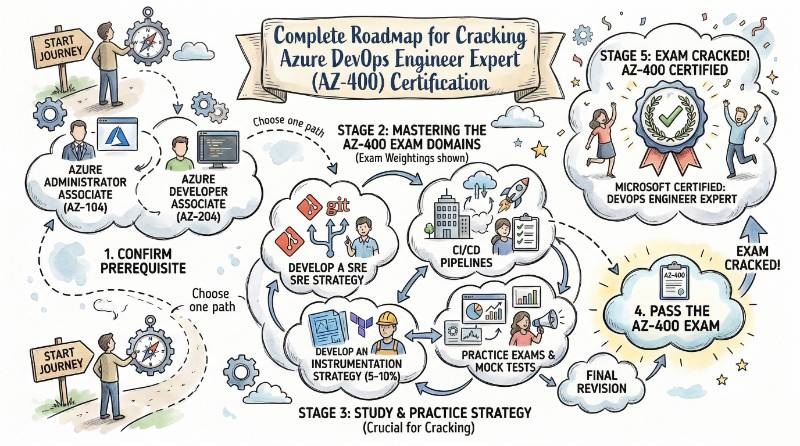
Azure DevOps is no longer just a tool choice. It is now a delivery mindset. Teams are expected to build faster, release safely, automate more, secure pipelines, and create feedback loops that actually improve product quality. That is exactly where Azure DevOps Engineer Expert (AZ-400) becomes valuable. Microsoft positions this certification for engineers who already understand Azure and want to design and implement real DevOps practices across collaboration, source control, pipelines, security, compliance, monitoring, and feedback.
For working engineers, managers, software developers, platform teams, and cloud professionals in India and globally, AZ-400 is not a beginner badge. It is an expert-level certification that proves you can connect people, process, code, and cloud delivery into one reliable operating model. Microsoft also requires that candidates earn at least one prerequisite certification before the DevOps Engineer Expert credential is awarded: Azure Administrator Associate or Azure Developer Associate.
What is Azure DevOps Engineer Expert (AZ-400)?
AZ-400 is the Microsoft exam behind the Microsoft Certified: Azure DevOps Engineer Expert credential. It measures your ability to design and implement DevOps processes and communications, source control strategy, build and release pipelines, security and compliance planning, and instrumentation strategy.
This certification validates that you can help a company move from disconnected development and operations work to a more automated, secure, observable, and scalable delivery model. It is built for real delivery environments, not just theory.
Why AZ-400 matters today
Modern engineering teams are judged by deployment speed, release safety, rollback readiness, traceability, security posture, and service reliability. Microsoft describes the DevOps Engineer role as one that works across developers, SREs, Azure administrators, and security engineers to deliver continuous security, integration, testing, delivery, deployment, monitoring, and feedback.
That is why AZ-400 has real market value. It sits at the point where cloud operations, developer productivity, compliance, and platform engineering meet. If your job touches CI/CD, IaC, release governance, Git workflows, environment promotion, or telemetry, this certification maps closely to your actual work.
Certification roadmap table
Below is a practical roadmap table built around AZ-400 and the certifications most closely connected to it.
| Track | Level | Certification | Who it’s for | Prerequisites | Skills covered | Recommended order |
|---|---|---|---|---|---|---|
| Azure Fundamentals | Foundation | AZ-900 | Beginners, managers, new cloud learners | None | Cloud concepts, Azure basics | 1 |
| Azure Admin Path | Associate | AZ-104 | Infra-focused engineers, admins, cloud ops | Basic Azure knowledge | Azure administration, monitoring, security, operations | 2 |
| Azure Developer Path | Associate | AZ-204 | App developers, backend engineers | Azure development basics | Azure app development, functions, storage, identity, DevOps practices | 2 |
| Azure DevOps Path | Expert | AZ-400 Azure DevOps Engineer Expert | DevOps engineers, platform engineers, release owners | AZ-104 or AZ-204 | CI/CD, source control, security, compliance, monitoring, release strategy | 3 |
| Security Expansion | Associate | AZ-500 | Security engineers, DevSecOps professionals | Azure knowledge | Identity, infrastructure security, app and network protection | 4 |
| Leadership / Architecture | Expert | AZ-305 | Senior engineers, architects, technical leaders | Strong Azure experience | Solution design, availability, scalability, security | 4 |
The AZ-400 role, prerequisite logic, and Microsoft exam scope come directly from Microsoft Learn. The connected Azure pathway items above are aligned to Microsoft’s Azure certification structure and Azure-focused roadmap summaries.
Who should take AZ-400?
This certification is a strong fit for:
- DevOps Engineers
- Platform Engineers
- Cloud Engineers
- SREs moving deeper into delivery automation
- Software Engineers working with Azure pipelines
- Release Managers and Build Engineers
- Engineering Managers who need practical DevOps understanding
Microsoft explicitly says DevOps Engineers should have experience in both administering and developing in Azure, with strong skills in at least one of those areas, plus experience implementing both GitHub and Azure DevOps solutions.
Skills you’ll gain
After serious AZ-400 preparation, you should be stronger in:
- Designing CI pipelines
- Designing CD and release workflows
- Git branching and source control strategy
- Package and artifact management
- Secrets handling and secure delivery
- Policy, compliance, and governance in pipelines
- Monitoring, logging, alerts, and feedback loops
- Deployment strategies such as blue/green and canary
- Team collaboration and workflow improvement
- Azure DevOps and GitHub-based automation
These skill areas map directly to the exam domains and Microsoft’s DevOps Engineer role description.
Real-world projects you should be able to do after it
A good AZ-400 learner should be able to handle projects like these:
- Build a full CI/CD pipeline for a web application on Azure
- Set up secure branch policies and pull request rules
- Automate infrastructure changes with approval gates
- Design release stages for dev, test, staging, and production
- Add secret management and pipeline security controls
- Implement telemetry dashboards and release feedback loops
- Create rollback-ready deployment workflows
- Integrate GitHub Actions or Azure Pipelines into enterprise delivery
These examples are practical extensions of the Microsoft exam scope around source control, pipelines, security/compliance, and instrumentation.
Preparation plan
7–14 days plan
This is only realistic for professionals who already work daily with Azure, Git, CI/CD, and release pipelines. Focus on domain revision, weak-topic review, hands-on labs, and practice questions. Spend most of your time on source control strategy, pipeline design, compliance controls, and monitoring.
30 days plan
This is the best option for most working engineers. Spend the first week on Microsoft exam domains, the second week on pipelines and deployment patterns, the third week on security/compliance and telemetry, and the final week on revision plus mock tests. This plan balances theory and hands-on work.
60 days plan
This is ideal if you are coming from AZ-104 or AZ-204 and want strong practical confidence. Use the first month to build Azure DevOps or GitHub-based labs. Use the second month for design-level understanding, mock exams, revision, and project-based reinforcement.
Common mistakes
Many candidates fail AZ-400 for avoidable reasons:
- Studying Azure services but ignoring delivery design
- Knowing tools, but not knowing when to use them
- Focusing only on Azure DevOps and ignoring GitHub relevance
- Skipping monitoring and instrumentation topics
- Underestimating compliance and security planning
- Memorizing screens instead of understanding process flow
- Not connecting build, release, approval, and rollback together
AZ-400 is not just a tool exam. It tests design thinking across collaboration, automation, security, and operational feedback.
Best next certification after this
If you complete AZ-400, your next move should depend on your role:
- Infra-heavy route: Go deeper with AZ-500 for security
- Architecture route: Move toward AZ-305
- App-heavy route: Strengthen your developer path with deeper Azure app architecture work
- Leadership route: Pair AZ-400 with architecture, governance, and platform strategy learning
This recommendation is based on how AZ-400 sits inside Microsoft’s broader Azure certification path and on how adjacent tracks are described in Azure-focused certification roadmaps.
Choose your path
DevOps path
Start with Azure basics, move through AZ-104 or AZ-204, then focus on AZ-400. This is the most direct path for release engineering, platform delivery, and CI/CD ownership.
DevSecOps path
Use AZ-400 as the delivery foundation, then expand into secure pipelines, secrets, compliance, policy enforcement, and Azure security. This path pairs well with AZ-500 and DevSecOps-oriented training ecosystems.
SRE path
If you are reliability-focused, AZ-400 gives you the automation and release side that many SRE teams need. Then build depth in observability, incident response, SLO thinking, and reliability architecture.
AIOps / MLOps path
AZ-400 helps you standardize delivery and monitoring. After that, AIOps and MLOps work becomes easier because you already understand pipeline automation, environment promotion, and telemetry-based feedback.
DataOps path
Data platforms also need release discipline, testing, lineage awareness, and environment control. AZ-400 gives a strong delivery foundation before moving into data-specific operations practices.
FinOps path
FinOps professionals benefit from understanding how cloud changes are delivered and governed. AZ-400 can help technical FinOps practitioners connect pipeline decisions with cloud spend, governance, and operational discipline.
Role → Recommended certifications
| Role | Recommended certification path |
|---|---|
| DevOps Engineer | AZ-104 or AZ-204 → AZ-400 |
| SRE | AZ-104 → AZ-400 → SRE specialization |
| Platform Engineer | AZ-104 → AZ-400 → AZ-305 |
| Cloud Engineer | AZ-104 → AZ-400 |
| Security Engineer | AZ-104/AZ-204 → AZ-400 → AZ-500 |
| Data Engineer | Azure base knowledge → AZ-400 + DataOps path |
| FinOps Practitioner | Azure foundation + AZ-400 awareness + FinOps specialization |
| Engineering Manager | Azure fundamentals → AZ-400 awareness → architecture/governance focus |
This mapping is a practical career interpretation of Microsoft’s prerequisite structure and the broader cross-track learning models commonly used in recent GurukulGalaxy certification guides.
Next certifications to take
Same track
Azure Administrator Associate (AZ-104) if your strength is infrastructure and operations, or Azure Developer Associate (AZ-204) if your strength is application delivery. Both are directly named by Microsoft as prerequisite certifications for the expert credential.
Cross-track
Azure Security Engineer Associate (AZ-500) is the best cross-track move for engineers who want stronger DevSecOps relevance. Azure roadmap summaries place AZ-500 beside the Azure admin, developer, architect, and DevOps tracks.
Leadership
Azure Solutions Architect Expert (AZ-305) is a smart leadership-oriented next step for engineers moving into architecture, design reviews, governance, and senior technical ownership.
Top institutions that help with Training cum Certifications for Azure DevOps Engineer Expert (AZ-400)
1. DevOpsSchool
DevOpsSchool lists Azure DevOps Engineer Expert (AZ-400) training on its certification catalog and also presents broader Azure DevOps learning paths that connect AZ-900, AZ-104, and AZ-400. That makes it useful for learners who want a structured path rather than a one-exam-only view. It is a strong option for candidates who prefer practical labs, broader DevOps exposure, and role-based progression.
2. Cotocus
Cotocus is useful for professionals who want certification guidance wrapped in practical DevOps career content. Its recent certification posts focus on hands-on labs, project-based training, and multiple delivery modes such as online, classroom, and corporate formats. For AZ-400 aspirants, that kind of practical framing can help convert theory into project-ready execution.
3. ScmGalaxy
ScmGalaxy has long-standing DevOps training content and certification-oriented course pages. It is a reasonable option for learners who want broad DevOps fundamentals, tool exposure, and a training-first approach before going deep into Azure DevOps specialization. It fits especially well for professionals building a wider DevOps foundation first.
4. BestDevOps
BestDevOps presents certification, consulting, support, and course offerings, and it also explicitly references a Master in Azure DevOps track covering AZ-900, AZ-104, and AZ-400. That makes it useful for learners who want a broader certification journey around Azure DevOps rather than exam prep in isolation.
5. DevSecOpsSchool
DevSecOpsSchool is more security-focused, but that makes it relevant for AZ-400 learners who want stronger security thinking in pipeline design, governance, and compliance. Its site emphasizes DevSecOps certification training and dedicated courses for engineer, architect, manager, and professional roles.
6. SRESchool
SRESchool is useful when your AZ-400 goal is tied to production reliability. Its programs highlight SRE certifications, instructor-led courses, real-world case studies, and consulting support, which complements the monitoring, feedback, and operational thinking needed around DevOps delivery.
7. AIOpsSchool
AIOpsSchool is a good extension point for engineers who want to connect Azure DevOps with AI-driven operations, observability, and MLOps workflows. Its courses emphasize AIOps and MLOps training, practical automation, and machine learning lifecycle awareness.
8. DataOpsSchool
DataOpsSchool is relevant for professionals who want to apply disciplined delivery practices to analytics and data systems. Its site shows both certification-oriented content and Azure DevOps-related program coverage, which makes it useful for engineers working across delivery and data pipelines.
9. FinOpsSchool
FinOpsSchool is not an AZ-400-first platform, but it is useful for cloud professionals who want to connect technical delivery with spend governance and optimization. Its site highlights certified FinOps training, courses, and consulting services around cloud spend analysis, visibility, forecasting, and cost modeling.
FAQs on Azure DevOps Engineer Expert (AZ-400)
1. Is AZ-400 difficult?
Yes, for most people it is moderately difficult to difficult because it expects real understanding of DevOps design, not just tool familiarity. It is an expert-level certification with prerequisite certifications behind it.
2. Is AZ-400 for beginners?
No. It is best for professionals who already have Azure administration or Azure development exposure. Microsoft clearly places it at the expert level.
3. Do I need AZ-104 or AZ-204 before AZ-400?
To earn the DevOps Engineer Expert certification, yes—you must have at least one of them. Microsoft lists both as valid prerequisites.
4. Can I prepare in 30 days?
Yes, if you already work with Azure, Git, and CI/CD. Otherwise, 60 days is safer.
5. Is AZ-400 useful for managers?
Yes, especially engineering managers, release managers, and delivery leaders who need a practical understanding of modern software delivery.
6. Does AZ-400 cover security?
Yes. Microsoft includes security and compliance planning as a core exam area.
7. Does it cover monitoring and feedback?
Yes. Microsoft includes instrumentation strategy in the measured skills.
8. Is GitHub part of the expected background?
Yes. Microsoft says DevOps Engineers should have experience implementing both GitHub and Azure DevOps solutions.
9. Is AZ-400 valuable for SRE roles?
Yes. It is useful for SREs who want stronger delivery automation, release control, and cross-team DevOps capability.
10. What is the best order to follow?
A practical order is AZ-900 for basics, then AZ-104 or AZ-204, then AZ-400. That aligns with Microsoft’s prerequisite structure and Azure roadmap logic.
11. Does AZ-400 help with salary and career growth?
It can help because it validates high-value skills around CI/CD, automation, security, and delivery design. Its value is strongest when paired with hands-on project experience.
12. What jobs can I target after AZ-400?
DevOps Engineer, Platform Engineer, Release Engineer, Cloud Engineer, Build Engineer, and some SRE or DevSecOps roles depending on your wider background.
Frequently Asked Qeustions
1. What is Azure DevOps?
Azure DevOps is a Microsoft platform that helps teams plan, build, test, deploy, and monitor software in one place.
2. Who should learn Azure DevOps?
Azure DevOps is useful for DevOps Engineers, Developers, Cloud Engineers, SREs, Platform Engineers, and even Engineering Managers.
3. Is Azure DevOps only for Microsoft Azure users?
No. Azure DevOps can also be used with other cloud platforms and on-premise environments.
4. Is Azure DevOps a good career option?
Yes. Azure DevOps skills are in demand because many companies want faster delivery, better automation, and reliable deployment processes.
5. Does Azure DevOps require coding knowledge?
Basic coding and scripting knowledge is helpful, especially for pipelines, automation, and infrastructure tasks.
6. What is the difference between DevOps and Azure DevOps?
DevOps is a culture and way of working, while Azure DevOps is a toolset that supports DevOps practices.
7. Can beginners learn Azure DevOps?
Yes, but beginners should first understand cloud basics, version control, and CI/CD concepts before going deeper.
8. Is Azure DevOps useful for managers?
Yes. Managers can use Azure DevOps knowledge to understand delivery flow, release planning, team collaboration, and project visibility.
9. Which roles commonly use Azure DevOps?
Common roles include DevOps Engineer, Build Engineer, Release Engineer, Cloud Engineer, Platform Engineer, SRE, and Software Engineer.
10. Is Azure DevOps only for large companies?
No. Small teams, startups, and large enterprises can all use Azure DevOps based on their delivery needs.
11. What are the main tools inside Azure DevOps?
The main services include Azure Boards, Azure Repos, Azure Pipelines, Azure Test Plans, and Azure Artifacts.
12. How long does it take to learn Azure DevOps?
It depends on your background, but with regular practice, most learners can understand the basics in a few weeks and gain stronger skills over time.
Conclusion
Azure DevOps Engineer Expert (AZ-400) is one of the strongest certifications for professionals who want to prove they can connect Azure, automation, release engineering, security, monitoring, and delivery strategy into one working system. It is not a basic cloud exam, and that is exactly why it carries weight. If your goal is to move from doing tasks to designing reliable delivery, AZ-400 is a smart certification to pursue. The best approach is simple: build your Azure foundation first, practice real pipelines, understand security and observability deeply, and treat the certification as proof of practical engineering maturity rather than just another exam badge.
