
Introduction
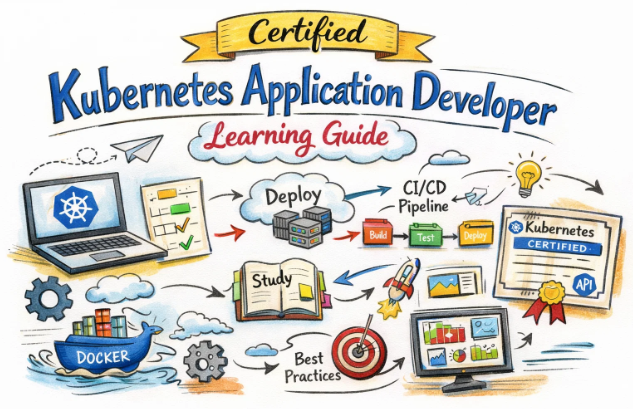
Modern software applications are often built using containers. Containers allow developers to package applications together with all required dependencies so they can run consistently in different environments. To manage large numbers of containers, organizations use Kubernetes, a powerful platform designed to automate deployment, scaling, and management of containerized applications.
Today Kubernetes is widely used by startups, technology companies, and large enterprises. Because of this, organizations need developers who understand how to build and deploy applications using Kubernetes. The Certified Kubernetes Application Developer (CKAD) certification confirms that a developer can design, configure, and deploy applications on Kubernetes clusters.
This guide explains everything professionals should know about the CKAD certification, including its benefits, preparation strategies, career opportunities, and learning paths.
Certified Kubernetes Application Developer (CKAD)
What it is
The Certified Kubernetes Application Developer (CKAD) certification proves that a developer can build, configure, and run applications on Kubernetes clusters.
It focuses on practical skills such as deploying containers, managing application configurations, scaling applications, and troubleshooting workloads in Kubernetes environments. The certification shows that a developer understands how to develop and operate applications in modern cloud-native platforms.
Who Should Take It
This certification is helpful for professionals who develop or deploy applications using Kubernetes.
It is ideal for:
• Software developers
• Cloud application developers
• DevOps engineers
• Backend engineers
• Platform engineers working with containers
Technical managers working with cloud-native teams may also find this knowledge useful.
Skills You’ll Gain
After completing the CKAD certification, professionals gain several practical development skills.
These include:
• Creating container-based applications
• Deploying applications on Kubernetes clusters
• Managing pods and deployments
• Setting up networking for applications
• Managing application configuration and secrets
• Scaling applications when demand increases
These skills help developers build reliable and scalable cloud applications.
Real-World Projects You Should Be Able To Do
After completing this certification, developers should be able to work on real cloud-native projects.
Examples include:
• Deploying microservices applications on Kubernetes
• Managing container-based backend services
• Configuring communication between Kubernetes services
• Managing application settings using ConfigMaps and Secrets
• Automatically scaling applications
These are common tasks performed by Kubernetes developers in production environments.
Preparation Plan
7–14 Day Fast Track Plan
This preparation plan is suitable for developers who already have Kubernetes experience.
- Week 1
Study Kubernetes architecture, pods, deployments, and services. - Week 2
Practice deploying applications, configuring services, and solving troubleshooting scenarios.
Practice with exam-style exercises.
30 Day Preparation Plan
- Week 1
Learn container fundamentals and Kubernetes architecture. - Week 2
Study deployments, services, and networking. - Week 3
Focus on configuration management and storage. - Week 4
Practice application deployment scenarios and mock tests.
60 Day Deep Learning Plan
- Month 1
Understand container technologies, Kubernetes basics, and workload management. - Month 2
Focus on application configuration, scaling, monitoring, and troubleshooting.
Hands-on practice is very important during this phase.
Common Mistakes During Preparation
Many candidates face difficulties because of simple mistakes.
Common mistakes include:
• Reading theory without practicing Kubernetes commands
• Ignoring configuration and networking concepts
• Not practicing troubleshooting scenarios
• Memorizing commands instead of understanding their purpose
• Not practicing within exam time limits
Practical experience is the best preparation method.
Best Next Certification After This
After completing CKAD, professionals can continue learning advanced certifications.
- Same Track: Certified Kubernetes Administrator (CKA)
- Cross Track: Cloud security certifications
- Leadership Track: Cloud architecture certifications
These certifications help professionals move into advanced engineering and leadership roles.
Choose Your Path
Technology professionals often choose different specialization paths depending on their career goals.
DevOps Path
Recommended certifications:
Docker → Kubernetes → CKAD → DevOps certifications
This path focuses on automation and application deployment pipelines.
DevSecOps Path
Recommended certifications:
Containers → Kubernetes → Security certifications
This path focuses on securing applications running in container platforms.
SRE Path
Recommended certifications:
Kubernetes → CKAD → Reliability engineering certifications
This path focuses on monitoring, performance, and system reliability.
AIOps / MLOps Path
Recommended certifications:
Kubernetes → Machine learning infrastructure certifications
This path focuses on managing AI and ML workloads on Kubernetes.
DataOps Path
Recommended certifications:
Data engineering certifications → Kubernetes
This path focuses on running large data platforms using container infrastructure.
FinOps Path
Recommended certifications:
Cloud financial management certifications → Kubernetes infrastructure
This path focuses on optimizing cloud spending and resource usage.
Role → Recommended Certifications
| Role | Recommended Certifications |
|---|---|
| DevOps Engineer | Docker, Kubernetes, CKAD |
| SRE | Kubernetes, CKAD |
| Platform Engineer | Kubernetes, CKAD, Cloud Architect |
| Cloud Engineer | Kubernetes deployment certifications |
| Security Engineer | Kubernetes security certifications |
| Data Engineer | Data engineering certifications |
| FinOps Practitioner | Cloud financial management certifications |
| Engineering Manager | Cloud architecture certifications |
Top Institutions Offering Training and Certification Support
Many organizations provide structured training programs to help professionals prepare for Kubernetes certifications.
DevOpsSchool
DevOpsSchool offers hands-on training programs focused on Kubernetes, DevOps automation, CI/CD pipelines, and container platforms. Their courses include real-world projects and practical labs.
Cotocus
Cotocus provides enterprise consulting and training focused on cloud infrastructure and DevOps transformation.
ScmGalaxy
ScmGalaxy offers training in DevOps tools, CI/CD automation, and Kubernetes infrastructure management.
BestDevOps
BestDevOps provides certification programs covering Kubernetes, DevOps practices, and cloud infrastructure management.
DevSecOpsSchool
DevSecOpsSchool focuses on secure DevOps practices and container security training.
SRESchool
SRESchool specializes in reliability engineering, monitoring tools, and incident response strategies.
AIOpsSchool
AIOpsSchool provides training in automation and AI-driven IT operations.
DataOpsSchool
DataOpsSchool focuses on building scalable data pipelines and managing data platforms.
FinOpsSchool
FinOpsSchool helps professionals understand cloud cost management and financial optimization.
Next Certifications to Take
After CKAD certification, professionals can expand their knowledge further.
- Same Track: Certified Kubernetes Administrator (CKA)
- Cross Track: Cloud security certifications
- Leadership Track: Cloud architecture certifications
These certifications help professionals grow into senior technical roles.
Certification Focused FAQs
1. Is CKAD certification difficult?
The exam can be challenging because it focuses on practical Kubernetes development tasks.
2. How long does preparation take?
Preparation usually takes between two weeks and two months depending on experience.
3. What prerequisites are recommended?
Basic knowledge of containers, Linux, and Kubernetes fundamentals.
4. Is practical experience required?
Yes. Hands-on experience with Kubernetes clusters is very important.
5. Who should take CKAD certification?
Software developers, DevOps engineers, and cloud application developers.
6. What roles benefit from CKAD certification?
Kubernetes developer, cloud application developer, DevOps engineer.
7. Is CKAD useful for career growth?
Yes. Kubernetes skills are highly valued in modern technology companies.
8. Can beginners attempt CKAD?
Beginners should first learn Docker and Kubernetes basics.
General FAQs
1. Why do developers use Kubernetes?
Kubernetes helps developers deploy and manage applications efficiently using containers.
2. What industries use Kubernetes?
Technology companies, financial institutions, healthcare organizations, and startups.
3. What tools should Kubernetes developers learn?
Container platforms, CI/CD tools, monitoring systems, and cloud platforms.
4. Do Kubernetes developers need programming skills?
Yes. Developers should understand application development and container packaging.
5. What is the difference between CKAD and CKA?
CKAD focuses on application development while CKA focuses on cluster administration.
6. How can developers move into Kubernetes careers?
By learning containers, microservices architecture, and Kubernetes deployment strategies.
7. Is Kubernetes a long-term technology?
Yes. Kubernetes continues to be widely used for managing cloud-native applications.
8. How can developers stay updated with Kubernetes technologies?
By practicing hands-on labs and participating in open-source communities.
Conclusion
The Certified Kubernetes Application Developer (CKAD) certification helps developers gain practical skills for building and deploying applications using Kubernetes.
It teaches developers how to manage application configuration, deploy workloads, scale applications, and troubleshoot deployment issues inside Kubernetes clusters.
For developers, CKAD strengthens their ability to build cloud-native applications. For organizations, certified developers help improve application deployment efficiency and infrastructure reliability.
As container technologies continue to grow across industries, Kubernetes skills are becoming increasingly valuable. Professionals who learn Kubernetes application development gain strong career opportunities and the ability to build scalable systems used by modern digital platforms.
